
ESD Equipment for Workplace Safety

ESD Equipment for Workplace Safety
Why ESD Control Matters in Modern Manufacturing
One of the least discussed hazards in industrial or manufacturing facilities is electrostatic discharge (ESD). Although static shocks to humans may not be of great concern, static shock to sensitive electronic components can cause severe damage, interrupt production processes, decrease product reliability, and cause costly equipment failures. To keep the workspace safe, save valuable products, and operate efficiently, the correct ESD equipment must be implemented. To reduce risks due to static electricity, modern ESD control program help businesses comply with industry requirements and quality standards.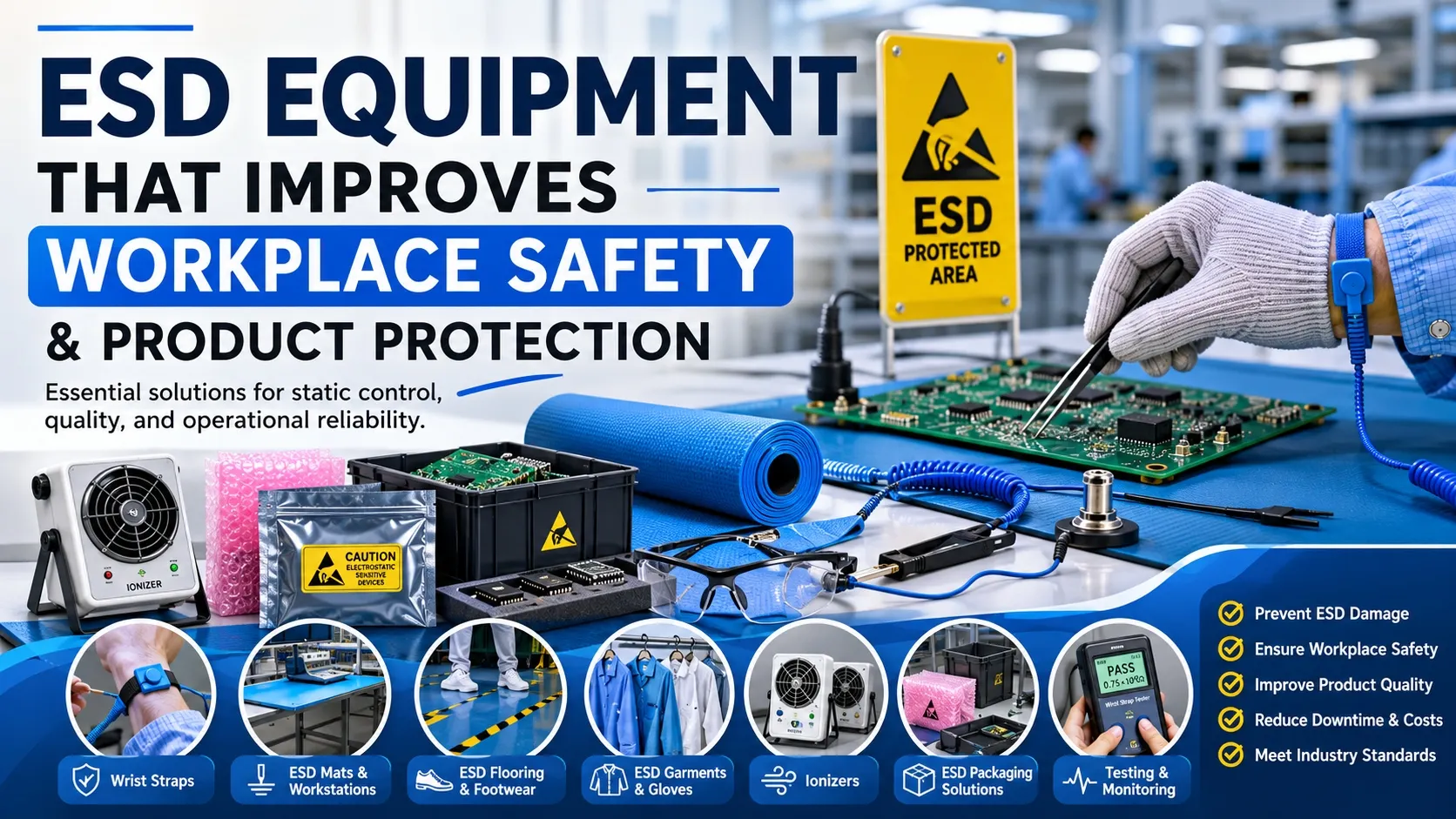
ESD protection systems are essential to industries like electronics manufacturing, semiconductor production, aerospace, automotive assembly, telecommunications, medical device manufacturing and cleanroom operations. A small amount of discharge — even the stuff that's not obvious to the naked eye — can ruin microchips and sensitive circuits forever. This is why an ESD-safe work place will be an integral part of quality assurance and workplace safety policies.
What Is ESD Equipment?
ESD equipment includes any device, tool, garment or workplace product that is used to prevent, control, dissipate or neutralize static electricity. These solutions are combined to form an Electrostatic Protected Area (EPA) to safely handle, assemble, test, store and transport static-sensitive devices.
ESD protection systems usually consist of:
- ESD wrist straps
- ESD workstations
- ESD mats
- Grounding systems
- ESD garments and gloves
- ESD flooring
- Ionizing equipment
- Static shielding packaging
- ESD testing devices
- Cleanroom-compatible consumables
Each component serves a specific purpose within a comprehensive static control program.
How Electrostatic Discharge Affects Workplace Safety
While many organizations only think about protecting products from ESD damage, workplace static control becomes a big asset to their workplace safety program. Improper static electricity control can pose operational risks, particularly in areas that process sensitive electronics, flammable substances, or precision manufacturing operations.
If the power system is not adequately protected against ESD, the following can occur:
- Product failures and defects
- Reduced equipment lifespan
- Production downtime
- Increased warranty claims
- Costly rework and repairs
- Regulatory compliance issues
- Reduced manufacturing efficiency
The use of ESD-safe procedures can help to provide a more controlled and predictable production area and minimize financial losses incurred from static damage.
Essential ESD Equipment for Modern Facilities
1. ESD Wrist Straps
One of the most popular grounding devices in electronics manufacturing is ESD wrist straps. They provide a path for static electricity to safely discharge from the operator to a safe point minimizing the risk of discharge to sensitive parts. Wrist straps are especially significant for assembly, repair, inspection and testing operations.
Benefits include:
- Continuous personnel grounding
- Improved protection for electronic components
- Cost-effective ESD control
- Easy integration into existing workstations
2. ESD Workstation Mats
ESD bench mats offer a controlled work surface that helps to safely dissipate static electricity. These mats are typically used on assembly benches, repair stations, and inspection tables where electronic devices are being handled.
High-quality ESD mats offer:
- Controlled resistance properties
- Reliable grounding paths
- Durable work surfaces
- Protection against electrostatic events
Workstation mats can be the base of an ESD protected workspace and should be referenced to a common grounding point.
3. ESD Floor Mats and Flooring
One of the most important elements of an ESD control program is flooring since static charges are created when people walk on it. ESD floor mats and conductive floor systems will safely dissipate charges formed by walking or moving equipment.
Advantages include:
- Reduced static accumulation
- Enhanced personnel grounding
- Improved protection in high-traffic areas
- Long-term static control performance
Facilities with large production areas often combine ESD flooring with foot grounders and conductive footwear for maximum effectiveness.
4. ESD Garments and Apparel
Static electricity can be generated in clothing. ESD-safe clothing is made of conductive fibers that help to dissipate charges before they build up to dangerous levels. Examples of ESD garments are: Jackets, lab coats, coveralls, caps and sleeves.
ESD clothing offers the following benefits:
- Reduced charge generation
- Improved cleanroom compatibility
- Enhanced product protection
- Compliance with industry standards
In controlled areas, wearing of ESD garments may be required for workers entering protected areas.
5. ESD Gloves and Finger Cots
Static charge and contamination can be transferred to sensitive electronics by direct contact. ESD gloves and finger cots offer operator dexterity and protection.
These products help:
- Prevent static transfer
- Reduce contamination risks
- Improve handling safety
- Protect sensitive electronic assemblies
They are especially valuable in cleanrooms and precision manufacturing environments.
6. Ionizing Equipment
Some materials and processes are not easily grounded. Under such circumstances the ionizers are effective because they neutralize the positive and negative static charges in the air surrounding the object.
Ionising blowers are regularly utilised in the following:
- Semiconductor manufacturing
- PCB assembly
- Cleanroom production
- Packaging operations
Ionizers neutralize static by balancing ions in the workspace every moment throughout its operation, when static can't be achieved by traditional grounding methods.
7. ESD Packaging Solutions
Once products are removed from the manufacturing line, protection should not come to an end. ESD bags, conductive containers, shielding packaging and protective storage systems provide protection for delicate components during transport and storage.
The most common packaging solutions are:
- Static shielding bags
- Conductive tote boxes
- PCB storage racks
- Conductive foam inserts
- ESD shipping containers
These products aid in the preservation of the integrity of the products during their entire supply chain.
8. ESD Testing and Monitoring Equipment
A control program for ESD will only be effective if it is continually checked. Organizations can track the performance of wrist straps, footwear, grounding systems, and workstations with testing equipment.
The following types of testing equipment are generally used:
- Wrist strap testers
- Footwear testers
- Surface resistance meters
- Continuous monitoring systems
- Ground verification equipment
Regular testing is done to meet internal processes and industry standards.
Building an Effective ESD-Protected Area (EPA)
An Electrostatic Protected Area is not built with just the purchase of ESD products. The success of an EPA depends on the equipment, procedures, training of employees, and continuous monitoring. It is industry recommended to ground computers, computer workstations, tools and equipment to a common ground point and to have regular compliance inspections.
The following are key elements of an EPA:
- Clearly marked ESD boundaries
- Grounded workstations
- ESD-safe flooring
- Personnel grounding systems
- Approved ESD tools and materials
- Continuous monitoring procedures
- Employee training programs
An EPA, if correctly done, significantly minimises the risk of failures or lost production due to static.
Choosing the Right ESD Equipment
Each facility is different. The best ESD solution will depend on a variety of factors:
- Industry type
- Product sensitivity
- Production volume
- Cleanroom requirements
- Regulatory standards
- Budget considerations
- Environmental conditions
Wrist straps and bench mats are all that may be needed at small repair facilities, or large electronics manufacturing plants may require a full ESD flooring package, ionization system, garments, monitoring system, and specialized packaging.
Conclusion
ESD equipment is an important component in ensuring that employees, products and production processes are not adversely affected by static electricity. Whether it's wrist straps, grounding systems, wrist straps, ionizers, ESD apparel, testing devices, or protective packaging, all these items help to create a safer and more efficient workplace. Comprehensive ESD protection programs can minimize product failure, enhance product quality, increase operational reliability, and assure industry standards.
No matter how big your electronics shop is, or how expansive your cleanroom, using the right ESD equipment makes good business sense and can be a long-term productivity, product quality, and workplace protection investment.
NEWS
GET SERVICE
With quality parts to meet every budget and friendly staff trained to make your visit informative and hassle free.