

Sticky mat vs entrance mat for commercial building hygiene

Sticky mat vs entrance mat for commercial building hygiene
Cleanliness in a commercial building is paramount for facility managers, business owners and health and safety teams. What's often overlooked is the most effective thing you can do to control dirt, dust and contaminants at the entrance. This is where floor mat systems come in handy.
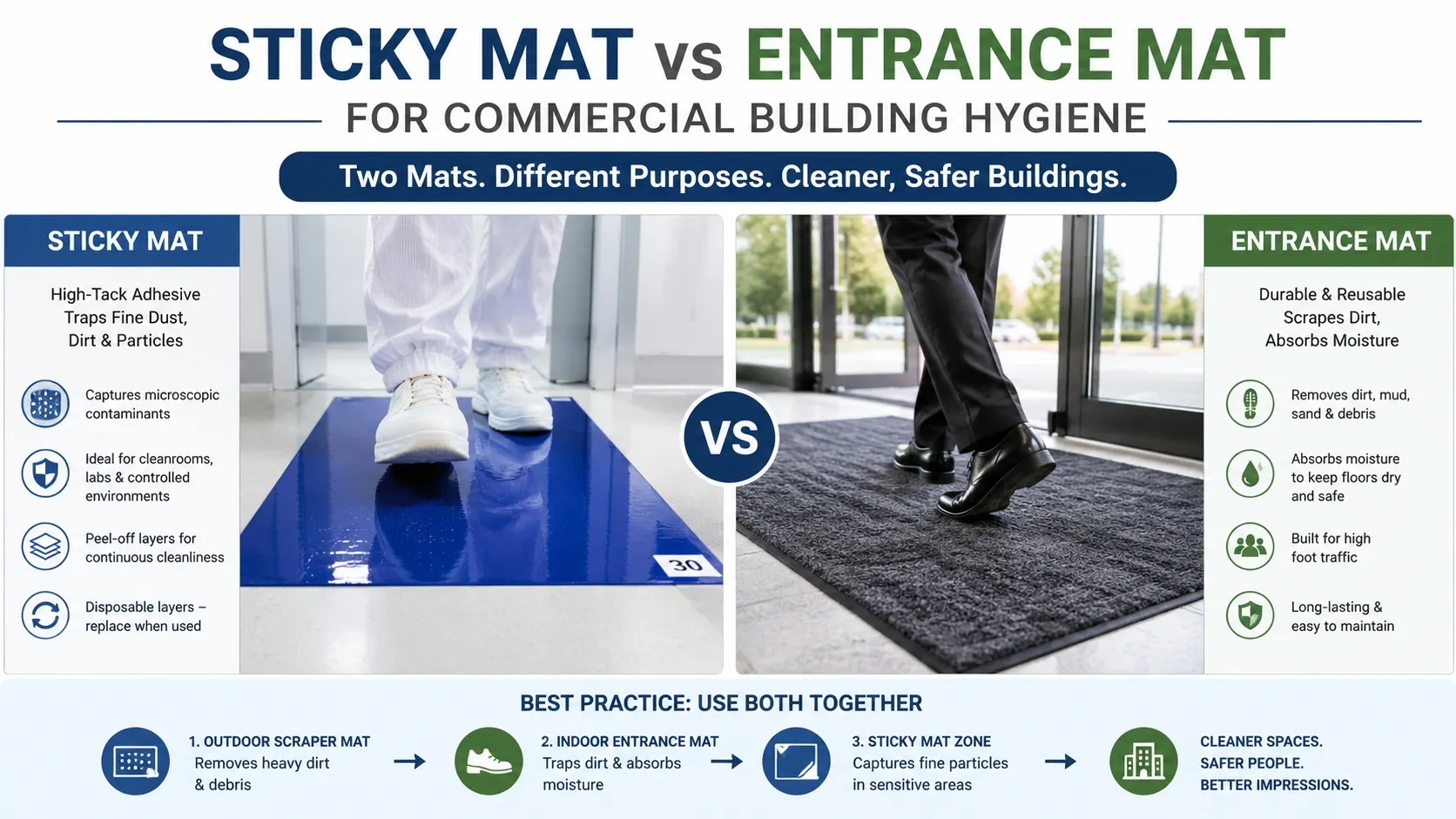
Sticky mats and entrance mats are two of the most popular choices. Both are aimed at improving hygiene, but very differently and in different ways. In this article, we'll examine Sticky Mat vs Entrance Mats for commercial building hygiene, including effectiveness, applications, pros and cons, and more to determine which solution is most suitable for your environment.
What Is a Sticky Mat?
A sticky mat (also known as a tacky mat or adhesive mat) is a multi-layered mat consisting of sheets of adhesive. To hold dust, dirt and microscopic particles which may be in shoes, wheels or equipment.
A dirty top surface is removed and a new clean adhesive surface is exposed.
Key Features of Sticky Mats:
- Multiple peel-off adhesive layers
- High-tack surface for trapping fine particles
- Typically used in controlled environments
- Disposable or semi-disposable design
Sticky mats are particularly in demand in facilities where contamination management is crucial, including cleanrooms, laboratories, or electronics production facilities.
What Is an Entrance Mat?
An entrance mat is a long-lasting floor mat that is installed at building entrances to trap dirt, moisture and debris from shoes before they enter the building interior.
Unlike sticky mats, entrance mats are washable and can be constructed of a variety of materials such as rubber, carpet fibers, polypropylene, or a combination of fibers.
Key Features of Entrance Mats:
- Heavy-duty, reusable construction
- Designed for high foot traffic
- Absorbs moisture and scrapes dirt from shoes
- Available in various sizes and materials
- Often part of a multi-mat flooring system
Entrance mats are widely used in offices, hotels, retail stores, schools, hospitals, and other commercial buildings.
Sticky Mat vs Entrance Mat: Core Differences
Understanding the differences between these two mat types is essential for choosing the right solution for commercial hygiene.
1. Purpose and Function
- Sticky Mats: Designed for contamination control at a microscopic level. They capture fine dust, bacteria, and particles.
- Entrance Mats: Designed for general dirt and moisture control at building entry points.
Sticky mats are more specialized, while entrance mats are more general-purpose.
2. Level of Cleanliness
Sticky mats offer a much higher level of cleanliness because of their adhesive surface, which traps even microscopic contaminants. This makes them ideal for:
- Cleanrooms
- Pharmaceutical labs
- Semiconductor facilities
- Medical environments
Entrance mats, on the other hand, are effective for:
- Dirt, sand, and debris
- Rainwater and moisture
- Everyday commercial foot traffic
They reduce visible mess but do not provide the same level of particle control.
3. Durability and Maintenance
- Sticky Mats: Disposable layers require frequent replacement. Once all layers are used, the mat must be replaced entirely.
- Entrance Mats: Highly durable and washable. They can last for years with proper cleaning and maintenance.
Entrance mats are more cost-effective in the long run for high-traffic commercial spaces.
4. Cost Efficiency
Sticky mats generally have higher recurring costs due to constant replacement of adhesive sheets.
Entrance mats have a higher upfront cost but lower long-term maintenance costs.
For budget planning:
- Sticky mats = higher ongoing expense
- Entrance mats = long-term investment
5. Installation and Usage
Sticky mats are typically placed in controlled zones or clean entry transitions, such as:
- Before sterile rooms
- Inside cleanroom airlocks
- Laboratory entrances
Entrance mats are placed at:
- Main building entrances
- Lobbies
- Elevator lobbies
- High-traffic corridors
Many commercial buildings actually use both systems together for layered protection.
Which Is Better for Commercial Building Hygiene?
There is no single “best” option—it depends on the building type and hygiene requirements.
Choose Sticky Mats if:
- You operate a cleanroom or lab
- You need contamination-free zones
- You work in electronics or pharmaceutical industries
- Particle control is critical
Sticky mats provide precision-level hygiene control and are essential in regulated environments.
Choose Entrance Mats if:
- You manage an office, hotel, or retail space
- Your goal is general cleanliness and moisture control
- You want a cost-effective long-term solution
- You handle high foot traffic daily
Entrance mats are the foundation of most commercial hygiene systems.
Best Practice: Use Both Together
In modern facility management, the most effective approach is a multi-layer matting system:
- Outdoor scraper mat – removes heavy dirt and debris
- Indoor entrance mat – absorbs moisture and fine dirt
- Sticky mat zone (if needed) – captures microscopic particles in sensitive areas
This layered approach significantly reduces cleaning costs, improves indoor air quality, and enhances overall building hygiene.
Impact on Indoor Air Quality and Safety
Floor mats are not just about cleanliness—they also affect:
- Air quality: Less dust entering HVAC systems
- Safety: Reduced slip and fall risks from wet floors
- Maintenance costs: Less frequent deep cleaning required
- Professional appearance: Cleaner entrances improve customer perception
Sticky mats are good for contamination control and entrance mats are good for moisture and dirt control. They form a complete barrier for hygiene.
Commercial Applications in the United States
In the U.S., commercial buildings, particularly in states such as California, New York, and Texas, have strict OSHA regulations which put a premium on entrance hygiene because of the high amount of public foot traffic.
Common applications include:
- Corporate office buildings
- Hospitals and clinics
- Airports and transportation hubs
- Educational institutions
- Shopping malls and retail chains
Climate is also a factor. For instance, mat with absorbent properties are more useful in rainy areas, and sticky mats are helpful in contamination control for high-tech industry.
Conclusion
As for sticky mat vs entrance mat for commercial building hygiene, one should keep in mind that they are not direct competitors.
- Sticky mats are specialized tools for high-level contamination control.
- Entrance mats are essential for everyday dirt and moisture management.
The best approach for most commercial buildings is to include both in a multi-layered approach to hygiene. This will result in cleaner floors, safer environment and better indoor air quality as well as lower maintenance cost in the long run.
A good matting system can be a simple investment with a significant positive impact on commercial building hygiene and efficiency.
NEWS
GET SERVICE
With quality parts to meet every budget and friendly staff trained to make your visit informative and hassle free.
