

Sticky mat vs shoe cover which is better for cleanroom use

Sticky mat vs shoe cover which is better for cleanroom use
Industries such as pharmaceuticals, biotechnology, electronics manufacturing, medical device manufacturing, and other controlled environments must adopt extreme precautions to maintain proper hygiene. A very frequent contamination control problem in cleanrooms is the prevention of dirt, dust and microbial particles entering the cleanroom through contaminated footwear.
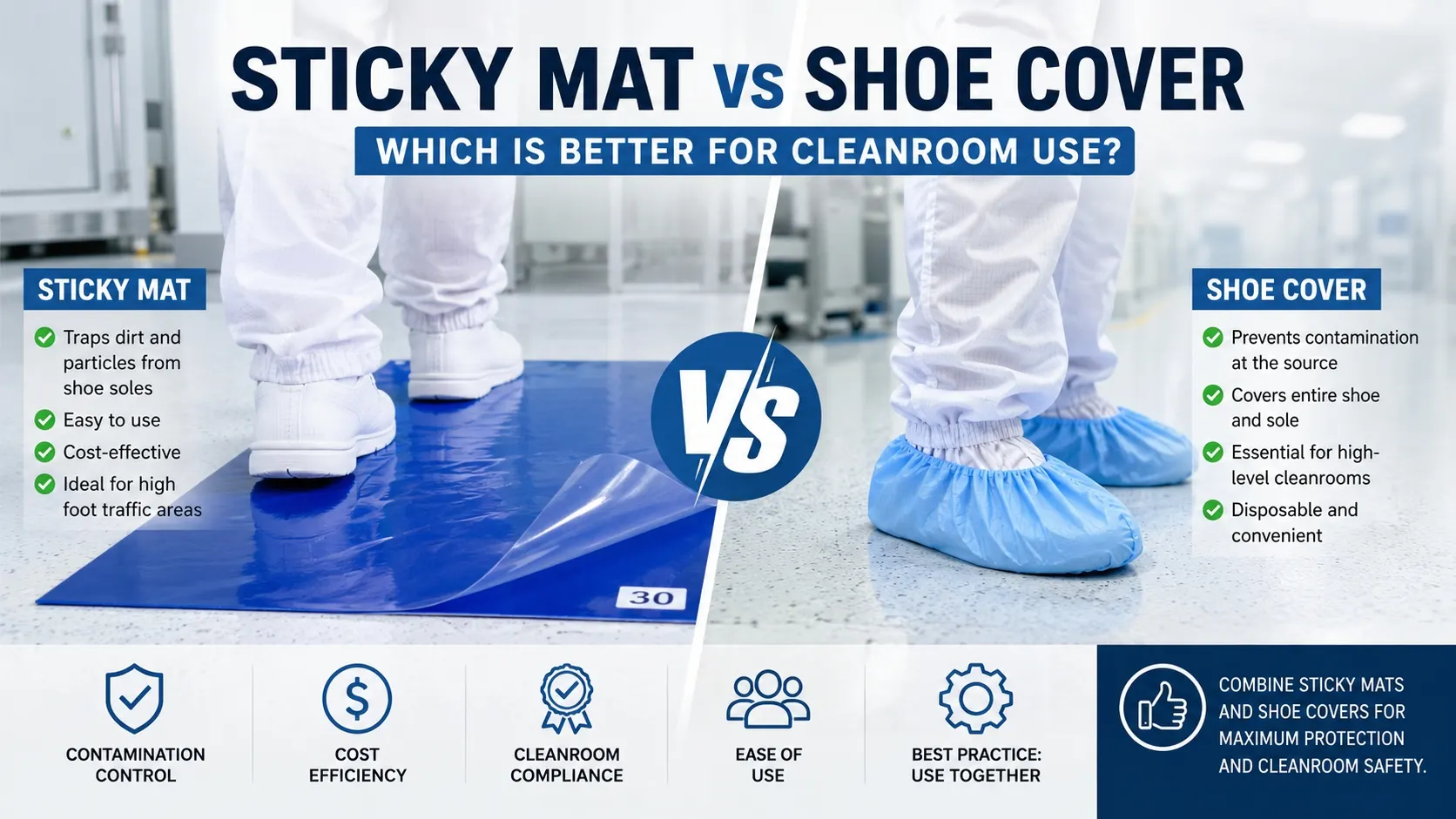
There are two popular products available: tacky mats and shoe covers. However, in the case of sticky mat vs shoe cover for cleanroom, it is not always clear. There are differences between the various options and when to use them.
Understanding Cleanroom Contamination Control
Cleanrooms are highly controlled areas in which the amount of airborne particles and surface contamination is restricted to within narrow limits. It can be just a speck of dust on a shoe that can affect product quality, research integrity or regulatory compliance.
That's why an entrance control system is essential. The two most popular methods are:
- Sticky mats placed at entry points to trap dirt from shoes
- Shoe covers worn over footwear to prevent contamination at the source
Both methods aim to reduce particulate transfer, but they work in very different ways.
What Is a Sticky Mat?
A sticky mat (also known as a tacky mat or adhesive mat) is a floor mat that is built up with several layers and is used within a cleanroom at the entrance. A light adhesive is applied on each layer, which will trap dust and dirt from shoe soles while people walk on it.
Key Features:
- Multiple peel-off adhesive layers
- Traps dust, fibers, and fine particles
- Installed at entry points
- Easy layer replacement when dirty
Sticky mats are particularly prevalent in semiconductor manufacturing, laboratory and pharmaceutical applications where airborne particle control is crucial.
Advantages:
- Highly effective at capturing fine particles
- Low maintenance (just peel off the top layer)
- Cost-efficient for long-term use
- Provides visible contamination control
Limitations:
- Only cleans shoe soles (not upper footwear)
- Can lose effectiveness if not replaced regularly
- Adhesive may reduce performance in high humidity or heavy traffic areas
What Is a Shoe Cover?
Shoe covers are disposable protective garments that are worn over normal shoes prior to entering a cleanroom. They serve as a barrier between shoes and controlled environment.
Key Features:
- Made from materials like polypropylene, polyethylene, or Tyvek
- Disposable or reusable options available
- Worn individually by personnel
- Often required in high-grade cleanrooms
Advantages:
- Prevents contamination at the source
- Covers entire shoe surface, including sides and soles
- Effective in highly sterile environments
- Portable and easy to distribute
Limitations:
- Can tear or slip off during use
- Requires consistent stock management
- May be uncomfortable for long-term wear
- Not always fully particle-proof in high-activity settings
Sticky Mat vs Shoe Cover: Direct Comparison
To determine which is better for cleanroom use, it’s important to compare them across key performance factors.
1. Contamination Control Efficiency
Sticky mats:
- Remove particles from shoe soles after entry
- Effective for dust and small debris
Shoe covers:
- Prevent contamination before entry
- Provide full external shoe coverage
Winner: Shoe covers (for prevention), Sticky mats (for final cleaning layer)
2. Ease of Use
Sticky mats:
- No preparation needed
- Simply walk over the surface
Shoe covers:
- Must be put on before entry
- Require proper fit and disposal after use
Winner: Sticky mats
3. Cost Efficiency
Sticky mats:
- Low ongoing cost
- Only require periodic sheet replacement
Shoe covers:
- Continuous consumable expense
- Higher long-term operational cost
Winner: Sticky mats
4. Compliance with Cleanroom Standards
Shoe covers:
- Often required in ISO Class 3–6 environments
- Common in pharmaceutical and medical facilities
Sticky mats:
- Usually used as supplemental control
- Rarely sufficient alone in high-grade cleanrooms
Winner: Shoe covers
5. Comfort and Practicality
Sticky mats:
- No impact on personnel movement
- No behavioral change required
Shoe covers:
- Can cause slipping or discomfort
- Require training for proper use
Winner: Sticky mats
Which Is Better for Cleanroom Use?
The answer depends on your cleanroom classification and contamination risk level.
Use Shoe Covers When:
- Working in high-grade cleanrooms (ISO 1–5)
- Handling sterile pharmaceutical or medical processes
- Preventing contamination at the entry stage is critical
- Regulatory compliance requires full footwear isolation
Use Sticky Mats When:
- You need supplementary contamination control
- Traffic volume is high at entry points
- Budget efficiency is important
- Used in combination with other cleanroom protocols
Best Practice: Combine Both Systems
In most modern cleanroom environments, the most effective solution is not choosing one over the other—but combining both.
Recommended setup:
- Personnel wear shoe covers before entry
- They step on a sticky mat at the entrance
- Additional gowning procedures follow inside an airlock
This layered approach ensures:
- Maximum particle reduction
- Reduced risk of human error
- Compliance with stricter ISO cleanroom standards
Industry Applications
Pharmaceutical Manufacturing
In situations where strict contamination control is necessary, shoe covers are essential PPE, sometimes with sticky mats in gowning areas.
Semiconductor Industry
Sticky mats and shoe covers are equally important in layered systems despite the fact that they are simply micro particles.
Medical Device Production
Shoe covers are often mandatory and sticky matting is used in transition areas.
Laboratories & Research Facilities
Sticky mats are often employed because there is less traffic and more flexible contamination requirements.
Final Verdict
There is no definite answer regarding which of the sticky mat vs shoe cover is better in a cleanroom environment.
- Shoe covers are superior for preventing contamination at the source and meeting strict regulatory standards.
- Sticky mats are more cost-effective, convenient, and excellent as a secondary cleaning barrier.
Best Conclusion:
A combination approach provides the maximum level of contamination control and compliance, providing the best practice of cleanroom hygiene.
Conclusion
No one solution fits the bill for cleanroom contamination control. Both sticky mats and shoe covers have a role to play, but both are most useful when included in a comprehensive cleanroom protocol.
For maximum protection, regulatory compliance, and operational efficiency, both systems can be used together in a modern cleanroom environment.
NEWS
GET SERVICE
With quality parts to meet every budget and friendly staff trained to make your visit informative and hassle free.
