
Adhesive Rollers for PCBs: A Practical Guide to Cleaner, Safer Assembly

Adhesive Rollers for PCBs: A Practical Guide to Cleaner, Safer Assembly
Adhesive rollers for PCBs are among the most fundamental cleaning tools in electronics manufacturing, yet their design and material properties are often overlooked until a contamination-related failure occurs. As PCB trace densities increase and component geometries shrink, the role of adhesive rollers has moved from simple dust removal to critical process control. This article explains the function of adhesive rollers for PCBs, the importance of controlling static electricity, and the alignment of contemporary designs (like Nabai's ESD-safe PP Sticky Roller) with the production requirements for 2026.
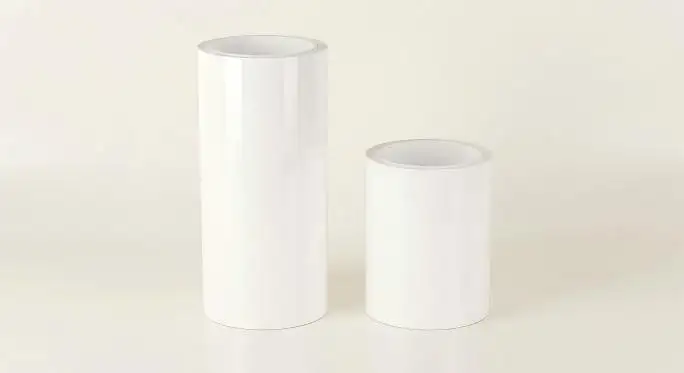
What Are Adhesive Rollers for PCBs?
Adhesive rollers for PCBs are tools (either manual or semi-manual) used for cleaning the surfaces of circuit boards, solder pads, and assembly workstations to remove the particles, dust, and fibers. While brushes and blowers can redistribute dirt and introduce static charges, adhesive rollers will capture and keep dust and particles.
Common uses of adhesive rollers include:
•Dust removal from PCB laminates before stencil printing during pre-soldering surface preparation;
•Removal of debris before conformal coating or testing after assembly; and
•Cleaning the ESD mats, fixtures, and tools of an EPA.
The principle used for cleaning is simple. A roller core has an adhesive film resting on it. As the roller is drawn across the surface, the film captures the contaminants. When the top layer of the film becomes full, it is removed to expose a new layer.
Why PCB Manufacturers Need to Pay Attention to Roller Material
Not every adhesive roller can be used in a PCB environment. There are two familiar issues with these kinds of rollers:
•Particle redeposition from low-quality adhesives and residues from the rollers;
•Electrostatic charging which occurs during the contact of the rollers against the surfaces of the PCB, or in dry rooms, causing the rollers to create charges in excess of several thousand volts, thus damaging electronic components.
For assembly lines with BGAs, chip-scale packages, and finer pitch components, unpredictable static is a silent yield killer. A discharge may not seem to damage anything, but insidiously causes latent gate-oxide defects which may fail in-field weeks later.
ESD-Safe Design and ESD-Safe Adhesive Rollers
PCB assembly lines are exposed to the static problem, and ESD-safe adhesive rollers use static-dissipative material to substitute the insulating plastic. The purpose here is also not to stop static, but to regulate the speed of dissipation, or in a better sense, slow it down to prevent sudden ESD events.
Nabai's ESD PP sticky roller, for example, uses a polypropylene (PP) core with permanent static-dissipative properties. The adhesive layer is carbon-loaded conductive adhesive, ensuring that the entire roller surface stays within the dissipative range of 10⁶ – 10¹⁰ Ω (surface resistivity).
Key advantages of ESD-safe construction:
•Reduces electrostatic buildup during rolling motion
•Allows safe discharge through a grounded path when used in EPA
•Prevents damage to static-sensitive components (Class 0 or Class 1 devices)
Without this characteristic, even a simple cleaning step can become a major risk source. This is why ESD compliance is increasingly written into PCB assembly purchase specifications.
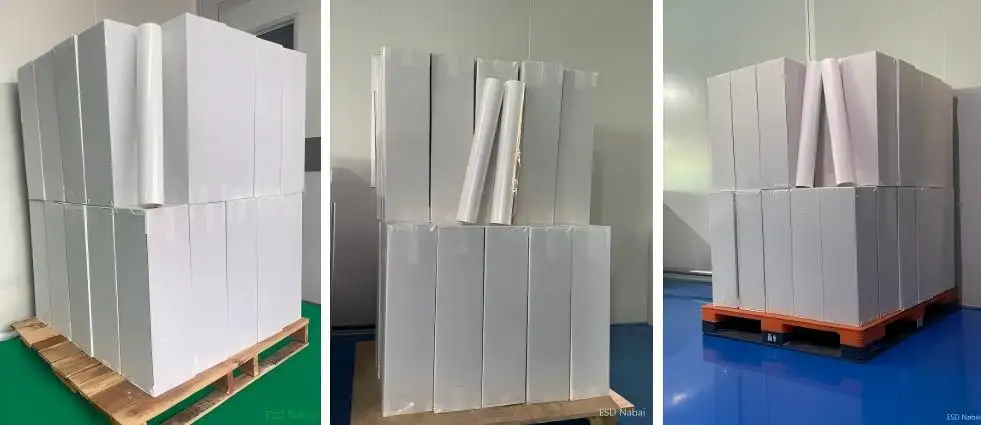
Performance Characteristics That Matter
For procurement and process engineers evaluating adhesive rollers for PCBs, the following technical parameters provide a useful comparison baseline. Nabai's model offers:
- Adhesive strength
•Range: 200D – 1500D (g/25mm)
•Lower tack (200D) for delicate coated surfaces; higher tack (1500D) for heavy particle loads
- Static-dissipative range
•Surface resistivity: 10⁶ – 10¹⁰ Ω (meets ANSI/ESD S20.20 requirements)
- Layer thickness
•80 micrometers per layer
- Length per roll
•Standard 20 meters (custom lengths available)
- Width options
•From 650mm to 2000mm (increments of 100mm/150mm per standard sizes)
- Core inner diameters
•38mm, 76mm, 51mm, 40mm to fit different handle systems
- Color options
•White (standard ESD identification)
•Custom colors for facility coding
These figures are typical for industrial-grade adhesive rollers for PCBs, but not every supplier provides verifiable resistivity data. Buyers are advised to request test reports.
How to Use Adhesive Rollers for PCBs Correctly
Correct technique improves cleaning efficiency and extends roller life.
Stage 1: Examine the Surface
Before you use the roller, check that the roller is clean. There should not be any old glue on it.
Step 2: Ground Connection
Ground the EPA using a wrist strap or mat grounding if the roller will be used.
Step 3: Roll Slowly
Always moving in a single direction when repositioning the roller prevents redepositing particles.
Step 4: Peel Layer
When the adhesive surface has lost its stickiness and appears to have a dusty surface, the soiled layer can be removed using the perforated edge.
Step 5: Continue Use
Use the roller until the surface appears to be clean. A single refill can make 20-30 cleaning passes.
Step 6: Dispose Properly
To avoid recharging the adhesive sheets, dispose the sheets in ESD-safe containers.
Step 7: Replace Refill
Replace used layers with a refill of the same width and core size.
Usage in PCB Assembly and Beyond
Adhesive rollers for PCBs can be useful in many areas of electronic manufacturing. Some of the areas of application include:
•PCB Assembly Lines: Cleaning the Boards Pre and Post Pick-and-Place Cleaning Operations
•Solder Paste Stencil Cleaning: Cleaning Underside of Stencils
•Cleaning Feeders, Trays, and Magazines
•Clean Rooms: Materials with Low Particulate Generation Meeting ISO Standards
•Rework Stations: Cleaning Boards to Prepare them for Inspection
The ESD-safe rollers can be used in manufacturing other industries like assembly of medical devices, control of optical components, and manufacturing of hard disk drives. These components have parts where contamination cannot be allowed.
How Nabai's Design Syncs with 2026 Industry Trends
Three main trends are changing the industry for adhesive rollers for PCBs in 2026:
•Miniaturization: Smaller electronic components create smaller acceptable particle sizes. Nabai provides a uniform adhesive strength, allowing for particle capture at 5–10 micrometers with no residue.
•Tighter ESD regulations: New iterations of ANSI/ESD S20.20 and IEC 61340-5-1 now require documented evidence of static control for tools used in Electrostatic Protected Areas (EPAs). Nabai provides a resistivity test at the batch level.
•Sustainable operations: Users want refillable systems that reduce plastic waste. The Nabai roller uses a permanent PP handle with replaceable refills, cutting consumable plastic by approximately 70% compared to all-in-one disposable rollers.
In addition, Nabai now offers custom widths (up to 2000mm) to fit automated roller stations and large-format panel cleaning lines—a response to the growth of panel-level packaging.
Choosing the Right Adhesive Roller for Your PCB Line
When selecting adhesive rollers for PCBs, consider the following checklist:
•Is the roller core ESD-dissipative (not just anti-static treated)? Permanent properties are more reliable.
•Does the supplier specify surface resistivity in ohms per square?
•Is adhesive strength matched to your board surface (e.g., low-tack for gold fingers)?
•Are refill widths and core sizes compatible with existing handles?
•Is documentation available from the supplier which shows batch traceability?
To meet industry design standards, Nabai's ESD PP Sticky Roller was developed with 6" and 10" width options, a ball-bearing handle to improve rolling action, and easy-to-refill construction. The white body is the most common industrial color and is designed to be easier to locate in an EPA than a typical sticky roller. The carbon-loaded adhesive maintains its electrical properties for the entirety of the roller's lifecycle.
Summary
Adhesive rollers for PCBs are simple in design, but improper material choices can reduce both yield and reliability. Changing standard plastic rollers to ESD-dissipative rollers like Nabai's Sticky Roller reduces the risk of electrostatic discharges while ensuring effective removal of particles. As the geometries of PCBs continue to shrink, the cleaning tools must remain on the cutting edge of material sciences.
Frequently Asked Questions (FAQ)
Q: Can I use normal sticky rollers on PCBs, as opposed to the ESD-safe ones?
A: No. Standard rollers can produce static charges harmful to sensitive electronic components. Ensure ESD-dissipative rollers are used in EPAs.
Q: How can I be sure that my adhesive roller is ESD-safe?
A: Look at the surface resistivity range (10⁶–10¹⁰ Ω). If you're looking for reliable suppliers, Nabai is one of them and offers test reports for every single batch for their customers.
Q: How many cleaning layers are in a Nabai PP sticky roller refills?
A: Each roll lasts approximately 20-30 layers, depending on contamination, and how wide the roller is. A clean roll has 20m of material.
Q: Are Nabai refills compatible with other roller systems?
A: They offer refills for 38mm, 51mm, 76mm, and also 40mm cores, therefore, they work with most systems.
Q: How strong of an adhesive should I choose for cleaning gold-plated PCBs?
A: 200D–500D adhesives are less sticky and won't leave a trail or mark a surface, so use that for cleaning gold-plated PCBs. If a PCB is dirty with solder paste and refuse, an adhesive with a 1000D–1500D strength should be used.
NEWS
GET SERVICE
With quality parts to meet every budget and friendly staff trained to make your visit informative and hassle free.