
Material Science of Anti-static Sticky Rollers: Why PE Stands Out for ESD-Safe Cleaning

Material Science of Anti-static Sticky Rollers: Why PE Stands Out for ESD-Safe Cleaning
In electronics assembly lines, semiconductor fabs, and cleanrooms, even microscopic dust or a sudden electrostatic discharge can ruin sensitive components. An Anti-static Sticky Roller has become an essential tool for particle removal without generating static risks. The core material of sticky rollers will determine whether they will be effective for use in cleaners in ESD-protected areas (EPAs). In the case of Nabai's ESD-Safe PE Sticky Roller, the engineering decisions made with respect to material choice illustrate how polyethylene (PE) sticky rollers can be used to manage static effectively.
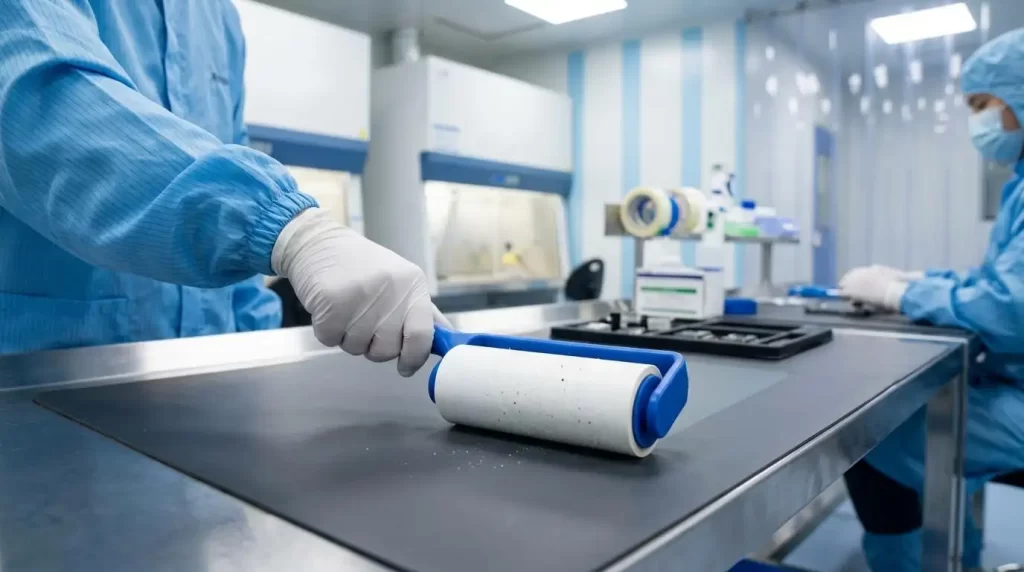
1. Material Choice for Anti-static Sticky Rollers
Rollers made with standard plastic or rubber will charge sticky rollers by the triboelectric effect, making them hazardous to ESD. Not every sticky roller can be used in sensitive environments.
• Rollers act as insulators: Most rollers will have a surface resistivity greater than about 10¹² Ω/sq and will therefore prevent static charges from dissipating.
• Charge accumulation can cause damage: If a roller is charged, it can cause a flowing current to nearby components, leading to a sudden failure.
• Static-dissipative material: In this context we define static-dissipative material as a material whose core is in the range of 10⁶ to 10¹⁰ Ω/sq.
• PE can be engineered to fall within this range: Polyethylene can be filled with carbon or made with static-dissipative additives and achieve the required resistivity and still be flexible and remain clean.
2. Polyethylene (PE): A Great Material
PE is a thermoplastic polymer. Combining mechanical, electrical, and chemical attributes appealingly and beneficially makes polyethylene an in-demand cleanroom product.
• Low outgassing and low linting: For cleanroom use, PE will outgas and lint far less VOCs and fibrous material than other plastics like PVC and polycarbonate.
• Chemical resistance to common cleaners: PE won't be damaged if it comes into contact with cleaners used in EPA and won't be damaged if contacted with cleaners that are solvents or are alcohol-based.
• Conductive adhesives will distribute evenly and will help achieve uniform contact of the adhesive to the particles because PE sheet is non-porous.
• Cost efficiency and sustainability: PE is very easy to recycle. This characteristic makes PE a material choice that sustains cleanroom operations and keeps the costs of refills low.
3. Static-Dissipative PE: Mechanism
Not all PE can be used in ESD-Safe PE Sticky Rollers. PE with modified, surface controlled resistivity can be used for this purpose. Nabai uses carbon infused rollers.
• A purposeful addition of carbon black or carbon fiber to PE bulk serves to create a network of carbon particles that facilitates movement of static charge within the PE.
• Surface resistivity of 10⁶–10⁹ Ω/sq: This will avoid the transit to an electrically insulating condition and sudden disruptive electrical discharges while permitting controlled dissipation of static charge.
• Why bulk material protection is better than a surface coating: Anti-static performance is guaranteed and remains consistent throughout the roller core because Nabai uses carbon loaded material throughout the core and not a surface coating.
• No topical antistat agents: Standards compliance of ANSI/ESD S20.20 is ensured by the method of infusing carbon within PE, a method that is not a superficial spray-on treatment and so will not diminish through physical contact and will not lose its anti-static properties.
4. The Adhesive Layer: Carbon-Loaded for Continuous Dissipation
A roller's cleaning performance comes from its adhesive, but for an Anti-static Sticky Roller, the adhesive must also be conductive. Nabai uses a carbon-loaded conductive adhesive system.
• Adhesive itself is static-dissipative: The glue contains conductive carbon particles, so even as you peel and re-apply layers, no charge separation builds up.
• Adhesion strength range: 250–550 g/25mm: Low end (250g) for delicate surfaces like optical films or populated PCBs; high end (550g) for heavy fiber or solder ball removal.
• Consistent dissipation through multiple layers: As each sticky layer is used and peeled away, the newly exposed adhesive surface maintains the same resistivity.
• No "peeling electrification" effect: Ordinary adhesive tapes generate high voltages when peeled; Nabai's carbon-loaded adhesive suppresses this phenomenon dramatically.
5. Low-Lint Performance: Why PE Reduces Fiber Residue
In cleanrooms, fiber shedding from cleaning tools is as problematic as the original dust. PE is superior to the non-woven or foam rollers in low-lint properties.
• PE is a film of its own: The PE sheet product, unlike the fabric based roller, leaves no fibers to fall out during the rolling process.
• Smooth edge cut: Nabai uses a method of manufacturing that improves the surface and edge quality by a precision cut process, reducing fraying and microfiber release.
• Low particulate generation when rolling: In comparison to PVC or rubber rollers, tests (for instance, the Helmke drum) show that carbon loaded PE rollers produce fewer particles that are suspended in air.
• Ideal for ISO 14644-1 Cleanrooms: These rollers are widely used in Cleanrooms Class 5 to 7 with virtually no violation of allowable particle counts.
6. Nabai's Design Advantages: Beyond the Material
Material science alone does not guarantee usability. With the PE core skillfully integrated, Nabai provides a complete tool that is easy to use and EPA friendly.
• Static dissipative PE handle: The grip is made of PE, and as such, no static is created when users grip the handle.
• Smooth rolling ball bearing: This minimizes the pressure that activates the triboelectric effect and protects the integrity of non-conductive sensitive materials.
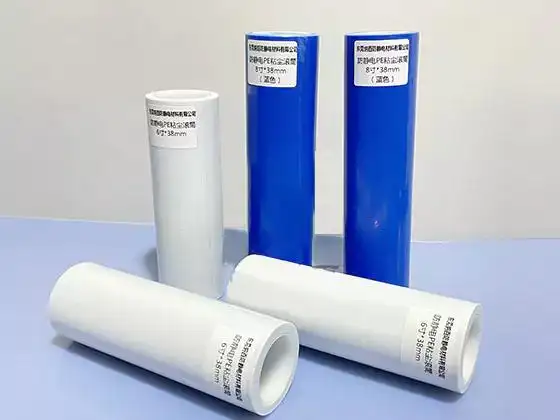
• Replacement of the core cartridge: This no-tools system provides different core diameters (38 or 76mm) and a quick refill in a snap.
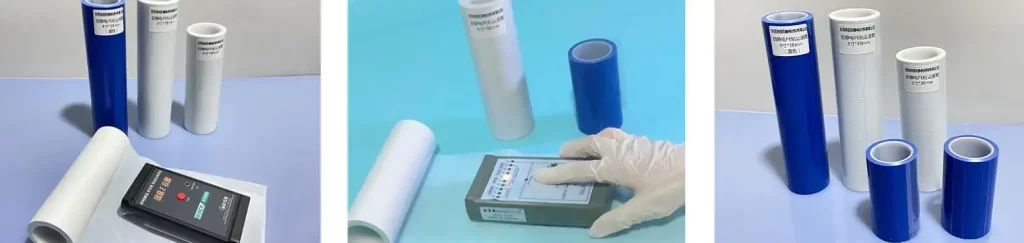
• Variety of color-coded (carbon infused) ESD rollers: The blue is for standard ESD designation; the white is for facility specific color codes.
• Rollers come in 4 to 12 inch widths: These adjustable rollers can be selected for a wide or suitable narrow roll, depending on the workspace.
7. Proper Use in an EPA: PE's Material Advantage
To fully exploit the anti-static properties of PE, the correct procedure must also be used. Nabai suggests following the instructions for any of their Anti-static Sticky Rollers in an EPA.
• Verify grounding: Only use the roller in a wrist strap EPA or a EPA with floor mats that is correctly grounded.
• Before using the roller, inspect for PF contamination or damage to the roller.
• Roll Along An Axis: With gentle and sustained pressure, roll in one way. Rollers can build electrostatic charge, even with dissipative materials, if roller is used in both directions.
• Remove contaminated layer: Remove the contaminated layer and the clean layer will be exposed.
• Use silicone sticky rollers if needed: If there is still a heavy contamination, start with a silicone sticky roller and then use the PE Adhesive roller.
• Use ESD-safe waste containers: The used adhesive layers should be disposed of in Conductive or Anti-static waste containers.
8. PE-Based Anti-Static Sticky Roller Application
In some cases, the costs of failure are so high that the PE static-dissipative rollers have to be used.
• Semiconductor manufacturing: used for cleaning tools and surfaces to avoid static-induced oxide breakdown.
• Electronics assembly (PCBA): Used for cleaning populated boards from residues and dust prior to coating and inspection.
• Medical device assembly: used for clean packaging of medical devices without contamination.
• Optical and display manufacturing: Low adhesion PE Rollers are used to minimize both scratches and ESD marks on films.
• Battery and EV electronics: Used to avoid static in the dry assembly of Li-Ion battery modules.
9. Comparison at a Glance: PE vs. Other Materials
| Material | Surface Resistivity (Ω/sq) | Lint Generation | ESD-Safe? | Typical Use |
| Plain PE (untreated) | >10¹² | Very low | No | General packaging |
| Carbon-loaded PE | 10⁶–10⁹ | Very low | Yes | Anti-static sticky rollers |
| PVC | 10¹º–10¹² | Low to medium | Marginal (may insulate) | Cheap rollers (not EPA-safe) |
| Rubber (conductive) | 10⁴–10⁶ | Medium (fiber fillers) | Yes but high friction | Floor mats, not delicate surfaces |
✅ Key takeaway: Carbon-loaded PE offers the best lint generation to conductivity ratio to design a safe surface.
Conclusion
The primary component of an Anti-static Sticky Roller determines how safe and effective the roller will be in ESD-sensitive areas. Polyethylene, when modified with carbon in the proper loading, can bring surface resistivity down to an ESD-safe level (10⁶–10⁹ Ω/sq) while maintaining low-lint and cleanroom-safe chemistry. Nabai uses these concepts in the design of their ESD-Safe PE Sticky Roller. It features a carbon-polyethylene core, a conductive core, a safe ergonomic handle, and a user-friendly design. In facilities that must comply with the standards of either ANSI/ESD S20.20 or IEC 61340-5-1, the engineering design of a PE-based anti-static roller is a major switching element.
Are you an EPA and looking for a PE-based anti-static sticky roller? Nabai Sticky Rollers can be tailored to the user's specifications in roller width, color, and adhesive strength. To receive a quote for this sticky roller, users must contact the Nabai technical team.
FAQs
Q1. What does "static-dissipative" mean for a sticky roller?
The surface resistivity of the sticky roller lies between 10⁶ and 10⁹ Ω/sq, enabling the surface of the rollers to gradually release static without the risk of build-up or discharge.
Q2. Can standard sticky rollers be used in ESD-protected areas?
No. Standard rollers are known to be insulating due to their extremely high levels of resistivity (> 10^12 Ω/sq). Because of that, they can generate unwanted charge through triboelectric effect that can damage some electronic components.
Q3. Why does Nabai prefer carbon-loaded PE over surface coatings?
Because of the consistent and wear-resistant static discharge of carbon-loaded PE in contrast to surface coatings that may rub off and/or degrade over time.
Q4. What is the adhesive strength range of Nabai's ESD-Safe PE Sticky Roller?
250–550 g/25mm. For softer, more sensitive surfaces (e.g., optical films) lower values will apply, while higher values will apply for the removal of more abrasive fibers or dust.
Q5. Is the roller handle also anti-static?
Yes, Nabai's ergonomic handle is made of static-dissipative PE to prevent static introduction from the operator's hand.
NEWS
GET SERVICE
With quality parts to meet every budget and friendly staff trained to make your visit informative and hassle free.