
Antistatic PP Adhesive Paper Roll Explained: Essential Knowledge for Modern Production Environments

Antistatic PP Adhesive Paper Roll Explained: Essential Knowledge for Modern Production Environments
The challenges posed by static electricity are present in any electronic assembly, PCB manufacturing, and semiconductor company.
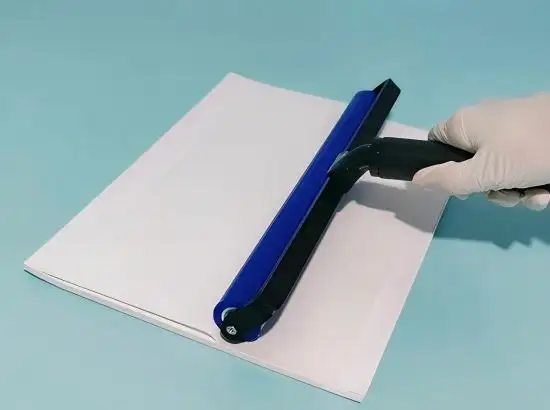
Personnel grounders and ESD bonding help in mitigating ESD problems. When static discharges are generated, even the cleaning tools themselves can be charged. The Antistatic PP Adhesive Paper Roll was designed to not only clean the surface dirt in the static charge environment, but also to not create any electrostatic risk to the production process.
This article describes what an Antistatic PP Adhesive Paper Roll is, how it functions, and its importance in today’s high-precision production.
What is Antistatic PP Adhesive Paper Roll?
An Antistatic PP Adhesive Paper Roll is a cleaning paper that can be used in conjunction with silicone Sticky Rollers and can also be used as a cleaning medium in sensitive production areas. The cleaning paper is made of a polypropylene (PP) Roll substrate that is coated with specialty acrylic adhesive that is treated with antistatic agents so that there is no electrostatic buildup when it is rolled or applied.
Because of this type of adhesive paper, it can be used in places where static can cause destruction to sensitive elements:
• Electronic assembly lines
• Semiconductor fabrication
• PCB cleaning stations
• Production of LCD and LED modules
• ESD controlled cleanrooms
The most important concern when cleaning is the risk of static charge. Leaning operations normally require breaking an adhesive paper into smaller sections. Layers of an adhesive when it gets unwound and pulled apart lead to a charges being built. This occurs as the adhesive side separates from the backing layer, and as the material moves over idler rollers and guide surfaces.
The consequences include:
• Particle re-attraction: Charged surfaces pull airborne dust back onto the very area being cleaned, defeating the purpose of the operation
• Product damage risk: Electrostatic discharge can permanently damage sensitive electronic components—particularly in semiconductor and PCB applications where component tolerances are measured in nanometers
• Process disruption: Moderate static levels can foul adhesive systems, jam production processes, and interfere with sensing equipment
• Material waste: Static buildup often slows production intentionally to reduce discharge events, costing time and reducing throughput
A properly specified Antistatic PP Adhesive Paper Roll addresses each of these issues at the material level.
Design and Technical Principles
The antistatic functionality is not an applied coating that can wear off—it is integrated into the material construction. In typical manufacturing, antistatic additives are blended directly into the PP resin through a melt-mixing process. This offers permanent electrostatic dissipating elements through the substrate, not just on the surface.
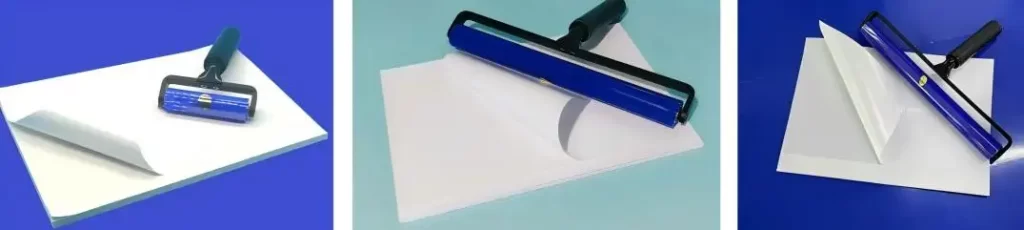
Main specifications:
• Withstands a surface voltage of 10^12 Ω/sq: Antistatic materials’ surface resistivities are between 10^9 and 10^12 Ω/sq, while materials that are static dissipative are between 10^5 and 10^9 Ω/sq. Ideal Antistatic PP Adhesive Paper Roll should be in the lower dissipative range so that charge can be conducted to the ground and avoid sudden discharge events.
• Charge decay time: Charge should decay from 5,000 V to 50 V in less than 2 seconds. The shorter the time, the better protection against the hazard of static discharge in real work situations.
• Acrylic adhesive formulation: This adhesive layer is a pressure sensitive acrylic adhesive that is water based. It is treated with antimicrobial additives, which provide a clean release and a residue free adhesive transfer.
• Pre-cut sheet design: Many Antistatic PP Adhesive Paper Roll products have pre-cut line designs on the sheets. Each sheet is wrapped with pre-cut tape eliminating the need to cut them with a knife when the roll is changed. This cutting eliminates the generation of dust and the waste of materials when changing the rolls.
• White backing construction: Bright white backing material serves two purposes. First, it provides visual contrast that makes particle contamination easier to spot. Second, when the roll is paired with a silicone roller, the white surface helps operators see when the sheet has reached its dirt-loading limit
Where Antistatic Adhesive Paper Rolls Are Used
The Antistatic PP Adhesive Paper Roll is a specialized cleaning consumable for production environments where static control is mandatory.
Applications include:
• PCB cleaning systems: Used on board surface cleaning machines where adhesive paper rolls remove dust from rotating silicone cleaning wheels. Different tack levels accommodate single-pass versus reciprocating cleaning configurations
• Light guide plate and optical film production: Surface cleaning before lamination or coating operations. Eliminates particles which would otherwise lead to visible imperfections in the finished optical assembly
• Semiconductor backend processes: Wafer carriers, lead frames, and component trays undergo cleaning after assembly and testing
• Precision printing: Removal of dust and fibers caused by printing press components and transfer surfaces
• Basic cleaning of the cleanroom: Cleaning work surfaces in a cleanroom of ISO Class 5 and above, where generation of particles must be kept to a minimum
Market Context and Industry Trends
As global electronic manufacturing grows, the demand for advanced cleaning consumables is increasing. The global cleanroom tape market size was USD 1.24 billion in 2025 and is expected to grow USD 2.22 billion by 2032, at a CAGR of 8.60%. Within this market, the use of antistatic adhesive products is the fastest-growing segment, due to the increasing sensitivity of digital devices.
The way cleaning and maintenance products are made is driven by multiple forces:
• Miniaturization: With semiconductor nodes at 5nm or fewer, components have even lower voltage tolerances. Therefore, cleaning devices that produce even the slightest static charge become taboo.
• Automation: The incorporation of cleaning systems within production machines requires the use of adhesive paper that performs adequately over a very large temperature range and over extended periods of time.
• Sustainability: There is a strong desire to minimize the materials expended, and roll designs that use less material contribute by eliminating angled cuts and reducing the frequency of roll changes.
The increase in global manufacturing has led to a push for a high level of cleaning standardization. Static-safe standards can be met by following requirements outlined in ANSI/ESD S20.20 and IEC 61340 among other international agreements.
Choosing the Correct Product
Choosing an Antistatic PP Adhesive Paper Roll is about the correspondence between product specifications and application requirements.
Here are some points to consider:
• Surface resistivity: Be prepared to provide testing for ASTM D257 and IEC 60093 standards or those in your country. For electronic-related use cases, resistivitys from the range 10^6 to 10^9 Ω/sq is acceptable.
• Adhesive quality: There should be evidence of uniform tack, clean removal, and residual absence at the target operating range (typically from 10 to 90 degree Celsius).
• Mechanical quality: It should allow unwinding easily, without failing in service. A transverse strength of >100N and a length ways strength of >50N is acceptable.
• Cut lines: Heed the absence of adhesion across lines, and evidence of cut domination across the line, as draw cuts can lead to material wastage due to adhesion across lines and domination of the cut.
• Flexibility: Acceptable manufacturers will create sheets and rolls of varying widths to allow greater flexibility.
Guidelines for Use
To prolong Antistatic quality, consider the following:
• Dust and moisture can render them inoperable, so secure the rolls in their boxes.
• Place in the absence of sun or the elements.
• Always insert items so that nothing moves abruptly. Static should be eliminated smoothly.
• Before rolling the next cut, check the tack for dirt.
• Used sheets can be thrown away with normal trash as the adhesive is not hazardous.
Conclusion
The Antistatic PP Adhesive Paper Roll eliminates both static and mess. Its permanent antistatic treatment, acrylic, pre-cut sheets, white backing, are designed to fit the electronics and semiconductor industry. With tightening ESD tolerances, even the choice of cleaning materials can make or break yield. Developers and engineers must understand the specifications for the protection of the product and the processes.
FAQ
Q1: How long does the antistatic effect last on the roll?
A: The antistatic feature is built into the PP sheets and will last as long as the sheet does. It will not wear off.
Q2: Can adhesive paper be applied to an uneven and circular surface?
A: It can stick to surfaces that are uneven or circular to some extent, but if there are big gaps the paper can be used with the silicone roller.
Q3: Is the white backing recyclable?
A: That backing is made with silicone paper, so you can only throw that with industrial common waste. If your locality has paper recycling, ask them.
Q4: What is the average shelf life?
A: It has an average of 12 to 24 months if it's well packed and stored away from moisture, excessive heat and sunlight.
Q5: Does Nabai offer custom adhesive tack levels?
A: If you contact them and specify the custom types of particles, they can meet that customization request.
NEWS
GET SERVICE
With quality parts to meet every budget and friendly staff trained to make your visit informative and hassle free.