
Blue Cleanroom Sticky Mat for PCB, SMT and Semiconductor Cleanroom Entrances

Blue Cleanroom Sticky Mat for PCB, SMT and Semiconductor Cleanroom Entrances
In electronics manufacturing, a Blue Cleanroom Sticky Mat is not simply an adhesive floor consumable. Its actual function is to interrupt the transfer path between uncontrolled floors and sensitive production areas by removing loose particles from footwear, cleanroom shoe covers, trolley wheels, carts, and maintenance equipment.
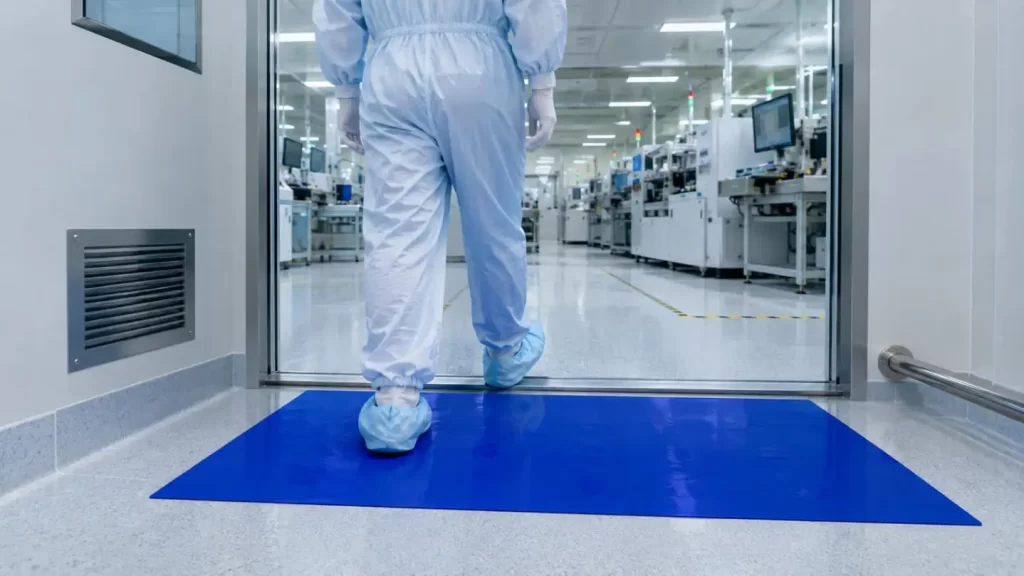
For PCB assembly, SMT lines, semiconductor production, optical electronics, and other controlled environments, selection should therefore be based on tack level, contact distance, traffic type, layer structure, film strength, ESD requirements, and installation position.
At Nabai, we configure Blue Cleanroom Sticky Mat solutions around these operating conditions rather than using one specification for every cleanroom entrance.
Why Electronics Cleanroom Entrances Remain Critical Contamination Points
HEPA filtration controls airborne particles, but it does not remove particles already attached to footwear or wheels. A typical contamination path is:
Corridor Floor → Shoe/Wheel Surface → Cleanroom Threshold → Controlled Production Area
A Blue Cleanroom Sticky Mat creates an adhesive contact zone within this path.
Some examples of typical installation points are:
•Gowning room exits: Aids in reducing the number of remaining loose particles on shoe covers.
•Main cleanroom entrances: Intercepts contact-based contamination on the boundary of the room.
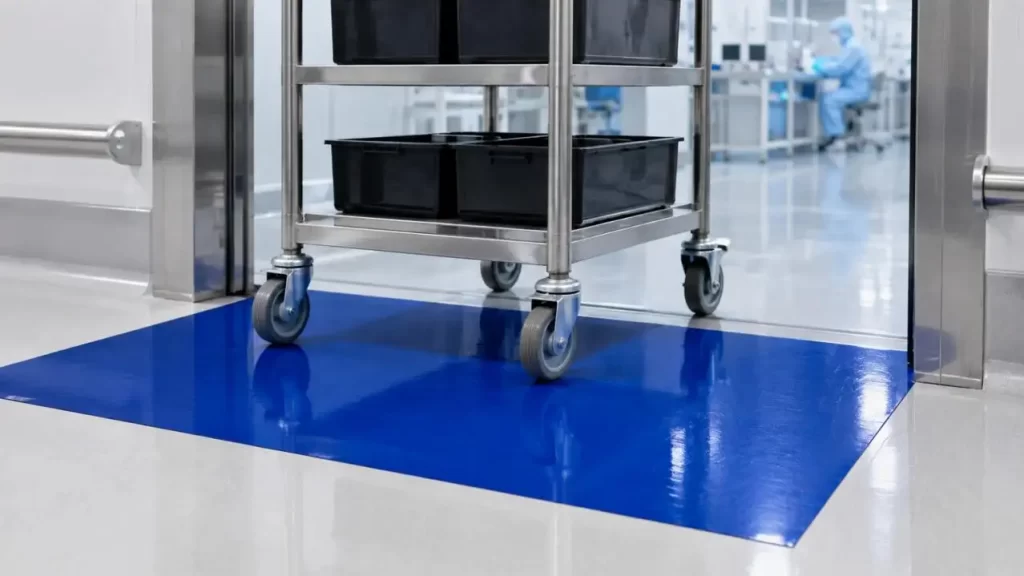
•Material transfer points: Decreases contamination due to particles on trolley and cart wheels.
•Equipment maintenance entrances: Aids in controlling contamination created by tools, service carts and equipment.
The critical factor is not simply whether a sticky mat is present, but whether traffic must make sufficient contact with its usable adhesive surface.
Tack Level Must Match Footwear and Wheel Traffic
The exposed surface of a Blue Cleanroom Sticky Mat retains loose contamination through adhesive contact. However, tack should not be specified on a "higher is always better" basis.
Higher tack may improve contact with particles but can also increase:
•Shoe-cover pulling;
•Wheel release resistance;
•Edge lifting under heavy traffic;
•Adhesive-transfer risk;
•Operator discomfort.
Nabai's flame-retardant sticky mat range provides a manufacturer-specified 250–550 g viscosity/tack range, allowing different adhesion levels to be considered for different entrance conditions.
For procurement, the number alone is insufficient. Buyers should also confirm the test method, peel/contact conditions, specimen dimensions, and acceptance tolerance, because tack values from different suppliers are not necessarily directly comparable.
Personnel Traffic vs. Trolley Traffic
| Entrance Type | Main Contamination Route | Key Selection Factors | Typical Design Priority |
| Personnel entrance | Shoe / shoe-cover soles | Moderate tack, width, walking distance | Comfortable release + full foot contact |
| Trolley entrance | Multiple wheel surfaces | Length, tack, wheel path | Multiple wheel-contact opportunities |
| High-traffic entrance | Shoes + wheels | Layer capacity, tack stability | Maintenance frequency |
| Fire-sensitive technical area | Contact particles | Material + flame performance | Particle control + fire-risk requirement |
A trolley entrance often requires a longer Blue Cleanroom Sticky Mat because the wheel needs sufficient travel distance to expose more of its circumference to the adhesive surface.
Mat Width and Length Affect Real Particle Capture
Size should be selected according to traffic geometry rather than available floor space alone.
Nabai provides standard sizes including:
•450 × 600 mm
•450 × 900 mm
•450 × 1143 mm
•600 × 900 mm
•650 × 1143 mm
Custom dimensions can also be considered where standard mats do not cover the complete entrance path.
Two dimensions have different functions:
Width controls bypass risk: The adhesive area should cover the effective walking or wheel path.
Length controls contact distance: A longer surface creates more consecutive shoe or wheel contacts.
For material transfer routes, simply increasing tack cannot compensate for a mat that is too short or narrow.
30-Layer and 60-Layer Designs Solve Different Maintenance Problems
Layer count affects service logistics—not necessarily single-layer particle pickup.
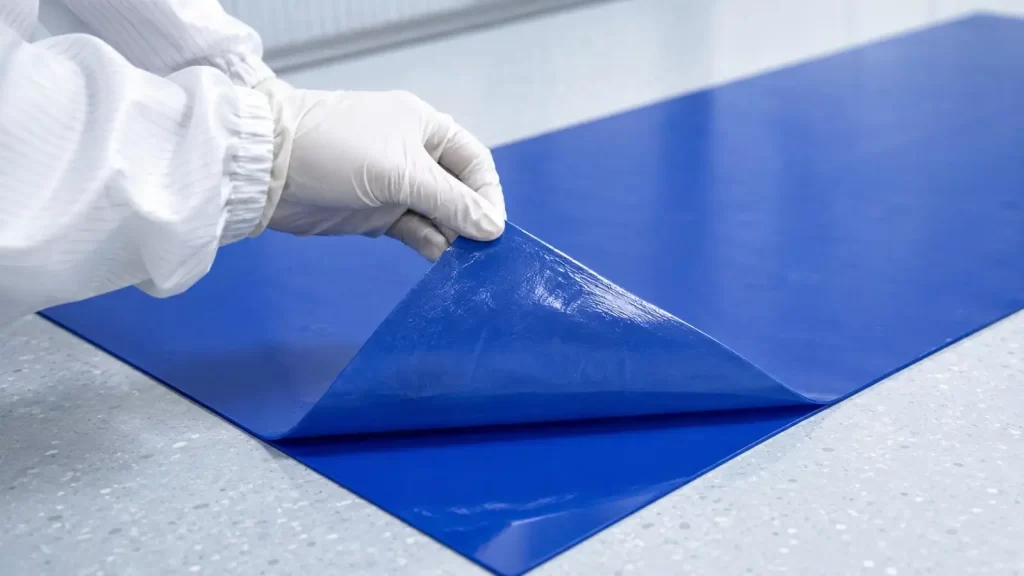
Nabai can provide 30-layer and 60-layer Blue Cleanroom Sticky Mat configurations. When tack, film, and adhesive construction are equivalent, a 60-layer mat primarily provides more replaceable surfaces.
30 Layers
Suitable where:
•Traffic volume is moderate;
•Contamination loading is relatively low;
•Mats can be replaced easily;
•Lower stack height is preferred.
60 Layers
More practical where:
•Personnel traffic is continuous;
•Trolley movement is frequent;
•Layer replacement occurs often;
•Reducing complete-mat replacement frequency is valuable.
Therefore:
60 layers ≠ higher particle-removal efficiency per layer.
It means greater usable layer capacity.
Film Construction Must Support Tack and Peel Performance
The PE film layer is another important specification that is often overlooked.
If film strength is insufficient relative to adhesive force, operators may experience:
•Tearing during layer removal;
•Incomplete peeling;
•Stretching at corners;
•Exposed adhesive irregularities;
•Increased maintenance time.
Nabai's flame-retardant sticky mat range specifies 3C–6C thickness options, giving buyers a reference when balancing film strength, flexibility, layer count, and peel operation.
For electronics cleanrooms, buyers should evaluate film thickness and tack together, not as independent parameters.
A Blue Cleanroom Sticky Mat Is Not Automatically ESD-Safe
This is particularly important for SMT, PCB, semiconductor, and ESDS component handling areas.
Blue is a color specification. It does not define electrical resistance or ESD performance.
A standard Blue Cleanroom Sticky Mat can remove particles effectively while still being unsuitable for a defined Electrostatic Protected Area.
Where ESD control is required, buyers should separately verify:
•Surface resistance or resistance-to-ground requirement;
•Relevant test method;
•Compatibility with ESD flooring;
•Personnel grounding system;
•Facility ESD control plan.
Particle contamination control and electrostatic discharge control are different engineering requirements and should not be combined into an unsupported "ESD-safe" claim.
Flame-Retardant Construction Adds Another Selection Dimension
Some electronics facilities also specify flame performance for materials placed inside controlled production environments.
For these applications, Nabai offers a flame-retardant polyethylene sticky mat design with 30- or 60-layer configurations. The published product specification describes self-extinguishing performance of approximately 10–30 seconds after flame removal.
This does not mean every Blue Cleanroom Sticky Mat must be flame-retardant. It should be selected when required by the facility's internal material specification, fire-risk assessment, or production environment.
Layer Replacement Should Follow Contamination Loading
A correctly selected mat will lose effective exposed adhesive area as particles accumulate.
Rather than replacing one layer simply "once per day," maintenance should consider:
•Personnel count per shift;
•Trolley frequency;
•Visible particle coverage;
•Reduction in exposed tack;
•Contamination generated by the adjacent uncontrolled area.
Nabai recommends peeling the exposed layer when approximately 70–80% of the surface has accumulated contamination.
High-volume trolley entrances may therefore require more frequent peeling than personnel-only entrances, even when both use the same Blue Cleanroom Sticky Mat.
The most effective Blue Cleanroom Sticky Mat is the one matched to the actual contamination path. By combining configurable tack, PE film construction, 30/60-layer options, multiple dimensions, blue color configurations, and specialized flame-retardant designs, Nabai can help electronics manufacturers build a more application-specific entrance contamination-control solution instead of selecting sticky mats by size or color alone.
FAQs
Q1. What sizes of Blue Cleanroom Sticky Mat does Nabai offer?
Nabai offers sizes of 450 x 600mm, 450 x 900mm, 450 x 1143mm, 600 x 900 mm and 650 x 1143mm. Custom sizes can be offered for wider entrances, trolley lanes or special layouts of the cleanroom.
Q2. Can Nabai adjust the tack level of a Blue Cleanroom Sticky Mat?
Yes. Nabai is able to alter adhesive levels to accommodate staff, trolley and contamination usage. The sticky mat range provides a tack/viscosity range of approximately 250 – 550 g and is flame retardant. Buyers should state the relevant test method when selecting adhesion.
Q3. Does Nabai offer 30-layer and 60-layer Blue Cleanroom Sticky Mats?
Yes. Both 30-layer and 60-layer variants are offered. A 60-layer mat would be better for areas requiring a greater number of peelable working surfaces, while a 30-layer mat would be more appropriate for a typical entrance with less traffic.
Q4. Is a blue sticky mat automatically anti-static?
No. Blue does not provide any information regarding ESD performance. Blue Cleanroom Sticky Mat should be used in EPA or areas proximate to ESDS, or electrical performance should be specified as a separate requirement.
Q5. Can Nabai supply Blue Cleanroom Sticky Mats for PCB and SMT factories?
Yes, Blue Cleanroom Sticky Mats can be supplied for PCB assembly, SMT production, semiconductor manufacturing, and other controlled areas of the manufacturing process, particularly personnel and material transfer interfaces.
NEWS
GET SERVICE
With quality parts to meet every budget and friendly staff trained to make your visit informative and hassle free.