
Why Optical-Grade Blue PE Protective Film Is Preferred for High-End Displays

Why Optical-Grade Blue PE Protective Film Is Preferred for High-End Displays
High-end displays used in medical equipment, broadcast monitoring, and industrial control can be damaged by fine scratches, dust, fingerprints, and handling marks before final assembly. Optical-grade Blue PE Protective Film provides temporary surface protection while allowing operators to identify the covered area and, where the selected grade permits, inspect the display through the film.
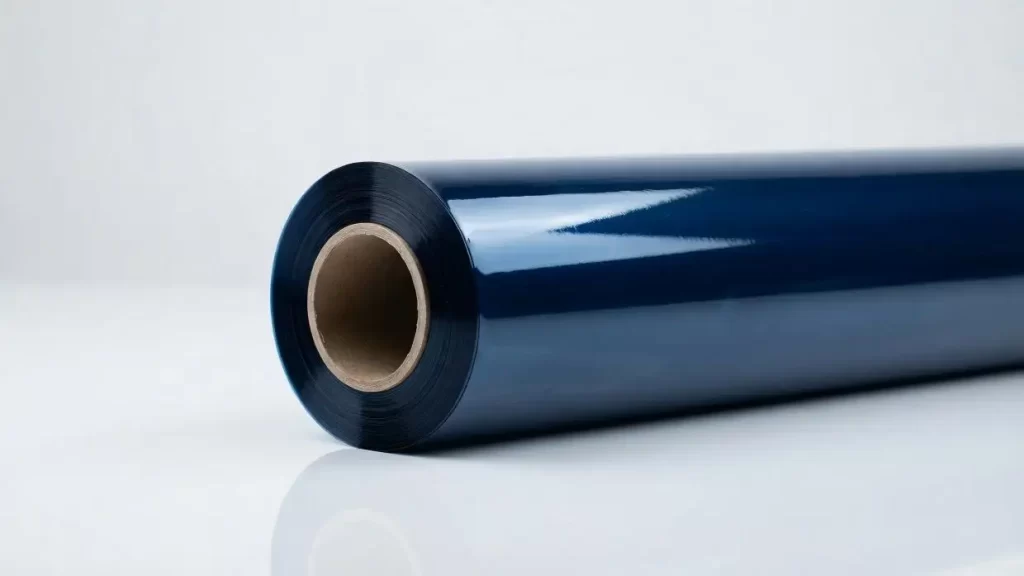
At Nabai, we develop Blue PE Protective Film around the substrate, optical requirement, static-control target, converting method, and removal process of each project.
What Is Optical-Grade Blue PE Protective Film?
Blue PE Protective Film is a product category, not one universal construction. Many industrial PE protection films use a removable acrylic pressure-sensitive adhesive, while the Nabai optical-grade version described here uses an engineered non-adhesive adsorption structure for clean, smooth surfaces. The construction must therefore be confirmed before ordering.
Its main elements include:
•PE carrier: Flexible LDPE-based film conforms to flat displays and gently curved covers.
•Blue Tint: Improves the ability to see the product during application and enabling the inspection, trimming and removal processes.
•Optical Grade Formulation: Improves control on gels and uneven color, haze and imperfections that can be seen.
•Static Control: Assists in the management of electrostatic charge during the handling and peeling processes.
•Custom Converting: The product can be easily modified in size and configuration to meet the needs of the application equipment.
Why the Blue Tint Improves Process Control
Clear film can be difficult to detect on glass, polarizers, acrylic covers, and glossy black frames. Blue PE Protective Film adds visual identification without requiring printed markings.
Key production benefits include:
•Faster confirmation that each panel is protected
•Clearer edge alignment during lamination
•Lower risk of film remaining on the display at the wrong stage
•Easier separation of film grades in storage
•Better visibility of wrinkles, bubbles, folds, or incomplete coverage
The tint must remain uniform and light enough for the intended inspection. Final color, haze, and transmission limits should be approved through samples rather than judged from the color name alone.
Optical and Static-Control Requirements
For optical applications, "high transparency" should be supported by a defined test method. ASTM D1003 covers haze and luminous transmittance measurements for transparent plastics.
Nabai lists more than 92% light transmission and less than 2% haze for its optical-grade Blue PE Protective Film. These are typical product values and should be confirmed for the selected thickness, blue color concentration, and agreed test conditions.
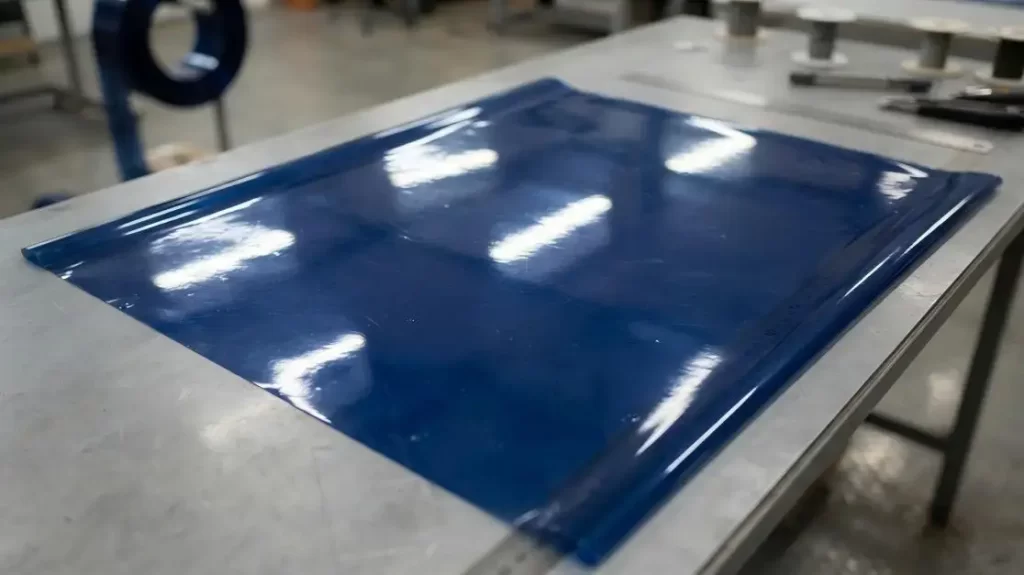
Nabai also lists a nominal surface electrical range of 10⁹–10¹¹ Ω/sq. This range may support charge dissipation, but resistance alone does not prove low-charging behavior or complete ESD protection. The film must be evaluated within the customer's overall ESD-control process.
Typical Technical Data
| Property | Nabai Typical Value | Purchasing Consideration |
| Base material | Ultra-clear LDPE | Confirm substrate compatibility |
| Nominal thickness | 3–20 µm | Match handling and puncture risk |
| Light transmission | >92% | Optical grade; verify test method |
| Haze | <2% | Optical grade; verify test method |
| Surface electrical property | 10⁹–10¹¹ Ω/sq | Confirm conditioning and measurement |
| Tensile strength, MD | >20 MPa | Relevant to winding and handling |
| Elongation at break | >400% | Correct classification of the original value |
| Temperature range | -50°C to 70°C | Validate dwell time and actual exposure |
| Roll length | 200–4000 m | Match laminator and changeover needs |
| Standard core | Approx. 76 mm | Confirm unwind-shaft compatibility |
Values are based on Nabai's currently published product information and should be treated as typical rather than guaranteed specifications.
Why Non-Adhesive Protection Can Be Useful
On suitable smooth surfaces, non-adhesive Blue PE Protective Film can reduce concerns related to adhesive transfer, peel-force growth, and interaction with delicate coatings.
Possible advantages may include:
•Elimination of an intermediate adhesive layer
•Reduced probability of adhesive ghosting
•Milder interaction with smooth or treated surfaces
•Facilitates repositioning in the early stage of application
•Consistent contact with the help of defined pressure in the lamination process
Nevertheless, the absence of adhesives in the adsorption process has its limitations for several types of substrates. Textured panels, dusty parts, long outdoor exposure, or severe vibration may require a tested low-tack adhesive film instead.
How Nabai Controls Blue PE Protective Film Production
As a Blue PE Protective Film manufacturer, Nabai focuses on variables that directly affect lamination, optical appearance, and removal:
•Resin and additive consistency
•Thickness and width control
•Uniform blue coloration
•Inspection for gels, specks, creases, and surface defects
•Stable winding tension and roll alignment
•Clean slitting, packaging, and product identification
•Sample testing on the customer's actual substrate
Rolls and pre-cut sheets can be customized by dimensions, roll length, color, and performance grade. Before mass production, we recommend confirming optical appearance, adsorption strength, peeling behavior, static performance, and storage stability on the actual display surface.
Recommended Application Procedure
1.Clean the glass, polarizer, acrylic, or coated surface.
2.Apply the Blue PE Protective Film in a low-dust area.
3.Align one edge and laminate progressively with a clean soft roller.
4.Push trapped air outward without applying excessive pressure.
5.Inspect for particles, wrinkles, bubbles, and edge lifting.
6.Remove the film at the specified production stage using a steady peel angle.
A Practical Protection Choice for Display Manufacturing
Optical-grade Blue PE Protective Film integrates several functions. These include process identification, temporary scratch protection, inspectability, and static control (when required). Its use cannot be determined by the blue color alone. It must be supported by testing of the substrates and proven technical data.
Nabai offers display manufacturers customized specifications of Blue PE Protective Film. We offer custom sized conversions and prototype development. We provide residue free removable films to offer the simplest application.
FAQs
Q1. Does Blue PE Protective Film leave residue?
Low-tack grades or non-adhesive grades that are correctly chosen are manufactured for clean removal.
Q2. Can Blue PE Protective Film be applied to glass surfaces?
Yes. It can be applied to clean and smooth glass surfaces.
Q3. Is Blue PE Protective Film free of adhesives?
Some grades are manufactured with a static adsorption system, while others are manufactured with a removable adhesive system.
Q4. Does Blue PE Protective Film interfere with display inspections?
Basic visual inspection through the covered surface is possible with optical grade films.
Q5. Is customization of the Film possible?
Thickness, width, length, color, and size of the sheets can be customized.
NEWS
GET SERVICE
With quality parts to meet every budget and friendly staff trained to make your visit informative and hassle free.