
Clean Room Sticky Floor Mats for GMP Facilities: Key Selection Criteria for Controlled Areas

Clean Room Sticky Floor Mats for GMP Facilities: Key Selection Criteria for Controlled Areas
In pharmaceutical, biotechnology, food, and cosmetics facilities, Clean Room Sticky Floor Mats are commonly positioned at transitions where personnel, carts, or materials move from less-controlled areas toward cleaner zones. Their role is specific: capture loose floor-borne particles from shoe soles and wheels before those contaminants travel farther into the controlled environment.
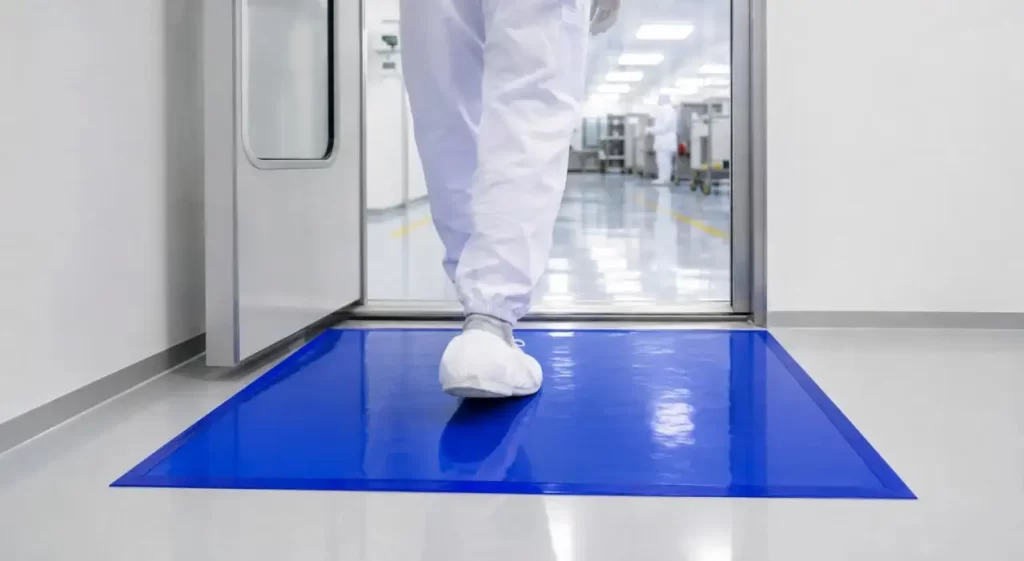
For GMP facilities, however, selecting Clean Room Sticky Floor Mats requires more than choosing a mat with high tack. Adhesive level, PE film construction, mat length, layer count, traffic volume, antibacterial requirements, installation position, and replacement rules all affect real performance.
At Nabai, these variables can be configured around the facility's traffic pattern rather than treated as isolated product specifications.
Why Floor Traffic Requires a Separate Contamination-Control Step
Footwear and trolley wheels repeatedly contact corridors, gowning areas, warehouses, and transfer zones. Dust, fibers, hair, packaging debris, and other particulate matter can remain attached to these surfaces and cross a controlled-area boundary.
The contamination route is typically:
Floor contamination → footwear or wheel pickup → boundary crossing → particle redistribution
Clean Room Sticky Floor Mats interrupt this route by providing a pressure-sensitive surface at the transition point.
Their effectiveness depends primarily on four conditions:
• Contact coverage: The sole or wheel must actually contact the adhesive surface.
• Contact distance: A longer mat provides additional footsteps or wheel rotation.
• Surface loading: Captured contamination progressively covers available adhesive area.
• Traffic frequency: Higher traffic loads the exposed layer faster.
For this reason, a small, high-tack mat placed incorrectly may perform worse than a properly sized medium-tack mat installed across the complete traffic path.
Adhesive Strength Must Match Shoes, Wheels and Contamination Load
Nabai offers Clean Room Sticky Floor Mats with a supplier-listed adhesive range of approximately 250–550g. This gives buyers room to match tack performance to the application rather than automatically specifying the highest value.
| Adhesive Direction | Typical Application Logic | Technical Point to Verify |
| Lower–medium tack | Routine personnel movement | Adequate particle pickup |
| Medium tack | Mixed personnel and light cart traffic | Balance between pickup and release |
| Higher tack | Heavier contamination or wheel traffic | Rolling resistance and shoe-cover release |
| Excessive tack | Usually unnecessary without testing | Adhesive transfer or shoe-cover pulling |
The measurement method behind a value stated in grams should also be confirmed during procurement. Buyers should determine whether the supplier is referring to peel adhesion, tack, holding force, or another test method instead of treating "250–550g" as a universal viscosity value.
Why Maximum Tack Is Not the Goal
Increasing tack can improve particle transfer under some conditions, but it may also increase:
• Resistance against trolley wheels;
• Pulling force on disposable shoe covers;
• Risk of edge lifting if the mat is poorly installed;
• Potential adhesive transfer if construction is unsuitable.
The correct Clean Room Sticky Floor Mats specification therefore balances contamination pickup with controlled release.
30 Layers vs. 60 Layers Is an Operating Decision
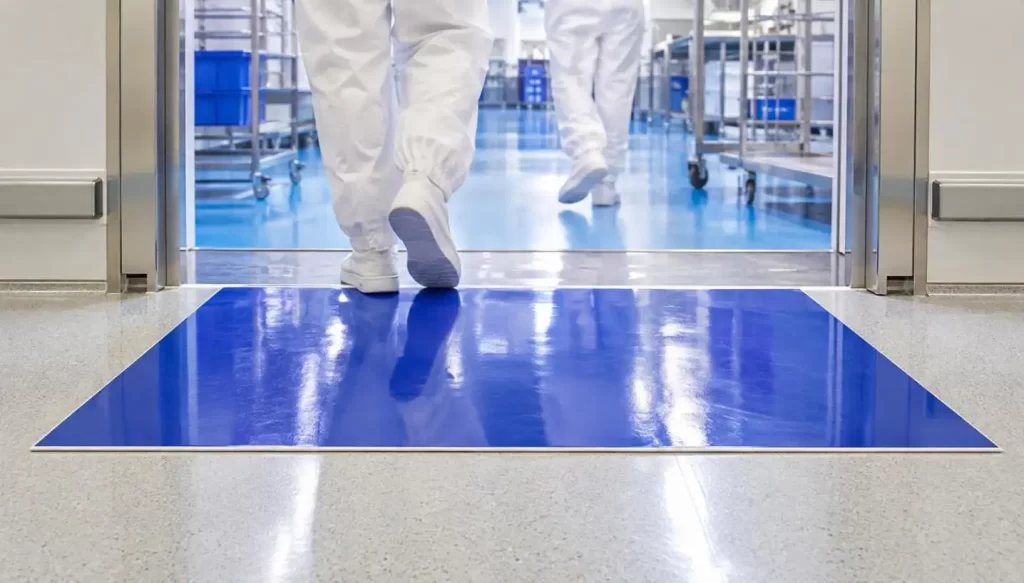
Nabai provides 30-layer and 60-layer Clean Room Sticky Floor Mats. Layer count should primarily be treated as an operating-life parameter, not an indicator of cleanroom grade.
A 60-layer construction does not automatically make the exposed adhesive layer more effective than a 30-layer construction. Instead, it reduces the frequency at which the entire mat needs to be replaced.
| Factor | 30 Layers | 60 Layers |
| Low/moderate traffic | Practical | Longer than necessary in some zones |
| High traffic | More frequent whole-mat replacement | Better operating continuity |
| Storage per mat | Lower layer count | Higher layer availability |
| Surface performance | Depends on adhesive | Depends on adhesive |
| Main selection driver | Consumption rate | Consumption rate |
Nabai's typical packing configuration is 30 layers/piece, 10 pieces/box, or 60 layers/piece, 5 pieces/box, allowing buyers to calculate consumption by entrance rather than simply comparing carton prices.
Mat Dimensions Should Follow the Actual Traffic Path
A critical mistake is selecting Clean Room Sticky Floor Mats only according to doorway width.
Width controls whether personnel or carts can bypass the mat. Length controls how much adhesive contact occurs.
Nabai offers several standard dimensions:
| Size | Suitable Selection Direction |
| 450 × 600 mm / 18 × 24 in | Compact personnel entrance |
| 450 × 900 mm / 18 × 36 in | Longer personnel contact zone |
| 450 × 1143 mm / 18 × 45 in | Narrow extended entrance |
| 600 × 900 mm / 24 × 36 in | Wider personnel or mixed traffic |
| 650 × 1143 mm / 26 × 45 in | Cart and wider transfer routes |
For personnel, buyers should consider shoe length and normal stride. For carts, wheel diameter, wheel spacing, cart width, and travel direction are more relevant.
A longer Clean Room Sticky Floor Mat increases the opportunity for wheel rotation across the adhesive surface. If only a small section of each wheel touches the mat, contamination removal may remain limited even when tack is high.
PE Film, Thickness and Backing Affect More Than Durability
Nabai uses polyethylene film for its Clean Room Sticky Floor Mats, with listed thickness options around 3C–6C.
Film construction affects:
• Dimensional stability;
• Flatness after installation;
• Resistance to tearing during layer removal;
• Edge behavior under trolley traffic;
• Handling during peeling;
• Particle generation from the mat itself.
Nabai also uses an HDPE or plastic backing structure to help stabilize the mat. In GMP traffic areas, this matters because mat movement, wrinkles, or lifted edges can interfere with personnel movement and cart travel.
Available colors include blue, white, transparent, and gray, allowing facilities to coordinate mats with visual-management or zoning practices.
Standard vs. Antibacterial Clean Room Sticky Floor Mats
Particle capture and antimicrobial surface performance should be evaluated separately.
| Function | Standard Sticky Mat | Antibacterial Sticky Mat |
| Dust/debris capture | Yes | Yes |
| Shoe/wheel particle removal | Yes | Yes |
| Antibacterial surface treatment | No | Yes |
| Replaces disinfection | No | No |
| Typical use | General controlled areas | Hygiene-sensitive controlled areas |
Nabai's antibacterial Clean Room Sticky Floor Mats combine PE film with a pressure-sensitive acrylic adhesive and antimicrobial treatment. They are intended for indoor applications including pharmaceuticals, food processing/packaging, cosmetics, and biotechnology environments.
Where antibacterial claims reference organisms such as Staphylococcus aureus or Escherichia coli, procurement teams should request the relevant test standard, laboratory conditions, sample identification, and reported performance rather than relying only on marketing terminology.
Installation Position Determines Real Particle Capture
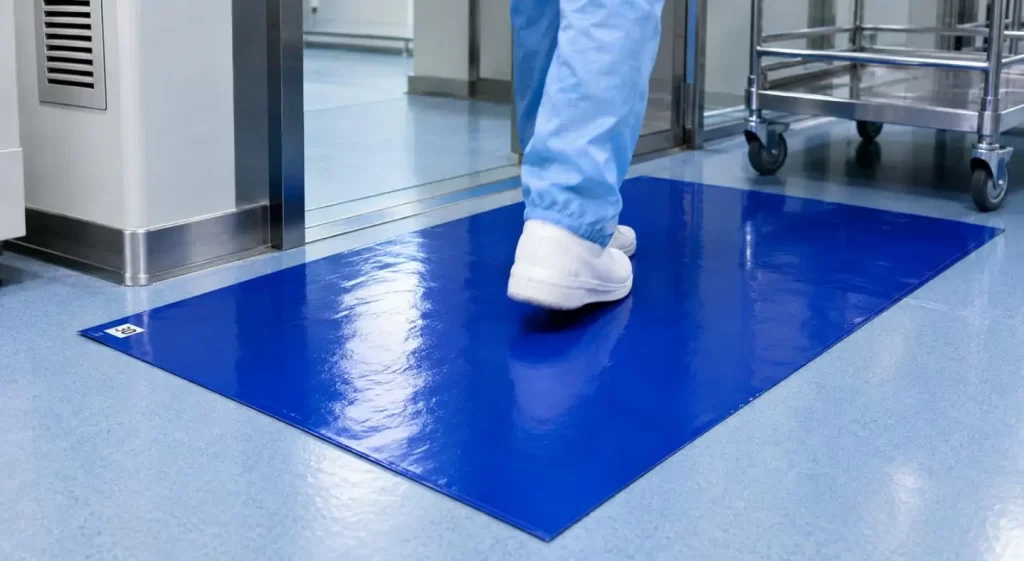
Even correctly specified Clean Room Sticky Floor Mats cannot compensate for poor placement.
Personnel Entrances
The mat should:
• Cover the natural walking route;
• Prevent easy bypass around either side;
• Sit on a clean, dry, level substrate;
• Remain clear of door movement;
• Provide adequate walking contact before the controlled boundary.
Cart Transfer Areas
The layout should account for:
• Cart width;
• Wheel track width;
• Wheel rotation distance;
• Turning direction;
• Frequency of material movement.
Larger formats such as 600 × 900 mm or 650 × 1143 mm may therefore be more appropriate than compact personnel sizes.
Replace Layers According to Surface Loading
A fixed statement such as "replace every eight hours" is rarely technically useful because contamination loading varies by facility.
Layer replacement should instead consider:
• Visible particle coverage;
• Noticeable reduction in tack;
• Traffic count;
• Cart frequency;
• Production shift pattern;
• Internal contamination-control SOP.
This allows Clean Room Sticky Floor Mats to be managed according to actual operating conditions rather than arbitrary time intervals.
Final Words
Nabai offers multiple configurable options including 250–550g adhesive, construction of 3C–6C PE, 30- and 60-layer, and antibacterial requirements to assist buyers in meeting diverse GMP traffic demands with Clean Room Sticky Floor Mats. Nabai is also able to assist buyers with their requirements by having them share information on doorway sizes, flow of personnel and carts, the expected amount of floor traffic, and the degree of required cleanliness. Nabai is then able to recommend a more suitable sampled configuration as well as a bulk procurement configuration.
FAQs
Q1. What materials are used in Nabai Clean Room Sticky Floor Mats?
Nabai Clean Room Sticky Floor Mats use polyethylene film with a pressure sensitive acrylic adhesive. This design enables low-linting indoor contamination-control applications.
Q2. What adhesive strengths are available?
Nabai has an adhesive range between 250g and 550g. Customers can choose between different levels of tack based on the amount of employee and trolley movement as well as the level of contamination and the type of shoe covers used.
Q3. Does Nabai offer both 30-layer and 60-layer Sticky Mats?
Yes. Nabai offers both 30-layer and 60-layer Clean Room Sticky Floor Mats. 30-layer designs cater to regular consumption, while 60-layer designs are designed for extended high traffic use.
Q4. What sizes are available for Clean Room Sticky Floor Mats?
The main sizes offered by Nabai are 450mm x 600mm, 450mm x 900mm, 450mm x 1143mm, 600mm x 900mm, and 650mm x 1143mm. Mats can be ordered to fit traffic routes for personnel and trolley transfers as well as to fit wider doorways.
Q5. Are Nabai Clean Room Sticky Floor Mats available with antibacterial treatment?
Yes. Nabai offers antibacterial sticky mats composed of a combination of adhesive and antimicrobial surface treatment for use in pharmaceutical, food, cosmetics and biotechnology industries, as well as other sensitive applications.
NEWS
GET SERVICE
With quality parts to meet every budget and friendly staff trained to make your visit informative and hassle free.