Clean Room Sticky Mats: EV Battery Dry Room Selection Guide

Clean Room Sticky Mats: EV Battery Dry Room Selection Guide
EV battery dry rooms solve a moisture-control problem, but they do not eliminate particle transfer. Shoes, trolley wheels, tools, packaging, and maintenance traffic can still carry dust, fibers, and metallic debris across controlled-area boundaries.
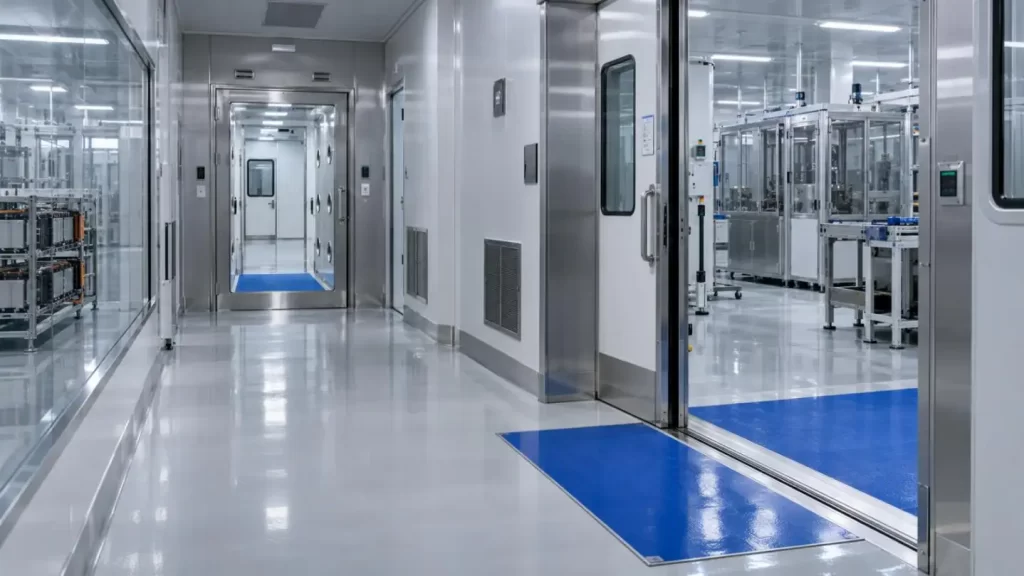
This is where Clean Room Sticky Mats provide a practical surface-contamination barrier. At Nabai, we view a sticky mat not as a stand-alone cleanliness solution, but as one component within a controlled traffic path involving airlocks, gowning, floor cleaning, filtration, ESD control, and operating procedures.
Lithium-ion battery production can require extremely dry environments, with some processes operating around -40°C dew point or below. At the same time, metal-particle contamination deserves particular attention because conductive particles can damage electrodes or separators and increase short-circuit risk.
Why Floor-Borne Particles Still Matter in a Battery Dry Room
HEPA filtration controls airborne contamination. Clean Room Sticky Mats, by contrast, target contamination transported through direct surface contact.
A common transfer route is:
General Area → Personnel/Material Airlock → Shoes or Wheels → Dry-Room Floor → Process Zone
The contamination challenge is therefore not simply "how much dust is in the air." Engineers also need to control particles that move mechanically between zones.
For Clean Room Sticky Mats, three variables are especially important:
•Contact area: How much of the shoe sole or wheel actually touches the adhesive surface.
•Contact distance: Whether personnel take several full steps or a cart wheel completes sufficient rotation across the mat.
•Tack level: Whether the adhesive can transfer particles without creating excessive walking or rolling resistance.
A mat that is too short may only clean part of a trolley wheel circumference. A mat with unnecessarily high tack may pull shoe covers, increase wheel drag, or create operational resistance.
Tack Strength Should Match the Traffic, Not the Marketing Claim
"Higher tack" does not automatically mean better contamination control.
Effective particle pickup can be considered as the interaction of:
Adhesive tack + Contact pressure + Contact area + Surface condition + Contamination loa
This means Clean Room Sticky Mats for personnel entrances and mats exposed to frequent cart traffic may require different evaluations.
| Operating Condition | Main Technical Concern | Selection Focus |
| Foot traffic | Shoe-cover pull and particle pickup | Balanced tack |
| Cart traffic | Wheel rotation and layer damage | Mat length + film strength |
| High particle loading | Rapid tack-area saturation | Layer-change frequency |
| ESD-controlled zone | Static behavior | Resistance data required |
| Low-dew-point room | Material stability | Adhesive/film validation |
For engineering procurement, the test method behind a tack or adhesion value is just as important as the number itself. Values measured using different methods should not automatically be compared.
What Low Humidity Changes for Clean Room Sticky Mats
A battery dry room can be much more demanding than an ordinary controlled production area. Low humidity may affect polymer behavior, electrostatic charging, adhesive performance, and dimensional stability.
Before approving Clean Room Sticky Mats for a battery dry room, we recommend evaluating:
Adhesive Stability
The adhesive should maintain usable tack over the intended environmental range without excessive transfer to shoes or wheels.
Film Stability
The film should resist tearing, curling, or dimensional changes after prolonged exposure.
Residue
Residue transferred from the adhesive can create a secondary contamination path rather than solving the original one.
Chemical Emissions
Where airborne molecular contamination is process-critical, material emissions may also require evaluation. ISO 14644-15:2026 provides guidance for assessing equipment and materials according to airborne chemical concentration.
ESD Behavior
A product described as "antistatic" should not automatically be treated as proof of ESD-system compliance. Floor resistance, footwear, personnel grounding, equipment grounding, and environmental conditions need to work together.
Nabai Clean Room Sticky Mats: Construction and Specifications
For facilities evaluating multilayer Clean Room Sticky Mats, our Nabai Cleanroom Anti-Bacterial Sticky Mat uses low-linting polyethylene film with an integrated antimicrobial agent and a pressure-sensitive antibacterial acrylic adhesive. The adhesive is specified as silicone-free and non-transferring, while an HDPE or plastic backing helps reduce mat movement.
Our specifications include:
| Specification | Nabai Data |
| Base material | Polyethylene |
| Adhesive | Antibacterial acrylic pressure-sensitive adhesive |
| Listed viscosity | 250–550 g |
| Thickness | 3C–6C |
| Layer options | 30 or 60 |
| Sizes | 450×600, 450×900, 450×1143, 600×900, 650×1143 mm |
| Colors | Blue, white, transparent, gray |
| 30-layer packing | 10 pieces/box |
The antimicrobial compound is integrated into the material rather than relying only on a temporary surface application.
These specifications provide a useful starting point, but battery manufacturers should still validate low-dew-point behavior, ESD properties, chemical emissions, and process-specific contamination requirements before qualification. Those parameters are not established merely by the antibacterial product specification.
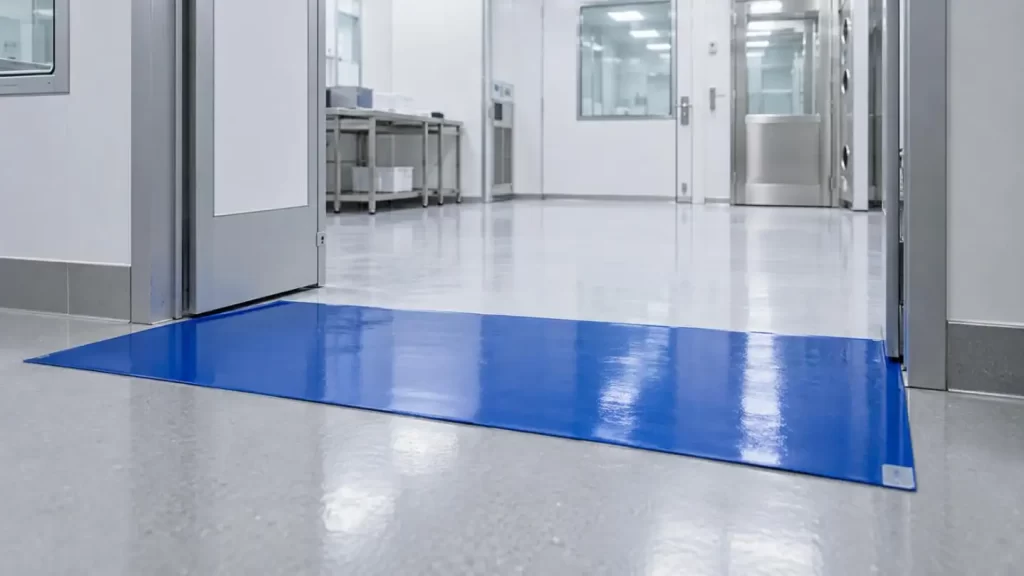
Where Should Clean Room Sticky Mats Be Installed?
Placement determines whether a mat actually interrupts the contamination path.
Typical control points include:
•Personnel airlock exits;
•Gowning-to-dry-room transitions;
•Material airlocks;
•Trolley entry routes;
•Entrances to higher-control process zones.
For foot traffic, the mat should allow multiple complete contacts rather than a single partial step.
For rolling equipment, engineers should consider wheel circumference, mat travel length, wheel load, and traffic frequency. A narrow doorway may only determine mat width; it does not automatically determine the correct mat length.
Layer Replacement Should Be Condition-Based
The advantage of multilayer Clean Room Sticky Mats is that a contaminated surface can be peeled away without replacing the entire mat.
However, simply changing one layer every shift may be inefficient.
A more controlled SOP considers:
•Traffic count;
•Visible particle loading;
•Loss of exposed tack area;
•Cart frequency;
•Process sensitivity;
•Abnormal contamination events.
The operating sequence should be simple:
Inspect → Assess Loading → Peel Layer → Record if Required → Verify Fresh Surface
Layer count mainly affects maintenance capacity. A 60-layer mat is not automatically more efficient at collecting particles than a 30-layer version.
Validate Mat as a Consumable for Use in Cleanrooms
The intent of ISO 14644-18:2023 is to evaluate the appropriateness of consumables to be used in cleanrooms and controlled zones. The criteria for evaluation consist of the intended use of the consumable, the presence of airborne particles and/or chemicals, functional properties of the consumable, risk and supporting evidence.
For a battery-dry-room RFQ, we recommend asking a Clean Room Sticky Mats supplier for:
•Adhesive/tack test method;
•Film material and thickness;
•Layer construction;
•Residue information;
•Environmental operating limits;
•ESD resistance data when required;
•Chemical-emission data when relevant;
•Recommended installation and replacement procedure.
Selecting Clean Room Sticky Mats by Process Risk
The correct purchasing sequence is not "find the stickiest mat."
It is:Contamination Risk → Traffic Type → Tack Requirement → Mat Dimensions → Material Compatibility → ESD/Chemical Requirements → Maintenance Plan → Validation
At Nabai, our antibacterial Clean Room Sticky Mats offer multiple dimensions, 30- and 60-layer structures, PE construction, and silicone-free acrylic adhesive for controlled-area contamination management. For EV battery dry-room projects, we recommend using these published specifications as the starting point, then confirming the required environmental, ESD, and contamination-control data against the facility's actual process conditions before final selection.
FAQs
Q1. What are Nabai Clean Room Sticky Mats made of?
Nabai Clean Room Sticky Mats use polyethylene film combined with an antibacterial acrylic pressure-sensitive adhesive. The construction is designed for controlled environments where footwear and wheel-borne contamination needs to be reduced.
Q2. How many layers are available for Nabai Clean Room Sticky Mats?
Nabai offers 30-layer and 60-layer configurations. Each contaminated layer can be peeled away to expose a fresh adhesive surface, helping simplify routine contamination-control maintenance.
Q3. What sizes are available for Nabai Clean Room Sticky Mats?
Available standard sizes include:
•450 × 600 mm
•450 × 900 mm
•450 × 1143 mm
•600 × 900 mm
•650 × 1143 mm
The appropriate size should be selected according to doorway width, walking distance, and trolley traffic.
Q4. What is the listed tack range of Nabai Clean Room Sticky Mats?
Nabai offers a viscosity or adhesive specification of approximately 250–550 g. Buyers should also confirm the corresponding test method when comparing adhesive performance between different products.
Q5. What thickness options does Nabai provide?
Nabai lists 3C–6C thickness options for its antibacterial sticky mats. Film thickness should be considered together with traffic load, tear resistance, and layer stability rather than evaluated alone.
NEWS
GET SERVICE
With quality parts to meet every budget and friendly staff trained to make your visit informative and hassle free.