
Clean Room Sticky Mats Suppliers: Antimicrobial Entry Control for 2026

Clean Room Sticky Mats Suppliers: Antimicrobial Entry Control for 2026
Contamination control at cleanroom entrances is no longer evaluated only by visible dust removal. Pharmaceutical, biotechnology, electronics, medical-device, food, and cosmetic facilities also assess how footwear and trolley traffic may transfer particles and microorganisms across controlled-area boundaries.
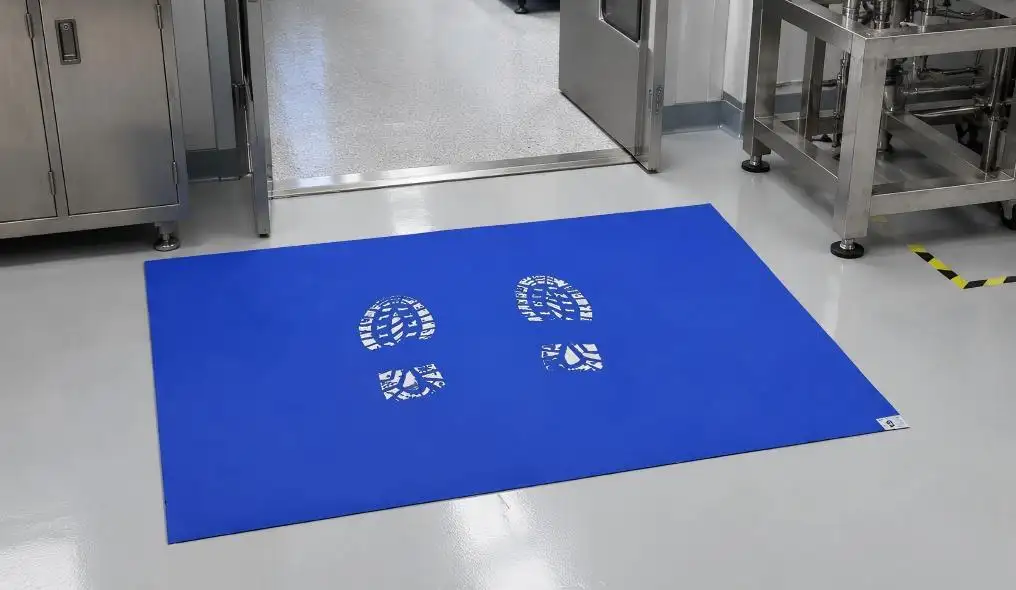
The engineering objective for Clean Room Sticky Mats Suppliers is to achieve reliable particle capture and surface hygiene in a mat while providing simplicity in the installation, layer removal and routine maintenance.
At Nabai, we manufacture antibacterial peel-off sticky mats as a supplementary entry-control measure. They support—but do not replace—validated cleaning, disinfection, gowning, environmental monitoring, or facility contamination-control procedures.
Why Entryway Control Matters in 2026
ISO 14644-1 classifies cleanrooms according to airborne particle concentration. The newly published ISO 14644-13:2026 addresses cleaning surfaces to defined particle and chemical cleanliness levels but specifically excludes microbiological aspects. In pharmaceutical manufacturing, EU GMP Annex 1 requires a facility-wide Contamination Control Strategy covering microorganisms, particles, personnel, premises, equipment, cleaning, and monitoring. hould therefore be selected as one component within a broader contamination-control system.
Key entryway risks include:
•Particle transfer from footwear, cart wheels, packaging, and tools
•Repeated traffic across the same transition point
•Moisture or residue that increases surface-hygiene concerns
•Mats that shift, wrinkle, or leave traffic paths uncovered
•Overused adhesive layers with reduced pickup performance
How Nabai Antibacterial Sticky Mats Work
Nabai's construction combines low-linting polyethylene film, pressure-sensitive acrylic adhesive, an antibacterial treatment, and a non-slip backing.
•Adhesive particle capture: The exposed surface collects loose dust and debris from shoes and wheels.
•Peel-off renewal: A loaded top sheet is removed to reveal a fresh numbered layer.
•Surface Hygiene Support: This treatment on the surface of the mat inhibits growth of bacteria during normal use.
•Stable Placement: An HDPE or Plastic backing reduces mat movement at the entrance.
Antibacterial sticky mats are not sterilization products and should never be presented as substitutes for routine cleaning or disinfectant procedures.
Professional Clean Room Sticky Mats Suppliers should provide more than dimensions and colors. Buyers should request technical documentation explaining how performance was measured.
| Evaluation Area | Information to Confirm |
| Particle control | Adhesive consistency, residue transfer, layer cleanliness, and footwear or wheel compatibility |
| Antibacterial claim | Test method, organism strains, contact time, laboratory, and reduction results |
| Construction | PE film grade, adhesive chemistry, silicone-free status, backing, and linting behavior |
| Cleanroom use | Installation zone, traffic level, replacement frequency, and storage conditions |
| Quality control | Coating checks, layer counting, adhesion testing, packaging inspection, and traceability |
| Customization | Size, color, layer count, labeling, packaging, and application-specific tack |
ISO 22196:2011 remains a current recognized method for evaluating antibacterial activity on treated plastics and other non-porous surfaces. Antibacterial claims should therefore be supported by a report for the relevant finished surface, not only by data for the antimicrobial additive. uct Specifications
| Parameter | Standard Offering |
| Base material | Low-linting PE film with integrated antibacterial treatment |
| Adhesive | Pressure-sensitive, silicone-free, non-transferring acrylic adhesive |
| Adhesive level | Supplier-stated tack range: 250–550 g; confirm the test method |
| Common sizes | 18 × 24, 18 × 36, 18 × 45, 24 × 36, and 26 × 45 inches |
| Layer thickness | Supplier-stated 3C–6C; confirm the final unit and tolerance |
| Layer count | 30 or 60 numbered layers |
| Colors | Blue, white, transparent, and gray |
| Backing | Non-slip HDPE or plastic sheet |
| Packing | 30-layer mats: 10 pieces/box; 60-layer mats: 5 pieces/box |
| Custom options | Size, color, layer count, labeling, and packaging |
The specifications above are based on Nabai's published product information. Final adhesive-test methods, thickness units, tolerances, and antibacterial reports should be confirmed in the approved technical datasheet before ordering. on and Replacement
1.Clean and dry the floor before installation.
2.Cover the full walking or trolley path.
3.Press the backing flat to prevent raised edges or trapped air.
4.Remove the top protective liner immediately before use.
5.Peel away a loaded layer according to its visual condition and site procedures.
6.Replace the mat when all layers are used or the backing becomes unstable.
7.Record replacement frequency where internal procedures require traceability.
Why Work with Nabai
As one of the experienced Clean Room Sticky Mats Suppliers in Dongguan, Nabai manages material selection, adhesive coating, converting, inspection, and packaging through an integrated production process.
Our manufacturing support includes:
•More than 17 years of experience in cleanroom and ESD materials
•Engineering, chemical, and quality-control personnel
•ISO-certified manufacturing operations
•In-house production and R&D capabilities
•Full-process checks from incoming materials to final packaging
•OEM and ODM support for customized specifications
Nabai's ISO-certified manufacturing facility is in Dongguan, supported by production lines, an R&D laboratory, and quality control covering raw materials through final packaging. Clean Room Sticky Mats Suppliers
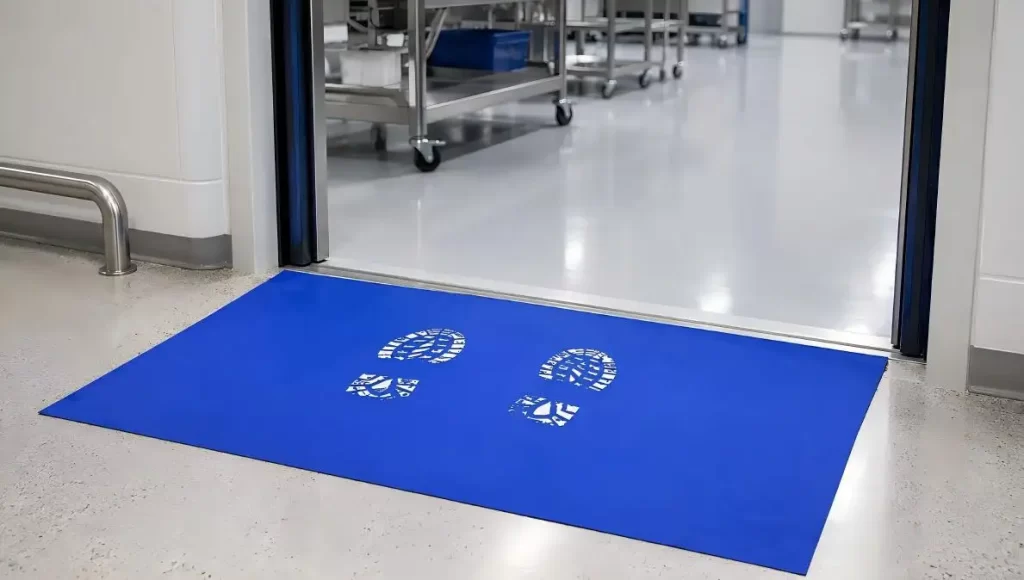
A suitable supplier should explain what the mat captures, how antibacterial performance is tested, where the product should be installed, and how consistency is controlled between batches.
Nabai develops antibacterial sticky mats as practical entryway components for contamination-sensitive environments. By combining peel-off particle capture, controlled adhesive performance, antibacterial surface support, and flexible manufacturing, we help facilities strengthen entrance control without adding complex operating steps.
Clean Room Sticky Mat Suppliers need to assess the following criteria prior to determining final specifications: traffic patterns, entry dimensions, load from a wheel, condition of the floor, anticipated frequency of replacement, type of documentation required, and whether or not antibacterial testing will be done.
FAQs
Q1. What is the purpose of a clean room sticky mat?
Sticky mats trap dust and other particulate matter on shoe and trolley wheels prior to entering a cleanroom.
Q2. Are antibacterial sticky mats a substitute for disinfection?
This is not the case. Antibacterial sticky mats assist with contamination control, however, do not take the place of scheduled cleaning or disinfection procedures.
Q3. What is the removal schedule for sticky mat layers?
The top layer of sticky mats should be removed when it is mat is visibly soiled or no longer sticky.
Q4. What is the maximum number of layers available for sticky mats?
Nabai usually offers sticky mats with 30 and 60 layers.
Q5. Do Nabai sticky mats contain silicone?
Nabai sticky mats are silicone-free.
NEWS
GET SERVICE
With quality parts to meet every budget and friendly staff trained to make your visit informative and hassle free.