

clean room sticky mats

clean room sticky mats
In the pharmaceuticals, biotechnology, electronics manufacture, aerospace, medical device and semiconductor manufacturing, among others, keeping an environment free of contamination is essential. Micro particles can cause product contamination, potentially damage sensitive equipment or cause expensive compliance problems.
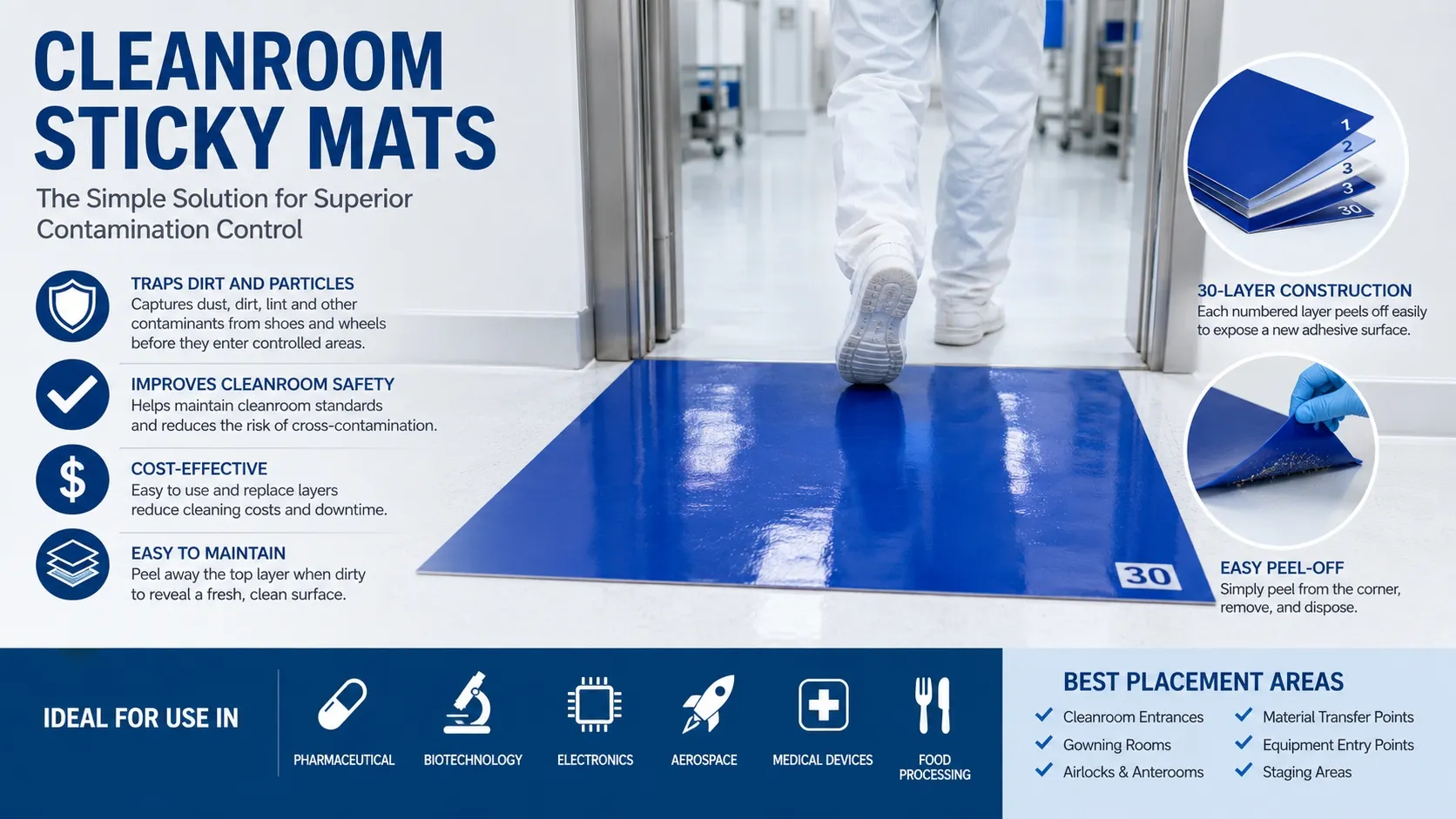
Cleanroom sticky mats (tacky mats or adhesive floor mats) are one of the easiest yet most effective methods of contamination control. These mats are installed at entry points and transition areas to prevent the spread of dust, dirt, lint and other contaminants from shoes and cart wheels into controlled areas.
This guide tells you what a cleanroom sticky mat is, where to use them, best practices for installing them, their maintenance needs and how to get the most out of them.
What Is a Cleanroom Sticky Mat?
A cleanroom sticky mat is an adhesive multi-layer floor covering that is used to capture particles that may be present on footwear or wheeled equipment before entering a controlled area. The mats are usually constructed by stacking layers of polyethylene film and applying an adhesive to the surface that becomes tacky when subject to pressure.
There are several sheets on each mat numbered. When the top layer gets dirty, it can easily be removed and a new adhesive surface will be exposed. This basic design enables continual contamination control without a large amount of cleaning or maintenance.
Key Features
- Multi-layer construction
- Pressure-sensitive adhesive surface
- Easy peel-off replacement layers
- Available in various sizes and colors
- Suitable for foot and wheel traffic
- Designed for controlled environments
How Cleanroom Sticky Mats Work
The principle of cleanroom sticky mats is based on the concept of adhesion that captures the contaminants. Any particles that stick to personnel's soles or wheels while walking on the mat or equipment roll stick to the mat.
The adhesive is designed to effective hold dust and debris without hindering walking and cart movement. This will prevent contamination being carried into sensitive manufacturing or laboratory areas.
Sticky mats are the first step on a comprehensive contamination-control strategy that helps lower the number of particles entering at entry points.
Benefits of Using Sticky Mats in Cleanrooms
1. Improved Contamination Control
The use of sticky mats can greatly minimize the amount of particulates that enter controlled environments. This is to maintain cleanliness levels and to help ensure compliance with ISO clean room standards.
2. Enhanced Product Quality
In certain sectors like semiconductor production and pharmaceuticals, the slightest amounts of contaminants can have an impact on production results. Sticky mats protect products and processes against undesirable particle intrusion.
3. Reduced Cleaning Costs
Contamination is trapped at the entry point, which minimises how much dirt is deposited on internal surfaces and the frequency of cleaning and maintenance.
4. Increased Operational Efficiency
Cleaner environments reduce the impact of contamination incidents, product defects and equipment issues.
5. Easy Maintenance
Unlike many systems which manage contaminants, sticky mats require little effort. Users just have to replace the contaminated layer and then proceed with operation.
Where Should Cleanroom Sticky Mats Be Installed?
Correct placement is crucial to maximum effectiveness.
Cleanroom Entrances
Most often it is installed right at the doorways to the cleanroom. This is to make sure that contamination is eliminated prior to entering the controlled area.
Gowning Rooms
Gowning areas are often used to change from street clothing to cleanroom gowning. Sticky mats help eliminate particles before employees proceed further into the facility.
Airlocks and Anterooms
The transition spaces are used to separate rooms of differing cleanliness. Sticky mats are used in these areas and this helps to prevent cross-contamination.
Material Transfer Areas
Firefighters can place a lot of trash on equipment, trolleys or carts. Wheel borne contamination is minimized with sticky mats placed at equipment entry points.
Staging Areas
Staging areas allow materials to be captured and the overall cleanliness of the materials to be improved prior to entering the cleanroom.
Choosing the Right Size of Sticky Mat
Selecting the correct size is crucial.
Consider Traffic Flow
A minimum of two to three steps should be able to be crossed over the mat. This allows for maximum contact between the shoe and the adhesive surface.
Consider Door Width
The mat should cover all of the walking path which staff use for a standard entryway. Larger mats or multiple mats might be needed for wider entrances.
Consider Equipment Traffic
If facilities are employing carts or wheeled equipment, they should be sure that there is enough space between the mat and the wheels to ensure that all wheels come into contact with the mat.
Best Flooring Surfaces for Installation
Sticky mats adhere best to:
- Vinyl flooring
- Smooth tile
- Finished epoxy flooring
- Other smooth, non-porous surfaces
Avoid installation on:
- Rough concrete
- Textured flooring
- Anti-slip grit coatings
- Uneven tile surfaces with deep grout lines
In facilities with challenging floor conditions, specialized mounting pads or mat frames can improve performance.
Step-by-Step Cleanroom Sticky Mat Installation
Step 1: Prepare the Surface
Clean the floor thoroughly to remove dust, grease, moisture, and debris. A clean installation surface ensures optimal adhesion.
Step 2: Position the Mat
Place the mat where all personnel and equipment must cross before entering the controlled environment.
Step 3: Remove the Bottom Backing
Carefully remove the protective backing from the underside of the mat and place it on the prepared floor surface.
Step 4: Eliminate Air Pockets
Apply pressure evenly across the mat to remove air bubbles and ensure secure attachment.
Step 5: Remove the Top Protective Film
Before use, peel away the top protective sheet to expose the adhesive surface.
How Often Should Sticky Mat Layers Be Changed?
The replacement frequency depends on several factors:
- Personnel traffic volume
- Equipment movement
- Environmental cleanliness
- Industry requirements
High-traffic facilities may need to replace layers several times per day, while lower-traffic environments may only require daily or weekly changes. Regular inspection is the best way to determine replacement intervals.
Signs That a Layer Should Be Removed
- Visible dirt accumulation
- Reduced adhesive performance
- Increased particle counts
- Scheduled maintenance intervals
Proper Layer Removal Technique
To avoid releasing captured particles back into the environment:
- Start peeling from the numbered tab corner.
- Slowly lift the sheet around the perimeter.
- Fold inward to contain contaminants.
- Dispose of the used layer immediately.
Rapid removal may create airflow disturbances and increase contamination risk. Slow, controlled removal is recommended.
Best Practices for Maximum Performance
To achieve the highest level of contamination control:
- Install mats in all critical transition zones.
- Train employees on proper usage.
- Monitor traffic patterns regularly.
- Replace layers before they become overloaded.
- Conduct periodic contamination audits.
- Integrate sticky mats with broader cleanroom protocols such as gowning, air filtration, and airlocks.
Sticky mats are most effective when used in conjunction with other elements of a complete contamination-control program.
Industries That Commonly Use Cleanroom Sticky Mats
Pharmaceutical Manufacturing
Ensuring particle-free product is vital to product safety and regulatory requirements.
Biotechnology Laboratories
Controlled environments are imperative for research accuracy.
Electronics and Semiconductor Production
Very small particles can short out circuits and cause a drop in manufacturing yields.
Aerospace Facilities
There are strict contamination control procedures needed for sensitive components.
Medical Device Manufacturing
Sterile production environments are used to help ensure product quality.
Food Processing Facilities
Sticky mats reduce transfer of contaminants to production areas.
Conclusion
Cleanroom sticky mats are one of the simplest, inexpensive tools available to control contamination. They trap dirt, dust, and particles at specific entry points which helps to keep environments cleaner, boost operational efficiency, and aid in adherence to stringent cleanliness standards.
Sticky mats can be an effective barrier to unwanted contaminants when properly installed, maintained and as part of a cleanroom contamination control program. No matter which industry your facility is in—pharma, electronics, biotechnology, aerospace, or healthcare—high-quality sticky mats are a sensible solution that can help your facility to improve its environmental control and safeguard sensitive processes.
NEWS
GET SERVICE
With quality parts to meet every budget and friendly staff trained to make your visit informative and hassle free.
