
cleanroom cleaning supplies

cleanroom cleaning supplies
Maintaining a cleanroom is about much more than meeting industry regulations. No matter the industry, from electronics manufacturing to semiconductor production, pharmaceuticals, biotechnology, medical device assembly or precision engineering, contamination control has a direct effect on product quality, performance, and customer satisfaction.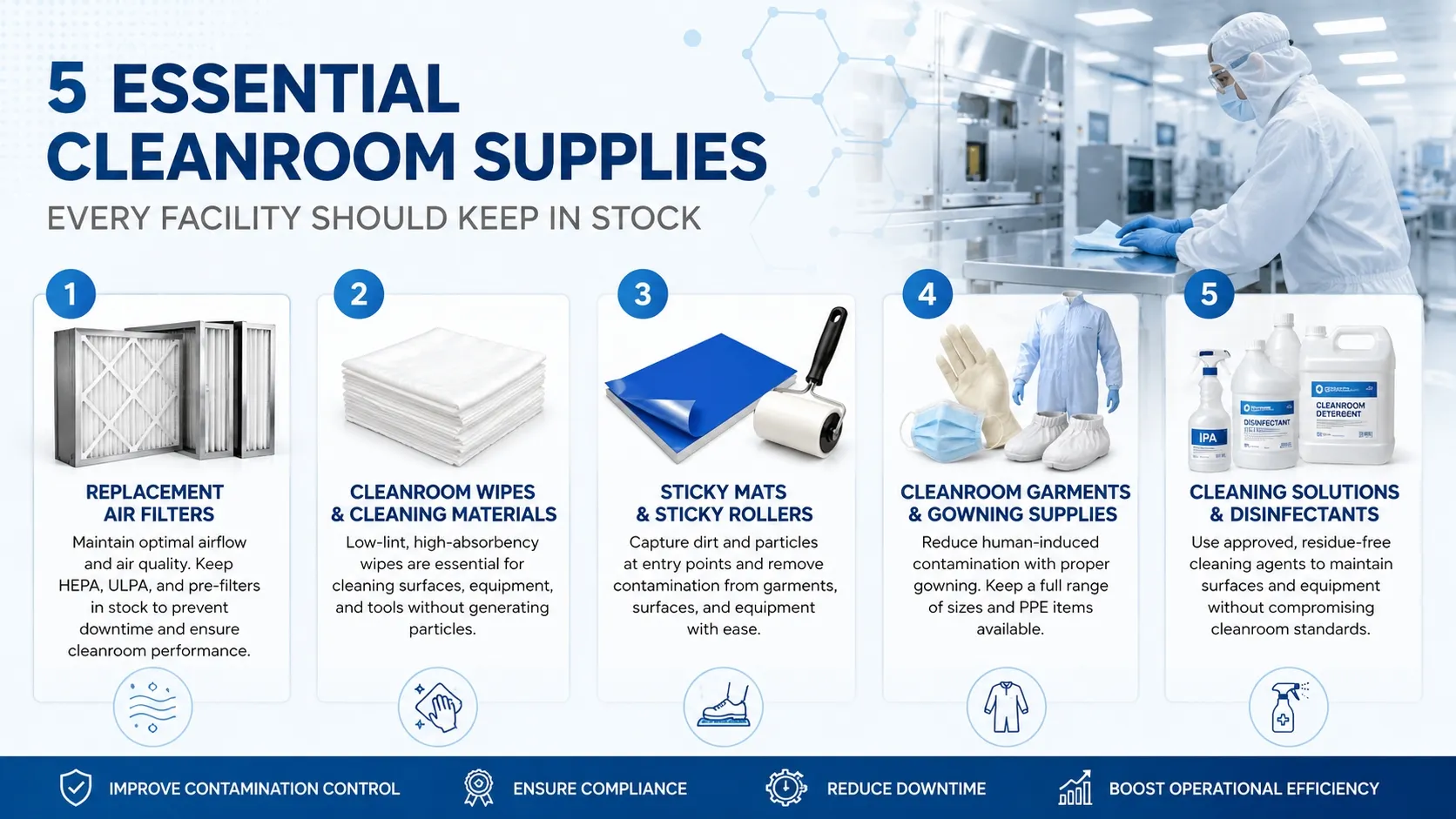
Even the highest grade clean room can get dirtier than its cleanliness classification if critical supplies are not available. Contamination issues, production delays, and expensive down time can result from a missing filter, stock-out of cleanroom wipes, or lack of gowning materials.
Each facility will need to have the necessary cleanroom supplies readily available to sustain continuous operations and comply with ISO cleanroom standard. Below are five of the most critical cleanroom products that should be always in your inventory management plan.
1. Replacement Air Filters
The basis of all cleanroom environments is air filtration. If a high-efficiency filtration system is used, airborne particles are filtered off, ensuring the correct cleanliness classification and safeguarding sensitive product against contamination.
The majority of cleanrooms utilize several stages of filtration, including:
- Pre-filters
- HEPA filters
- ULPA filters
Pre-filters trap larger particles first, which prolongs the service life of higher cost filters such as HEPA and ULPA filters. The filters used in HEPA and ULPA filters are designed to capture at least 99.97% of particles at 0.3 microns and have even better filtration efficiency in critical applications.
During normal use, unsuspected causes of filter failure or degradation can arise. Having spares on hand enables maintenance personnel to take quick action and prevents disruptions that may affect the cleanroom.
Best Practice
Keep at least one copy of important filters for every cleanroom system. Scheduled replacement and regular monitoring for optimum airflow and contamination control.
2. Cleanroom Wipes and Cleaning Materials
Contamination on the surface can be as harmful as air particles. These are cleaned regularly to eliminate particles building up on equipment, workstations, walls, windows and production tools.
Cleanroom wipes are specially formulated for use in controlled environments. They are made with low lint materials which reduce particle generation during use, compared to conventional wipes.
Common clean room wipe uses are:
- Cleaning production surfaces
- Equipment maintenance
- Spill control
- Applying cleaning solutions
- Removing dust and particles
In cleanliness environments ranging from ISO Class 5 to 8, polyester wipes, microfiber wipes or nonwoven cleanroom wipes may be used.
Low supply of cleanroom wipes could cause operators to postpone cleaning tasks, which can be dangerous for contamination and inefficient for operations.
Best Practice
Set up automatic stock rotation and hold a level of safety stock for at least a few weeks' operations.
3. Sticky Mats and Sticky Rollers
Prevention is one of the best ways to control contamination, as it is to avoid getting particles into the cleanroom in the first place.
Sticky Mats
Sticky mats are placed at doors, gowning rooms and change rooms. Each adhesive layer blocks dirt, dust and debris from shoes, carts and equipment wheels reaching controlled environments. Sticky mats are used extensively in the cleanroom as an initial barrier to particulate contamination.
Sticky Rollers
Sticky rollers are also of paramount importance for the removal of particles from:
- Cleanroom garments
- Work surfaces
- Packaging materials
- Equipment housings
- Electronic assemblies
The sticky roller is widely applied in electronics manufacturing, semiconductor factory and precision assembly production.The sticky rollers are usually applied in the electronics manufacturing, semiconductor factory and precision assembly production. ESD-safe sticky rollers are used for extra protection in static-sensitive areas.
Adhesive products must be changed regularly as contaminated mats and rollers will not work as well as they should.
Best Practice
Have sufficient replacement sticky mat sheets and refills for the contamination control procedure.
4. Cleanroom Garments and Gowning Supplies
One of the biggest sources of contamination in any cleanroom is the personnel. Any uncontrolled environment can be quickly contaminated by human skin flakes, hair, fibers and microorganisms if adequate gowning procedures are not followed.
Gowning supplies that are necessary:
- Cleanroom coveralls
- Bunny suits
- Face masks
- Hoods
- Gloves
- Shoe covers
- Boot covers
- Beard covers
Appropriate gowning minimizes particle shedding and helps to safeguard products and processes.
One of the most frequently cited reasons for production delays is that the garment size or protective equipment are not available. Having adequate stock on hand allows workers to always meet the cleanroom entry standards.
Gowning rooms, proper cleanroom gowning and contamination-control procedures are always mentioned as necessary elements of successful cleanroom operations.
Best Practice
Keep track of how much stock is on-hand and how quickly it's being used. Set reorder points in advance of supply coming to a tipping point.
5. Cleanroom Cleaning Solutions and Disinfectants
Cleaning Agents play an important role to ensure contamination free environment. Not all cleaning chemicals are appropriate for use in cleanrooms, however.
Cleanroom cleaning solutions are exclusively developed to reduce residue, particles and at the same time to remove contaminants.
Common options include:
- Isopropyl alcohol (IPA)
- Sterile disinfectants
- Neutral cleaners
- Residue-free detergents
- Hydrogen peroxide-based solutions
These products are used to clean:
- Floors
- Walls
- Equipment surfaces
- Pass-through chambers
- Workstations
- Storage areas
In regulated industries like pharmaceuticals and medical device production, cleaning validation procedures will frequently call for cleaning agents and documented cleaning schedules.
The lack of approved cleaning chemicals may cause delays in production, affect compliance, and introduce contamination risks.
Best Practice
Keep stocks of backups and FIFO to ensure freshness and efficiency of products.
Building a Reliable Cleanroom Supply Strategy
However, good cleanroom operation relies on more than state-of-the-art design and filtration systems. Essential supplies are always available so that contamination control procedures can be completed uninterruptedly.
A complete cleanroom inventory program should consist of:
- Scheduled stock audits
- Automated reorder systems
- Supplier partnerships
- Emergency backup inventory
- Usage trend analysis
Having proactive facilities management systems in place, that manage inventory, can help to better maintain the ISO classifications, minimize downtime and enhance overall productivity.
With the ever-ascending level of cleanroom quality in the electronics, semiconductor, biotechnology, aerospace, and medical manufacturing sectors, having the appropriate cleanroom supplies on hand in the right time becomes all the more crucial.
Final Thoughts
Cleanrooms are engineered to provide a highly controlled space with as little contamination as possible and to ensure the quality of the product. But no cleanroom, no matter how advanced, can function properly without the necessary operation materials.
The cornerstones of a successful contamination control program are replacement filters, cleanroom wipes, sticky mats, sticky rollers, gowning materials and approved cleaning solutions. With proper stock management and forward-looking approach to supply management, facilities can reduce downtime, maintain compliance and deliver long-term smooth operations.
When considering cleanroom supplies, make sure they are reliable and capable of supporting quality product and consistent manufacturing performance for years to come with reduced risk.
NEWS
GET SERVICE
With quality parts to meet every budget and friendly staff trained to make your visit informative and hassle free.