
Cleanroom Consumables Sticky Roller for ESD Control and Low-Residue Cleaning in 2026

Cleanroom Consumables Sticky Roller for ESD Control and Low-Residue Cleaning in 2026
For electronics, semiconductor, optical and precision manufacturing, a Cleanroom Consumables Sticky Roller is no longer selected only by asking whether it can pick up dust. The more important question is whether the roller removes particles without introducing electrostatic charge, adhesive transfer, silicone contamination or unnecessary consumable waste.
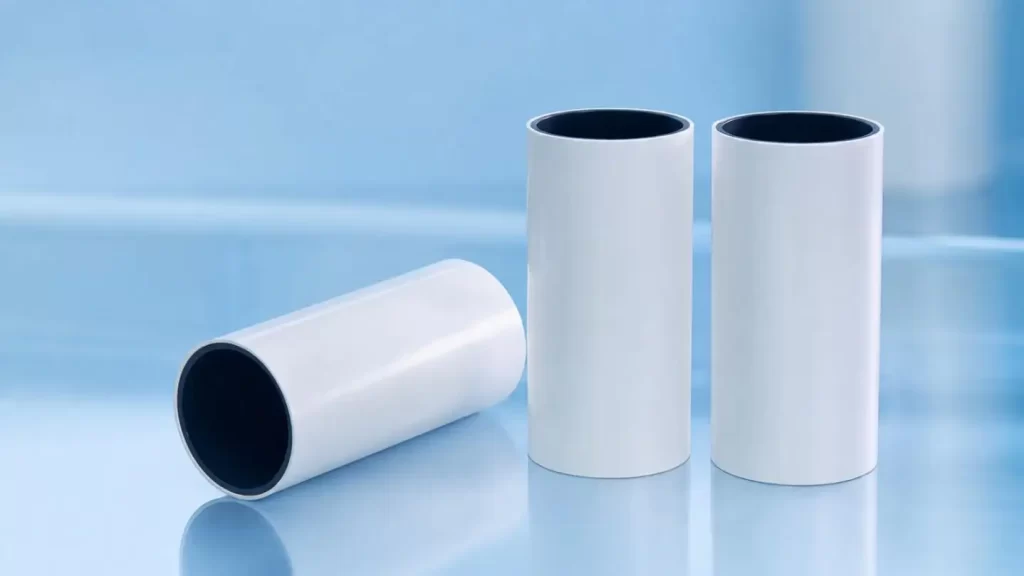
These criteria come into focus in 2026. ISO 14644-18:2023 assesses the compatibility of consumables concerning the requirements of the product or process, cleanliness and functional performance. ISO 14644-13:2026 standardizes methods of reaching required levels of surface cleanliness by definition of particles and chemicals.
At Nabai, this means treating the Cleanroom Consumables Sticky Roller as part of the contamination-control system rather than as a simple adhesive roll.
Particle Pickup Must Be Balanced Against Surface Risk
A sticky roller removes contamination by creating controlled adhesive contact with the target surface. The useful tack level therefore depends on both the contamination and the substrate.
The relationship is:
Particle adhesion → required tack → surface sensitivity → residue risk
Higher tack can help with more strongly attached dust and fibers, but excessive adhesion may be unsuitable for delicate films, coated panels or other sensitive surfaces.
| Process Surface | Main Concern | Roller Selection Priority |
| PCB / electronic assemblies | Particles + ESD | Controlled tack + ESD structure |
| Semiconductor handling areas | Fine particles + static | Stable pickup + full ESD path |
| Optical films / displays | Surface marking | Low residue + controlled tack |
| LED / coating processes | Silicone contamination | Silicone-free option |
| Equipment / workbenches | General dust | Coverage + refill efficiency |
For this reason, a Cleanroom Consumables Sticky Roller should not be specified simply as "high tack." Tack must stay inside a usable process window.
Low Residue Is More Than Visible Adhesive Transfer
A surface can look clean while still carrying contamination capable of affecting the next operation.
For processes involving:
• Coating;
• Bonding;
• Lamination;
• Printing;
• Optical inspection;
• PCB assembly;
Buyers should distinguish between particle cleanliness, adhesive residue and silicone contamination.
Silicone-free does not automatically mean residue-free. Likewise, "clean peeling" does not prove that a roller is chemically suitable for every downstream process. For sensitive production, residue performance should therefore be verified against the actual substrate and subsequent manufacturing step.
ESD Control Is Moving From the Surface to the Complete Roller Structure
The 2024 edition of IEC 61340-5-1 defines requirements for establishing and maintaining an ESD control program, while IEC TS 61340-5-4:2026 provides compliance-verification procedures for ESD control items.
This makes a simple "anti-static" label increasingly insufficient for a Cleanroom Consumables Sticky Roller used around ESD-sensitive devices.
The electrical path should be considered as a system:
Adhesive Surface → Roller Film → Core → Handle → Grounded Workstation
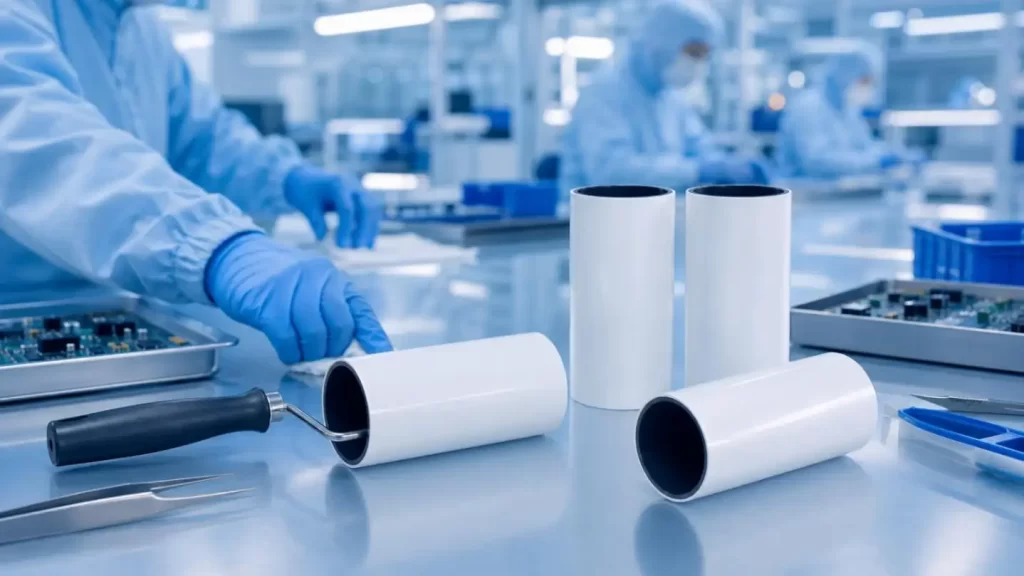
Surface-Only ESD vs. Full-Structure ESD
| Technical Point | Surface-Only ESD Roller | Full-Structure ESD Roller |
| Dissipative outer layer | Yes | Yes |
| Conductive / dissipative core | Not always | Designed into structure |
| Electrical continuity | Limited by construction | Maintained through roller |
| Main use | General ESD-controlled cleaning | Higher-risk electronics processes |
| Verification focus | Surface resistance | Surface + core + electrical path |
Nabai's Full ESD-Safe PP Sticky Roller follows the second approach. Its published design combines a carbon-based conductive core with a static-dissipative adhesive coating and manufacturing intended to maintain electrical continuity between the outer sheets and the core. Nabai lists the conductive core surface resistivity at 10⁶–10⁹ Ω/sq.
This design is intended for applications where cleaning performance and charge-control behavior must be considered together.
PP Construction Must Also Match the Cleaning Task
PP provides the structural base of this Nabai Cleanroom Consumables Sticky Roller, but material alone does not determine suitability.
The specification should be considered together with:
Roller Width
A wider roller covers more area per pass but may provide less maneuverability on narrow components or irregular fixtures.
Core Design
Core diameter and construction determine handle compatibility and, for ESD designs, can affect the electrical path.
Adhesive Layer
The adhesive formulation controls tack, particle pickup, peeling behavior and interaction with the cleaned substrate.
Refill Structure
Replaceable rolls allow the handle to remain in service while only the contaminated consumable is replaced.
This is why PP, tack, ESD performance and refill format should be specified as one system instead of four unrelated product features.
Match the Cleanroom Consumables Sticky Roller to Process Risk
ISO cleanroom classification alone should not determine roller selection. ISO 14644-1 classifies air cleanliness by airborne particle concentration; it does not specify a mandatory sticky-roller construction for each ISO class.
A more practical selection sequence is:
• PCB / SMT: prioritize particle pickup and controlled electrostatic behavior.
• Semiconductor: add tighter control of static, fine particles and material contamination.
• Optical / display: place more emphasis on low residue and surface compatibility.
• LED / coating: evaluate silicone-free construction where silicone contamination could affect downstream processing.
• General cleanroom surfaces: avoid over-specifying full ESD performance where the process does not require it.

Rolling Technique and Layer Replacement Affect Actual Performance
A technically correct Cleanroom Consumables Sticky Roller can still perform poorly if used incorrectly.
For stable cleaning:
• Confirm refill-to-handle compatibility before use;
• Roll with even pressure rather than forcing the adhesive against the surface;
• Avoid repeatedly rolling over already contaminated areas;
• Peel off the exposed layer when particle loading noticeably reduces pickup;
• Protect unused refills from open-air contamination;
• Use ESD rollers within the facility's established grounding and ESD-control procedure.
Nabai's Full ESD-Safe PP construction includes ESD verification during production, core and sheet resistivity testing, core traceability coding and manufacture under ISO Class 8 cleanroom conditions.
Sustainable Selection Should Focus on Consumable Efficiency
For a disposable Cleanroom Consumables Sticky Roller, sustainability should not be reduced to a claim such as "PP is recyclable."
A more useful procurement calculation is:
Cleaning Area per Refill → Layers Consumed → Refill Frequency → Reusable Handle Life → Packaging Volume
Reducing unnecessary layer changes, selecting the correct roller width and using reusable handles can improve material efficiency without weakening contamination control.
Build the Purchase Specification Around Measurable Risk
A professional Cleanroom Consumables Sticky Roller specification should follow this order:
Surface → Particle Type → Tack → Residue Sensitivity → Silicone Requirement → ESD Requirement → Roller Structure → Width/Core → Refill → Test Method → Batch Verification
This prevents purchasing decisions from being based only on terms such as "high tack," "anti-static" or "cleanroom grade."
For projects involving PCB, semiconductor, optical or other controlled manufacturing environments, Nabai can support selection around the actual cleaning surface, ESD requirement, adhesive behavior and roller structure. The goal is not to specify the most complex Cleanroom Consumables Sticky Roller, but to define the one that fits the contamination risk and process conditions with the least unnecessary compromise.
FAQs
Q1. How is Nabai's Full ESD-Safe PP Sticky Roller different from a regular sticky roller?
Nabai's Full ESD-Safe Sticky Roller is constructed with a carbon-based conductive core and an adhesive surface with dissipative static properties. This construction creates a charge dissipation path that is more continuous when compared with wrap-around anti-static layers.
Q2. What is the surface resistivity of Nabai's conductive roller core?
The surface resistivity of the conductive core of the Full ESD-Safe PP Sticky Roller is in the range of 10⁶–10⁹ Ω/sq. Prospective buyers are reminded to examine the test method and the batch data when incorporating the roller into a specific ESD control system.
Q3. In what contexts can Nabai's Cleanroom Consumables Sticky Roller be utilized?
Examples of use include PCB assembly, SMT production, production of optical equipment and components, as well as other production of semiconductor devices, LEDs and manufacturing activity in cleanrooms. The required roller structure depends on the sensitivity to ESD, the type of substrate, and the degree of contamination risk.
Q4. Does Nabai offer different Cleanroom Consumables Sticky Rollers?
Yes. In the construction of sticky rollers, Nabai offers the standards of PP and ESD safe PP, Full ESD Safe PP, and silicone free PP, from which prospective buyers can select regarding particle control, ESD and residue.
Q5. Is a higher-tack Cleanroom Consumables Sticky Roller always better?
No. Although a high level of tack may assist in the capture of particulate that strongly adheres to a substrate, this may cause problems with sensitive films, coatings and optical surfaces. Nabai recommends that the level of tack be tailored to the type of surface and the nature of the contamination.
NEWS
GET SERVICE
With quality parts to meet every budget and friendly staff trained to make your visit informative and hassle free.