
cleanroom contamination control

cleanroom contamination control
Where precision, safety and product quality are critical, contamination control is not a suggestion, it's a requirement. Cleanrooms offer a controlled environment that limits the amount of contaminants that can affect the product, decrease yields or cause patient risk in pharmaceutical manufacturing and biotechnology, semiconductor manufacturing, medical device assembly, and more.
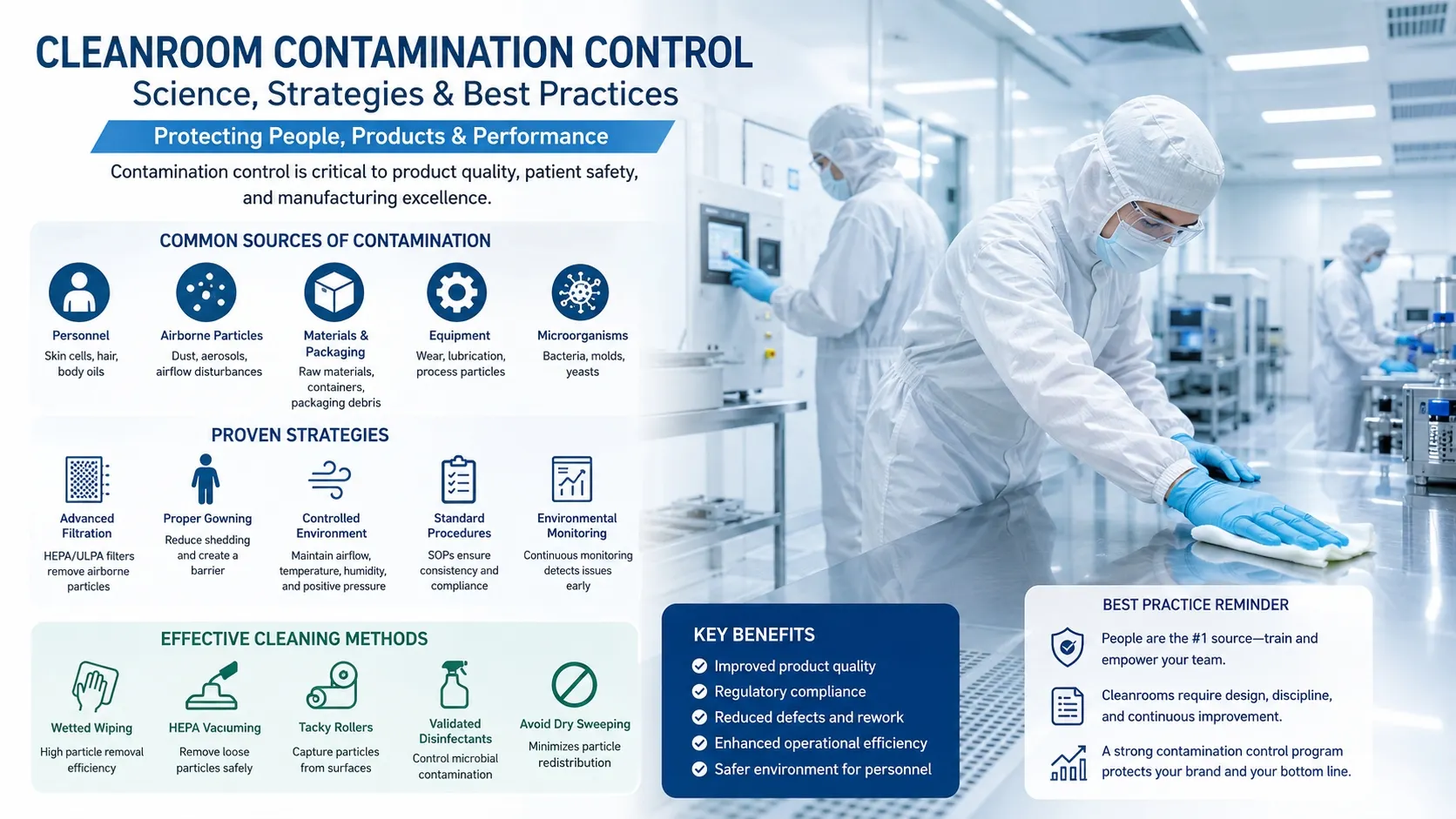
Good cleanroom contamination control involves knowledge and science, facility design, proper training and knowledge of cleaning procedures, and the actual cleaning process. Comprehensive contamination control programs can enhance operational efficiencies, ensure regulatory compliance and help ensure product integrity. Industry and research has been consistent on the sources of contamination in controlled areas, and they are personnel, airborne particles, fibers and residues.
This guide examines the science of contamination, covers common sources of contamination, and details some of the best practices for keeping a cleanroom high performing.
What Is Cleanroom Contamination?
Contamination in a cleanroom is any unwanted particle, microorganism, fiber, chemical residue or airborne polluter in a controlled environment. Sensitive manufacturing processes can be impacted by even the smallest of contaminants.
Examples include:
- Dust particles
- Human skin flakes
- Hair and fibers
- Microorganisms
- Chemical residues
- Process-generated particles
- Packaging debris
Depending on the cleanroom classification and industry, the acceptable level of contamination may vary. In semiconductor manufacturing plants, the required particle counts can be extremely low and in cleanrooms used within the pharmaceutical industry, there is a need to deal with microbial contamination risks as well.
Why Contamination Control Matters
Contamination could have an impact on several industries.
Pharmaceutical Manufacturing
Sterile products may be contaminated causing regulatory nonconformances, product recalls and/or patient safety issues.
Semiconductor Manufacturing
The small size of the particles pose a risk to integrated circuit manufacturing and to the manufacturing of wafers, which can result in defects and lower yields.
Medical Device Production
Product performance, reliability and regulatory compliance can be affected by contaminants.
Aerospace and Advanced Manufacturing
Foreign particles have the potential to impact component accuracy and longevity.
Therefore, contamination control is considered as a critical task of Quality Management and not merely cleaning.
Major Sources of Cleanroom Contamination
Understanding contamination sources is the foundation of any effective control strategy.
1. Personnel
In most clean rooms, human contamination is the greatest source of contamination. During the process of normal motion and activity, humans constantly shed skin cells, hair, and microorganisms. Manpower is always seen as the main source for contamination events, according to industry experts.
Examples of common sources of contamination related to personnel are:
- Improper gowning
- Excessive movement
- Touching critical surfaces
- Poor hygiene practices
- Incorrect material handling
2. Airborne Particles
Particles are introduced into facilities via ventilation, open doors, equipment operation and transfers of materials.
If not filtered and controlled, contaminants may deposit themselves on products, equipment and work surfaces. Airborne particle removal and maintaining cleanliness standards is widely accomplished with HEPA and ULPA filtration systems.
3. Materials and Equipment
Raw materials, packaging, tools and equipment may be a source of contamination if they are not cleaned and brought into the clean room space.
Material transfer procedures are therefore crucial parts of contamination control programs.
4. Facility Design Issues
Contamination hotspots and ineffective environmental control can occur when facilities are not designed properly, there are inadequate airflow patterns, and facilities are not maintained properly.
The Science Behind Particle Adhesion
Particles don't just lie around on surfaces, one of the difficulties in contamination control is this. Contaminates stick tightly together by various physical forces.
These forces include:
- Electrostatic attraction
- Van der Waals forces
- Gravity
- Moisture-induced adhesion
- Surface tension effects
These adhesion mechanisms make it difficult to remove contamination; sometimes more than air can be blown across a surface or dry cleaning can be done. To reliably remove the necessary particles, these forces must be overcome with the use of effective cleaning techniques.
Most Effective Cleanroom Cleaning Methods
The best cleaning will be provided by methods that have been researched and proven to be effective in the field, from industry experience.
Dry Wiping
Dry wiping will pick up some visible contamination but will likely not remove it entirely.
Air Blow-Off
Particles can be dislodged by compressed air, but it can also be a way of spreading contamination to other places.
Tacky Rollers
Larger particles from floors, garments and selected surfaces can be effectively removed using adhesive rollers.
Vacuum Cleaning
Loose contaminants can be effectively removed by HEPA-filtered vacuum systems, and are commonly employed for facilities maintenance.
Wetted Wiping
Research suggests that wetted, non-shedding wipes remove particles and retain them during the cleaning process which leads them to be some of the most effective wipes at removing particles. Therefore, it is important to select the right wipe for the right application in the cleanroom.
Best Practices for Cleanroom Contamination Control
Establish Standard Operating Procedures (SOPs)
Every cleanroom should operate under documented procedures covering:
- Gowning requirements
- Cleaning schedules
- Material transfer processes
- Equipment maintenance
- Environmental monitoring
Consistency is one of the most important factors in contamination prevention.
Implement Proper Gowning Protocols
Protective garments act as a barrier between personnel and the controlled environment.
Recommended apparel may include:
- Coveralls
- Gloves
- Face masks
- Hair covers
- Shoe covers
- Goggles
Proper gowning significantly reduces particle generation from personnel.
Maintain Positive Air Pressure
There are many types of cleanrooms that are run at positive pressure. This design allows air to flow outwards from the controlled area, which helps to prevent unconditioned air from entering the conditioned area when doors open.
Use HEPA and ULPA Filtration
The advanced filtration systems that are used continuously remove airborne particles and will maintain the required ISO cleanliness classifications.
Laminar airflow design coupled with filtration systems provide a controlled environment that helps to reduce the risk of contamination.
Control Material Transfer
All materials brought into the cleanroom must be inspected, cleaned and approved for entry.
Airlocks, pass through areas and designated transfer stations can minimize contamination from outside areas.
Conduct Regular Environmental Monitoring
Monitoring programs should evaluate:
- Airborne particle counts
- Surface cleanliness
- Microbial levels
- Temperature
- Humidity
- Differential pressure
Environmental monitoring helps identify trends before contamination becomes a serious issue.
Employee Training: The Human Factor
Technology alone cannot maintain a cleanroom. Employee behavior plays a crucial role in contamination control success.
Training programs should focus on:
- Correct gowning procedures
- Proper cleaning techniques
- Material handling protocols
- Cleanroom behavior standards
- Contamination awareness
Organizations that foster a culture of cleanliness often achieve more consistent contamination control results than those relying solely on equipment and procedures.
Future Trends in Cleanroom Contamination Control
As manufacturing technologies become more advanced, contamination control programs are evolving.
Emerging trends include:
- Real-time particle monitoring
- Automated cleaning systems
- Data-driven environmental monitoring
- Smart facility management platforms
- AI-assisted contamination analysis
- Enhanced cleanroom materials and surface technologies
These innovations help facilities achieve greater process reliability while reducing operational costs.
Conclusion
Cleanroom contamination control is a science involving many disciplines including engineering, microbiology, facility management and human behavior. The first step in successful contamination prevention is to identify the source of contamination and to take steps that will address the human factors, materials, air movement, and cleaning process.
Organizations can achieve and sustain a high standard of cleanroom performance, enhance product quality, and comply with increasingly stringent industry standards through the effective design of facilities, validated cleaning procedures, training of personnel, environmental monitoring, and continuous improvement.
With the precision driven and highly regulated nature of many industries today, contamination control has become a critical competitive advantage that cannot be overlooked as it influences the quality of products and services, compliance, and overall operational performance.
NEWS
GET SERVICE
With quality parts to meet every budget and friendly staff trained to make your visit informative and hassle free.