
Cleanroom Roller for Cosmetic Labs: Choose the Right Adhesive Level (200D–1500D) for 4 Scenarios

Cleanroom Roller for Cosmetic Labs: Choose the Right Adhesive Level (200D–1500D) for 4 Scenarios
Cleanliness in cosmetic product labs is about ensuring product balance, correct color, and microbiological safety. Contaminants come in various forms, from pigments to airborne fibers, even tiny particles can compromise an entire cosmetic product batch. Therefore, the Cosmetic Lab Cleanroom Roller is necessary cleaning equipment. However, there are various types of adhesive rollers, and one extremely important, but often overlooked, factor is adhesive strength, measured in g per 25mm (g/25mm) and typically falls between 200D to 1500D.
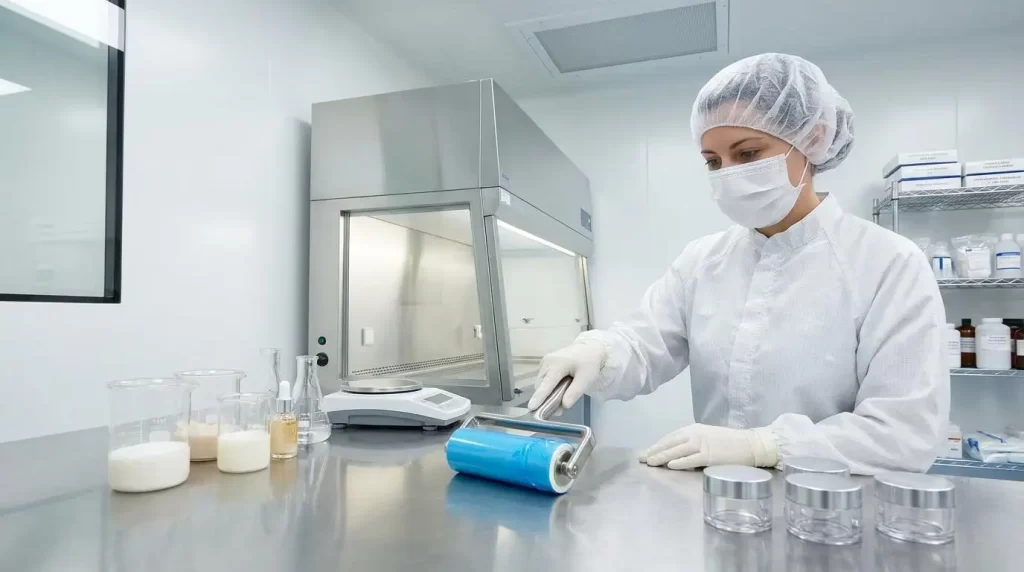
In this article, four common contamination situations and their adhesive requirements are defined and explained, along with the engineering aspects of the No-Knife PP Sticky Roller manufactured by Nabai.
What Do 200D–1500D Mean? Adhesive Requirements
Adhesive strength is defined as the amount of force required to peel sticky sheets off from a defined test surface. A value within the range of (200D-400D) indicates low strength and an ability to clean efficiently. While a value in the range of (1300D-1500D), indicates a strong material with an enhanced cleaning ability. Careful selection of those values will not damage surfaces, leave spots, or provide a subpar cleaning experience.
•Low (200D-400D): Accepted for less dusty, more fragile surfaces.
•Medium (500D-800D): Accepted for typical lab surfaces and powder debris.
•Medium-High (900D-1200D): Accepted for sticky and/or oily mixed solid contamination.
•High (1300D-1500D): Accepted for tough, sticky contamination (e.g. dried slurry, silicone oils).
Scenario 1: Precision Balances and Microscope Stages
Recommended adhesive level: 200D–400D
In cosmetic labs, active ingredients like hyaluronic acid and retinoids, as well as raw material crystals, are often examined under the microscope. Weighing them requires the use of precision balances. Both of these machines contain delicate surfaces that can be damaged, or made unbalanced, by excessive tack.
•Why low tack? High tack can either remove calibration stickers or leave behind a residue on metal plates that are polished.
•About: Typical lab contaminants that can be found in the air are talc and starch. Fibers from lab coats (with a common size of 5-50µm) are also an example of such contamination.
•Roller requirement: for a cosmetic lab a cleanroom roller with 200D-400D adhesive collects dust with minimal impact to the mechanism.
✅ Nabai advantage: The No-Knife PP Sticky Roller has a low constant tack, allowing it to achieve particle collection across the entire 20m length.
�� Tip: Use a white roller, dust collection will have a high contrast against a white background, making it easy to see when looking through a microscope.
Scenario 2: Laboratory Benches and Fume Hoods (Daily Powder Spills)
Suggested adhesive level: 500D-800D
Everyday lab tasks lead to a mixture of contaminations (fine powders and liquid residue). Some of these tasks include sieving pigments or weighing mica, and handling serums, and even some tasks done by hand. Tack needs to be medium to allow the removal of debris without spreading residue.
•Why medium tack? Lower than 500D may slide over compacted powder; higher than 800D can pull paint from aged bench surfaces.
•Common contaminants: Iron oxides, titanium dioxide, glitter flakes, and dried emulsion splashes.
•Roller requirement: A 500D–800D roller quickly cleans 0.5 m² per second, matching the pace of formula development.
•Operational benefit: Nabai's perforation technology allows tool-free sheet removal — pull the soiled sheet at a 45° angle, and the next layer is instantly ready. No scissors, no knife blades that could introduce metal fragments into open beakers.
�� Data point: With an 80µm thickness and low-lint PP material, the roller reduces loose fiber spread by approximately 70% compared to standard lint-free wipes.
Scenario 3: Filling Needles, Homogenizer Shafts, and Pump Tubes
Recommended adhesive level: 900D–1200D
These parts contact semi-solid formulations (foundations, lip gloss bases, emulsions). Contaminants include sticky waxes and silicone oils, in addition to partially dried product films. Medium-to high-tack is required to break the surface tension.
•Why medium-to high-tack? Oily films decrease contact efficiency. Partials with high adhesion (≥900D) are able to penetrate the oily films and contact the encapsulated particles.
•Common impurities include: Residues of cetyl alcohol, dimethicone, and micronized pigments which exhibit shear thickening.
•Roller requirement: A Cleanroom Roller for Cosmetic Labs with 900D–1200D can be used alone or in conjunction with a silicone sticky roller — first use the silicone roller to lift bulk oil, then the PP roller to capture remaining dry specs.
•Nabai design feature: The polypropylene core with a smooth-rolling ball bearing mechanism ensures even pressure, so the high-tack layer does not bunch up or leave adhesive transfer on stainless steel shafts.
⚠️ Caution: Always verify residue-free performance. Nabai's pressure-sensitive acrylic adhesive is formulated for non-transferring use, meaning it leaves no ghosting on 316L stainless steel or PTFE surfaces.
Scenario 4: New Equipment Surfaces and Removal of Mold Release Agents
Adhesive recommendation: 1300D–1500D
New equipment arrivals — homogenizers, mixing tanks and filling nozzles — can have a variety of mold release agents, anti-friction oils and protective wax coatings. These contaminate the first production batch and must be completely cleaned off.
•Why high tack? Release agents form a low-energy surface and only strongly bonded (≥ 1300D) adhesives can lift them away without the use of solvents.
•Typical contaminants: silicone sprays, paraffin wax, metalworking fluids.
•Roller requirement: A high tack cleanroom roller supports IPA wipes as a dry degreasing step.
•Efficiency: A 1500D roller of 20m length can prepare a filling table that is 1.3m wide and draw the table to a state of GMP compliance in under 2 mins.
✅ Recommended procedure: A surface energy test (contact angle of water) measurement should be performed following the use of a high tack roller. A surface should have a measurable angle of > 70° for hydrophobic surfaces and > 30° for a clean surface of a hydrophilic nature. Nabai rollers have been validated to not alter these measurements.
Why Nabai's No-Knife PP Sticky Roller Excels Across All Adhesive Levels
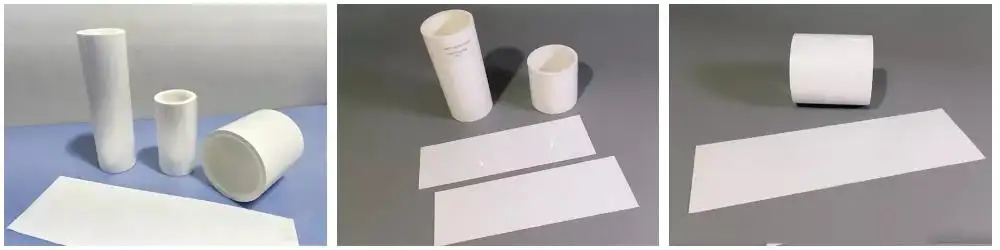
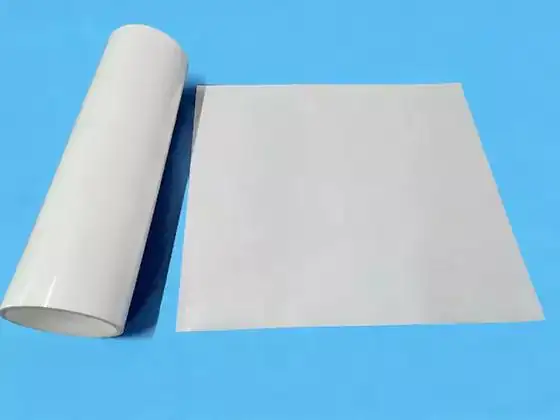
Regardless of which adhesive tier you choose (200D to 1500D), the underlying tool must support fast, safe, and consistent operation. The No-Knife PP Sticky Roller from Nabai offers the following laboratory-friendly features:
•Tool-free sheet removal: Precision laser-cut micro-perforations allow instant tearing by hand — no blades, no cuts, no metal debris near your formulations.
•Stable particle collection: The uniformly coated acrylic adhesive captures dust, fibers, and fine debris with a smooth rolling action, minimizing re-aerosolization.
•Low-lint PP material: Spread of loose fiber is mitigated with a PP construction, which is important in sterile cleanroom zones ISO 5–7, which are necessary for filling sterile cosmetics.
•Multiple Width Choices: Widths from 650mm to 2000mm suit small laminar flow workstations and large production sheets alike.
•Custom colors for line segregation: Use of white is for cleanroom approved items, blue is for non-restricted use, with a color coding system for production lines indicated with pink for lip products and green for skin care products.
•Shipping consideration: With a core size of 38/51/76mm and packing variations, such as 9 pcs/ctn of the 38mm, Nabai helps inventory control problems for cosmetic production line operations with multiple daily shifts.
Final Recommendation: Develop Your Adhesive Level Plan
There is no one size fits all for any contamination control situation with rollers. To improve the benefits of your Cleanroom Roller for Cosmetic Labs:
•Do a surface audit: note what contamination is likely and what equipment is in use.
•Allocate adhesive levels: low for precision equipment, moderate for work surfaces and equipment with contamination from oil, and high for equipment which is brought in for immediate use.
•Color coding system: for high tack rollers used for visible particle checks, white is used, and blue is for rollers used for routine checks and cleaning.
Train employees to use rollers at a 45° angle: pulling downward tears the sheet cleanly and prevents jamming in the mechanism.
By using the appropriate adhesive level for the type of contamination, the particle contamination failure of production batches can be reduced and equipment contamination can be controlled while retaining the necessary standards of cleanliness for regulatory compliance. The Nabai No-Knife PP Sticky Roller, with the low-lint PP, no-tool perforation, and a large range of adhesive options, helps allow this type of program to be implemented.
Do you want to optimize your lab for surface cleaning? Get a custom quote for tailored widths, adhesive levels, and color coding to fit your needs.
Frequently Asked Questions
Q1: Can powder and liquid spill roller pads be the same?
Yes, however for oily or wet residues we recommend a stronger adhesive (900D-1500D) for effective pick up.
Q2: Does the No-Knife PP Sticky Roller leave any residue?
The No-Knife PP Sticky Roller does not leave residue. The acrylic adhesive will pickup residue and will not leave any residue on the lab surfaces of stainless steel and glass.
Q3: Can I sterilize the roller for use in aseptic cosmetic filling?
The PP material and adhesive can tolerate gamma irradiation or EtO sterilization; consult Nabai for validated cycles.
Q4: Is 200D too weak for cleaning a homogenizer shaft?
Yes. For shafts with dried product or oil, use at least 900D; reserve 200D–400D for delicate balances and microscopes.
Q5: How do I store the roller between uses?
Store vertically via the handle's hanging hole or place on a clean, dry surface away from solvents and high humidity.
NEWS
GET SERVICE
With quality parts to meet every budget and friendly staff trained to make your visit informative and hassle free.