
Cleanroom Roller Selection Guide: ESD-Safe vs. Conductive vs. Dissipative – What's the Difference?

Cleanroom Roller Selection Guide: ESD-Safe vs. Conductive vs. Dissipative – What's the Difference?
Choosing the right Cleanroom Rollers for the assembly of sensitive electronics is beyond mere dust removal. It is about controlling electrostatic discharge (ESD) without damaging components. Many engineers struggle with terms like "ESD-safe", "conductive", and "dissipative". Are they the same? Can any of them work in a cleanroom? This guide explains the differences in plain language, helping you select Cleanroom Rollers that truly protect your products.
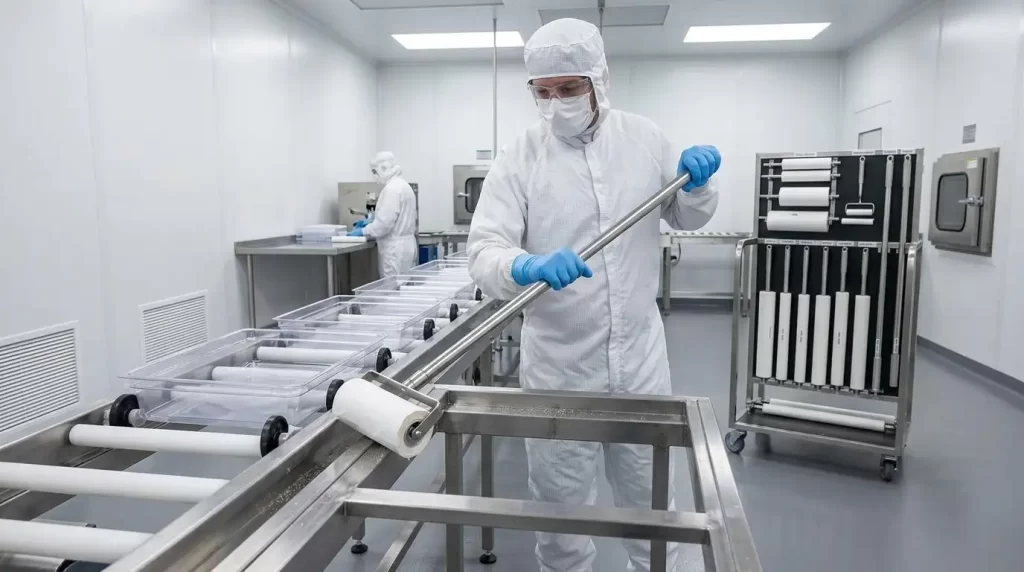
Why Static Control Matters in Cleanroom Cleaning
Static electricity can destroy microchips, contaminate wafers, or cause latent failures. A simple cleaning stroke with the wrong roller may generate thousands of volts. That is why Cleanroom Rollers are classified by their electrical resistance. Understanding these classes is the first step to preventing ESD damage.
• ESD damage is often invisible: A component may pass final test but fail weeks later due to hidden electrostatic stress.
• Friction during cleaning is responsible for charging: things like tearing apart sticky sheets and even just walking around generate different triboelectric charges.
• Safe roller materials facilitate safe charge release: a good level of resistance slows down charge release and prevents the discharge from being too sudden.
Three Main Electrical Classes in Relation to Cleanroom Rollers
Three main electrical classes have been adopted by international standards (ANSI/ESD S20.20, IEC 61340-5-1), based on surface resistivity (ohms per square), for cleanroom rollers. Each class behaves differently when grounded.
1. Conductive Cleanroom Rollers (10³ – 10⁵ Ω/sq)
These materials usually have carbon black, promoting faster movement of electrons.
• Very low surface resistivity: When these materials are used for the grounding pathway, the static discharge is almost immediate.
• Very fast discharge: If a charged object touches a conductive roller, very rapid discharge could damage sensitive circuit components.
• It is usually found in: Floor mats, grounding straps, or any surface that will not be used in contact with ESD-sensitive items.
2. Dissipative Cleanroom Rollers (10⁶ – 10⁹ Ω/sq)
Dissipative materials handle charge transfer in a safe manner; therefore, they are in the perfect range for Cleanroom Rollers that come in contact with PCBs, wafers, and medical devices.
• Static can still discharge, but in this case it will take longer to do so, preventing the formation of sparks.
• Examples include: Pink polypropylene, many ESD-safe plastics, and adhesive rollers with embedded conductive particles.
• Most cleanroom ESD standards require dissipative surfaces where operators handle components.
3. Insulative / Antistatic (Above 10¹¹ Ω/sq)
Antistatic materials reduce triboelectric charging but do not drain existing charge. They are not truly ESD-safe for grounded environments.
• No conductive path: A standard antistatic roller cannot discharge a charged component or work surface.
• May allow static accumulation: The surface itself resists charging, but any existing voltage remains.
• Suitable only for low-risk areas: For example, holding non-sensitive parts or packaging.
• Do not confuse with dissipative: Antistatic does not meet ESD control program requirements for direct cleaning.

ESD-Safe – The Overarching Term
"ESD-safe" is not a single resistance value. It is a system-level claim meaning the product, when used correctly, does not cause or permit ESD damage. Both conductive and dissipative materials can be ESD-safe under the right conditions.
• For Cleanroom Rollers, "ESD-safe" usually implies dissipative range (10⁶ – 10⁹ Ω/sq): This offers the best balance between static removal and component protection.
• A truly ESD-safe roller must also have a conductive core and handle: Surface-only treatment leaves the inner layers ungrounded, creating a hidden capacitor.
• Compliance requires continuity from outer adhesive to the operator's ground: Any break in the path makes the roller unsafe.
The Hidden Weakness of Traditional ESD Rollers
Many standard Cleanroom Rollers claim ESD protection but only treat the outer sticky sheets. The cardboard core and handle remain insulative. This leads to the "last inch" problem.
• Only the adhesive layer is dissipative: The inner core can store a static charge like a capacitor.
• When the roller is tilted or the sheet is partially peeled: The conductive layer may lose contact with ground, and the core discharges through the component.
• This hidden risk causes intermittent ESD failures: Operators blame handling, not the roller.
Full ESD Protection – What to Look for in a Cleanroom Roller
A truly safe roller must have electrical continuity from the outermost sheet to the handle and through the core. This is where Nabai's design leads the industry.
Introducing Nabai's Full ESD-Safe PP Sticky Roller
Nabai has developed a Full ESD-Safe PP Sticky Roller that delivers continuous static dissipation across the entire roller structure. Every part – adhesive, core, and handle – works together to reduce unwanted static buildup.
• Complete static dissipation: Conductive materials thr all through the roller structure, eliminating the "last inch" problem.
• Effective Remover of Contaminants: The adhesive layer of the roll removes dust, fibers and debris, leaving no residue on the cleanroom surfaces.
• Clean peeling: The sheets eject cleanly, without leaving any adhesive residue.
Core technology – Dual-layer ESD Protection
Nabai's roller is not limited to surface treatments. It comprises two built-in ESD layers:
• Conductive core construction: The cardboard tube is integrated with carbon-based material, and maintains the surface resistivity of the ideal range of 10⁶–10⁹ Ω/sq.
• Static-dissipative adhesive layer: The sheets contain conductive particles that form a charge dissipation pathway.
• Complete electrical path: Forming a complete pathway of current from the outer sheets to the core and handle is achieved by special fabrication.

Importance of Full-Structure ESD Design in Your Cleanroom
Using Cleanroom Rollers with complete ESD design impacts compliance and yield significantly. Compared to surface-only or conductive-only rollers, Nabai's design gives tangible benefits.
Performance Benefits
• Complete protection: No hidden source of static offering protection from the "last inch" problem, which is a common failure among traditional rollers.
• Consistent protection: The ESD properties are preserved to the last sheet, unlike coated rollers that wear off.
• Static protection: No static accumulation from partial ESDs.
• Validated ESD compliance: Meet the most comprehensive ESD procedures and standards (ANSI/ESD S20.20, IEC 61340-5-1).
• Inventory savings: Consolidating a variety of partial protection products into a single product.
Maintaining Cleanroom Standards
• Our in-house and field studies show a reduction in ESD related defects of up to 95% when compared to ESD rollers which work with the surface only.
• No adapters are necessary for compatibility with grounded workstations and personal grounding devices.
• Visual Confirmation: Distinctive black conductive core aids identification of ESD ability for audits.
• No special handling or preparation: Use similarly to a standard sticky roller only with complete safety.
• Effective in low humidity environments (15-20% RH): Where many antistatic products cease to work, the reliable internal conductive path of Nabai persists.
How to Choose the Right Cleanroom Roller – A Simple Decision Guide
| If your process involves… | Recommended roller type | Why |
| Direct contact with bare ICs, wafers, or medical devices | Dissipative (10⁶–10⁹) with full-structure ESD (Nabai style) | Safe discharge + no spark risk |
| Cleaning floors or grounded workbench frames | Conductive (10³–10⁵) | Fast ground path, no direct component contact |
| Non-sensitive packaging or general dust removal | Antistatic or even standard roller | Lower cost, minimal risk |
| Any cleanroom with electronics assembly | Full ESD-Safe PP Sticky Roller (dissipative + continuous core) | Eliminates hidden core static |
Real-World Applications of Nabai's Full ESD-Safe Roller
Nabai's design is trusted in industries where static damage is costly:
• PCB manufacturing: Cleaning circuit boards during assembly and inspection without latent ESD defects.
• Semiconductor handling: Protecting wafers and chips in ISO Class 5–8 cleanroom environments.
• Medical device assembly: Keeping implantables and diagnostic electronics in sterile, static-free environments.
• Aerospace electronics: Prevention of ESD damage to avionics which are particularly sensitive due to their required high levels of reliability.
• Automotive electronics: Protection of control modules from field failures (ADAS, ECUs).
Quality Assurance – Traceability You Can Count On
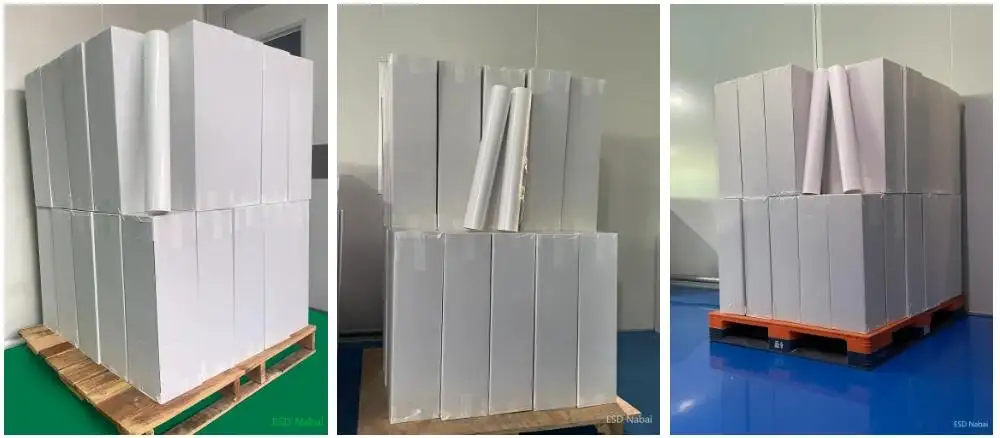
Nabai produces each and every Full ESD-Safe PP Sticky Roller under rigid quality controls.
• No guesswork – we have each batch independently tested for ESD performance.
• During production, core and sheet resistivities are measured to confirm a consistent level of 10⁶–10⁹ Ω/sq.
• Traceability coding on every core: Allows quality tracking from raw material to final use.
• Manufactured in ISO Class 8 cleanroom conditions: The roller itself does not introduce particles or fibers.
Conclusion: Match the Class to Your Risk
Not all Cleanroom Rollers are equal. Conductive rollers drain static too quickly for direct part contact. Antistatic rollers do not drain at all. Dissipative rollers (10⁶–10⁹ Ω/sq) are the safest choice for cleaning sensitive electronics – but only if the entire structure, including the core and handle, is dissipative. Nabai's Full ESD-Safe PP Sticky Roller delivers exactly that: complete, continuous, and verifiable ESD protection from the first sheet to the last. When you select Cleanroom Rollers for your PCB, semiconductor, or medical line, make sure they protect every inch – not just the surface.
For more technical specifications or to request a sample, contact Nabai directly.
FAQs
Q1: Why does the roller core matter for ESD protection?
A: An insulative core can store static and discharge it through components – full-structure ESD prevents that hidden risk.
Q2: How do I verify if my cleanroom roller is truly dissipative?
A: Measure surface resistivity from outer sheet to core/handle – it should read 10⁶–10⁹ Ω/sq with a megohmmeter.
Q3: Can Nabai's Full ESD-Safe roller work in low humidity (below 20% RH)?
A: Yes – its carbon-impregnated core and internal conductive particles provide humidity-independent ESD performance.
Q4: Does every layer of a full ESD roller stay dissipative until the last sheet?
A: Yes – Nabai's design maintains 10⁶–10⁹ Ω/sq throughout, unlike surface-coated rollers that wear off.
Q5: What industries require dissipative cleanroom rollers?
A: Semiconductor, PCB assembly, medical devices, aerospace avionics, and automotive electronics – any ESD-sensitive environment.
NEWS
GET SERVICE
With quality parts to meet every budget and friendly staff trained to make your visit informative and hassle free.