
Cleanroom Sticky Mat: Selection, Installation & Best Practices for Contamination Control

Cleanroom Sticky Mat: Selection, Installation & Best Practices for Contamination Control
Cleanroom sticky mats are one of the simplest and most cost-effective tools for controlling contamination at the entrance of critical environments. As production tolerances tighten and regulatory expectations rise across industries like electronics, pharmaceuticals, EV batteries and medical devices, the role of a properly selected and maintained sticky mat has become more important than ever.
This page explains what cleanroom sticky mats are, how they work, how to choose the right mat for your application, and how to install and maintain them according to current best practices and market trends.
What is a cleanroom sticky mat?
A cleanroom sticky mat (also called tacky mat, adhesive mat or contamination control mat) is a low-profile mat composed of multiple peel-off adhesive layers. It is typically placed at the entrance of a cleanroom or controlled area so that dust, dirt, and particles are captured from shoe soles and cart wheels before they enter the critical zone.
Each layer of the mat is coated with a pressure-sensitive adhesive. When the surface becomes visibly contaminated or loses its tack, the top layer is peeled away to reveal a fresh layer underneath. This makes sticky mats a disposable, low-maintenance solution for reducing foot-borne contamination.
Core functions of a cleanroom sticky mat:
- Capture particles from footwear and wheels
- Reduce cross-contamination between areas of different cleanliness levels
- Complement other contamination control measures (cleanroom garments, air showers, HEPA filtration, etc.)
- Support compliance with cleanroom and GMP procedures
Why cleanroom sticky mats matter in 2024
Several trends have increased demand for reliable contamination control at the floor level:
- Miniaturization in electronics and semiconductors has made processes more sensitive to micron-sized particles carried in from outside areas.
- Growth of EV and lithium battery manufacturing demands more stringent particle and metal contamination control in dry rooms and production lines.
- Stricter regulatory focus in pharmaceutical, biotech and medical device manufacturing (e.g., data-driven contamination monitoring, Annex 1 updates in Europe) puts more emphasis on robust, documented entry procedures.
- Hybrid layouts and multi-purpose facilities mean more traffic between low-grade and high-grade areas, raising risk of cross-contamination.
- Increased awareness of total cost of ownership has driven companies to reconsider simple, preventive tools like cleanroom sticky mats that avoid expensive cleaning and unplanned downtime.
Within this context, cleanroom sticky mats remain a cost-efficient way to cut down particle migration, especially when combined with proper gowning protocols and regular floor cleaning.
How cleanroom sticky mats work
The basic principle
The working principle of a cleanroom sticky mat is straightforward:
- Placement in the traffic path
The mat is positioned so that staff and carts must walk over it before entering the clean zone. - Contact with the adhesive surface
When shoe soles or wheels pass over the mat, the adhesive surface grabs and holds loose particles such as dust, fibers, hair, and small debris. - Layer removal
Once the top layer is saturated or becomes less sticky due to buildup, it is peeled away, exposing a new clean and adhesive layer underneath. - Continuous performance
By regularly removing layers, the mat maintains a consistently high particle capture efficiency.
Key performance factors
Several technical aspects affect the performance of a cleanroom sticky mat:
- Adhesive strength
Needs to be high enough to capture particles, but not so high that it leaves residue on shoes or wheels. Quality mats are designed to balance tack and cleanliness. - Surface finish
A smooth and even surface ensures full contact under the entire shoe sole; some mats have micro-embossed surfaces for better coverage without trapping liquids. - Layer count
Common configurations include 30-layer and 60-layer mats. More layers mean less frequent replacement of the entire mat but can increase thickness. - Material and backing
Most mats use polyethylene film layers with a non-slip backing or frame to keep the mat in place and prevent curling.
Types of cleanroom sticky mats
Different industries and facilities require different mat configurations. Below are the main categories and their typical uses.
1. Peel-off multi-layer sticky mats
These are the most widely used type in cleanroom environments.
Features:
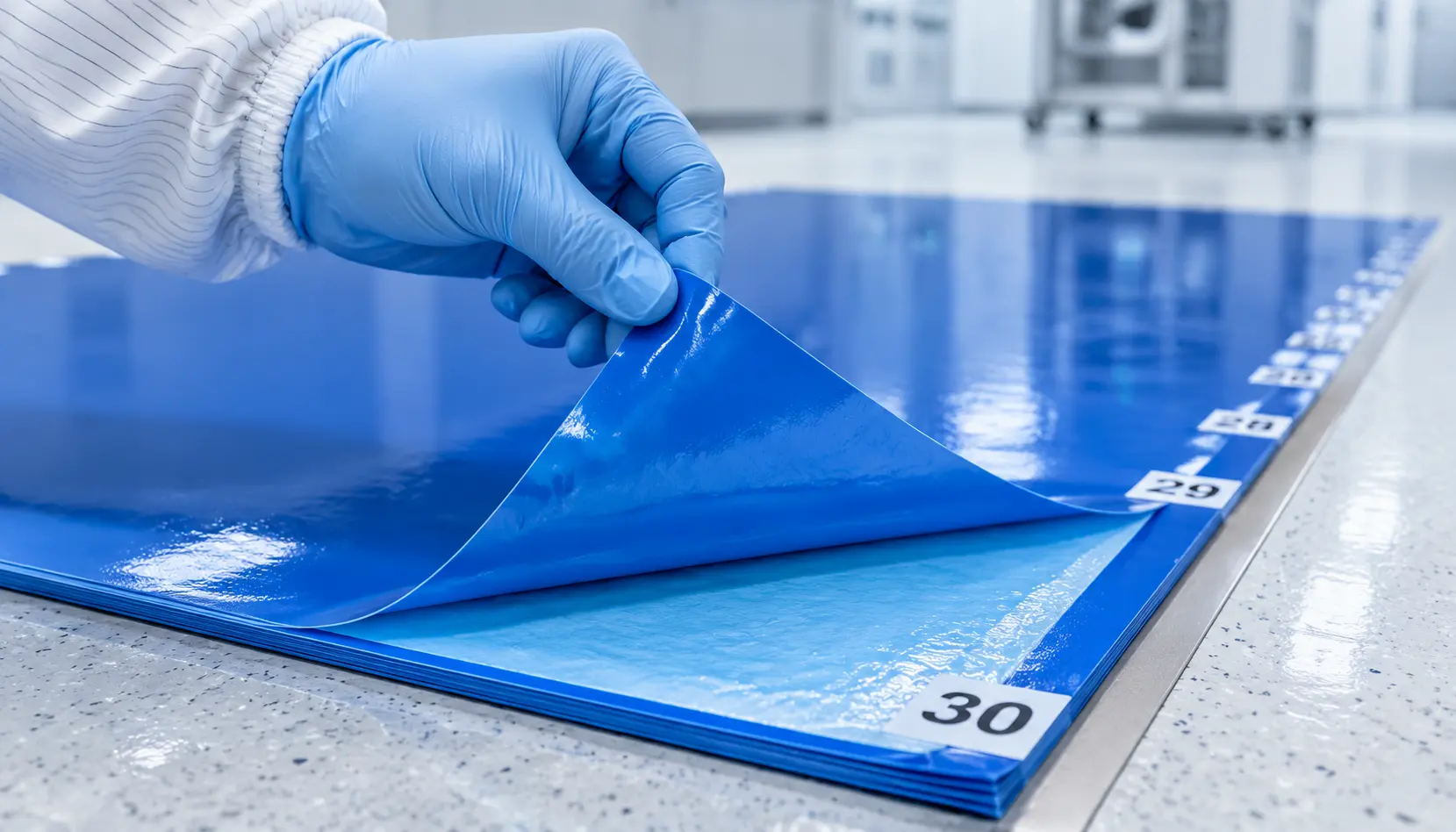
- Multiple numbered peel-off layers (e.g., 30 or 60)
- Uniform adhesive coating on each layer
- Non-slip backing for stable placement
- Designed for easy visual inspection and quick layer changes
Typical applications:
- Cleanroom entrances (ISO 3–8)
- Gowning rooms and airlock transitions
- Pharmaceutical packaging areas
- Electronics assembly and SMT lines
- Medical device production zones
2. Reusable / washable tacky mats
Reusable contamination control mats are made from polymeric materials that can be cleaned and reactivated using specific cleaning agents.
Features:
- No disposable layers; the mat surface is washed on a set schedule
- Higher upfront cost, lower solid waste output
- Require defined cleaning procedures and compatible detergents
Typical applications:
- Facilities with sustainability goals to reduce disposable waste
- Sites with predictable, moderate traffic volumes
- Areas where maintenance staff can support regular cleaning routines
3. Sticky mats for special environments
Some sticky mats are designed for specialized conditions:
- ESD-safe sticky mats for electronics and semiconductor environments that require electrostatic discharge control.
- Antimicrobial treated mats for certain healthcare or laboratory environments where microbial load on surfaces is a concern.
- High-temperature tolerant mats for specific industrial applications (though most standard mats are used at ambient temperature zones).
Key selection criteria: How to choose the right cleanroom sticky mat
With many products on the market, selecting the right cleanroom sticky mat involves balancing performance, durability and cost, while matching your cleanroom classification and traffic patterns.
1. Cleanroom class and industry requirements
Your cleanroom classification (e.g., ISO 5, ISO 7, ISO 8) and industry (pharma, micro-electronics, optics, food, etc.) influence mat selection.
- Higher-class cleanrooms (ISO 3–5)
Prioritize low shedding, high-quality films and consistent adhesive performance. Typically use mats at every critical entry, sometimes in series. - Mid-class cleanrooms (ISO 6–8)
Can use standard multi-layer mats with verified particle retention efficiency. Often integrate mats into broader SOPs with floor cleaning and gowning. - GMP and regulated environments
Require documented change schedules and traceability. Numbered layers and recorded layer removal help support audit trails.
2. Size and layout
Selecting the correct size and placement is critical for effectiveness.
Guidelines:
- The mat should be long enough to allow at least two full steps with each foot (often 1.2–1.8 m / 4–6 ft in the walking direction).
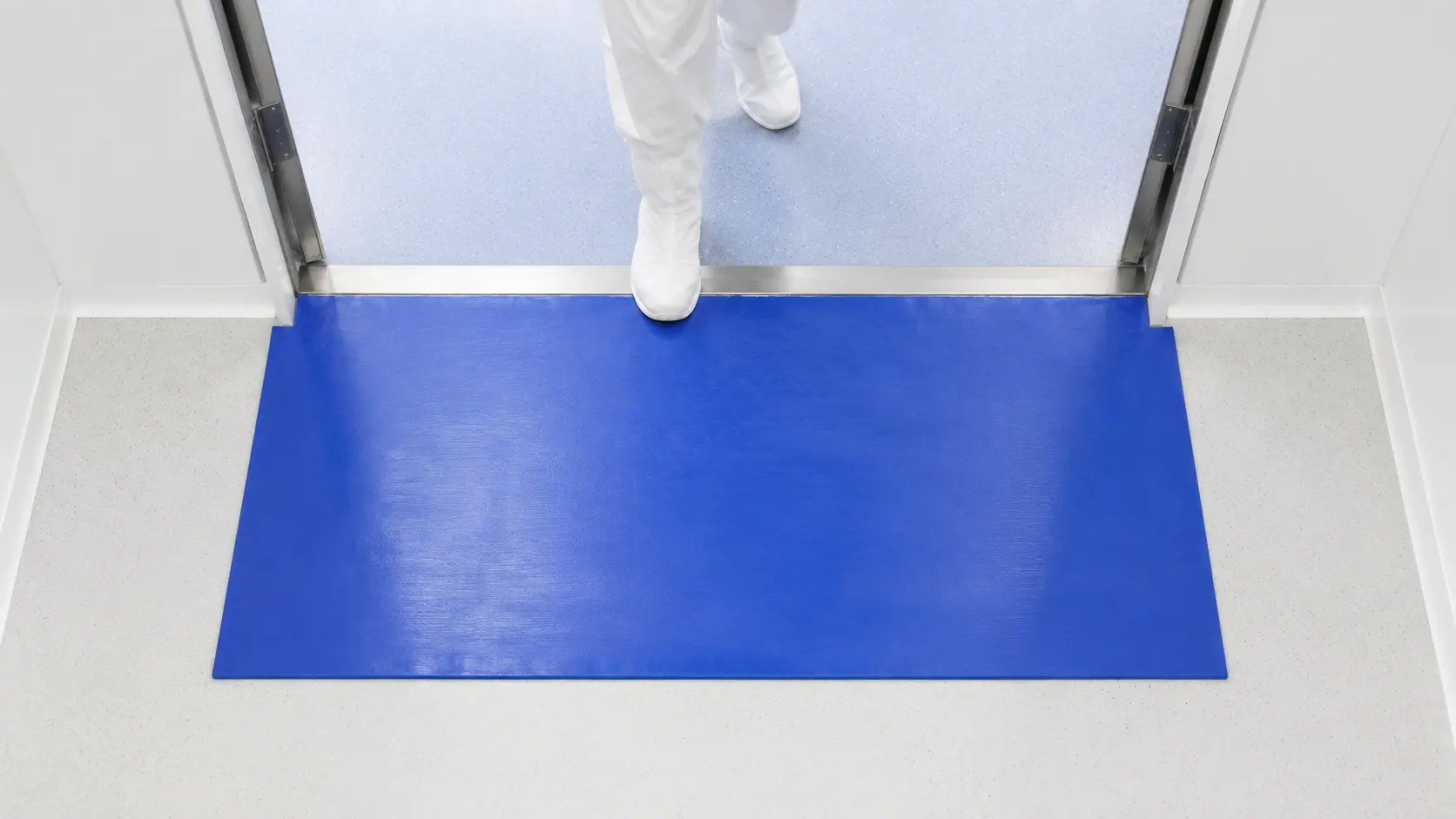
- Width should cover the entire doorway or corridor to prevent bypassing.
- For high traffic or larger entrances, using multiple mats in sequence can improve particle capture.
Common sizes include:
- 18" × 36" (45 × 90 cm) – small doorways, light traffic
- 24" × 36" (60 × 90 cm) – standard door entrances
- 36" × 45" or larger – main cleanroom access, cart traffic
3. Adhesive level and surface properties
Different environments require different levels of tack:
- Standard tack – suitable for most shoe-borne contaminants in office-to-cleanroom transitions.
- High tack – helpful where heavier dust or larger particles are present, such as warehouse-to-production transitions.
- Residue-free – for applications where adhesive transfer to soles is unacceptable or floors and wheels are highly sensitive.
Modern high-quality mats are formulated to minimize residue while maintaining particle capture, but validating performance in your environment is recommended.
4. Traffic volume and layer count
Assess the number of people and carts passing over the mat per shift.
- Low to medium traffic (laboratories, R&D rooms)
30-layer mats may be sufficient with daily or shift-based layer changes. - High traffic (mass manufacturing, packaging halls)
60-layer mats can reduce the frequency of full mat replacement. You may need to peel layers multiple times per day.
Using traffic counters or simple manual logs can help optimize change frequency and reduce wasted layers.
5. Waste management and sustainability
Sustainability is increasingly important in 2024:
- Multi-layer mats create regular plastic waste; facilities may prefer thinner layers or larger mats to optimize layer use.
- Reusable mats can reduce disposable waste but require cleaning chemicals, water and labor.
- Some suppliers now offer recyclable film options; check local recycling capabilities and regulations.
Best practices for installing cleanroom sticky mats
Correct installation is essential for both performance and safety.
Site preparation
- Clean the floor thoroughly
Remove dust, oils and residues from the installation area. A clean substrate improves adhesion and prevents mat movement. - Ensure the surface is dry and level
Moisture or uneven surfaces can cause bubbling, curling, or tripping hazards. - Plan the walking flow
Place the sticky mat where everyone must step on it when entering the controlled area. Avoid configurations where staff can walk around the mat.
Installation steps
- Remove protective backing from the underside of the mat.
- Align the mat with the doorway or corridor, ensuring it is square and centered.
- Apply from one side to the other to avoid trapping air bubbles; press down firmly to ensure full contact with the floor.
- Check edges to make sure they are flat and fully adhered to the floor to reduce trip risk.
- Number the mat position if multiple mats are used in a facility, to support maintenance records and audits.
Using frames or bases
Where mats are frequently replaced, or the floor surface is not suitable, an aluminum or plastic frame/base can be used:
- Frame is permanently attached or placed at the entrance.
- Multi-layer mats are applied onto the frame, simplifying replacement.
- Frames can provide a visual boundary and better edge containment.
Maintenance: When and how to change layers
Regular and documented maintenance turns a sticky mat from a passive accessory into an active part of your contamination control program.
Establishing a layer change schedule
The actual change frequency depends on:
- Traffic volume (people per shift)
- Environmental cleanliness on the "dirty" side
- Regulatory and QA requirements
Common approaches:
- Fixed schedule: e.g., change the layer at the start of each shift and whenever visibly soiled.
- Usage-based: change after a defined number of people or carts (using a simple tally counter).
- Visual threshold: change whenever 30–50% of the surface is visibly contaminated.
Document these rules in your SOPs and train operators accordingly.
Proper technique for peeling layers
- Stand on the "clean" side of the mat to avoid dragging contaminants into the clean area.
- Lift a corner of the top layer, using the numbered tab if available.
- Peel back slowly and evenly, rolling the film inwards so captured particles are enclosed.
- Dispose of the used layer according to facility waste procedures.
- Inspect the new surface for defects or trapped debris before use.
Integration with a holistic contamination control strategy
A cleanroom sticky mat is not a standalone solution. It is most effective when integrated into a broader contamination control strategy.
Combine with gowning protocols
- Position mats after initial gowning steps (donning shoe covers) in high-grade areas, or before gowning in lower-grade environments, depending on your process.
- Use mats as a mandatory step in the entry sequence, with signs reminding staff: "Step on mat before entering."
- For areas with multiple cleanliness grades, use separate mats at each transition.
Coordinate with cleaning and monitoring
- Align mat layer-change schedules with floor cleaning plans to avoid recontamination.
- Track mat changes and cleaning events together for trend analysis.
- Use environmental monitoring data (e.g., particle counts, surface swabs) to evaluate how effectively mats are reducing contamination in critical zones.
Consider airflow and pressure differentials
- Place mats on the low-pressure side of airlocks to reduce inward airflow from dirty areas.
- Ensure that mat presence does not obstruct door seals or automatic door functions.
Common mistakes to avoid
Despite their simplicity, sticky mats are often misused:
- Incorrect placement – Mats placed to the side of main traffic pathways or partially covered by doors are less effective.
- Insufficient size – Small mats that only accommodate one footstep provide limited particle capture.
- Infrequent layer changes – Overloaded mats can become a contamination source rather than a barrier.
- Ignoring edge conditions – Curled or loose edges are both a safety hazard and a sign of poor performance.
- No documentation – Without simple logs or SOPs, it's difficult to demonstrate control during audits or investigations.
Cost considerations and market trends
In 2024, organizations are increasingly looking at total cost of ownership rather than only unit price.
Cost components
- Product cost – price per mat and per layer, including any frames or accessories.
- Labor cost – time spent on installation, peeling layers, inspection and documentation.
- Waste management – disposal costs and potential recycling options.
- Risk cost – potential impact of contamination incidents on yield, batch rejection, rework and downtime.
Current market trends
- Growing interest in optimized layer thickness to balance performance and material usage.
- Adoption of color-coding strategies (e.g., blue mats at building entrances, white mats in high-grade inner areas) to visually distinguish zones.
- Integration of lean and 5S practices, where mat positioning and change schedules are standardized to reduce variation.
- More frequent inclusion of sticky mats in digital SOPs and electronic batch records, supporting traceable contamination control evidence.
By choosing high-quality mats and aligning change schedules with actual usage, facilities can reduce overall contamination-related costs while maintaining or improving cleanliness.
Application scenarios for cleanroom sticky mats
Pharmaceuticals and biotech
- Use cases: production suites, secondary packaging, weighing rooms, airlocks between classified areas.
- Focus: support Annex 1-oriented contamination control strategies and documented cleaning procedures.
- Typical setup: multi-layer mats at each entry to Grade B/C/D areas, integrated with gowning zones.
Medical device manufacturing
- Use cases: assembly lines, sterilization areas, clean packaging rooms.
- Focus: prevent particulate contamination on critical components and sterile barrier systems.
- Typical setup: mats at material entry points and main personnel entrances, often combined with footwear policies.
Electronics, semiconductors and EV batteries
- Use cases: wafer fabs, SMT lines, clean assembly cells, dry rooms for battery cell production.
- Focus: control dust, fibers, and metallic particles that may affect yield and reliability.
- Typical setup: large mats at production hall access routes, specific mats at entrances to high-grade areas or tool bays.
Laboratories, healthcare and life sciences
- Use cases: microbiology labs, hospital pharmacies, clean imaging rooms.
- Focus: support clean workflows and reduce environmental contamination risk.
- Typical setup: mats at lab entrances, clean corridors and in front of critical equipment rooms.
Implementation checklist
When planning or upgrading your cleanroom sticky mat program, use this concise checklist:
- Define goals – Reduce particle ingress? Support regulatory compliance? Standardize entry procedures?
- Map traffic flows – Identify all personnel and material paths into and out of clean zones.
- Select mat types and sizes – Choose dimensions that guarantee at least two steps per foot, and appropriate layer count.
- Set SOPs – Document installation locations, layer change frequency, and responsible personnel.
- Train staff – Include mat usage and layer change instructions in operator training.
- Monitor and adjust – Periodically review contamination data, audits, and user feedback to refine placement and schedules.
Conclusion: Maximizing the value of cleanroom sticky mats
Cleanroom sticky mats are a small investment with significant impact on contamination control when used correctly. By selecting mats that match your cleanroom class, traffic levels and regulatory requirements, and by integrating them into a documented, data-driven contamination control strategy, you can reduce particle ingress from footwear and wheels, protect sensitive products and equipment, support compliance with cleanroom and GMP standards, and lower the overall cost of contamination-related issues.
For facilities designing new clean zones or upgrading existing ones, sticky mats should be considered a standard, carefully engineered element of the entry system rather than a simple consumable. Through proper planning, installation and maintenance, they contribute directly to product quality, process reliability and regulatory confidence.
NEWS
GET SERVICE
With quality parts to meet every budget and friendly staff trained to make your visit informative and hassle free.