
Cleanroom Sticky Mat for ISO Class 5–8 Cleanrooms: Application and Selection Guide

Cleanroom Sticky Mat for ISO Class 5–8 Cleanrooms: Application and Selection Guide
Selecting a Cleanroom Sticky Mat for an ISO Class 5 cleanroom is not the same decision as selecting one for an ISO Class 8 production area. As airborne particle limits become more stringent, contamination control around benches, inspection stations, assembly areas, and exposed products also requires tighter material evaluation, residue control, replacement management, and documentation.
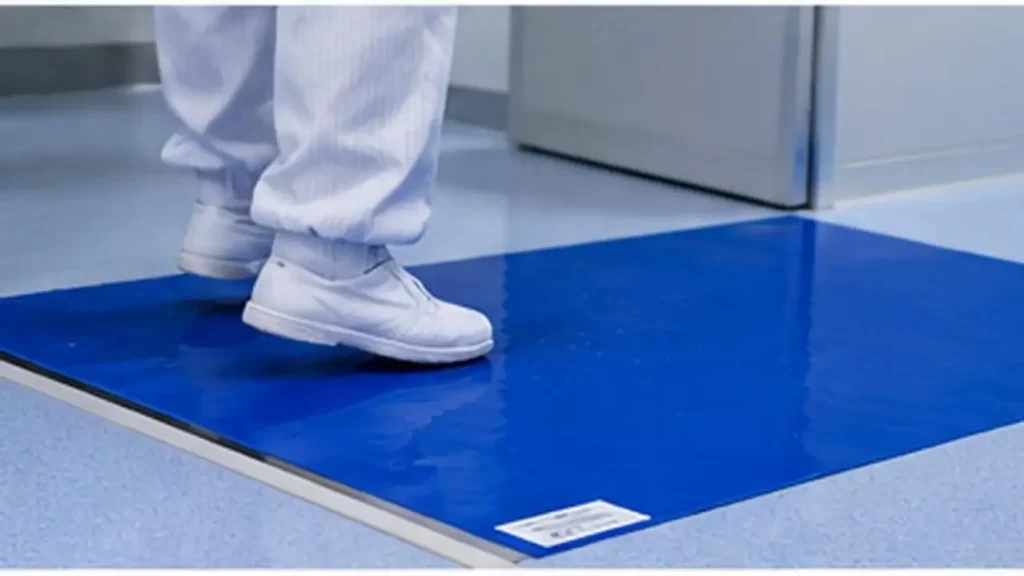
However, ISO 14644-1 does not specify a required tack, thickness, or layer count for a Cleanroom Sticky Mat. These parameters must be matched to the process. Nabai therefore provides configurable apron-style Cleanroom Sticky Mat options including 250–550g adhesive specifications, 3C–6C PE film, 1–5 layers, customized sizes, and blue, white, transparent, or gray surfaces.
How Cleanroom Sticky Mat Requirements Change From ISO Class 5 to Class 8
The lower the ISO class number, the tighter the airborne particle control. This does not mean ISO Class 5 automatically requires the highest-tack mat. Instead, stricter rooms normally require more attention to particle generation, adhesive transfer, exposed-product risk, and replacement discipline.
| Cleanroom Level | Typical Workstation Risk | Cleanroom Sticky Mat Selection Focus | Practical Application |
| ISO Class 5 | Very particle-sensitive exposed processes | Low-lint PE, silicone-free adhesive, residue verification, controlled replacement | Critical inspection, optical components, sensitive electronics |
| ISO Class 6 | High-sensitivity assembly | Adhesive stability, appropriate tack, close bench coverage | Precision electronics and component assembly |
| ISO Class 7 | Controlled assembly and packaging | Balance of tack, durability, layer count, operating cost | Medical-device assembly, electronics, clean packaging |
| ISO Class 8 | General controlled manufacturing | Coverage, handling durability, practical replacement frequency | Packaging, component preparation, general clean production |
These are application guidelines rather than ISO-mandated sticky mat specifications. The final configuration should be verified against the actual process.
ISO Class 5: Prioritize Material Cleanliness and Residue Control
In an ISO Class 5 area, the consequences of introducing particles near exposed products can be more significant. A Cleanroom Sticky Mat used around a bench should therefore be evaluated as a cleanroom consumable, not simply as an adhesive sheet.
Key selection priorities are as follows:
•Low-lint PE carrier: The film should not become an unnecessary particle source.
•Silicone-free adhesive: Used where silicone contamination may reject/impact electronic devices, optics, coatings, or bonding.
•Residue performance: Adhesive transfer should be tested on the actual surface of the workstation.
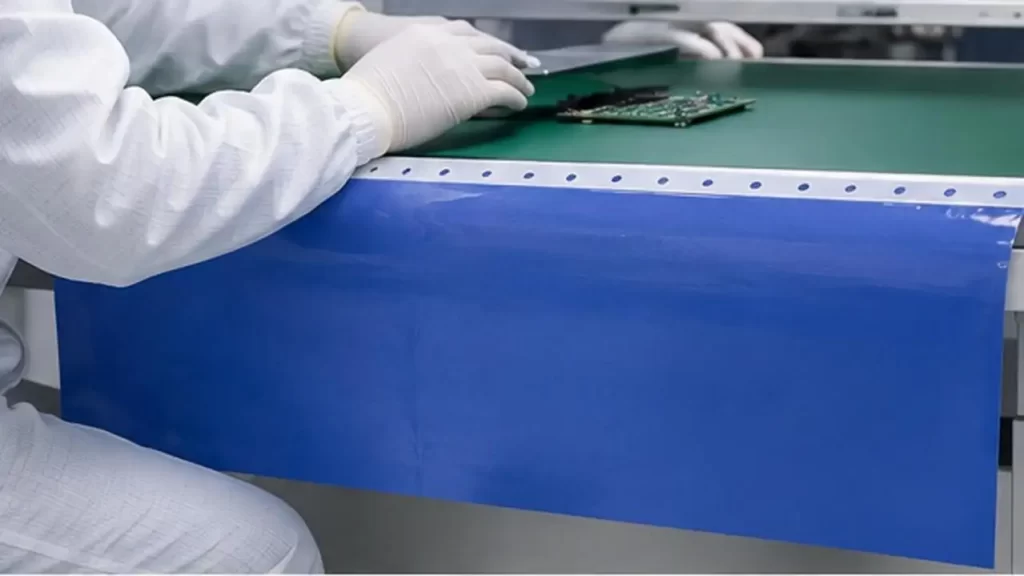
•Correct coverage: The apron must completely cover the sleeve and touch the garment's surface.
•Frequent checks: Particle loading should be checked before the adhesive surface is completely loaded.
For the applications described above, Nabai's 3C-6C PE Cleanroom Sticky Mat has been designed with selectable thickness in the region of bench geometry. A thinner film may be more conformable to edges; a thicker film may be more load stiff.
The highest 250–550g adhesive option should not be automatically selected. Tack should remain compatible with bench materials and the contact pattern.
ISO Class 6: Balance Particle Capture With Workstation Interaction
ISO Class 6 production usually involves closely working personnel next to exposed parts. A Cleanroom Sticky Mat should therefore have sufficient adhesive contact, but should not restrict movement.
Selection should focus on:
Tack Level
Nabai provides a 250–550g adhesive range. A medium-to-higher specification may be evaluated where particle loading is greater, but the corresponding test method and residue behavior should also be checked.
Apron Depth
The mat should extend below the actual operator contact zone rather than simply covering several centimeters of the bench edge.
Film Stability
Where operators repeatedly contact or move around the workstation, a more structurally stable PE film within the 3C–6C range may reduce folding and deformation.
ISO Class 6 selection therefore becomes a balance between particle retention, operator interaction, and mechanical stability.
ISO Class 7: Optimize Tack, Layers, and Maintenance Frequency
For ISO Class 7 electronics, medical-device assembly, and controlled packaging areas, contamination control remains important, but higher workstation traffic can also make maintenance efficiency a major purchasing consideration.
This is where the 1–5 layer Cleanroom Sticky Mat structure becomes particularly useful.
Layer count affects:
•How often an entire mat needs to be removed;
•How quickly operators can expose a clean adhesive surface;
•Consumable usage per workstation;
•Maintenance interruption;
•Waste volume.
A five-layer Cleanroom Sticky Mat does not capture five times more particles than a single layer. Multiple layers mainly provide additional replaceable surfaces.
For a multi-shift ISO Class 7 workstation, for example, a multi-layer configuration may be more practical than repeatedly replacing a complete single-layer apron.
ISO Class 8: Focus on Coverage and Practical Contamination Control
ISO Class 8 environments generally allow higher airborne particle concentrations than Classes 5–7, but uncontrolled contact contamination should still not be ignored.
At this level, a Cleanroom Sticky Mat selection often emphasizes:
•Sufficient bench-edge coverage;
•Practical adhesive strength;
•Resistance to routine handling;
•Efficient replacement;
•Reasonable consumable cost.
Typical areas include component preparation, clean packaging, general electronics production, and controlled assembly.
Using maximum tack or maximum thickness without examining the workstation may unnecessarily increase cost or reduce handling convenience. Nabai can instead customize the Cleanroom Sticky Mat size, thickness, tack, layer count, and color around the actual workstation.
Apron Cleanroom Sticky Mat vs. Floor Sticky Mat
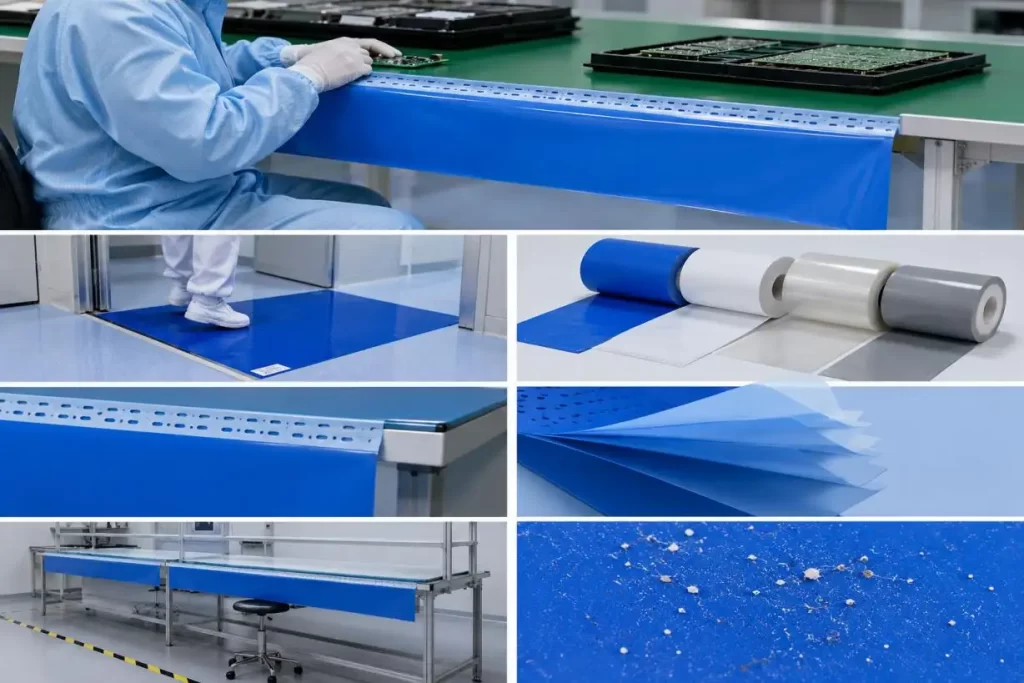
ISO Class 5–8 facilities often need both formats because they control different contamination pathways.
| Feature | Apron Cleanroom Sticky Mat | Floor Sticky Mat |
| Main contamination source | Sleeves, garments, local bench particles | Shoes and cart wheels |
| Installation position | Workbench edge | Entrance or transfer area |
| Main contact zone | Upper-body work area | Floor traffic |
| Best application | Assembly and inspection stations | Personnel/material entrances |
| Selection priority | Tack, residue, dimensions, film flexibility | Foot/wheel pickup and durability |
A floor mat cannot fully replace workstation-level particle control.
Use Thickness, Tack and Layers as a System
The most reliable specification is based on parameter interaction rather than selecting each value independently.
Contamination load → tack requirement → substrate compatibility → film thickness → replacement frequency → layer count
For example, a high-sensitivity ISO Class 5 optical workstation may prioritize residue control and precise coverage, while a busy ISO Class 7 assembly station may place greater emphasis on multi-layer replacement efficiency.
Color can aid in process management:
•White: Improves seeing captured contamination.
•Blue: Used for general identification of cleanrooms.
•Transparent: Designed not to obstruct visibility.
•Gray: Designed for specific workspace or zoning requirements.
Installation and Replacement Must Align With the ISO Environment
Before installing a Cleanroom Sticky Mat, clean the bench edge with an appropriate lint-free wipe and position the apron across the real operator contact area.
Replacement should be triggered by:
•Visible particle loading;
•Reduced effective tack;
•Damaged or folded PE film;
•Contamination following maintenance;
•Process-specific cleanliness procedures.
More critical ISO Class 5–6 workstations normally justify tighter inspection and replacement control than lower-risk ISO Class 8 stations, although the actual interval should be determined from operating data rather than an arbitrary fixed schedule.
Specify the Cleanroom Sticky Mat by Process, Not ISO Class Alone
A useful RFQ should state both the cleanroom environment and the required Cleanroom Sticky Mat construction:
ISO class + application + bench size + contamination source + adhesive requirement + test method + 3C–6C thickness + 1–5 layers + color + packaging + residue requirements.
Nabai can configure Cleanroom Sticky Mat specifications across its 250–550g adhesive range, 3C–6C PE film, 1–5 layer structures, multiple colors, and customized dimensions. For ISO Class 5–8 projects, providing the cleanroom class together with workstation dimensions and process conditions allows a more meaningful sample specification to be evaluated before bulk production.
FAQs
Q1. Can Nabai alter the size of a Cleanroom Sticky Mat?
Yes. Nabai alters Sticky Mat size to fit bench width, hanging depth, operator contact areas, and equipment clearance. These alterations can allow for the use of full length, apron-style mats (which help to avoid bypass contamination zones).
Q2. Is a Cleanroom Sticky Mat of the highest tack necessary for ISO Class 5?
Not always. Although ISO Class 5 has more stringent requirements for airborne particles, it does not designate a requirement of sticky mat tack. Nabai can apply an adhesive range of 250-550g, allowing tack to be adjusted for the particle load, operator contact, and reside requirements.
Q3. What adhesive specification can Nabai provide?
Nabai provides a Cleanroom Sticky Mat adhesive specification of 250g to 550g. When, unfortunately, users need to compare different suppliers, the corresponding adhesive test method should be confirmed.
Q4. What options does Nabai have for the thickness of the PE film?
Nabai offers PE film choices of 3C-6C. Thinner PE films conform to the edges of benches, while thicker films provide greater stability to the mat. The final PE film thickness selected should be based on bench edge geometry and working conditions.
Q5. How many layers can Nabai Sticky Mat have?
Nabai provides Sticky Mat with one to five layers. The layers provide a surface of adhesion to simplify replacement, as multiple layers do not necessarily improve adhesion to particle capture.
NEWS
GET SERVICE
With quality parts to meet every budget and friendly staff trained to make your visit informative and hassle free.