
Cleanroom Sticky Roller Selection Guide: Tack Level, Residue Risk and Particle Pickup

Cleanroom Sticky Roller Selection Guide: Tack Level, Residue Risk and Particle Pickup
A Cleanroom Sticky Roller cannot be selected based on the highest tack available. In controlled environments, effective cleaning typically requires a combination of adhesive strength, particle pickup and residue control along with the construction of the roller film and the surface.
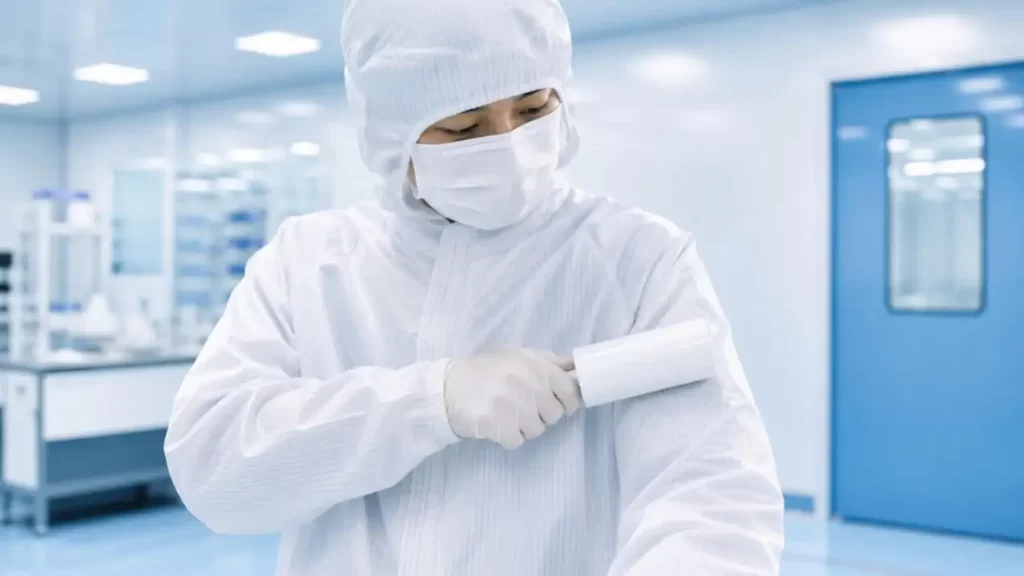
At Nabai, we have designed PP and PE Cleanroom Sticky Roller configurations considering these interrelated factors. The goal is to develop enough adhesive contact to remove loose particles without creating too much rolling resistance, adhesive transfer or an electrostatic risk.
How Cleanroom Sticky Roller Adhesion Actually Works
Most Cleanroom Sticky Roller designs use a pressure-sensitive adhesive (PSA). Unlike heat-activated or chemically cured adhesives, PSA develops adhesion through pressure and intimate surface contact.
Particle removal follows three basic stages:
• Contact: The adhesive surface conforms around exposed areas of dust, lint, fibers or debris.
• Adhesion: Applied rolling pressure increases the effective contact area between adhesive and contaminant.
• Transfer: The particle releases from the substrate when adhesive-to-particle attraction exceeds particle-to-surface attachment.
A useful engineering principle is:
Effective particle pickup = suitable tack + sufficient contact area + controlled rolling pressure + compatible surface conditions
Therefore, adhesive strength alone cannot define Cleanroom Sticky Roller performance.
Tack Strength: Why Higher Tack Is Not Always Better
"Tack" describes how readily an adhesive develops bond strength during relatively short contact. For a Cleanroom Sticky Roller, the required tack depends on both the contaminant and the surface being cleaned.
| Tack Selection | Pickup Behavior | Main Risk | Typical Consideration |
| Low Tack | Loose fine dust and light particles | Insufficient pickup | Delicate or sensitive substrates |
| Medium Tack | Dust, lint, fibers and general debris | Low when correctly matched | Routine cleanroom surfaces |
| High Tack | Larger or more persistent loose particles | Higher rolling force / surface interaction | Durable industrial surfaces |
Excessively low tack may cause repeated passes and poor particle-transfer efficiency. Excessively high tack can increase:
• Roller drag and operator effort;
• Film deformation during rolling;
• Difficulty separating contaminated layers;
• Interaction with coatings or sensitive films;
• Risk of adhesive transfer under unsuitable conditions.
This is why Nabai offers different adhesive configurations instead of defining one tack level as suitable for every Cleanroom Sticky Roller application.
For example, our standard PP sticky roller range lists multiple adhesive-strength options within the product specification, combined with 80 μm PP film, 20 m roll length and multiple roll widths and core diameters.
Tack, Peel Adhesion and Residue Are Different Parameters
A common purchasing mistake is treating tack, peel adhesion and residue as the same characteristic.
They should be evaluated separately:
• Initial tack: How rapidly the adhesive establishes contact.
• Peel adhesion: The force required to separate adhesive from a defined test substrate.
• Cohesive strength: How well the adhesive layer remains internally stable.
• Residue performance: Whether adhesive components transfer to the cleaned surface.
For meaningful supplier comparison, a tack or adhesion value should therefore be reviewed together with the test method, substrate, adhesive formulation and material construction. Two Cleanroom Sticky Roller products carrying similar numerical adhesion values may behave differently if their film stiffness, coating uniformity or adhesive chemistry differs.

Why Adhesive Residue Can Become Secondary Contamination
A Cleanroom Sticky Roller is intended to remove contamination. Adhesive transfer defeats that purpose.
Residue risk is influenced by several interacting variables:
Adhesive Formulation
The PSA requires sufficient cohesion so that the adhesive remains on the roller rather than splitting during contact.
Coating Uniformity
Uneven adhesive coating may create localized high-tack areas, inconsistent pickup or irregular rolling resistance.
Surface Energy
Glass, metals, engineering plastics, protective films and coated surfaces interact differently with pressure-sensitive adhesives.
Pressure and Surface Contact
Applying too much pressure or contact for too long on an adhesive surface can negatively affect sensitive substrates.
Temperature and Storage
Both high temperatures and poor storage can impact the behavior of a PSA and the performance of a roll of adhesive.
Nabai uses pressure-sensitive acrylic adhesive systems in its PP and PE sticky roller lines. For applications where control of silicone contamination is absolutely necessary, we also provide silicone-free PP Cleanroom Sticky Roller configurations using silicone-free adhesive systems.
Particle Size and Surface Structure Change Pickup Efficiency
Particle pickup is also a mechanical-contact problem.
| Variable | Effect on Cleanroom Sticky Roller Performance |
| Fine dust | Requires stable adhesive contact and uniform coating |
| Fibers / hair | Larger contact length generally supports effective pickup |
| Irregular debris | Contact may occur only at several points |
| Smooth surface | Allows more uniform roller contact |
| Textured surface | Recessed particles may remain outside adhesive contact |
| Excessive rolling speed | Can reduce effective contact time |
| Uneven pressure | Produces inconsistent pickup across roller width |
This explains why the same Cleanroom Sticky Roller can perform differently on a smooth equipment panel and a deeply textured production surface.
PP vs. PE Cleanroom Sticky Roller
Roller film is another important engineering parameter because it affects flexibility, dimensional stability and contact behavior.
| Specification Factor | PP Sticky Roller | PE Sticky Roller |
| Film Character | Relatively stable structure | Greater flexibility |
| Contact Behavior | Suitable for controlled flat-surface rolling | Adapts well to general rolling contact |
| ESD Version | Available | Available |
| Silicone-Free Options | Available | Application-dependent |
| Width / Core | Multiple configurations | Multiple configurations |
| Customization | Available | Available |
At Nabai, our PP Cleanroom Sticky Roller portfolio includes standard, ESD-safe, no-knife, card-slot, rounded-edge and silicone-free configurations. Our PE range includes standard and ESD-oriented designs with different widths, cores and handle-compatible structures.
The correct choice should therefore be based on the cleaning process—not simply "PP versus PE."
When ESD Performance Becomes Critical
In semiconductor, PCB and electronics production, contamination control and electrostatic control may need to be considered simultaneously.
An ESD-oriented Cleanroom Sticky Roller should be evaluated for:
• Surface resistance or static-dissipative behavior;
• Compatibility with the facility's ESD control program;
• Adhesive formulation;
• Roller and handle construction;
• Particle pickup capability;
• Residue performance.
Nabai's ESD-safe PE sticky roller configurations combine static-control material structures with replaceable adhesive rollers, allowing particle-removal requirements to be considered alongside electrostatic sensitivity.
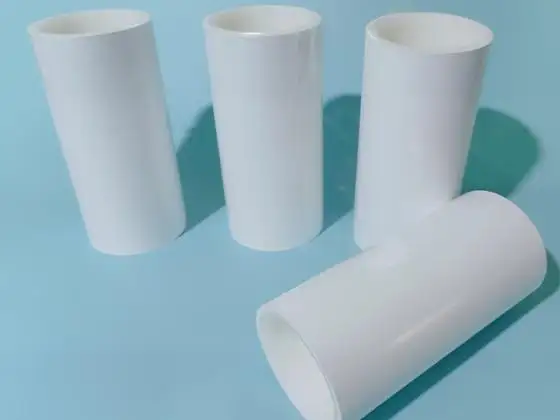
Cleanroom Sticky Roller Specification Checklist
Prior to selecting a Cleanroom Sticky Roller, some specifications include:
• Contaminant: Dust, lint, hair, fibers and process related waste.
• Surface: Glass, metal, PCB, plastic, film or equipment housing.
• Adhesion requirement: The required level of tack (rather than selecting maximum tack).
• Residue sensitivity: Particularly important for optics, electronics and processes involving coatings.
• Material: PP or PE
• Special control: ESD-safe or silicone-free construction.
• Roller width: Selected based on working area and efficiency of cleaning.
• Core diameter: Selected based on the handle or machine used.
• Roll length: Determines interval at which replacement is needed and the efficiency of the consumable.
• Customization: Width of the Roller, core, adhesive, packaging, and labeling.
Match Adhesive Technology to the Actual Process
A technically suitable Cleanroom Sticky Roller balances tack strength, adhesive cohesion, particle-transfer efficiency, residue control, film structure and surface compatibility. Maximum adhesion is rarely the correct engineering target.
Nabai manufactures PP, PE, ESD-safe and silicone-free Cleanroom Sticky Roller solutions with multiple widths, core sizes and adhesive configurations. For new applications, buyers can provide the target surface, contamination type, roller dimensions and ESD or residue requirements. We can then help translate those operating conditions into a more appropriate Cleanroom Sticky Roller specification for production evaluation.
FAQs
Q1. What Cleanroom Sticky Rollers does Nabai sell?
Nabai sells PE and PP Cleanroom Sticky Rollers. PP has a stable film structure. PE has more flexibility to satisfy different needs for rolling contact.
Q2. How to decide between PP and PE Cleanroom Sticky Rollers?
The cleaning surface, contaminant, required tack, and rolling contact width and diameter should all be taken into consideration. It should not be a PE vs PP decision.
Q3. Does Nabai Customize the tack strength of Cleanroom Sticky Rollers?
Yes, we can do that. Our customers need to submit the surface type and how sensitive the surface is to residue and contaminants. We can then set the correct tack strength.
Q4. What tack level is PP Sticky Rollers available at?
Nabai PP Sticky Rollers come with many adhesive strength options. They range from 200 D up to 1500 D in g/25 mm specification field (depending on the specific configuration).
Q5. What tack is PE Sticky Rollers available at?
Nabai's PE Sticky Rollers offers a general adhesive strength of 250-550 g/25 mm.
NEWS
GET SERVICE
With quality parts to meet every budget and friendly staff trained to make your visit informative and hassle free.