
Contamination Control Mat: How to Choose, Use, and Maintain Sticky Mats for Clean Environments

Contamination Control Mat: How to Choose, Use, and Maintain Sticky Mats for Clean Environments
Contamination control mats—often called sticky mats or tack mats—capture dust, dirt, microbes, and other particles at the entrance to controlled environments. As cleanroom, healthcare, and high-precision manufacturing standards tighten, choosing the right mat and using it correctly has become a critical part of contamination control strategy.
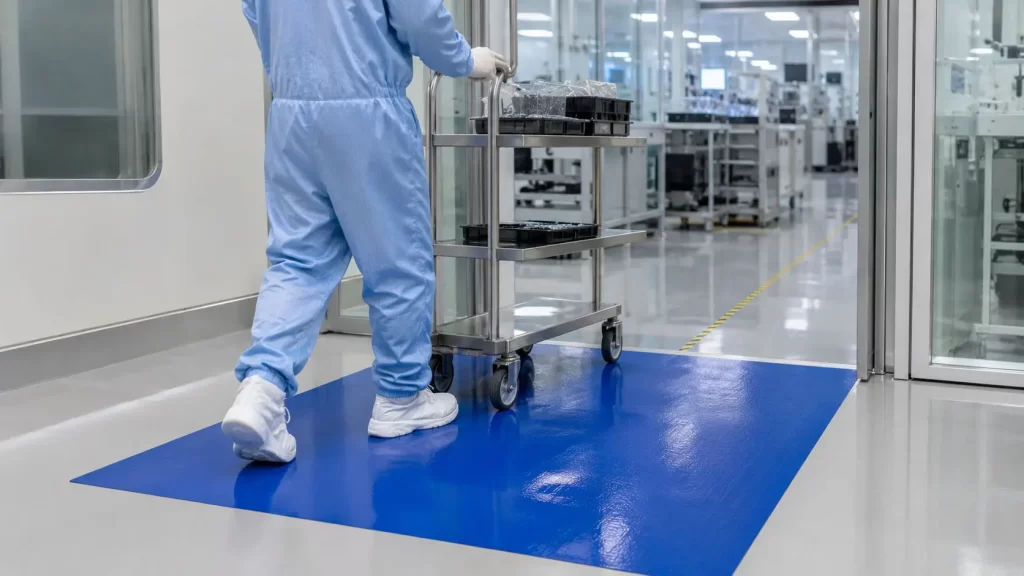
What Is a Contamination Control Mat?
A contamination control mat is a floor mat designed to capture particles from footwear, wheels, and air movement at the entrance to a controlled or cleanliness-sensitive area.
Most products fall into two main categories:
- Peelable sticky mats (tack mats): Multi-layer adhesive mats. When the top layer is dirty, you peel it away to reveal a fresh surface.
- Reusable polymeric mats: Durable, permanently tacky mats that you clean and reuse instead of discarding.
Contamination control mats are widely used at entrances to cleanrooms (ISO 14644-1 ISO Class 3–9), pharmaceutical and biotech production suites, semiconductor assembly areas, hospital operating rooms, food processing facilities, laboratories, and high-tech manufacturing spaces.
Why Contamination Control Mats Matter Now
Growing Cleanliness Requirements
Cleanliness standards have tightened across industries:
- Pharmaceutical and biotech: Stronger emphasis on contamination prevention in current Good Manufacturing Practices (cGMP), FDA, and EMA guidance.
- Healthcare: Infection-prevention standards from the WHO and CDC increasingly emphasize environmental hygiene.
- Electronics and semiconductor: Finer geometries require stricter particle control standards.
The cost of contamination events has risen sharply. Product recalls, batch failures, and yield loss can be extremely expensive. Healthcare-associated infections add significant cost and risk. Contamination control mats provide a low-cost barrier that helps reduce particle load and supports compliance.
Market Trends
Recent developments include a shift toward whole-facility contamination control programs that integrate sticky mats with gowning, cleaning, air filtration, and training. Sustainability concerns have driven interest in reusable mats and higher-capacity peelable options to reduce waste. Non-traditional sectors like e-commerce, automotive, and advanced composites are adopting mats to protect finishes and reduce rework. Facilities now monitor contamination levels and mat replacement frequencies to optimize placement and cleaning schedules.
How Contamination Control Mats Work
Mats work through three mechanisms: surface tackiness grabs particles from shoe soles or wheels; pressure and slight deformation during crossing enhance contact between the surface and contaminants; once captured, particles remain bonded to the surface instead of being re-released.
A mat alone cannot guarantee cleanliness or compliance. It must be part of a layered defense that includes controlled air flow (HEPA or ULPA filtration), proper gowning and PPE protocols, routine cleaning and disinfection, material controls, and staff training. Within this system, the mat is the first physical line of defense at a doorway or transitional area.
Types of Contamination Control Mats
Peelable Adhesive Mats (Sticky Mats / Tack Mats)
Peelable mats consist of 30–60 thin layers of polyethylene, each coated with pressure-sensitive adhesive. They come on a low-tack backing fixed to the floor with a frame or adhesive.
Advantages: Always-fresh surface after peeling, easy visual confirmation of dirt, simple installation, suitable for cleanrooms.
Limitations: Ongoing consumable cost, plastic waste, requires manual peeling and disposal, may not tolerate aggressive disinfectants.
Reusable Polymeric Mats
Reusable mats are made from soft, durable polymer with inherent tackiness. You clean them (usually with water or recommended cleaner) to restore effectiveness instead of peeling.
Advantages: Lower long-term cost in high-traffic areas, reduced waste, stable surface with no layer-edge curling, can combine with peelable mats in high-risk zones.
Limitations: Requires consistent cleaning, higher initial cost, cleaning process must be validated for high-hygiene areas.
Specialized Mats
Some manufacturers offer antimicrobial surfaces designed to inhibit microbial growth, ESD-compatible mats for electronics environments, and heavy-duty options for carts and forklifts.
Key Selection Criteria
Application and Environment
Consider cleanroom classification (ISO Class 3–9), industry requirements (pharma, med-device, electronics, healthcare, food), and traffic type and volume (light foot traffic, medium with light carts, or heavy with frequent carts).
Size and Placement
Ensure sufficient length so each foot makes 2–3 contacts on the mat, or each wheel makes at least one full rotation. Place mats immediately before entry into critical areas, just after gowning rooms, or at boundaries between cleanliness zones.
Adhesive Strength and Surface Profile
Adhesive must be strong enough to capture particles but not so strong that it leaves residue on shoes or creates a tripping hazard. Surface finish should facilitate particle capture and safe movement.
Compatibility With Cleaning Agents
In pharma, biotech, and healthcare, mats may be exposed to disinfectants during routine cleaning. Confirm the mat tolerates your approved disinfectants and does not degrade or lose tackiness prematurely.
Cost of Ownership
Evaluate purchase price plus replacement frequency, labor time for changes or cleaning, waste disposal expenses, and impact on yield or infection prevention. A higher-priced mat that performs better can reduce overall facility costs.
Installing Contamination Control Mats
Prepare the Floor Surface
Clean and dry the floor thoroughly. Remove dust, grit, and grease. Ensure no existing adhesive residue will prevent proper adhesion. Verify the substrate is sound and level.
Position Strategically
Place mats so traffic cannot bypass them. Align with the natural walking line and avoid gaps near walls. Use multiple mats in sequence for heavy-duty applications or high contamination risk.
Ensure Secure Adhesion or Framing
For peelable mats, remove the protective backing and press firmly from center outward to remove air bubbles. Optionally use a rigid frame. For reusable mats, follow manufacturer instructions for adhesive or mechanical fixation. Ensure edges lie flat to prevent trips.
Integrate With Traffic Flow
Use signage or floor arrows to direct people over the mat. If using carts, ensure the full width of travel passes over the mat.
Operating and Maintaining Contamination Control Mats
Determining Replacement or Cleaning Frequency
Peel the top layer of sticky mats when it appears visibly dirty, adhesive performance decreases, or streaking appears from wheels or shoes. Many facilities define a layer change schedule by location and traffic level (for example: high-traffic hospital OR entrance changes multiple times per day; medium-traffic lab changes daily; low-traffic storage changes weekly as needed).
For reusable polymeric mats, cleaning frequency should be based on documented traffic and contamination levels, visual inspection, and routine preventive schedules (for example: once per shift or once per day).
Cleaning and Disinfection
Use cleaning agents approved by both the mat manufacturer and your facility. Avoid harsh solvents or abrasive cleaners unless specifically permitted. Ensure the mat is completely dry before resuming traffic to maintain tack and safety.
Documentation and SOPs
For regulated or high-risk environments, create a standard operating procedure covering installation, daily inspection, layer change or cleaning schedule, and disposal with record keeping. Train staff on why mats are used, how to walk over them without stepping around, and how to safely peel layers or clean the surface.
Industry-Specific Use Cases
Pharmaceuticals and Biotech
Mats are installed at entry to gowning rooms, transition zones between Grade D/C/B areas, and material transfer hatches. They support cGMP compliance and reduce particulate ingress that could compromise sterile products.
Healthcare (Hospitals, Clinics, Laboratories)
Mats are placed at operating room and procedure suite entrances, isolation unit entry and exit points, and microbiology and diagnostic lab doors. They add a supplemental barrier in infection prevention programs and help capture debris that routine shoe covers may not retain.
Electronics, Semiconductor, and Optics
Mats are used in cleanroom gowning areas, photolithography and assembly zones, and precision optics production rooms. They reduce yield loss from microscopic particle contamination and support ISO cleanroom standards and internal QA protocols.
Food and Beverage Processing
Mats are placed at entrances to high-hygiene food processing rooms and boundaries between raw and finished product zones. They limit foreign body contamination and environmental debris and support compliance with food safety systems like HACCP.
Common Mistakes to Avoid
Insufficient mat length or width means people or carts step over or around edges, leaving contamination unaddressed. Irregular or infrequent layer changes mean saturated mats may redistribute contamination instead of capturing it. Using incompatible cleaning chemicals can degrade mat surfaces. Without clear SOPs, personnel may bypass mats or peel layers incorrectly. Mats work best as one element in a coherent contamination control plan, not as a standalone fix.
Evaluating Performance
Compare airborne or surface particle levels in areas with and without mats under comparable conditions. In healthcare or pharma, monitor bioburden levels near controlled entrances over time. Track how quickly layers appear dirty in different locations to optimize replacement intervals. Ask operators whether mats impact movement, safety, or workflow. Use this data to adjust mat types, positions, or maintenance schedules.
Selecting a Supplier
When evaluating suppliers, consider product range and specialization, availability of technical documentation and compatibility information, regulatory and standards support, and service and support for installation, placement strategy, and SOP development.
At Nabaie Scandinavian For Environmental Solutions & Development Co. Ltd., we focus on practical, technically sound environmental and contamination control solutions. For detailed product information, facility integration, or standards support, contact us:
- Address: Nabaie Scandinavian For Environmental Solutions & Development Co. Ltd., Madina Road, al Manar District, 4046, Jeddah 21491, Saudi Arabia
- Phone: +86-769-26381251
- Email: info@nabaiesd.com
Practical Buying Guide
For Cleanrooms and Controlled Manufacturing
Prefer high-quality peelable sticky mats at airlocks and gowning rooms. Use ISO-compatible materials and ensure low particle shedding. Combine with reusable mats in high-traffic corridors to reduce consumable usage.
For Hospitals and Healthcare Facilities
Position mats at ORs, isolation rooms, and critical labs. Coordinate with infection control teams to align with existing disinfection protocols. Use easy-to-inspect, high-contrast colors to quickly identify when mats need changing.
For Food Processing and Packaging
Ensure mats are food-area compatible and resistant to common detergents and disinfectants. Place them at entries from external or low-hygiene areas into production zones. Combine mats with boot washes or hygiene stations for higher-risk processes.
For Industrial and Logistics Environments
Consider durable, reusable polymeric mats at main traffic routes. If using carts or forklifts, evaluate mat thickness and impact resistance. Use mats to reduce dust transfer into high-value areas like finishing lines or precision assembly.
Environmental and Cost Considerations
To reduce waste, use higher-capacity mats to reduce packaging and replacement frequency. Combine reusable mats in high-traffic zones with peelable mats only in critical areas. Optimize replacement schedules based on actual contamination rather than fixed time intervals alone.
When calculating return on investment, include downstream savings from reduced contamination incidents (fewer rejects, rework, or infections), decreased cleaning requirements inside controlled areas, and lowered risk of regulatory non-compliance. In many cases, a well-chosen contamination control mat program pays for itself through increased yield and reduced risk.
Integrating Contamination Control Mats Into Your Facility
When correctly selected, installed, and maintained, contamination control mats reduce particle and debris transfer into sensitive areas, support compliance with strict regulatory and quality standards, improve overall hygiene and product or patient safety, and offer a relatively low-cost, high-impact addition to contamination control.
To implement or upgrade mats in your facility:
- Map your critical entrances and traffic flows.
- Define cleanliness, regulatory, and operational requirements.
- Select mat types (peelable, reusable, or hybrid) aligned with each zone's risk profile.
- Establish SOPs and training for installation, maintenance, and monitoring.
- Periodically review performance and adjust placement or schedules as needed.
For organizations planning or upgrading cleanrooms, high-hygiene manufacturing spaces, or clinical environments, contamination control mats should be treated as a core part of facility design, not just an afterthought at the doorway.
If you need support specifying or integrating contamination control mats as part of a wider cleanroom or environmental solution, reach Nabaie Scandinavian For Environmental Solutions & Development Co. Ltd. at info@nabaiesd.com or +86-769-26381251 to discuss your project requirements.
NEWS
GET SERVICE
With quality parts to meet every budget and friendly staff trained to make your visit informative and hassle free.