
Anti-Static Contamination Control Roller for ESD-Sensitive Manufacturing Areas

Anti-Static Contamination Control Roller for ESD-Sensitive Manufacturing Areas
In PCB assembly, semiconductor processing, LED production and other ESD-sensitive manufacturing areas, particle removal cannot be evaluated independently from electrostatic control. A Contamination Control Roller repeatedly contacts and separates from the working surface; this removes loose contamination, but the same contact-separation mechanism can also generate triboelectric charge. The ESD Association identifies contact and separation as a fundamental source of electrostatic charging.
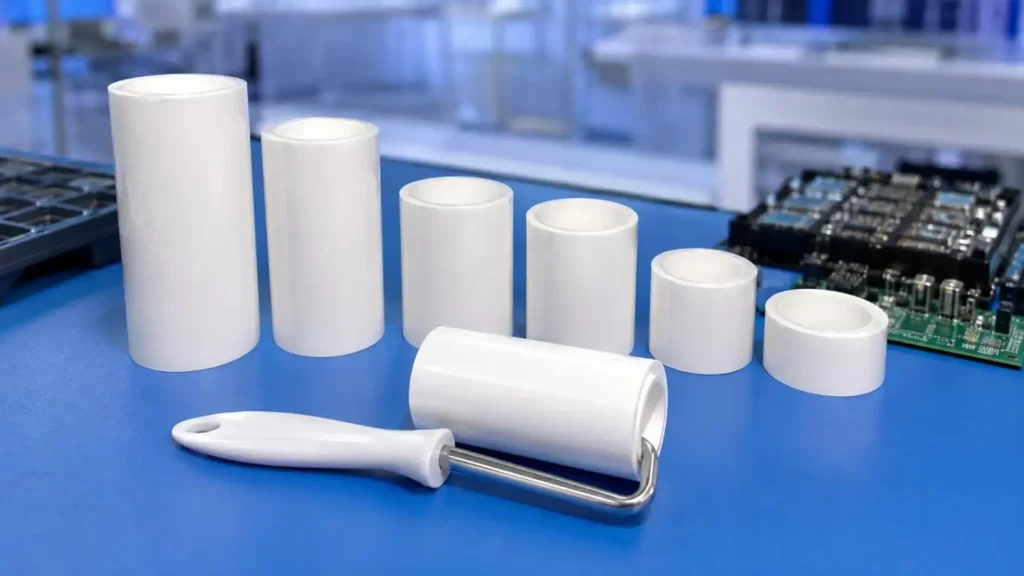
For this reason, Nabai evaluates a Contamination Control Roller through four connected factors: particle pickup, tack level, electrostatic behavior and process compatibility.
Particle Removal and ESD Control Must Be Evaluated Together
A standard adhesive roller may remove dust effectively, but ESD-sensitive manufacturing introduces another question: what happens electrically during rolling and peeling?
A suitable Contamination Control Roller needs to manage three risks at the same time:
•Particle contamination: Dust, fibers and loose debris must transfer from the substrate to the adhesive.
•Electrostatic charging: Rolling and separation should not introduce uncontrolled charge around ESDS components.
•Chemical contamination: Adhesive chemistry must not introduce silicone or unacceptable residue onto sensitive surfaces.
Low electrical resistance alone does not prove low charging behavior. ESD guidance distinguishes charge generation from the ability of a material to dissipate charge, so both characteristics need to be considered when selecting materials used near ESDS items.
The Main Contamination Control Roller Parameters Work as a System
The performance of a Contamination Control Roller is determined by interacting parameters rather than one specification.
| Parameter | Process Effect | Risk if Incorrectly Selected |
| Tack / Adhesion | Determines particle holding force | Excessive peel force or residue |
| Roller Material | Controls rigidity and contact stability | Uneven contact or unsuitable flexibility |
| Static-Dissipative Structure | Supports charge dissipation | Local charge accumulation |
| Adhesive Chemistry | Affects residue compatibility | Silicone or chemical contamination |
| Roller Width | Controls coverage per pass | Uneven pressure on wide surfaces |
| Core Size | Determines machine/handle compatibility | Installation or tracking problems |
Tack Must Match the Surface
Higher tack is not automatically better.
In practice:
Higher tack → stronger particle retention → higher separation force
A high-tack Contamination Control Roller can be useful for heavier particle loads, while lower or medium tack may be more appropriate for:
•Optical films;
•Coated materials;
•PCB surfaces;
•Delicate laminates;
•Surfaces where adhesive transfer must be minimized.
Nabai's silicone-free PP platform is available with multiple adhesive-strength configurations, allowing tack to be specified according to the substrate rather than using one adhesive level for every application.
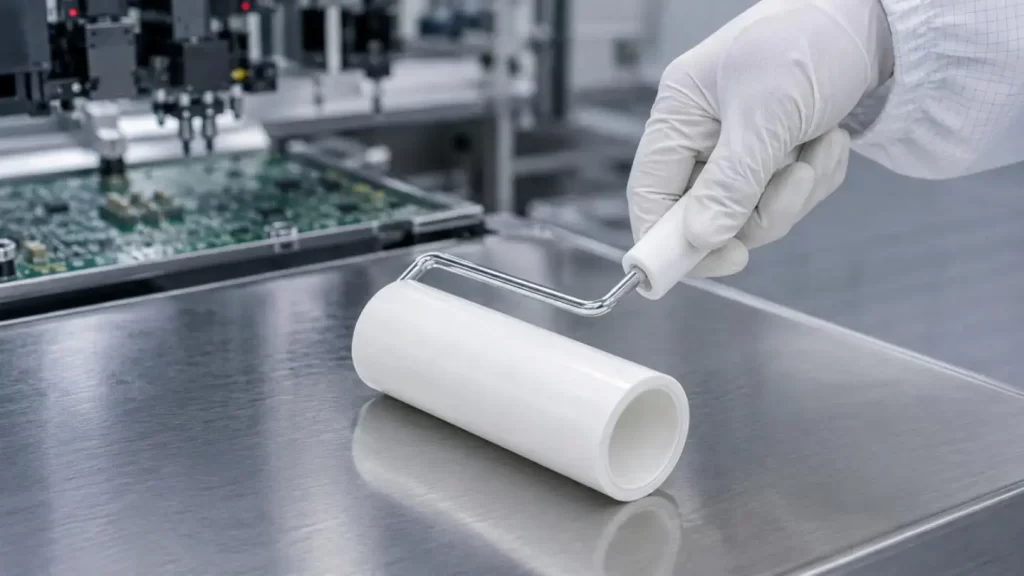
Standard, ESD and Silicone-Free Rollers Solve Different Problems
Selecting a Contamination Control Roller should begin with the failure mode that needs to be controlled.
| Configuration | Primary Control Objective | Typical Process |
| Standard PP/PE | General particle removal | Equipment and non-ESDS surfaces |
| ESD-Safe Roller | Particle + electrostatic control | PCB, SMT, electronic assembly |
| Full ESD Structure | More complete charge-dissipation path | Higher-sensitivity ESDS processes |
| Silicone-Free PP | Particle + silicone contamination control | LED, optics, coatings, PCB |
Silicone-sensitive processes require particular attention. Silicone contamination can interfere with downstream coating, bonding or precision surface processes, so changing adhesive chemistry may be more important than simply increasing tack.
For these applications, Nabai's silicone-free Contamination Control Roller uses a high-purity PP roller core with static-dissipative properties and a specially formulated silicone-free acrylic adhesive. Nabai specifies this design for LED manufacturing, optical lens production, coating processes, PCB assembly and medical-device manufacturing.
Match the Contamination Control Roller to the Production Surface
The same roller specification should not be applied across every manufacturing station.
PCB and SMT Areas
PCB and PCBA processes require a balance between particle pickup and surface cleanliness. When the Contamination Control Roller is used inside an EPA, the roller must be considered together with operator grounding, workstation grounding and other ESD controls.
Semiconductor and Precision Electronics
For more ESD-sensitive processes, evaluate the entire path:
Adhesive Surface → Roller Structure → Core → Handle → Grounded Process Environment
A static-dissipative roller surface should not automatically be treated as proof that the complete cleaning assembly provides a continuous dissipation path.
Optical and Coated Surfaces
These applications usually require greater attention to:
•Controlled tack;
•Low residue;
•Silicone restrictions;
•Uniform contact pressure.
For silicone-sensitive production, Nabai's silicone-free design separates particle-control requirements from silicone-contamination requirements, rather than treating them as the same issue.
Width and Core Size Affect Process Integration
For production equipment, roller geometry is a functional parameter.
Nabai's silicone-free PP Contamination Control Roller uses an 80 μm PP structure and a standard roll length of 20 m. Published widths include 650, 850, 1300, 1400, 1500, 1600, 1700, 1800, 1900 and 2000 mm, with other dimensions available for customization. Inner-core options include 25.4, 38, 40, 51 and 76 mm.
These dimensions allow the roller to be matched to:
•PCB or film line width;
•Manual or equipment-mounted use;
•Existing shafts and roller holders;
•Required cleaning coverage.
A wider Contamination Control Roller reduces the number of passes, but only when pressure remains uniform across the full contact width.
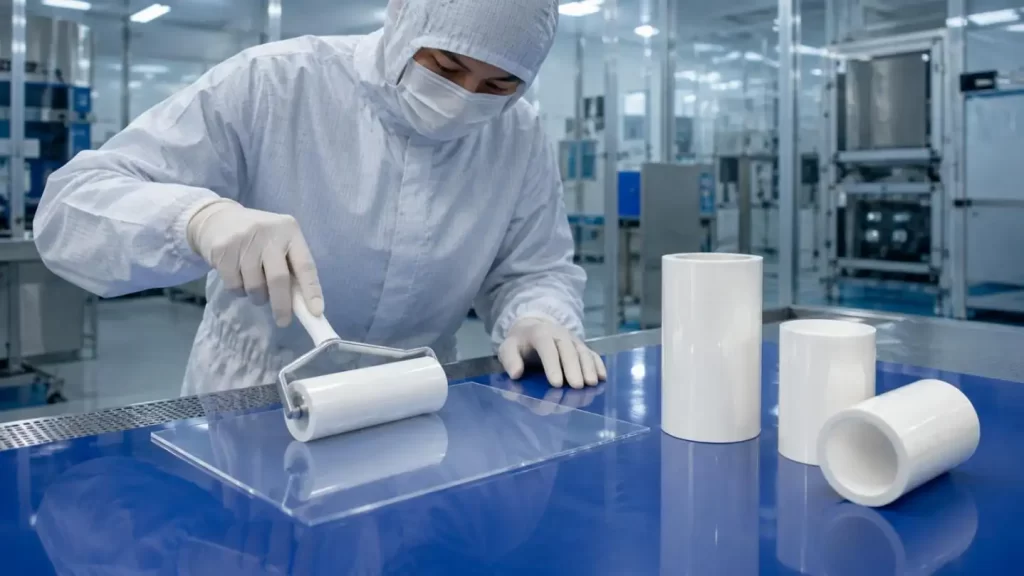
Rolling Pressure and Layer Replacement Affect Cleaning Stability
Correct use is as important as roller specification.
For the Nabai silicone-free PP Contamination Control Roller, recommended operation includes light pressure, consistent rolling in one direction and removal of the contaminated adhesive layer when pickup capacity decreases.
Layer replacement should be based on actual process conditions:
•Visible particle loading;
•Reduced tack;
•Change of production zone;
•Change of sensitive product;
•Internal contamination-control SOP.
Excessive rolling pressure should be avoided because additional force does not automatically produce better particle transfer and may increase stress on sensitive surfaces.
Verify ESD Performance Before Approving the Roller
An "anti-static" label alone is insufficient for engineering approval.
IEC 61340-5-1:2024 specifies requirements for an overall ESD control program, meaning a Contamination Control Roller must operate within the site's wider ESD control system rather than replace it.
For supplier qualification, buyers should request:
•Measured electrical property and units;
•Test method;
•Test voltage;
•Humidity and conditioning conditions;
•Measurement location;
•Charge-decay or continuity data where required;
•Tack or adhesion test method;
•Silicone-free or residue information where process-critical.
Cleanroom classification should also be treated separately. ISO 14644-1 classifies cleanroom air cleanliness by airborne particle concentration; it does not create a universal "ISO Class 5 Contamination Control Roller" product certification.
Specify the Contamination Control Roller From the Process Backward
A technically useful RFQ should follow this sequence:
Surface → contamination type → ESD sensitivity → silicone restriction → tack → roller material → width → core → electrical requirements → validation data
At Nabai, this approach allows the Contamination Control Roller to be configured around actual process conditions instead of selecting only by roll width or maximum tack. For silicone-sensitive PCB, LED, optical or precision-manufacturing lines, buyers can define the required adhesive level, PP dimensions, core format and identification options before the final specification is confirmed.
A properly selected Contamination Control Roller should therefore do more than pick up visible dust: it should fit the substrate, contamination limit, ESD control program and equipment interface as one integrated cleaning solution.
FAQs
Q1. What kinds of Contamination Control Rollers does Nabai offer?
Nabai provides a selection of configurations of Contamination Control Rollers for your industrial need. These materials include PP adhesive rollers, ESD related materials, full ESD solutions, silicone-free PP rollers and reusable silicone rollers. The correct configuration depends on your requirements for particle load, sensitivity of the substrate, needs for ESD control and limitations for chemical contamination.
Q2. Does Nabai make silicone-free Contamination Control Rollers?
Yes. We can supply silicone-free PP Contamination Control Rollers using a specially formulated acrylic adhesive. These are used in instances where one contamination transfer issue is the potential of silicone contamination affecting coating, bonding, optical, LED, PCB and other related high precision manufacturing processes.
Q3. What are the standard widths for Nabai's silicone-free PP Contamination Control Rollers?
Published standard widths are available in 650, 850, 1300, 1400, 1500, 1600, 1700, 1800, 1900 and 2000 mm. For other widths required for specific machine or production line widths, please notify us.
Q4. What are the available inner-core sizes?
Nabai's silicone-free PP Contamination Control Rollers have available inner-cores in 25.4, 38, 40, 51, 76 mm, and other sizes will be determined based on the customer's needs for shafts, holders, or automated cleaning equipment.
Q5. Can the degree of tack of a Nabai Contamination Control Roller be adjusted?
We offer various levels of adhesive strength. The level of tack should be selected considering the sensitivity of the substrate to particle loading, rather than assuming the most adhesive strength is best. Tack levels should be fully reviewed and selected to fit the sensitivity of the substrate and not be assumed.
NEWS
GET SERVICE
With quality parts to meet every budget and friendly staff trained to make your visit informative and hassle free.