
5 Critical Stations in Electronics Assembly That Demand an Electronics Cleaning Roller

5 Critical Stations in Electronics Assembly That Demand an Electronics Cleaning Roller
Particle contamination is a major threat to yields in today's manufacturing of electronic devices. For example, just a bit of dust or lint on a surface can result in open circuits, bad adhesion, and optical defects. Cleanrooms and improved air filtration work to clean the air of particles, but surface contamination still poses a threat. That's where a high-performance Electronics Cleaning Roller is the solution. Among available options, Nabai's standard PP sticky roller combines stable particle collection with low-lint surface performance, making it a reliable choice for controlled operating environments.
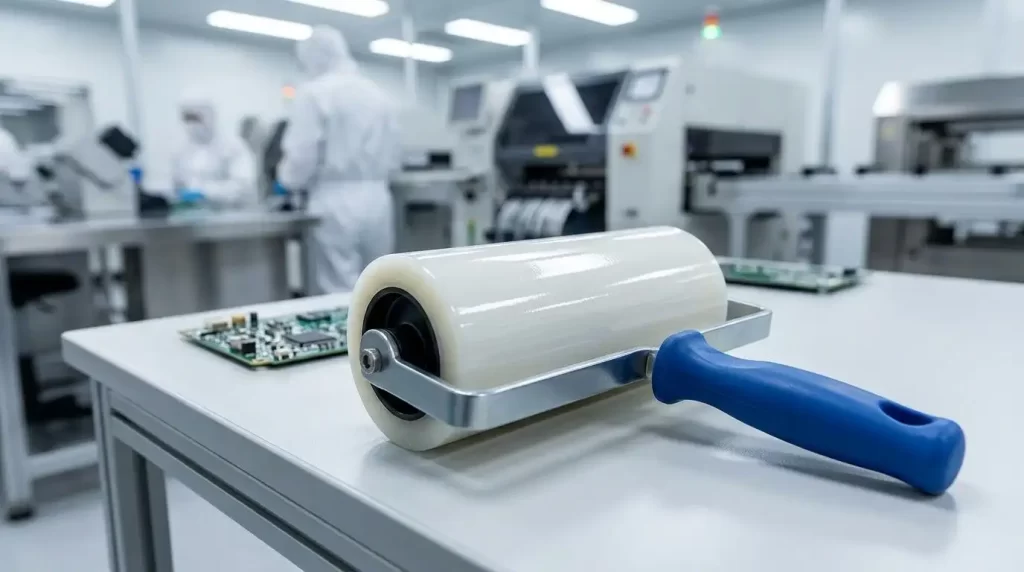
Below are five specific stations on an electronics assembly line where an Electronics Cleaning Roller is not just helpful — but necessary.
Station 1 – Solder Paste Printing / Stencil Cleaning
Before solder paste is deposited onto a printed circuit board (PCB), the stencil underside and the board surface must be free of contaminants.
•Present contaminants: Residual solder paste, flux, dried particles from prior jobs, dust
•Why a cleaning roller is necessary: Particles, outlined or not, block paste transfer. Blockage results in a lack of solder, or bridging occurs.
•How Nabai roller helps: the layer of acrylic adhesive lifts fine particles without smudging thanks to its rigidity. Rollers shed particles; by design, Nabai rolllers do not shed particles.
•Key advantage: adhesive strengths from 200D to 1500D are customizable for a sticky roller or a gentler tack for delicate stencil foils.
�� Product tip: After the stencil is wiped with a solvent, it is best practice to use a white Electronics Cleaning Roller. The white surface shows solder paste confirming the stencil is clean.
Station 2: Pre-cleaning PCB Substrates Before SMT Placement
Pre-cleaning of Dust and Fibers from Handling: After the bare PCB is received it is often dust from the handling and packaging or particles from the cardboard boxes.
•Debris: electronic dust and cardboard lint.
•Dust on pads: reduces the wetting of solder and creates head-in-pillow and tombstoning defects.
•Why air doesn't clean: air blow-off redistributes particles. A sticky roller cleans and captures.
•Design feature: the low-lint Nabai roller surfaces shrinks fiber residue and particles; you get a stick roller without diminishing returns. The roller's 80u thickness is a perfect balance for durability and effective cleaning of rigid boards.
•Operational efficiency: The roller functions by itself or alongside a silicone sticky roller – silicone tackles residues, while the PP roller seizes dust.
Available widths range from 650mm to 2000mm, allowing large scale, single-pass cleaning of PCBs.
Station 3 – Wire Bonding or Die Attach Area
Gold/aluminum wedge or ball bonding and die attach are some of the most sensitivity-critical processes. Here, contamination directly impacts the strength and reliability of a bond.
•Sub-micron dust, dried photo-resist fragments, and particles generated by handling are considered critical contaminants.
•A 0.5µm particle on a bond pad can cause lifted balls or a non-stick bond.
•What a standard sticky roller does: The acrylic adhesive layer does not transfer residues, meaning there is no chemical trace on the bond pad.
•Selecting the appropriate adhesive strength: When cleaning bond pads, lower adhesion (around 200D–400D) is used. Nabai's 200D captures fine particles and does so without any disruption of sensitive gold.
•Material safety: The high-purity PP film does not outgas harmful, volatile compounds, and thus is safe to use for enclosed bonders and cleanrooms (ISO Class 5 and above).
Many quality engineers specify a white Electronics Cleaning Roller before wire bonding because the high visibility of captured contaminants provides visual proof of cleanliness.
Station 4 – Flat Panel Display or Lens Assembly
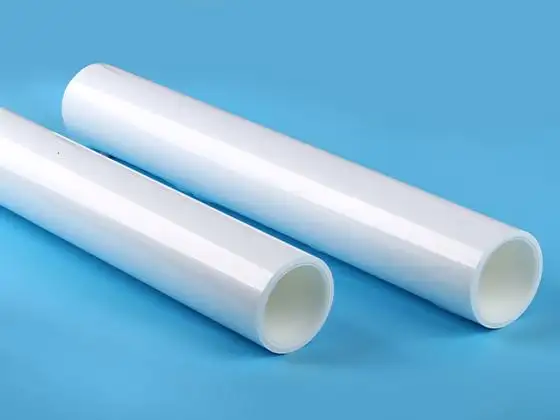
In display modules, touch panels, or camera lens assembly, any particle between layers becomes a visible defect – bright spots on a dark screen or black dots in an optical path.
•Problematic particles: Lint from cleanroom wipers, plastic shavings from frame edges, and airborne cellulose fibers.
•A one of a kind problem: The surfaces to contend with are usually untextured, large, and smooth. Not to mention, static sensitive. Repeated cleaning should not leave behind scratches, or lint.
•Reasons why Nabai's PP sticky roller excels: Thanks to its low-lint PP surface, fiber residue after cleaning is reduced. The sticky operation of the roller allows for a steady movement over smooth surfaces without any skipping or jerking.
•Large format customization: Standard widths are offered at 1300mm, 1400mm, 1500mm, to 2000mm. This range is designed for display panels of 55 inches and larger.
•Color selection benefit: Use white for final QC cleaning (shows every captured speck). Use blue for pre-lamination cleaning where slight residue visibility is acceptable.
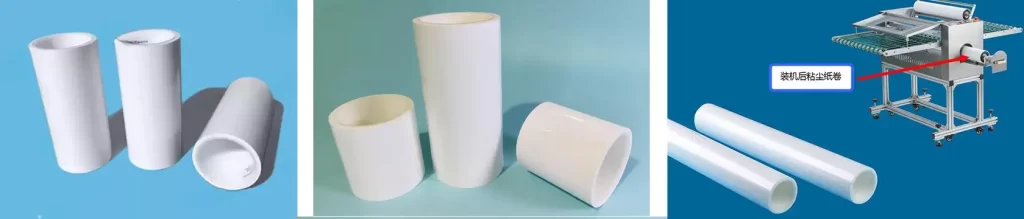
The roller can be mounted on a 3-inch cardboard core dispenser, allowing one-handed operation across large glass sheets.
Station 5 – Final Packaging and Sealing
Just before an electronic product is sealed into its antistatic bag, clamshell, or shipping carton, a final surface clean removes any handling-introduced contaminants.
•What accumulates during final assembly: Fingerprints (though not removed by dry rolling), but more importantly – loose fibers from gloves, paper dust from manuals, and environmental fallout.
•Why final cleaning matters: A particle trapped under a protective film or inside a sealed product can lead to customer returns and field failures, especially in medical or automotive electronics.
•Effectiveness of Nabai's design: The uniformly coated adhesive layer captures fine particles from tools and equipment surfaces without leaving sticky residue on the product.
•Simple procedure: Mount the roll, tear a desired length (perforated edges available on custom orders), gently press onto the product housing or display, then discard the used sheet. Repeat as needed.
•Color for traceability: Many packaging lines use blue rollers to avoid showing every minor speck (which might cause unnecessary rework), while white rollers are preferred for high-reliability products where zero defects are mandatory.
Nabai's roller can be supplied in 20m lengths per roll, with other lengths customizable – reducing downtime for roll changes on high-volume packaging lines.
Summary: Why Nabai's Standard PP Sticky Roller Fits the Five Stations
Across every station – from stencil cleaning to final packaging – the requirements are consistent: stable particle pickup, no secondary contamination, and easy operation. Nabai's standard PP sticky roller delivers these through:
•Low-lint PP surface: The polypropylene material helps reduce fiber residue during cleaning tasks.
•Efficient dust collection: The adhesive layer collects and holds micro-particulate dust on tool and equipment surfaces.
•Easily cleanable, stable motion: Designed for flat and efficient transit across large areas to be cleaned.
•Excellent adaptability: Works with silicone sticky rollers (cleanroom wipers) or may be used alone.
•Flexibility: Can be adapted to any assembly line with different widths, cores (25.4mm to 76mm), and packing.
For quality managers and process engineers, the Electronics Cleaning Roller offers direct benefits for yield and reliability.
GET A QUOTE – To specify your requirements, adhesives strengths (from 200D to 1500D), colors (white or blue), width, and core size, please contact Nabai. The roller can be designed for your cleanroom class and substrate sensitivity.
FAQs
Q1: Can the Electronics Cleaning Roller be used on sensitive electronic components?
Yes, the low adhesion versions (from 200D to 400D) may be used on bond pads or bare dies.
Q2: Does the Nabai PP roller leave any residues?
No, the fully coated roller uses a residue free, non-transferring adhesive.
Q3: Can I use this roller alongside a silicone roller?
The PP roller, sold either as a standalone product or as a companion product to a silicone sticky roller, can, by itself, remove other contaminations.
Q4: How strong is the adhesive?
Nabai makes rollers with adhesive strengths, from 200D to 1500D (g/25mm), to meet different surface sensitivities.
Q5: How wide or long can the rollers be?
Rollers can be manufactured at widths anywhere from 650mm to 2000mm including, but not limited to, 1300mm, 1500mm, 1700mm, etc.
NEWS
GET SERVICE
With quality parts to meet every budget and friendly staff trained to make your visit informative and hassle free.