
The Static Dissipation in an ESD Cleanroom Sticky Mat

The Static Dissipation in an ESD Cleanroom Sticky Mat
In semiconductor, electronics, precision optics, and controlled assembly areas, floor traffic can introduce two separate risks: particles carried by footwear and trolley wheels, and electrostatic charge generated by movement. An ESD Cleanroom Sticky Mat is designed to support both contamination control and controlled charge dissipation at entrances, gowning transitions, and other high-traffic boundaries.
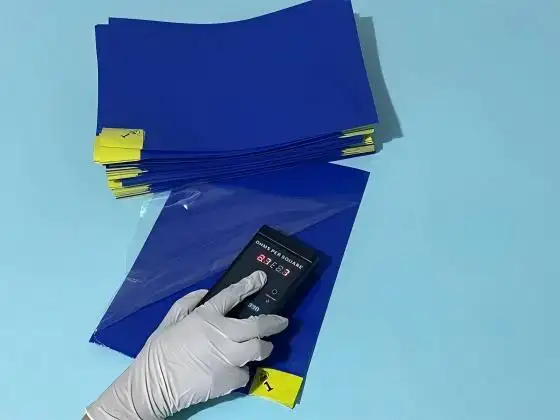
At Nabai, we treat the ESD Cleanroom Sticky Mat as one element of a wider cleanroom and ESD control program. ISO 14644-1 classifies cleanrooms according to airborne particle concentration; it does not certify an individual mat or verify its ESD performance. Like standard IEC 61340-5-1:2024, IEC 61340-5-1:2007 requires companies dealing with ESD sensitive devices to implement a coordinated ESD control program.
How Static Dissipation Works
Static charges are built up by movement or contact of different materials. In order for the charge to dissipate safely an ESD control mat have to be bonded to ground.
However, resistance values must be interpreted correctly. ANSI/ESD STM7.1 classifies flooring according to resistance to ground:
•Conductive flooring: ≤1 × 10⁶ Ω
•Static-dissipative flooring: >1 × 10⁶ Ω and <1 × 10⁹ Ω
The complete person-footwear-flooring system must also be evaluated. An ESD Cleanroom Sticky Mat cannot reliably ground personnel when footwear is insulating, the grounding connection is incomplete, or the components have not been qualified as a system.
Nabai's Three-Layer Composite Structure
Nabai's ESD Cleanroom Sticky Mat utilizes a three-layer composite base film. This film combines a conductive adhesive with a grounded backing.
1. Static-Dissipative Top Surface
The upper layer captures charge from the footwear or trolley wheels while dissipating the charge. At the same time, the adhesive layer captures and holds particulate and debris.
2. Conductive Distribution Layer
This carbon-based layer ensures even charge distribution on the mat surface. In the absence of a distribution layer, localized charge would occur in one section of the mat. This layer also helps in the movement of charge across the mat to the grounded section.
3. High-Strength, Low-Linting Support Layer
The lowest structural layer helps in giving the mat a stable structure and in preventing tearing. It also supports controlled sheet removal with limited fibre generation.
A carbon-loaded conductive adhesive connects the functional layers while providing particle pickup. Beneath the peel-off stack, a conductive carbon-loaded vinyl backing helps secure the mat to the floor and connects the structure to the designated grounding point.

What the Construction Controls
| Function | Design Contribution | Verification Focus |
| Particle capture | Pressure-sensitive surface removes loose debris from soles and wheels | Tack consistency, residue and pickup performance |
| Charge dissipation | Conductive and dissipative materials create a path toward ground | Resistance to ground and point-to-point resistance |
| Charge distribution | Carbon-loaded layer limits localized charge concentration | Electrical uniformity across the mat |
| Clean surface renewal | Peel-off sheets expose a fresh working surface | Peel force, layer count and low-linting removal |
| Installation stability | Conductive backing holds the mat in position | Ground continuity, floor adhesion and edge flatness |
Typical Nabai Product Configuration
Nabai supplies the ESD Cleanroom Sticky Mat in 30- or 60-layer formats. Published product information includes:
•Polyethylene composite film
•Approximately 30–50 μm thickness per peel-off layer
•Typical resistance range of 10⁶–10⁹ Ω
•Standard sizes from 18 × 24 inches to 26 × 45 inches
•Blue, white, grey, transparent, and customized colours
•Conductive backing and grounding connection
The exact resistance type, conditioning environment, electrode configuration, and test method should be confirmed in the quotation and technical report. Nabai's published information lists 30–60 sheets and a typical film thickness of 30–50 μm per layer.
Adhesion values expressed in grams should not be described as "viscosity." They normally represent a tack or peel-force measurement and are meaningful only when the test method, specimen width, contact time, and environmental conditions are specified.
Where an ESD Cleanroom Sticky Mat Adds Value
An ESD Cleanroom Sticky Mat is particularly relevant at controlled entry and transfer points, including:
•Semiconductor facilities: Reduces particle transfer near wafer-processing and assembly areas.
•PCB assembly zones: Supports EPA procedures around sensitive boards and components.
•Manufacturing Precision Optics: Aids in the mitigation of particle contamination and electrostatic attraction around lenses and sensors.
•Manufacturing Displays: Assists in the reduction of uncontrolled movement of personnel and transport equipment.
•Contamination-Control Areas: Captures waste from the trolley wheels prior to equipment entering a cleaner zone.
•Front of Cleanroom Gown: Adds a contamination-control step on the floor level.
The mat supports these processes but does not replace cleanroom cleaning, air filtration, ESD footwear, wrist straps, ionization, personnel grounding, or documented compliance verification.

Installation and Routine Verification
Pre Installation Actions
•Choose a verified grounding location.
•Comply with the facility resistance and footwear requirements.
•Ensure the floor is clean, dry, and level.
•Check that the selected mat grade is appropriate for the intended EPA.
Installation Actions
•Install ESD Cleanroom Sticky Mats in the line of normal traffic.
•Firmly press the permanent backing to the floor.
•Use facility compliant procedure to install the grounding cord.
•Remove the protective liner from the 1st working layer.
•Record the resistance, measure and verify value is within limits.
Actions for Daily Operation
•Replace the exposed working layer when the tack is reduced due to loading of the sticky mat.
•Peel sheets slowly and in a uniform manner to minimize disturbance.
•Inspect grounding connection, look for signs of damage or disconnection.
•Record resistance measurements at the defined verification interval.
•Evaluate the mat together with the actual footwear and flooring system.
A Supporting Control, Not a Standalone Solution
An ESD Cleanroom Sticky Mat combines entry-point particle capture with a controlled path for electrostatic charge dissipation. Its effectiveness depends on the composite construction, conductive adhesive, grounded backing, compatible footwear, correct installation, and documented testing.
From Nabai's manufacturing perspective, the objective is not simply to create the most conductive or tackiest surface. A properly engineered ESD Cleanroom Sticky Mat should deliver repeatable particle pickup, controlled electrical performance, clean layer removal, and stable grounding as part of a complete contamination and ESD control strategy.
FAQ
Q1. What is an ESD Cleanroom Sticky Mat?
An ESD Cleanroom Sticky Mat captures loose particles and helps to dissipate static charge with its grounded design.
Q2. Where should the mat be installed?
It should be installed at the cleanroom entrances, gowning areas and material transfer areas.
Q3. Does the mat replace ESD flooring?
No. It complements a full ESD flooring and grounding system, but does not replace them.
Q4. How often should the top layer be replaced?
It should be replaced when the top surface is visibly dirty or no longer has tack.
Q5. How many layers are available?
NEWS
GET SERVICE
With quality parts to meet every budget and friendly staff trained to make your visit informative and hassle free.