
Air Showers for Cleanroom Entrances: How They Work With Entry Mats, Not Instead of Them

Air Showers for Cleanroom Entrances: How They Work With Entry Mats, Not Instead of Them
A cleanroom air shower uses high-velocity filtered air to dislodge loose particles from personnel or objects before they enter a classified cleanroom. A cleanroom entrance mat captures contamination carried on footwear and wheels. These two systems address different contamination pathways, so an air shower is not automatically a replacement for an entry mat — and an entry mat is not a substitute for an air shower.
This guide explains what an air shower does, where it fits in the entrance sequence, how it differs from an entry mat, and what to ask when evaluating an air-shower manufacturer.
What Is a Cleanroom Air Shower?
An air shower is a self-contained chamber installed at a cleanroom entrance. It uses nozzles to direct high-velocity air onto personnel or objects, dislodging loose particles such as dust, lint, and skin flakes, then recirculates the air through filters. Esco, a cleanroom equipment manufacturer, describes an air shower as a chamber that uses high-velocity, HEPA- or ULPA-filtered air to remove dust, lint, and other contaminants from personnel or objects before they enter a cleanroom.
Air showers are common in semiconductor, pharmaceutical, electronics, and medical-device facilities, where even small numbers of particles can compromise product quality or process control.
How an Air Shower Removes Contamination
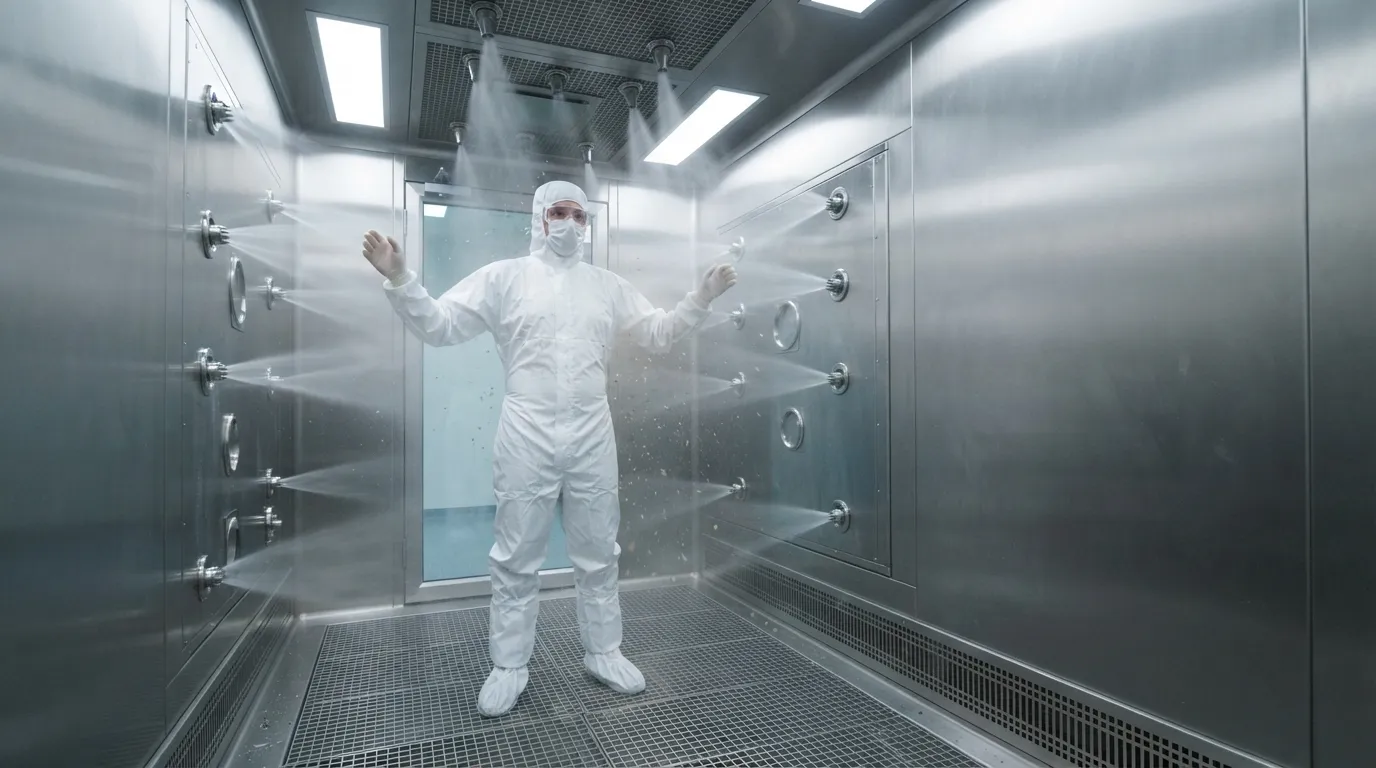
The operating cycle follows a straightforward sequence:
- Personnel or objects enter the air-shower chamber.
- Nozzles discharge high-velocity filtered air from multiple directions.
- The airflow dislodges loose particles from garments, skin, or object surfaces.
- Contaminated air is drawn toward the base of the chamber.
- Filters capture the particles.
- Cleaned air is recirculated through the system.
The effectiveness of an air shower depends on factors such as airflow velocity, nozzle placement, cycle time, and filter condition. A system described simply as "HEPA-filtered" does not, on its own, demonstrate whole-system performance — the airflow design and filter integrity matter equally.
Where Air Showers Fit in the Entrance Sequence
Air showers are commonly positioned after the gowning room and immediately before the cleanroom. Clean Air Products' technical guidance describes the air shower as a final cleaning step before cleanroom entry, with personnel first donning appropriate cleanroom clothing in a gowning room.
This order makes sense: gowning introduces particles from the garment itself, and the air shower removes loose surface contamination before the wearer crosses into the controlled area.
Air Shower vs. Entry Mat: Two Different Contamination Pathways
The fundamental difference between an air shower and an entry mat is the contamination pathway each one addresses.
An air shower targets loose particles on surfaces — clothing, exposed skin, or the exterior of components and packaging. An entry mat targets contact contamination — particles transferred from footwear or wheels onto the floor. These are not the same problem, and one system does not automatically cover for the other.
| Factor | Cleanroom air shower | Cleanroom entry mat |
|---|---|---|
| Contamination pathway | Loose surface particles on garments, skin, or objects | Particles carried on footwear or wheels |
| Removal mechanism | High-velocity filtered air dislodges and captures particles | Adhesive surface captures particles on contact |
| Typical position | After gowning, before cleanroom entry | Floor-level, positioned according to the facility's contamination-control plan |
| Replaces the other? | No | No |
The decision to use both systems depends on the facility's validated contamination-control strategy, the cleanroom classification, and the type of traffic entering the area. Some entrances with full gowning and air showers may still benefit from an entry mat where floor contamination is a known risk. Others may rely on an air shower alone. There is no universal rule requiring both.
For detailed information on mat options for air-shower rooms, see Nabai's dedicated pages on the sticky mat for air shower room and the adhesive mat for air shower.
Designing a Cleanroom Entrance: Gowning, Air Showers, and Entry Mats
Entrance design requires a clear sequence: gowning, air shower, and then cleanroom entry — with the mat decision made independently, based on the contamination sources present.
There is no single layout that fits every cleanroom. The right design depends on the cleanroom's ISO classification, the sensitivity of the process, the volume of personnel or material traffic, and the facility's validated contamination-control plan.
Personnel Traffic
For personnel, the entrance sequence typically follows this pattern:
- Change into cleanroom garments in the gowning room.
- Enter the air-shower chamber.
- Complete the air-shower cycle.
- Enter the cleanroom.
The air-shower chamber must be sized for the expected number of people per cycle. Some facilities install a single-person unit; others use larger chambers for multiple staff members. The correct size depends on shift patterns, the number of people entering, and the facility's planned workflow.
Cart and Material Traffic
Carts and materials present a different challenge. Air showers for carts require larger chambers, wider doors, and different nozzle placement than personnel units. The supplier should provide dimensioned drawings showing that the specified chamber can accommodate the largest cart or material load the facility expects to move through it.
Entry mats for cart traffic need to be positioned where wheel contact is most likely. A peel-off adhesive mat can capture particles from wheels just as it does from footwear, but the mat must be wide enough and positioned so the cart actually crosses it.
Mat Placement Questions
Before deciding whether an entry mat belongs in the sequence, ask:
- Is the mat intended to protect the area before the air shower, after it, or both?
- Will it be used by personnel, carts, or both?
- Should the mat be a disposable peel-off type or a washable silicone mat?
- Does the facility's contamination-control plan or validation protocol require a mat at this location?
- What documentation and replacement or cleaning procedures apply?
The answers determine whether a mat adds value at a specific entrance — and which type is appropriate.
For mat-specific selection guidance, refer to the sticky mat for air shower room and the adhesive mat for air shower product pages.
How to Evaluate an Air Shower Manufacturer
When evaluating an air-shower manufacturer, focus on evidence rather than marketing language. A credible supplier should be willing to provide model-specific specifications, technical drawings, filter and airflow data, and installation documentation.
Use this checklist when comparing manufacturers:
- Confirm whether the company is the actual manufacturer, a distributor, or a system integrator.
- Request the model-specific technical data sheet and dimensioned drawings.
- Ask about chamber size, door dimensions, and compatibility with the planned traffic.
- Request airflow velocity and uniformity data for the specific model.
- Confirm the filter type (HEPA or ULPA) and the filter replacement procedure.
- Ask about door interlocks, control logic, and cycle time.
- Ask who performs installation and what site acceptance testing is included.
- Confirm the maintenance schedule, spare-parts availability, and after-sales support.
Manufacturer, Distributor, or Integrator?
The first step is understanding who you are actually dealing with:
- Manufacturer: designs and builds the air-shower unit. The manufacturer should have drawing, testing, and support responsibilities.
- Distributor: resells air showers produced by another company. A distributor may not have the authority to modify designs or provide direct after-sales support.
- Integrator: combines equipment, installation, and commissioning into a system. An integrator may manage the full project but may not manufacture the air shower itself.
Knowing which role you are dealing with matters because it determines who is responsible for design accuracy, performance validation, and warranty support.
Chamber Size and Traffic Type
The chamber must fit the traffic. For personnel, this means the number of people entering per cycle and the usable internal height. For carts, this means the overall dimensions of the largest load that will pass through.
Ask the manufacturer for a dimensioned drawing showing the chamber, door openings, nozzle positions, and clearance allowances. Do not rely on catalogue dimensions alone — site layout may impose constraints the catalogue does not cover.
Filter Type, Airflow Data, and Door Controls
The filter category matters, but it is only one part of the system. A manufacturer should be able to state:
- the filter type (HEPA or ULPA) and whether it is fitted on the supply side, exhaust side, or both;
- the airflow velocity at the nozzles and how uniform the airflow is across the chamber;
- how door interlocks and the control system prevent both doors from opening simultaneously;
- the recirculation path and how frequently the filters are replaced.
Depending on the facility design, cleanroom air handling may also involve other components such as a fan filter unit ffu supplier for supplying filtered air to the cleanroom itself. An FFU serves a different function from an air shower — it maintains ceiling-level filtration and airflow, while the air shower is a self-contained entrance-control system — but both are typically specified at the same design stage.
Installation, Commissioning, and Maintenance
An air shower is only as effective as its installation and its maintenance program. Before purchasing, clarify:
- Who is responsible for installation and site acceptance testing?
- What tests are performed at commissioning? Examples include airflow measurement, filter leak testing, and door-interlock verification.
- What is the recommended filter replacement interval, and how are replacement filters sourced?
- What spare parts are held in stock, and what is the typical lead time?
- What after-sales support does the manufacturer provide for the life of the unit?
Documents and Evidence Every Buyer Should Request
For any air-shower purchase, the supplier should provide documentation that matches the exact model in the quotation.
| Document | What it provides | What to verify |
|---|---|---|
| Technical data sheet (TDS) | Model-level specifications, chamber dimensions, filter type, electrical requirements | The model number matches the quotation |
| Batch or model-specific test report | Measured values such as airflow, filter integrity, or noise level | The test method, date, and model or batch identifier |
| Certificate | Formal attestation of compliance with a named standard | The standard, issuing body, and covered product or batch |
| Safety data sheet (SDS) | Handling, storage, and safety information | Relevant to installation and maintenance staff |
| Dimensioned drawings | Physical layout, door openings, and service clearances | Match the site layout and planned traffic |
| Installation and maintenance manuals | Setup, operation, filter change, and service procedures | Written for the specific model supplied |
TDS vs. Test Report vs. Certificate
These three documents are easy to confuse, and the distinction matters:
- A technical data sheet (TDS) describes the typical specifications of a product or model. It states what the unit is designed to do, but it is not proof that a specific unit achieved a specific result.
- A test report records measured values for a defined model or batch, using a named test method. It is evidence that the unit was actually tested.
- A certificate is a formal attestation of compliance. It is only meaningful when it names the standard, the issuing body, and the specific product, model, or batch covered.
Safety, Compliance, and Environmental Documents
Depending on the application, additional documents may be required:
- An SDS (safety data sheet) where installation, maintenance, or cleaning involves chemicals or adhesives.
- RoHS or REACH statements when the buyer's application or target market requires substance-compliance documentation.
- Flammability or other test statements only when the application requires them.
When a supplier claims compliance with a standard, ask for the document that proves it — and confirm that the document names the exact product or batch you are buying.
Common Mistakes When Specifying Cleanroom Entrances
Five mistakes appear repeatedly when facilities specify air showers and entrance controls:
1. Treating "HEPA-filtered" as proof of whole-system performance. The filter is a component, not the entire system. Airflow velocity, nozzle placement, recirculation design, and filter integrity all affect performance.
2. Treating ISO 14644 as a product certification. ISO 14644-1 classifies air cleanliness by particle concentration in a cleanroom; it does not certify that an individual air shower or mat meets a cleanliness grade. ISO 14644-4 covers cleanroom design, construction, and start-up — again, not a product certificate. A supplier who claims "ISO 14644 compliant" for a product should explain what that actually means.
3. Assuming an air shower replaces all floor-level contamination controls. An air shower dislodges surface particles; it does not prevent particles from being tracked in on footwear or wheels. That is the entry mat's function.
4. Buying from a supplier without verifying whether it is the manufacturer. Distributors and integrators have legitimate roles, but the buyer should know who is responsible for design, performance, and support.
5. Skipping commissioning and documentation. An air shower that is not properly installed, tested, and documented can fail silently. Site acceptance testing and a complete documentation pack protect the buyer after installation.
Summary and Next Steps
An air shower and an entry mat each control a specific contamination pathway. An air shower removes loose surface particles with high-velocity filtered air; an entry mat captures contamination transferred on footwear and wheels. The decision to use one, the other, or both should be based on the facility's validated contamination-control plan, traffic type, and cleanroom classification — not on a generic rule.
When evaluating an air-shower manufacturer, ask for model-specific drawings, specifications, airflow and filter data, commissioning procedures, and after-sales support. The manufacturer that can provide this evidence is the one worth taking seriously.
For mat-related decisions at air-shower entrances, Nabai provides dedicated product pages covering the sticky mat for air shower room and the adhesive mat for air shower. Contact Nabai with your cleanroom entrance details if you need help selecting an appropriate contamination-control solution.
NEWS
GET SERVICE
With quality parts to meet every budget and friendly staff trained to make your visit informative and hassle free.