
How High Tack Sticky Roller Saves Millions in Electronics Manufacturing Yield

How High Tack Sticky Roller Saves Millions in Electronics Manufacturing Yield
In electronics manufacturing, yield rate is the ultimate metric of success. A single microscopic particle landing on a PCB, display panel, or semiconductor wafer can trigger short circuits, open circuits, or visual defects—scrapping an entire product. With the shrinking of component densities comes the increase in cost and importance of contamination control, which is where the High Tack Sticky Roller comes in. These rollers are a cost-effective method of removing particle contamination. They combine high-adhesion cleaning and gentle surface contact, so they are able to funcionally remove particle contamination without damaging the sensitive electronics.
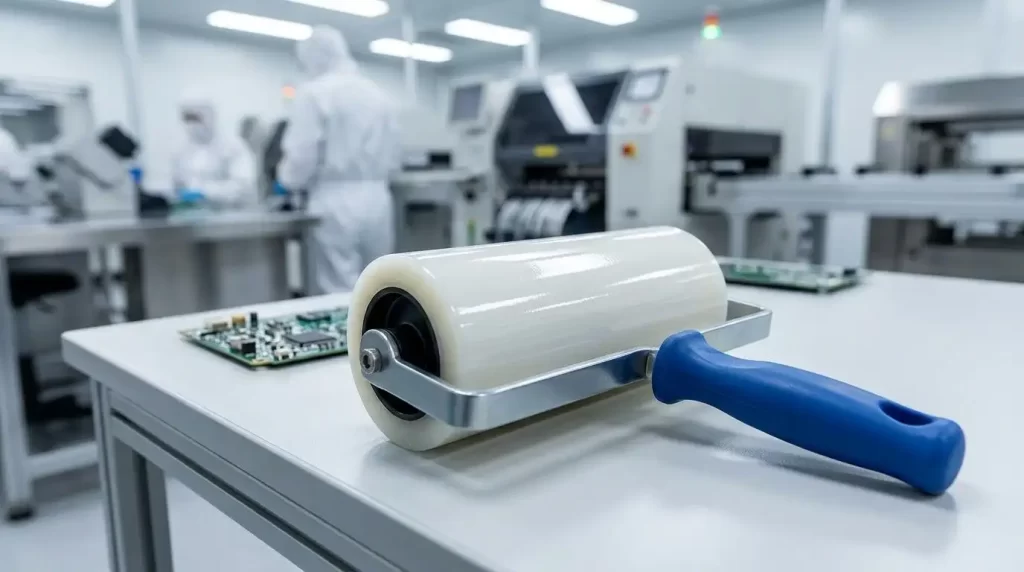
Below, we examine the science, application, and the engineering of high quality sticky rollers, and we use Nabai's sticky rollers as an example of how a quality sticky roller can save the manufacturer millions of dollars.
The Microscopic Contamination Yield Threat
Before we can develop a solution we must understand the depth of the problem.
•Particle size matters: A 10μm dust particle is invisible to the naked eye, yet it can ruin a 5nm semiconductor trace or create a dead pixel on an OLED screen.
•Common sources of contamination: Human skin flakes (30–50μm), clothing fibers, airborne dust, and even residue from packaging materials all settle on sensitive surfaces.
•Cost of a single defect: In high-volume PCB assembly, a 1% yield loss on a $10 million monthly production run equals $100,000 lost—before rework or warranty claims.
•Cleanroom classes explained: ISO 5 (Class 100) cleanrooms allow no more than 3,520 particles (≥0.5μm) per cubic meter. A careless cleaning tool can easily violate this limit.
Using cleaning methods like compressed air or cloth wipes tend to spread and/or leave behind particles and/or fibers. The High Tack Sticky Roller provides a controlled, residue-free option.
How a High Tack Sticky Roller Works - The Science of Clean
A High Tack Sticky Roller consists of a cylindrical core that has a layer of pressure-sensitive adhesive. When a Sticky Roller is rolled over a surface, it lifts and traps particles through several different actions.
•Van der Waals Forces: The attraction of the adhesive's molecules actually draws particles away from the surface, and it does so without the need for a solvent, or even a mechanical abrading system.
•Mechanical Engrampment: The soft adhesive of the roller adequately conforms to the many absurdities of a surface, and thus traps much of the debris that is simply too small to be seen and/or be captured through the use of a conventional style broom or vacuum.
•Electrostatic discharge safety (ESD-safe): Specialized high tack rollers, including many from Nabai, are formulated with anti-static properties—preventing sudden discharges that could fry sensitive chips.
Unlike sticky tapes, a High Tack Sticky Roller does not leave adhesive residue. After use, the contaminated outer layer is peeled off (if using a roll of adhesive sheets) or the silicone surface is cleaned for reuse (in industrial systems).
Critical Applications in Electronics Production
Where exactly does a High Tack Sticky Roller save yields? Let's walk through three key stages.
1. PCB Assembly Line – Before Component Placement
•Solder paste printing: Dust on the stencil or PCB pads leads to poor solder paste release causing opens or bridges. A sticky roller cleans stencils between cycles.
•Pick-and-place machines: These high-speed robots pick tiny passive components (0201, 01005 size). A particle on the nozzle or feeder can misalign the component—immediately flagged by AOI (automated optical inspection).
•After reflow: Flux residue and airborne carbon particles settle on boards. Rolling with a High Tack Sticky Roller removes them before conformal coating or testing.
2. Display Module Assembly – LCD, OLED, Touch Panels
•Bonding surfaces: Before laminating cover glass to the display, even a 5μm dust speck creates a visible bubble or Mura defect.
•Polarizer attachment: Dust trapped under the polarizer creates bright spots that cannot be repaired. Manufacturers routinely use sticky rollers on both film and panel surfaces.
•Flexible OLED fabrication: These ultra-thin layers are easily scratched. Nabai's low-lint PE rollers bond gently with surfaces for cleaner particle removal without the inclusion of mechanical stress.
3. Semiconductor Back-End – Wafer Handling and Packaging
•Wafer dicing: Once the wafer has been sectioned into discrete dies, silicon dust remains on the surface. A High Tack Sticky Roller can remove this dust prior to die bonding.
•Wire bonding: Wire bonds are constructed from either gold or copper and require the bonding pads to be completely clear. Contamination causes the wire bond to be weak and to fail prematurely.
•Molding and trim/form: Leadframes typically collect some plastic flash or dust which can be removed by inline roller stations.
Nabai's Standard PE Sticky Roller – Engineered for High-Yield Cleaning
To protect yield, a High Tack Sticky Roller needs to meet the highest demands. Nabai's standard PE sticky roller is a good example of such engineering. The product description that follows is the actual product description with some additional information.
1. Product Overview
Nabai's standard PE sticky roller fuses surface performance and stabilized particle collection with durable PE roller material. The rollers smooth adhesive surface removes cleaning debris from a sensitive surface.
2. Key Advantages Explained
Chemical resistant PE surface: The roller can be used with stable effectiveness where the environment is moist or may have come in contact with oils. In many electronic lines, there are mild solvents or a mis of coolants. Standard acrylic rollers would be damaged, but PE roller remains intact.
•Low lint cleaning structure: The fiber residue left on surfaces when cleaning is reduced with the PE material. This is critical for cleanrooms; any lint left behind becomes a new contaminant.
•Gentle particle removal: The adhesive layer lifts dust and fine debris from delicate surfaces such as flexible PCBs, anti-glare coated glass, or gold-plated contacts.
3. Performance & Technical Data (Nabai Standard PE)
| Feature | Description |
| Material | Polypropylene (core) + Acrylic adhesive |
| Adhesive Strength (g/25mm) | 250g–550g (selectable according to tack level required) |
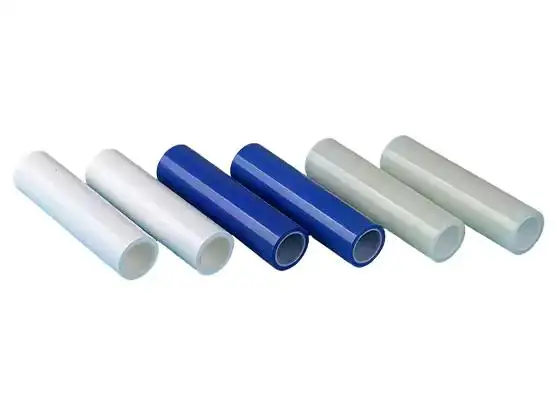
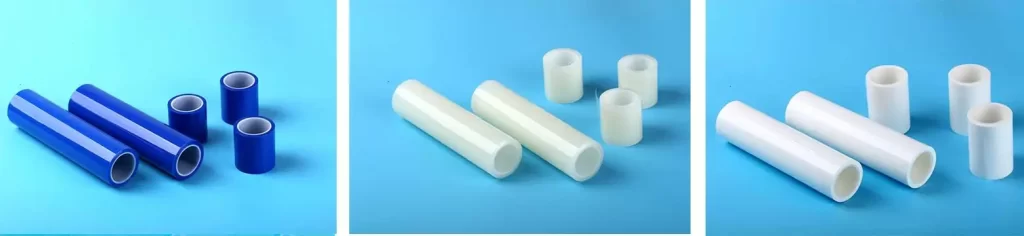
| Color | White (cleanroom), Blue (general industrial), Transparent (multi-purpose) |
| Thickness (μm) | 4C–6C (40–60μm) |
| Length (m) | Customizable per customer requirements |
| Width (mm) | 4″, 6″, 8″, 10″, 12″ or custom (102mm–305mm) |
| Inner Core Size (mm) | 38mm / 76mm / 25.4mm / 50.8mm (to fit standard handles) |
| Packing | 4″: 10pcs/bag, 200pcs/carton; 6″: 10pcs/bag, 100pcs/carton; 8″: 5pcs/bag, 100pcs/carton; 10″: 5pcs/bag, 50pcs/carton; 12″: 5pcs/bag, 50pcs/carton |
How to Use Nabai's Sticky Roller for Maximum Yield Protection
•Hold the Roller: Grip the handle comfortably. Ergonomics lessens fatigue from constant cleaning (e.g., cleaning every PCB batch).
•Roll Over Surface: Glide roller with even contact and light pressure. More force won't lead to increased contact and will potentially damage coating.
•Tear Soiled Sheet: Tear guides are on the sheet to help with removal. Don't reuse sheets, previously used sheets can damage surfaces.
•Continue Cleaning: In production settings sheets are replaced and cleaning continues every 5-10 boards found to be contaminated.
•Dispose: Previously used sheets can be recycled with normal waste.
Nabai's Design and Technical Advantages Over Generic Rollers
How is a high quality high tack sticky roller different from a cheap roller? Here are some of Nabai's advantages over competitors.
•Uniform adhesive coating (≤±2μm variance): Cheap rollers leave stripes. Nabai rollers leave no stripes.
•Perforation precision: Perforation is laser guided - no jagged edges on a Nabai roller. Jagged edges can damage a surface.
•Ball-bearing handle integrated: Nabai rollers have constant pressure thanks to ball-bearing design. With a cheap roll constant pressure will leave missed areas and deep wear.
•Anti-static surface resistivity (10⁹–10¹¹ Ω/sq): Prevents triboelectric charging when rolling over insulators like FR-4 PCBs or polyimide films. A static discharge as low as 30V can damage MOSFET gates.
•Low outgassing adhesive: Meets outgassing requirements for sealed electronic assemblies (e.g., hard disk drives, optical modules). No silicone vapors that contaminate contacts.
•Customizable tack levels: Nabai offers 250g/25mm (low tack for AR-coated glass) up to 550g/25mm (high tack for rough surfaces like solder mask). Users can select exactly what their yield data demands.
Conclusion: Small Tool, Massive Impact
The High Tack Sticky Roller is often overlooked as a commodity item. Yet in electronics manufacturing, where profit margins are measured in single-digit percentages and defect costs run high, this humble cleaning tool directly protects yield. Nabai's standard PE sticky roller brings chemical resistance, low linting, and gentle particle removal to the production floor—backed by precise technical specifications and customizable options. For any quality engineer seeking a low-cost, high-return contamination control method, the High Tack Sticky Roller deserves a prominent place in their process flow.
GET A QUOTE – Nabai offers standard and custom high tack sticky rollers for cleanrooms, PCB assembly, display bonding, and semiconductor backend. Contact their engineering team to match tack level, width, and core size to your exact production needs.
FAQs
Q1: Is Nabai's standard PE sticky roller ESD-safe?
Yes, it may be made with Surface Resistivity of 10⁹ to 10¹¹ Ω/sq, which is great for electronics sensitive to static issues.
Q2: Will the roller leave residue on my display or wafer surface?
No, a quality high tack sticky roller uses residue-free acrylic adhesive; cheap alternatives may leave glue marks.
Q3: How often should I replace the roller handle or core?
Handles with ball bearings last thousands of cycles. Replace only when rolling becomes uneven or the bearing feels rough.
Q4: Can the roller be used on uneven surfaces?
The soft adhesive works best on flat surfaces, but can make a stronger bond on PCBs and cable connectors where moderate curves are present.
Q5: How do I get a custom width or tack level from Nabai?
Full customization is available, and only Nabai's sales team need to know your required roller width (from 1″ to 12″+), core, and adhesive strength.
NEWS
GET SERVICE
With quality parts to meet every budget and friendly staff trained to make your visit informative and hassle free.