
How Card Slot Sticky Rollers Work | Mechanism & Industrial Guide

How Card Slot Sticky Rollers Work | Mechanism & Industrial Guide
How it Works: Guide to Industrial Cleaning Efficiency
- How card slot sticky rollers work? The cleanliness is not only a necessity in the modern electronics production and precision assembly, but also a performance factor. Even a single microscopic dust particle may lead to conductivity, alignment, or signal stability problems in sensitive parts like card slots and PCB interfaces.
- This is where the card slot sticky roller mechanism is a major concern among the engineers, technicians, and cleanroom operators. These rollers are specifically developed to collect ultra-fine particles with a sophisticated adhesive technology and controlled mechanical pressure.
Nabai ESD provides modern industries with high-performance contamination control solutions.
Knowledge of the Working Principle of Card Slot Sticky Rollers
The principle of cleaning rollers of card slots is based on a very simple and at the same time effective scientific principle: adhesion and surface energy difference. Dust particles are naturally moved off a low-energy surface (electronic card slot) to a high-energy adhesive layer as the roller passes over a surface. Some of the important scientific principles used are:
• Sticky rollers' process of adhesion of particles.
• Principle of adhesion of surface energy difference.
• Viscoelastic adhesive layers behavior.
• Dust lifting mechanism based on friction.
The roller has an adhesive coating that is intended to trap micro and Nano-sized contaminants without leaving any residual. This is suitable for cleanroom-grade roller cleaning systems and high-precision electronics maintenance tools.
Detailed Explanation of the Sticky Roller Mechanism of Card Slots
The card slot sticky roller is made to fit in small and delicate areas that cannot be accessed by conventional cleaning tools. It operates by three synchronized activities:
1. Controlled Rolling Pressure
The operator uses light pressure to make sure that the surface is in contact. This improves:
• Dust pickup efficiency
• Particle transfer rate
• Surface contact uniformity
This is known as the rolling pressure effect in improving the efficiency of dust pickup in industrial cleaning systems.
2. Adhesive Layer Interaction
The roller surface has pressure-sensitive adhesive technology, which traps particles instantly.
This includes:
• Micro-particle capture system
• Low-residue adhesive coating technology.
• Micro-fiber particle entrapment system.
3. Particle Locking Mechanism
The high viscosity and surface tension differences entrap the particles in the adhesive layer when they are attached. This ensures that there is a non-destructive cleaning process of the surface that can be used on sensitive electronic parts.
Operation of Sticky Roller Card Slot Step-by-Step
How card slot sticky rollers work? The knowledge of the card slot sticky roller operation can assist technicians in utilizing it better in industrial settings.
Step 1: Surface Alignment
The roller is positioned directly on top of the card slot.
Step 2: Smooth Rolling Motion
A gradual, deliberate motion starts over the slot area.
Step 3: Particle Pickup
The dust and micro-contaminants adhere immediately to the adhesive layer.
Step 4: Cleaning Pass Repeat
High contamination may require several passes.
Step 5: Surface Inspection
The space is inspected using lighting or magnification equipment.
The whole card slot cleaning roller working process guarantees the uniformity in the performance of this roller in a sensitive environment, such as semiconductor assembly.
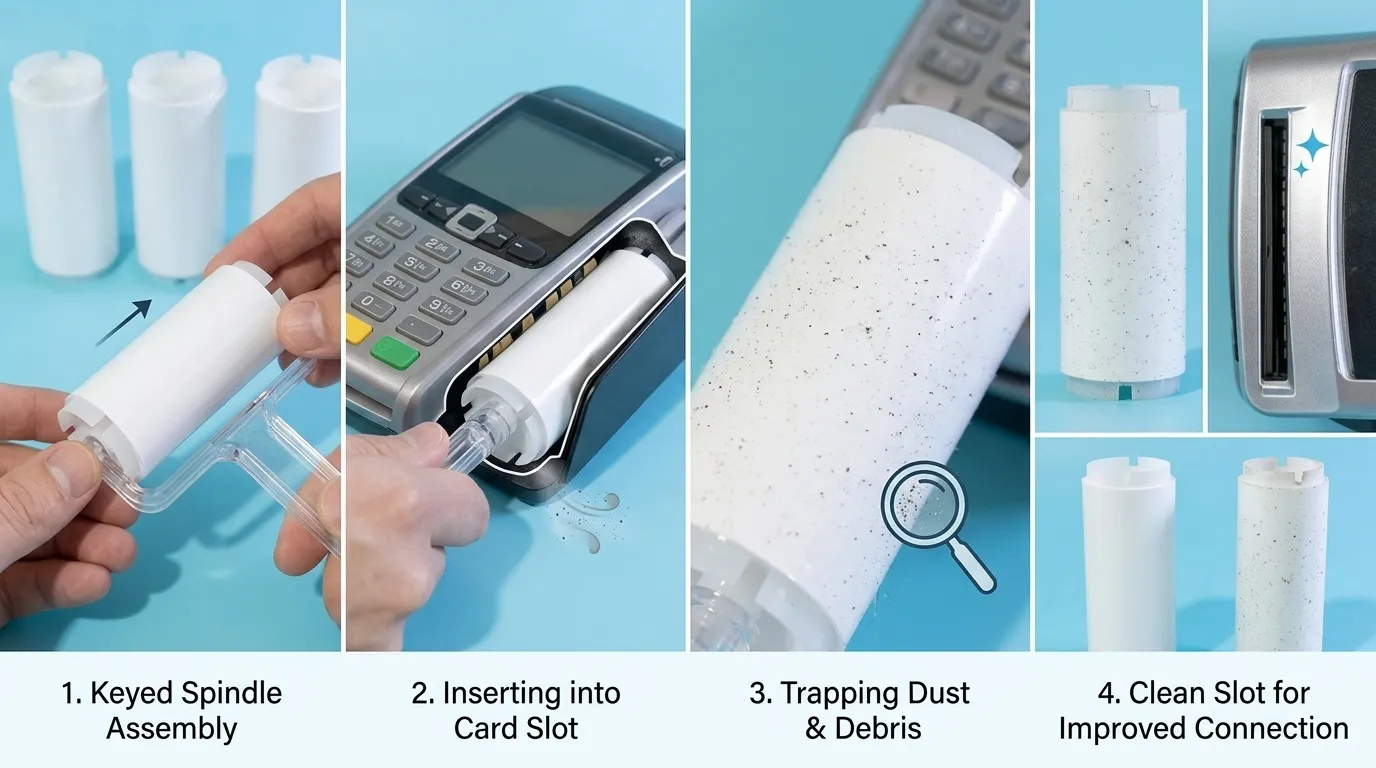
Industrial and Technical Organization of Sticky Rollers
The industrial sticky roller mechanism is made of high-engineering materials that are accurate and long-lasting. Key components include:
• Elastic roller core to roll easily.
• ESD-safe outer coating
• Pressure-sensitive adhesive layer
• Anti-static handle design
Supporting technical systems:
• Electrostatic dust cleaning roller system.
• Card slot cleaning technology that is ESD safe.
• Cleanroom dust control equipment.
These systems can be safely used in an environment where the release of static charge may be detrimental to the microchips or electronic circuits.
Mechanism of Dust Removal in Card Slot Rollers
The multi-layer interaction of particles makes the dust removal mechanism in card slot rollers very efficient.
It works through:
• Electrostatic attraction neutralization
• Trapping of micro particles by adhesion.
• Surface energy imbalance exploitation
This is usually known as a particle removal roller working principle in cleanroom engineering. It is widely used in:
• Cleaning machines of electronic card slots.
• Cleaning products in the PCB slot dust.
• Cleaning equipment of semiconductor assembly.
Precision Engineering Behind Cleaning Rollers Adhesive
The card slot cleaning systems have modern adhesive rollers that are designed with material science. Some of the important engineering concepts are:
• Surface energy difference principle of adhesion.
• Friction-based dust lifting mechanism.
• Behavior of the viscoelastic adhesive layer.
• Accurate cleaning system of small slots.
These properties enable the roller to do contamination control on electronic components without actual abrasion or damage to the surface.
Uses in Industry and Cleanroom Applications
Sticky rollers are card slot sticky rollers that are usually used in different industries, where the control of contamination is of utmost importance. Major applications include:
• Semiconductor manufacturing lines
• Precision electronics maintenance
• Cleanroom production environments
• Dust abatement systems in industries.
They are especially important in cleanroom card slot cleaning tools, where even microscopic dust can lead to product failure.
Benefits of Using Card Slot Sticky Rollers
These rollers have several operational benefits:
• High-efficiency dust removal
• Non-abrasive cleaning process
• Minimizes failure of products.
• Improves manufacturing yield
• Favors production lines that are contamination-free.
The contamination removal process on the surface ensures a consistent and reproducible cleaning performance.
Technical Overview of How Sticky Rollers Work
To summarize how adhesive cleaning rollers function:
- Controlled contact leads to the loosening of dust particles.
- Micro-contaminants are immediately trapped in the adhesive layer.
- Particles are adhesive-bonded.
- Surface is clean with no residue or damage.
This is the principal dust removal process in card slot rollers, which is popular in industrial contamination control systems.
Conclusion
Reliability in high-tech electronics manufacturing is cleanliness. The card slot sticky roller is not merely a cleaning device, but a highly-engineered contamination control system, which is based on science, material innovation, and controlled adhesion.
Professional solutions are available in case you want to achieve stable and cleanroom-grade performance. Enhance and advance your production dependability. Select trusted engineering with real-world industrial performance in high-precision applications. Visit Nabai.
NEWS
GET SERVICE
With quality parts to meet every budget and friendly staff trained to make your visit informative and hassle free.