
How Do Sticky Mats Work | Cleanroom Contamination Control Guide

How Do Sticky Mats Work | Cleanroom Contamination Control Guide
What is a Sticky Mat | Cleanroom Contamination Control
- The query is how sticky mats work, which is prevalent in clean industries. These mats enable a clean space in the laboratories, hospitals, and factories. They are applied as a floor mat that traps particles, which reduces dust on shoes and wheels.
- The principle of a cleanroom sticky mat is very effective and easy to work with. It has sticky layers to capture dirt before it enters clean areas. This helps in ensuring that the hygienic levels in sensitive areas are maintained. These mats are also known as contamination control sticky mats. They act as a shield between the dirty and clean areas.
Basic Principles of Sticky Mat
The principle of sticky mat working is adhesive. Dust is deposited on the surface with every step. It operates by an adhesive surface that is pressure sensitive and grips fine particles. When the shoes or wheels come in contact with dust, it attaches instantly.
Key working flow:
- Foot or wheel contacts the mat surface.
- Dust and debris are held in an adhesive layer.
- Particles are trapped in the surface film.
- A clean layer is on to continue to the next step.
This is an example of a dust-trapping floor system in controlled areas.
Design of Adhesive Structure and Layer Design
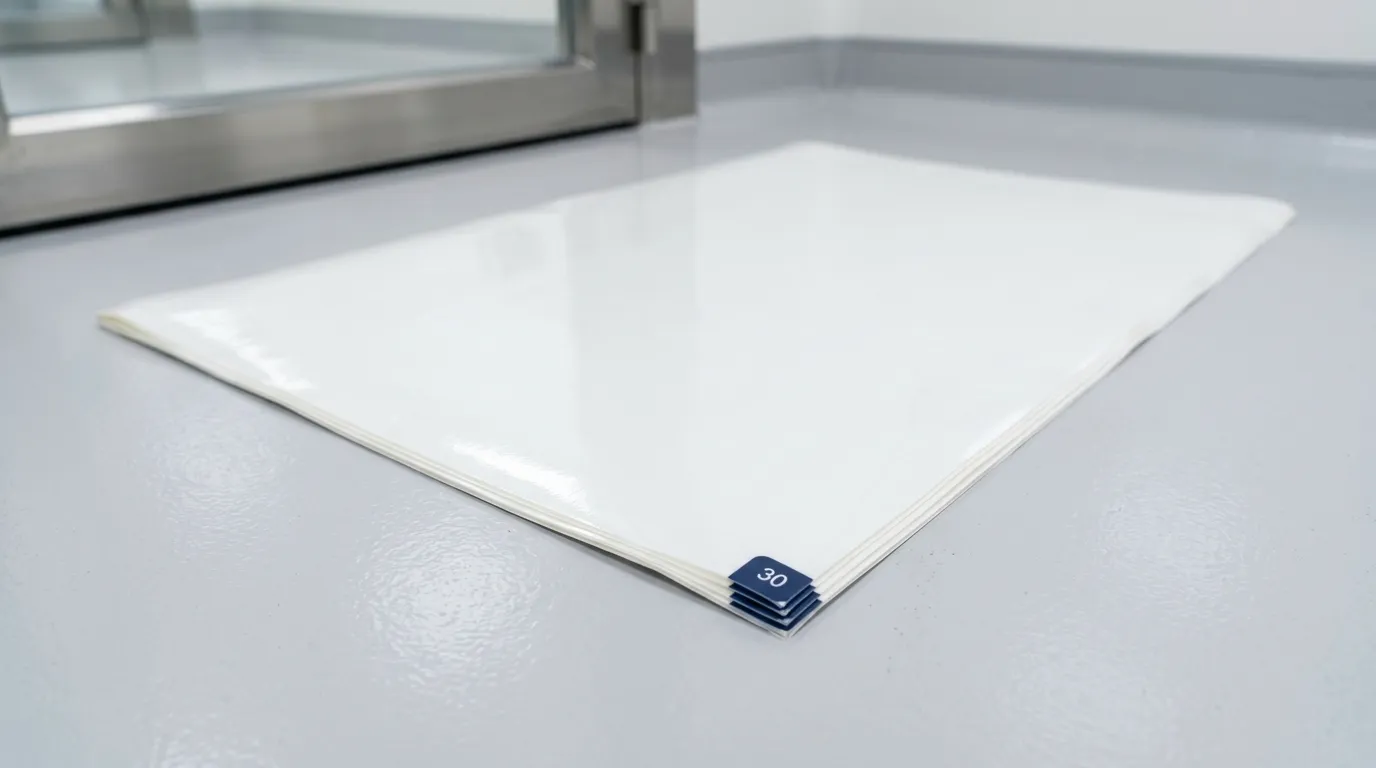
The strength of a sticky mat is based on its design. It is a multi-layer peel-off mat system that allows for new cleaning layers.
Technical Layer Build
- Top Layer: Static-dissipative polymer surface
- Middle Layer: Conductive layer of charge distribution.
- Bottom Layer: Low-lint high-strength backing.
This forms a mat layer structure that is tacky and can be used over a long period in clean zones.
Adhesive System
• Carbon-loaded conductive adhesive
• Resistivity of stable surfaces control.
• Good fine dust retention.
• Design of low particle shedding.
This design improves the effectiveness of the adhesive particle capture system.
The Working of Adhesive Mats in Removing Dust From Surfaces
The question many users pose is how the adhesive mats can eliminate dust. Surface contact and micro adhesion are the answers. When a shoe is stepped on the mat, the dust is sprayed onto the adhesive film. The particles are trapped at the micro level by the mat. The process is referred to as:
- Surface debris capture technique.
- Particle adhesion mechanism
- Micro-particle trapping technology
It is a dust spread prevention surface technology that is a contamination control technology.
Location in Cleanroom Sticky Mat Working Environments
In clean industries, entry to cleanrooms is necessary. Cleanroom sticky mat system minimizes contamination at entry points.
It is used in:
• Areas of the ISO cleanroom floor mat system.
• Cleanroom sticky mats semiconductor.
• Dust control entrance systems in the laboratory.
• Biotech contamination prevention mats.
This helps in safe entry zones and controlled environment floor protection.
ESD and Static Control of Sticky Mats
The static charge is also controlled by the modern mats. This causes them to be included in ESD-safe sticky mat explanation systems. Electronics and instruments are sensitive to damage from static. Such mats minimize that risk. Technical features:
- A polymer layer that is not moving and dissipative.
- Carbon adhesive coating is conductive.
- Middle layer of charge distribution.
- Support by backing.
This forms an electrostatic dust control mat that is applied in ESD zones.
Benefits of Cleanroom Entry Contamination Control
A cleanroom entry contamination control solution is the use of sticky mats. They reduce the flow of particles at the points of entry.
They support:
• Cleanroom hygiene barrier system ISO.
• Sterile zone entry cleaning system
• Controlled adhesion surface system.
• Foot-borne contamination control
These mats prevent dirt from entering critical areas.
Biomedical and Healthcare Applications
Medical areas have high hygiene control. Infection safety is enhanced by sticky mats.
- Hospital-grade infection control mats.
- Reduction of laboratory contamination.
- Dust barrier systems of medical cleanrooms.
- Contamination control mats in the operating room.
- Laboratory hygiene flooring systems.
They are also used in the healthcare entry dust reduction mat systems in hospitals.
High-Tech Manufacturing: Industrial Use
Sticky mats are also relied upon in industrial zones. These are used in sensitive production lines.
Common uses include:
• Cleanroom flooring systems in semiconductors.
• Electronics assembly clean areas.
• Precision handling areas
• Prevention tools for biotech facility contamination.
This helps reduce micro-particle adhesion technology risks in production.
Technical Performance and Efficiency Factors
Sticky mat performance is determined by the quality of materials. Key performance points:
• Multi-sheet replaceable mat design.
• Polymer layers of low-tack adhesive.
• Flooring structure non-slip adhesive.
• Removal of contamination from the layers of sheets.
These features increase cleaning management and longevity.
The Reason Sticky Mats are Better Than Ordinary Floor Mats
Normal mats are not able to contain fine particles. Sticky mats are not the same. Comparison points:
• Frequent mats simply smear out the visible dirt.
• Micro-particles are trapped on sticky mats.
• Normal mats enable re-entry of dust.
This renders them an efficient surface particle capture technology solution.
Product Design and Material Insight from Nabai
The Nabai anti-static sticky mat is an ESD control and cleanroom product. Product structure includes:
• Three-layer composite base film
• Polymer top layer-static-dissipative.
• Conductive middle charge layer
• High-strength low-lint backing
• Carbon-loaded adhesive surface
It promotes contamination control entrance mat systems in sensitive areas.
Available colors:
• Blue ESD areas.
• Black is to be used in the general industry.
• White on clean places.
• Facility code custom colors.
Conclusion
Clean zones are based on control. The smallest dust can interfere with the safety of the system. The knowledge of the working principle of how sticky mats work reveals their true worth in contemporary industries. They are a good barrier to dust and static in sensitive areas.
They safeguard clean rooms, hospitals, and laboratories with an easy yet intelligent design. Their stratified system guarantees stability and security of points of entry. Choose trusted contamination control solutions from Nabai. Adjust your cleanroom entrance with reliable sticky mat systems that can fit specific industries.
NEWS
GET SERVICE
With quality parts to meet every budget and friendly staff trained to make your visit informative and hassle free.