
How ESD Safe Sticky Rollers Work | Guide for Cleanroom Use

How ESD Safe Sticky Rollers Work | Guide for Cleanroom Use
What is an ESD Safe Sticky Roller?
An ESD safe sticky roller is an anti-static contamination control roller to eliminate dust, fibers, and micro-particles. It is created to guard against ESD during the production procedure, especially when the electronic parts are fragile. The roller has two tasks simultaneously:
• Scrapes off surface dust adhesively.
• Controls that are in place and have conductive materials.
This combination helps in avoiding the destruction in semiconductor cleanroom contamination control and PCB manufacturing cleaning standards.
The Principle of the Working of the ESD Safe Sticky Roller
The concept of the working of the ESD safe sticky roller is based on two forces. First is adhesion. Second is the static control.
Key working actions:
- The controlled tack adhesive layer technology entraps dust particles.
- Adhesion and removal of the particles increases micro-contaminants.
This is the process of decay and dissipation of charges on the surface and is referred to as the process of static decay and charge dissipation. The roller ensures the cleanliness of surfaces without creating extra static load. This is the reason why it is referred to as a static dissipative sticky roller function tool.
How ESD Safe Sticky Rollers Work
How do ESD safe sticky rollers work? ESD safe sticky rollers might seem to be a simple design, but the design is highly regulated. They wash surfaces and control the risk of electrostatic discharge. Components in electronics work can be destroyed by even the smallest sparks of electricity. This is the reason why these tools are applied in cleanrooms and PCB lines.
We also incorporate the actual industrial terminology, such as electrostatic discharge safe cleaning equipment, static dissipative roller technology, and cleanroom contamination cleaning equipment removal systems, to enhance further SEO power and technical understanding.
Basic Technology of ESD Sticky Rollers
The actual power of this tool is within its structure.
1. Conductive Core Construction
- The core is made of carbon-based materials. It is resistive and has a range of 10 6 -10 9 ohms/square.
- This allows the transfer of charges safely in the roller.
2. Adhesive Coating System
- The outer layers employ a non-transfer adhesive cleaning mechanism.
- It captures dust without leaving any traces.
3. Electrical Continuity Design
The system comes up with a rolling contact dust capture system. It conducts charge between the core and surface safely. In this design, the dissipation of electrostatic charges in each layer is made easy.
The Real Use of Anti-Static Sticky Rollers
The mechanism of how anti-static sticky rollers is easy yet accurate.
Step-by-step flow:
• Roller contacts the surface with a constant pressure.
• Dust adheres because of the difference in surface energy.
• Lift-off of contaminants without re-release.
This helps in the anti-static surface cleaning mechanism in controlled areas. It also enhances the efficiency of the removal process and particle adhesion.
The Reason Behind the Use of ESD Safe Sticky Rollers in Cleanrooms
There is a high level of control needed in cleanrooms. Chips can be damaged by even invisible dust.
The use of these rollers is based on the fact that they support:
• cleanroom contamination removal systems
• low static generation cleaning equipment
• micro-particle pollution control systems.
They are used to keep the ISO-grade environments in electronics and labs. They are, on most occasions, included in ISO clean room compliance tools that are used daily.
ESD Roller Cleaning Mechanism Detailed
The ESD roller cleaning system is a layered contact system.
Key points:
• The dust is caught right away on the adhesive surface.
• Conductive layer minimizes the static charge.
• Rolling motion eliminates recontamination.
• No shedding of fibers in use.
This ensures that there is low roller performance in terms of particle generation. It also safeguards sensitive areas in precision engineering cleaning solutions.
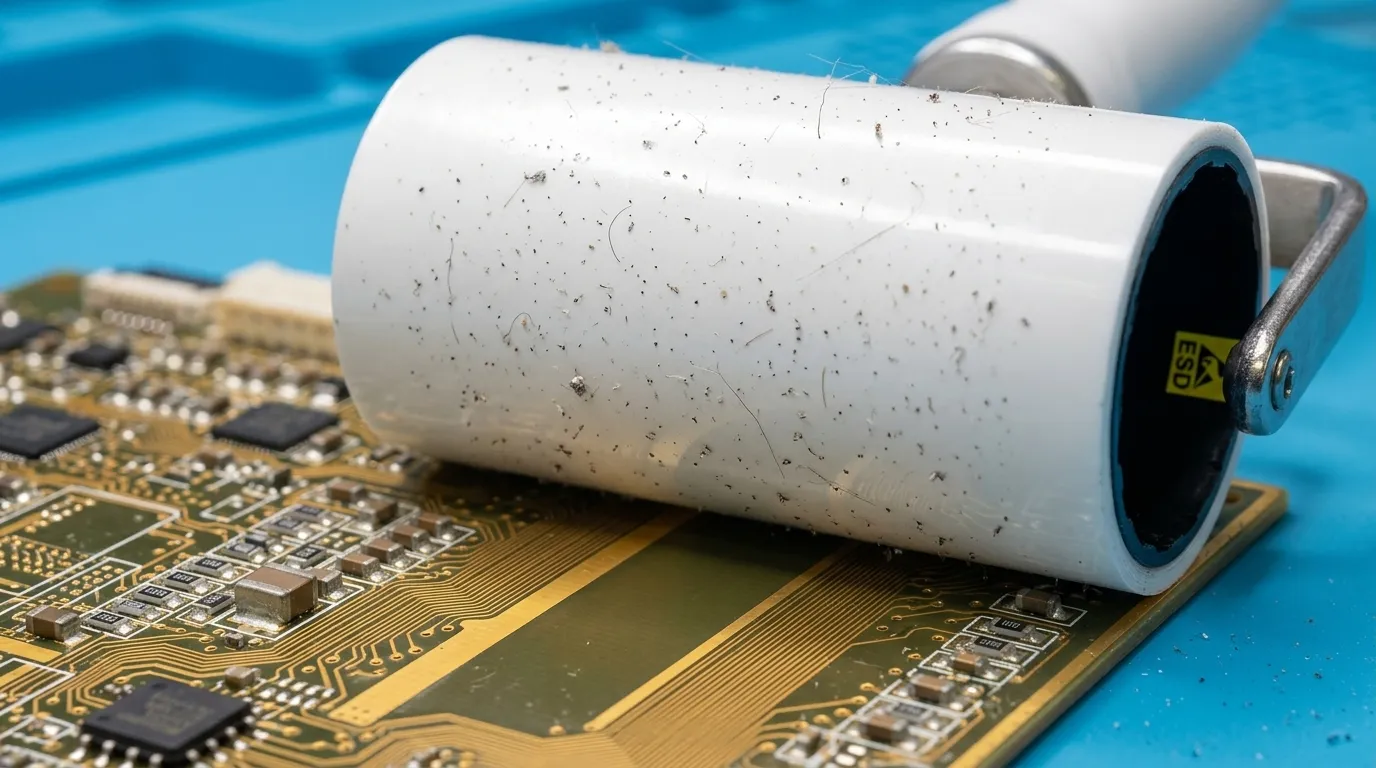
Technical Structure and Material Design
The roller has a high-level material engineering.
Functional elements:
• Polymer roller surface reusable adhesive.
• Ion balancing of ESD safe tools.
• Principle of adhesion of surface energy and particles.
Both layers are dust capture-controlled. This is the reason why it is effective in electronics assembly dust management systems.
Significant Applications in the Electronics Industry
ESD sticky rollers are used in production lines. Main applications:
• PCB assembly cleaning
• Semiconductor wafer handling
• LCD panel production
• Microchip assembly lines
• Automotive electronics modules
They also facilitate ESD protection and cleaning device requirements in delicate factories.
Benefits of ESD Safe Sticky Rollers
These instruments are powerful in terms of operation. Performance advantages:
• Reduces the chances of statistical damage.
• Increases the rate of dust removal.
• Supports cleanroom standards
• Works in low-humidity areas
They help in reducing defects in electronics production by up to 95 percent in controlled systems. This renders them important instruments in the control of particle contamination in electronics.
Full ESD Safe PP Sticky Roller Technology Insight
Full ESD Safe PP Sticky Roller provides full control of the static situation.
Core features:
- A conductive core reduces the risk of static.
- Fine dust is captured by adhesive layers.
- The whole structure aids in charge flow.
Industrial strengths:
• Constant performance up to the final sheet.
• Grounded workstations are safe.
• Operates in 15-20% RH conditions.
This system enhances the performance of the cleaning tools in terms of electrostatic discharge control in industries.
Quality Control and Safety Assurance
All rollers are put through controlled conditions. Quality checks include:
• Measurement of resistivity at different stages.
• Batch-level ESD verification
• Cleanroom production of ISO Class 8.
• Traceable production coding
This renders it safe to apply ESD protection in the manufacturing setups.
Conclusion
How do ESD safe sticky rollers work? Safe sticky rollers that are used by ES are not merely cleaning tools. They are the contemporary electronics protection systems. They are sticky and include a control of statistics. This minimizes harm, enhances quality, and helps in clean production lines.
In order to reach the desired performance of a cleanroom, take into consideration the reputable solutions provided by Nabai ESD and update your contamination control process.
NEWS
GET SERVICE
With quality parts to meet every budget and friendly staff trained to make your visit informative and hassle free.