
How to Choose a Sticky Mat for Cleanroom | Complete Buying Guide

How to Choose a Sticky Mat for Cleanroom | Complete Buying Guide
How to Choose a Sticky Mat for a Cleanroom to Improve Contamination Control
Even a small dust particle can cause costly issues in a cleanroom. The first step in contamination control is at the door, regardless of whether you are operating a semiconductor fabrication plant, a pharmaceutical manufacturing plant, an electronics assembly line, a laboratory, or a hospital sterile room.
- A lot of facility managers pay much attention to air filtration systems and gowning procedures. But foot-borne contamination and wheel-borne contamination are still significant sources of particulate contamination. How to choose a sticky mat for cleanroom can have a substantial impact on the reduction of the number of particles that get into controlled areas.
- To provide businesses with professional contamination control solutions, Nabai has a variety of sticky mats that are ISO-compliant. Nabai sticky mats can be used as the initial barrier to contamination by capturing footwear and cart wheel dust before it gets into sensitive zones.
Knowledge of the Purpose of a Cleanroom Sticky Mat
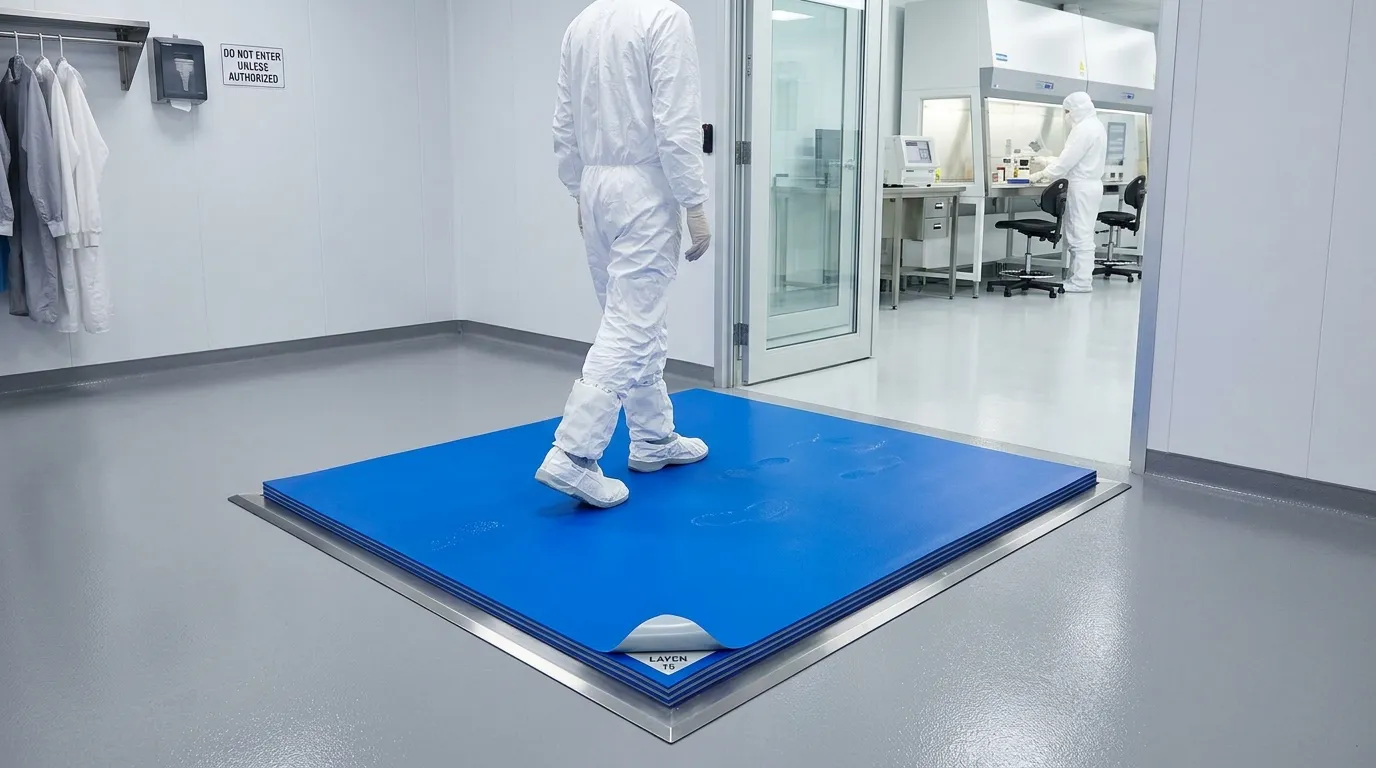
Cleanroom environment sticky mat is a multi-layered adhesive floor system that is used in entry points, gowning areas, and air showers. The adhesive surface captures dust, fibers, dirt, and other airborne particles on the shoes and equipment wheels before they can get to the vital production areas.
In contrast to typical floor mats, a cleanroom tacky entrance mat is a proactive remover of contaminants by controlled adhesive technology.
Key functions include:
• Capturing particulate contamination
• Reducing contamination risk
• Encouraging adherence to cleanroom measures.
• Improving environmental cleanliness
• Preventing particle migration
• Obtaining sensitive manufacturing processes.
These mats are usually used in:
• Semiconductor manufacturing
• Pharmaceutical production
• Electronics assembly
• Medical device manufacturing
• Biotechnology laboratories
• Hospital cleanrooms
Determine Cleanroom Class Compatibility
Cleanroom class-compatible sticky mat performance is one of the initial aspects to be considered. Various cleanrooms have different standards of cleanliness. The ISO 14644-compliant facilities require contamination control products to meet their classification needs. In choosing a mat, check:
• Particle shedding performance
• Adhesive stability
• Material composition
• Cleanroom certification
• Interoperability with ISO Class 5 to ISO Class 8 environment.
The cleanroom entry barrier mats used should be of high quality and have low particle generation, as well as be effective at trapping incoming contaminants.
Selection of the Appropriate Adhesive Strength
Among the most frequently asked questions is:
Low Tack Adhesive
Best for:
• Sensitive footwear
• Light traffic areas
• Laboratory environments
Medium Tack Adhesive
Best for:
• Pharmaceutical facilities
• Electronics production
• Medical device manufacturing
High Tack Adhesive
Best for:
• Semiconductor facilities
• Heavy industrial cleanrooms
• High-traffic entrances
The adhesive must be strong enough to hold the contaminants yet not so vigorous as to leave a residue or inconvenience during operations. Air shower adhesive mats produced by Nabai are generally in the range of 250g to 550g viscosity, which is effective in capturing the larger particles in the busy cleanroom doors.
Take Note of Layer Count
A quality multi-layer sticky mat will consist of a number of peel-away sheets. These sticky mat layers are peel-off and provide a continuous contamination control without the necessity to regularly change the entire mat.
Common options include:
• 30-layer mats
• 60-layer mats
More layers increase is likely to provide:
• Longer service life
• Reduced maintenance frequency
• Better operational efficiency
• Lower replacement costs
Nabai provides sticky mats in different configurations of layers to suit the different contamination control needs.
Sticky Mat Selection Based on Industry
There is a threat of contamination in various industries. Selecting a mat that fits your particular environment enhances performance.
Semiconductor Industry
Semiconductor manufacturing plants need a lot of cleanliness. A single microscopic particle can lead to damage to wafers, a reduction of yield, and influence the production quality.
Recommended options include:
- Semiconductor clean room sticky mat.
- ESD sticky mat for semiconductor manufacturing.
- Wafer fabrication cleanroom mat
- Semiconductor contamination control mat.
- Electrostatic discharge protection is also crucial.
ESD-safe products can be used to safeguard sensitive microelectronic components and still ensure contamination control. Nabai has been applied in semiconductor applications where the ESD protection and control of particulate matter are critical to the integrity of the device.
Pharmaceutical Industry
Pharmaceutical plants have to comply with stringent GMP. Recommended solutions include:
- A cleanroom sticky mat is used in the pharmaceutical industry.
- GMP cleanroom entrance mat.
- Sterile area sticky mat
- Pharmaceutical contamination control mat.
These mats help in keeping the manufacturing environment sterile and help in regulatory compliance programs. Nabai solutions are used in pharmaceutical applications where sterility and prevention of contamination are paramount.
Laboratory and Healthcare
Healthcare facilities are in need of efficient contamination control.
Common choices include:
• Hospital cleanroom sticky mat.
• Laboratory contamination control mat.
• Laboratory entrance mat, sterile.
These mats facilitate the prevention of contamination transfer and are part of hygiene management programs.
What is the Cleanroom Sticky Mat Replacement Schedule?
The replacement frequency is dependent on:
• Traffic volume
• Cleanroom class
• Environmental conditions
• Contamination levels
Best practices include:
• When visibly soiled, change single layers.
• Check the particle build-up.
• Adhere to facility contamination control measures.
• Perform regular cleanroom inspections.
Most of the facilities lose a layer with every visible dirt or with a decrease in the particle capture efficiency.
Conclusion
The process of choosing the right sticky mat to choose a sticky mat for a cleanroom might be a simple purchasing decision, but the selection may directly influence the quality of the product, its adherence to the regulations, volumes of production, and its stability in the operations. The best facilities understand that contamination prevention should start even prior to the employees entering the cleanroom.
Ready to enhance your contamination control plan? Get to know about the high-quality cleanroom solutions that can be found at NABAI and why manufacturers all over the world use their experience in cleanroom and ESD protection.
NEWS
GET SERVICE
With quality parts to meet every budget and friendly staff trained to make your visit informative and hassle free.