
How to Reduce Dust Contamination in Factories | Guide

How to Reduce Dust Contamination in Factories | Guide
How to Minimize Dust Contamination in Factories?
One of the most silent foes in manufacturing is dust. It does not scream, but it destroys all it comes in contact with. Even minor contamination of air particles can decrease the efficiency and quality, starting with product defects and machine wear. This is why the issue of minimizing dust pollution in factories has become an urgent issue in contemporary industrial facilities.
What is Industrial Dust Contamination?
- Dust contamination is any undesirable dust, such as fibers, metal dust, soil, chemical dust, and airborne pollutants, that find their way into the production areas. The particles may be deposited on products, equipment, and delicate electronic parts.
- Even microscopic particles can be disastrous in such industries as electronics, pharmaceuticals, and precision manufacturing. This is the reason why the factory dust management solutions are necessary in ensuring quality control.
Factories are Contaminated with Dust Because of the Following Reasons
Dust does not occur randomly. It has various internal and external sources:
• Handling and cutting of raw materials.
• Poor ventilation systems
• Pedestrian traffic in manufacturing areas.
• Unsealed factory structures
• Friction and wear of machinery.
• Outside air pollution into facilities.
All these factors contribute to airborne particle control in factories, becoming a constant challenge.
The Importance of Dust Control in Modern Manufacturing
Dust particles can create:
• Electronic surface defects.
• Contamination in pharmaceuticals
• Poor bonding of coatings.
• Reduced product lifespan
This has a direct impact on quality assurance in factories, and it increases the rejection rates.
Impact on Production Lines and Machines
The build-up of dust in machines leads to:
• Overheating
• Mechanical failure
• Reduced efficiency
• Frequent maintenance shutdowns
This adds to the cost of operation and lowers productivity.
Health and Safety Hazards
The lack of good industrial hygiene practices may cause respiratory problems to the workers. Small dust particles can be suspended in the air, which can cause greater exposure.
Effective Dust Prevention Techniques in the Industry
1. Air Filtration Systems in Industries
In contemporary factories, industrial air filtration systems are essential for the elimination of airborne contaminants. These systems include:
- HEPA factory filtration.
- HVAC dust filtration systems.
- Air purification systems
The particles of 0.3 microns with a maximum efficiency of 99.97 can be captured by the HEPA filters and are therefore suitable in clean production zones.
2. Dust Collector Systems
An effective dust collector system eliminates the dust particles at the source before they are dispersed.
Key benefits:
• Immediate dust capture
• Reduced airborne contamination
• Better dust control at the workplace.
They are common in woodworking, metal fabrication, and chemical processing industries.
3. Industrial Ventilation Design
Appropriate industrial ventilation systems aid in the maintenance of clean air.
Techniques include:
• Positive pressure cleanrooms
• Areas of negative pressure containment.
• Air circulation systems that are controlled.
These techniques will guarantee constant circulation of clean air in production spaces.
Dust Control Cleaning Procedures in the Factory
The management of factory cleanliness is based on daily cleaning. When surfaces are not cleaned frequently, dust accumulation is rapid.
• Vacuum dust removal as opposed to dry sweeping.
• Wash the machinery every day.
• Adhere to regular cleaning and maintenance.
Sticky Cleaning Solutions and Anti-Static Cleaning Solutions
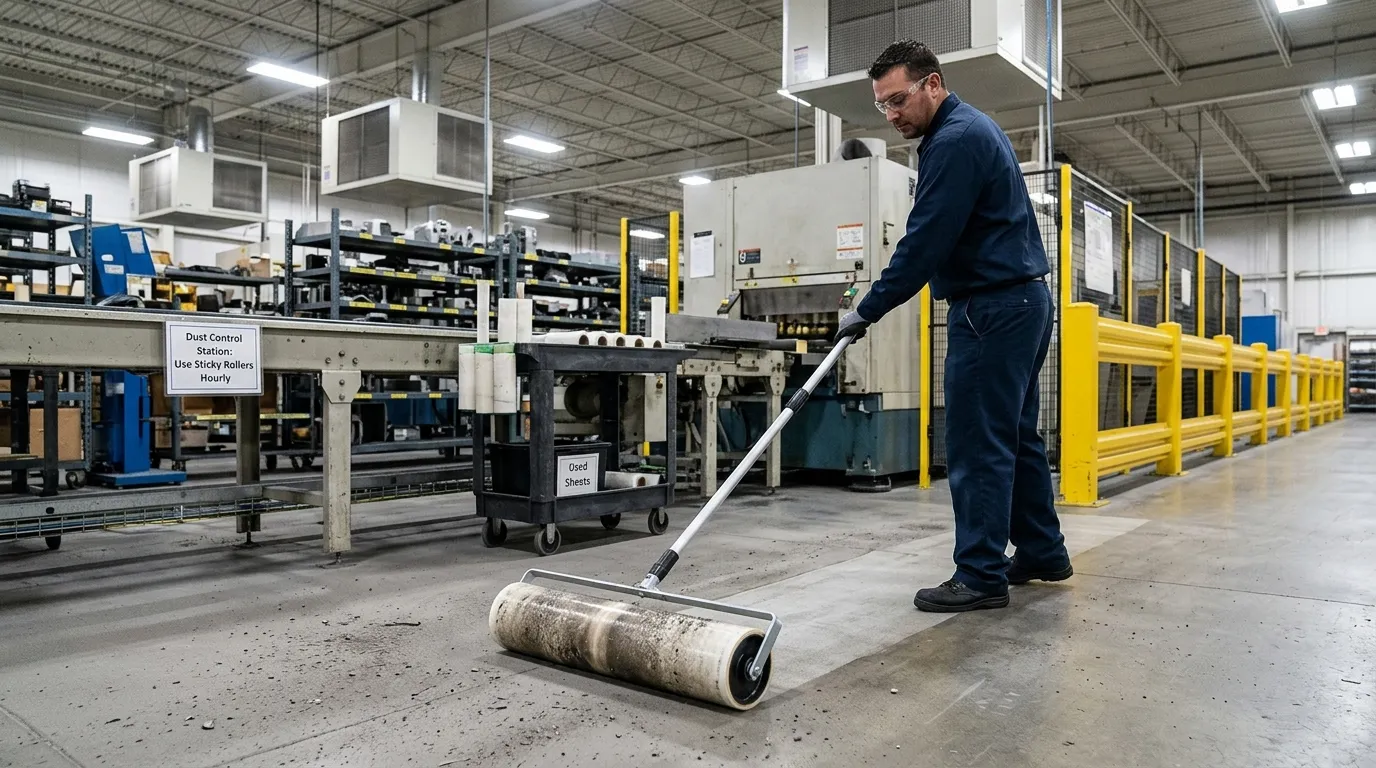
Adhesive-based cleaning products are one of the best tools that can be used in dust suppression techniques in factories. These include:
- Anti-static sticky rollers
- Sticky mat contamination control systems.
- Dry particle removal equipment.
These solutions help in minimizing dust contamination in production areas without damaging sensitive surfaces. Sticky rollers are popular in electronics and precision industries to cleanse small dust and fiber particles at a high speed and without any harm.
Clean Environment Strategies of Manufacturing
How to reduce dust contamination in factories? Cleaning alone does not bring about a clean manufacturing environment. It involves system design.
Key strategies include:
• Clean and dirty areas.
• Controlled entry points
• Workers' air shower systems.
• Protective clothing protocols
ESD-Safe and Electrostatic Dust Control
Dust particles are attracted to the static electricity. Electrostatic dust control is significant in electronics manufacturing for this reason. Solutions include:
• ESD-safe cleaning tools
• Grounded workstations
• Anti-static flooring
This makes particulate contamination management problems a lot less.
State-of-the-Art Dust Filtration and Engineering Solutions
In modern factories, HVAC filtration efficiency systems are highly developed to ensure the air is clean.
These systems regulate:
• Temperature
• Humidity
• Air pressure
• Particle concentration
This guarantees uniform air quality improvement in production areas.
Contamination Monitoring Systems
Contamination monitoring systems in smart factories are now implemented by sensors. These devices track:
• Particle concentration levels
• Air quality index
• Dust accumulation trends
This helps in predictive maintenance and early intervention.
Cleaning Equipment That Enhances Dust Control in the Factory
The dust suppression techniques in factories require tools such as sticky rollers.
Benefits:
• Quick surface cleaning
• Good particle capture efficiency.
• Sensitive component safe.
Industrial vacuums are stronger than regular cleaning devices. They help in:
• Elimination of deep layers of dust.
• Cleaning machinery interiors
• Stopping the release of dust into the air.
Industrial Hygiene and Safety Standards
A safe factory is also a clean factory. Good occupational safety standards contribute to minimizing dust exposure.
Important safety practices:
• Dust exposure control systems
• Respiratory protection equipment
• Periodic air quality tests.
• Policies of environmental contamination control.
This enhances the quality of products and the safety of workers.
Conclusion:
How to reduce dust contamination in factories? Dust is small, but its impact is massive. Any factory that wants to produce at a high quality should be concerned with the way to decrease dust contamination in factories through a combination of filtration systems, cleaning tools, and intelligent industrial design.
An effective factory dust management plan is not only a cleaning plan, but a prevention, control, and monitoring plan. Since HEPA filtration to sticky roller systems, each layer counts in creating a truly contamination-free production environment.
To make your factory cleaner and minimize contamination at the origin, consider professional-grade solutions of Nabai ESD.
NEWS
GET SERVICE
With quality parts to meet every budget and friendly staff trained to make your visit informative and hassle free.