
Cleanroom Polyester Wipes in Bulk: Specification and Volume Buying Guide

Cleanroom Polyester Wipes in Bulk: Specification and Volume Buying Guide
Cleanroom polyester wipes are controlled-environment cleaning products made from polyester fabric and sold in bulk as standardized pack and case quantities. Buying them in volume requires comparing construction, edge treatment, size, cleanliness data, packaging, and documentation—not just price per case, because those variables directly affect cost per usable wipe.
Polyester wipes are one component of a complete cleanroom cleaning program that also includes entrance mats, rollers, and other consumables. This guide focuses specifically on what to specify, what to compare, and what to request from a supplier when purchasing polyester cleanroom wipes in bulk.
What Are Cleanroom Polyester Wipes?
Cleanroom polyester wipes are wiping products manufactured from polyester fibers for use in controlled environments where particle control, absorbency, and low fiber release are important. They are used in electronics assembly, semiconductor fabrication, pharmaceutical manufacturing, medical-device production, optics, and precision industries.
They are not all the same product. Polyester wipes differ by:
- Fabric construction—knitted or nonwoven.
- Fiber content—100% polyester or a polyester/cellulose blend.
- Edge treatment—laser-sealed, heat-sealed, or knife-cut.
- Cleanliness level—affected by manufacturing, packaging, and testing.
- Format—dry, presaturated, sterile, or ESD-safe.
The Fisher Scientific Cleanroom Wipes Guide identifies 100% polyester knit wipes with sealed edges as a major category because the knit structure and edge sealing together reduce particle and fiber release. Understanding these differences before requesting a quote is the difference between a routine purchase and a specification-driven purchase.
Polyester Wipe Constructions: 100% Polyester Knit vs. Polyester/Cellulose Nonwoven
The two most common polyester wipe constructions occupy different cost and performance positions. They are not interchangeable, although both are frequently sold as "cleanroom wipes."
| Attribute | 100% Polyester Knit | Polyester/Cellulose Nonwoven |
|---|---|---|
| Fiber content | 100% polyester | Polyester blended with cellulose (for example, 45/55 in some documented products) |
| Construction | Knitted fabric | Nonwoven web |
| Edge treatment | Often laser-sealed or heat-sealed | Often knife-cut |
| Particle/fiber release | Generally lower, especially with sealed edges | Generally higher, depending on edge and binder |
| Absorbency | Good; depends on knit structure | Often higher due to cellulose content |
| Wet strength | Strong | Weaker when wet |
| Typical use | Critical surfaces, electronics, optics, semiconductor | Less critical controlled areas, general wiping |
| Typical price direction | Higher | Lower |
100% Polyester Knit Wipes
A 100% polyester knit wipe is made by knitting polyester yarn into a fabric. The knit structure gives the wipe strength, flexibility, and a relatively low particle profile. When the edges are laser-sealed or heat-sealed, fiber shedding from cut edges is significantly reduced, which makes these wipes suitable for critical cleaning tasks where particles and fibers cannot be tolerated.
The Fisher Scientific Cleanroom Wipes Guide describes this category as appropriate for controlled environments where low particle generation, absorbency, and chemical compatibility are required.
Polyester/Cellulose Nonwoven Wipes
Polyester/cellulose nonwoven wipes blend polyester fibers with cellulose fibers in a nonwoven structure. The cellulose contributes absorbency, while the polyester adds some strength. These wipes are commonly sold in larger pack counts at a lower price point.
A documented example is Nova-Tech's 45% polyester/55% cellulose wipe, which is listed at 9 × 9 inches with 300 wipes per bag and 12 bags per case (Nova-Tech product listing). This product is positioned for ISO Class 5–8 environments, illustrating that a polyester/cellulose blend can be a valid controlled-environment product even though its particle and fiber profile differs from a sealed 100% polyester knit.
The trade-off is direct: higher absorbency and lower unit cost versus generally lower particle control and weaker wet strength. For a bulk buyer, that trade-off should be decided by the application, not by price alone.
Choosing a Construction for Bulk Buying
| Decision Factor | Choose 100% Polyester Knit | Choose Polyester/Cellulose Nonwoven |
|---|---|---|
| Critical particle control | Yes | No |
| Solvent-intensive cleaning | Yes | Caution—weaker wet strength |
| Highest absorbency for cost | No | Yes |
| Static-sensitive electronics | Yes, if ESD variant specified | Only if ESD-tested variant documented |
| Budget-constrained general cleanroom wiping | No | Yes |
| Documented low particle/fiber data required | Yes | Usually limited |
Bulk Wipe Specification Checklist
Before requesting a quote, define every specification that affects cost and performance. The following table is the minimum set of fields a bulk polyester wipe buyer should compare across suppliers.
| Specification | What to Ask | Why It Matters |
|---|---|---|
| Fiber content | 100% polyester, or blend ratio | Determines performance and price |
| Construction | Knit or nonwoven | Determines strength, absorbency, particle profile |
| Edge treatment | Laser-sealed, heat-sealed, or knife-cut | Affects particle release and durability |
| Wipe size | State dimensions in inches or cm | Affects cost per wipe and coverage per task |
| Basis weight / thickness | GSM or mil/micron where supplied | Affects feel, absorbency, and cost |
| Sheets per bag | Number of wipes per inner pack | Required for cost-per-wipe calculation |
| Bags per case | Number of inner packs per case | Required for cost-per-wipe calculation |
| Total wipes per case | Sheets per bag × bags per case | The true denominator for price comparison |
| Cleanliness data | Particle and fiber release values with test method | Validates "low lint" claims |
| Test method | Example: IEST-RP-CC004.3 or ASTM E2090-12 | Makes the cleanliness claim verifiable |
| Packaging | Inner bag, double bag, vacuum seal, etc. | Protects wipes before use |
| Sterility | Sterile or non-sterile | Required for certain pharmaceutical/medical uses |
| ESD properties | Surface resistance or resistivity, if claimed | Required for static-sensitive electronics |
| Documentation | TDS, batch test report, SDS | Verifies product and lot-level performance |
Material, Construction, and Edge Treatment
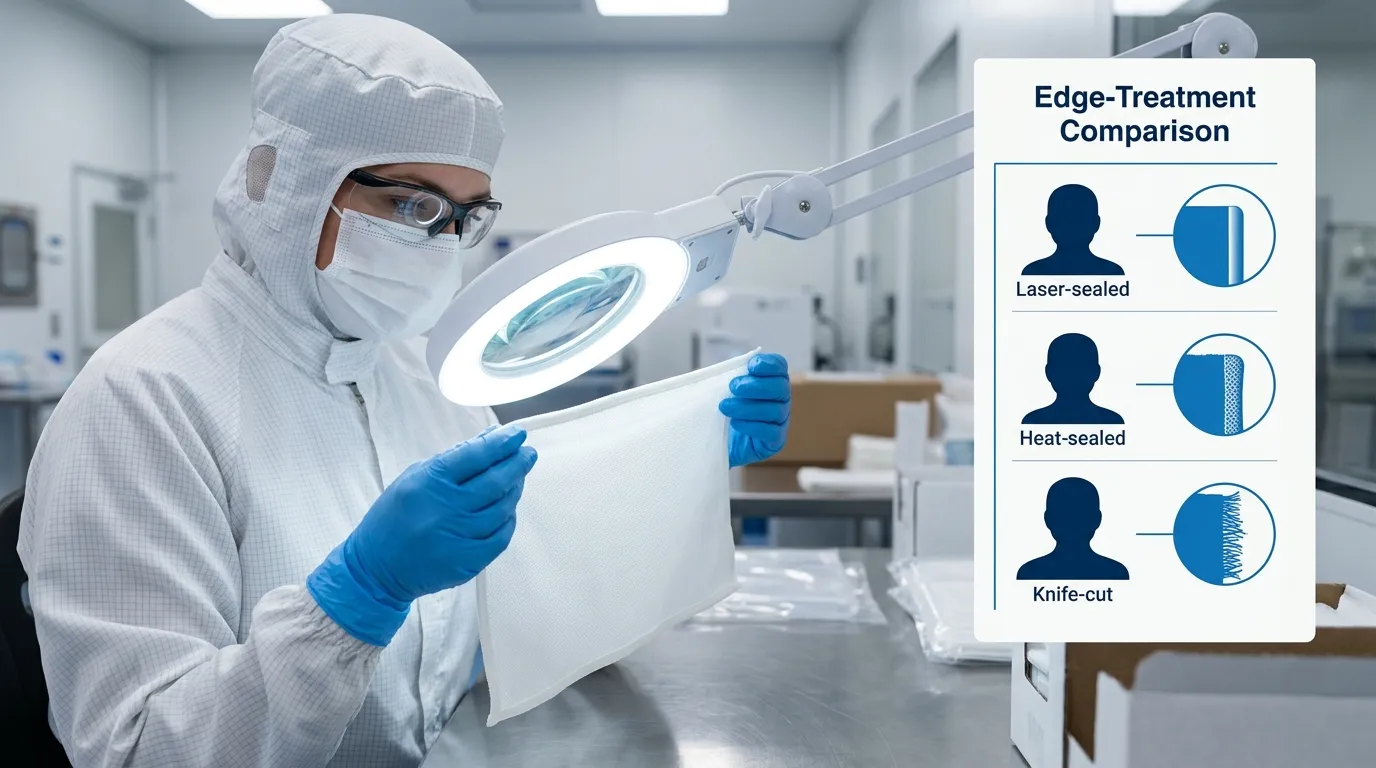
A bulk quote is not comparable until these three physical attributes are confirmed for each product under evaluation.
| Edge Type | How It Is Made | Typical Particle Behavior | Typical Price Direction |
|---|---|---|---|
| Laser-sealed | Edge melted by laser | Low fiber release | Higher |
| Heat-sealed | Edge melted by heat | Low fiber release | Moderate |
| Knife-cut | Fabric cut without sealing | Higher fiber release | Lower |
Size, Thickness, Basis Weight, and Pack Configuration
Two suppliers can quote the same size wipe with very different pack configurations. A supplier offering 150 wipes per bag and a supplier offering 300 wipes per bag may appear to quote similar case prices while delivering very different cost per wipe. Always convert to total wipes per case before comparing any price.
Cleanliness, Packaging, and ISO-Class Compatibility
Do not accept "lint-free" or "ISO Class compatible" as a certified fact. These phrases are common in product listings, but they mean little without a test method and a product-specific document.
Wipe cleanliness is typically evaluated using methods such as ASTM E2090-12 for particle and fiber release or referenced through IEST-RP-CC004.3, a recommended practice for evaluating wiping materials. Ask which method was used and request the measured result for the specific product you are buying.
"ISO Class compatible" typically means the product is considered suitable for use in that class of cleanroom, not that the wipe itself is certified to an ISO 14644 classification. The claim should be supported by the supplier's test data and by your own application qualification.
Cleanroom packaging matters equally. A wipe manufactured in a controlled environment but shipped in damaged or non-cleanroom packaging can be contaminated before it reaches your process.
Dry, Presaturated, Sterile, and ESD Polyester Wipes
Bulk buyers also need to decide whether a standard dry wipe is sufficient or whether a specialized variant is required.
| Variant | Best For | Additional Requirements |
|---|---|---|
| Dry | General controlled-environment wiping; user applies the solvent | TDS; cleanliness data |
| Presaturated | Consistent solvent application; convenience | SDS; shelf-life data; packaging integrity |
| Sterile | Pharmaceutical, aseptic, and certain medical-device processes | Product-specific sterility evidence |
| ESD-safe | Static-sensitive electronics and components | Measured surface resistance or resistivity data |
Dry vs. Presaturated Wipes
Dry wipes give the user control over solvent choice and dilution. Presaturated wipes provide consistency and convenience but introduce chemistry, shelf-life, and safety-documentation considerations. If a presaturated wipe is under evaluation, request the SDS and confirm the solvent's compatibility with your process.
Sterile vs. Non-Sterile Wipes
Sterile wipes are not automatically required in every cleanroom. The need is driven by the process—particularly in pharmaceutical, aseptic, and medical-device applications. Sterility claims must be product-specific and documented. Ask for the sterilization method, sterility assurance level if applicable, and evidence that the bulk product you are ordering was sterilized and packaged correctly. Shelf life is also more critical for sterile wipes because packaging integrity degrades over time.
ESD-Safe Polyester Wipes
For static-sensitive electronics, ESD-safe wipes may be necessary. These wipes often incorporate carbon yarn or another conductive component into the fabric. An ESD claim should be supported by measured surface resistance or surface resistivity data with the test method stated. A general "anti-static" label is not sufficient for a specification-driven purchase.
How to Compare Bulk Prices and Estimate Cost per Wipe
Bulk wipe pricing is quote-based and varies by supplier, quantity, construction, size, packaging, sterility, and documentation requirements. The most reliable way to compare offers is to normalize them to a common metric.
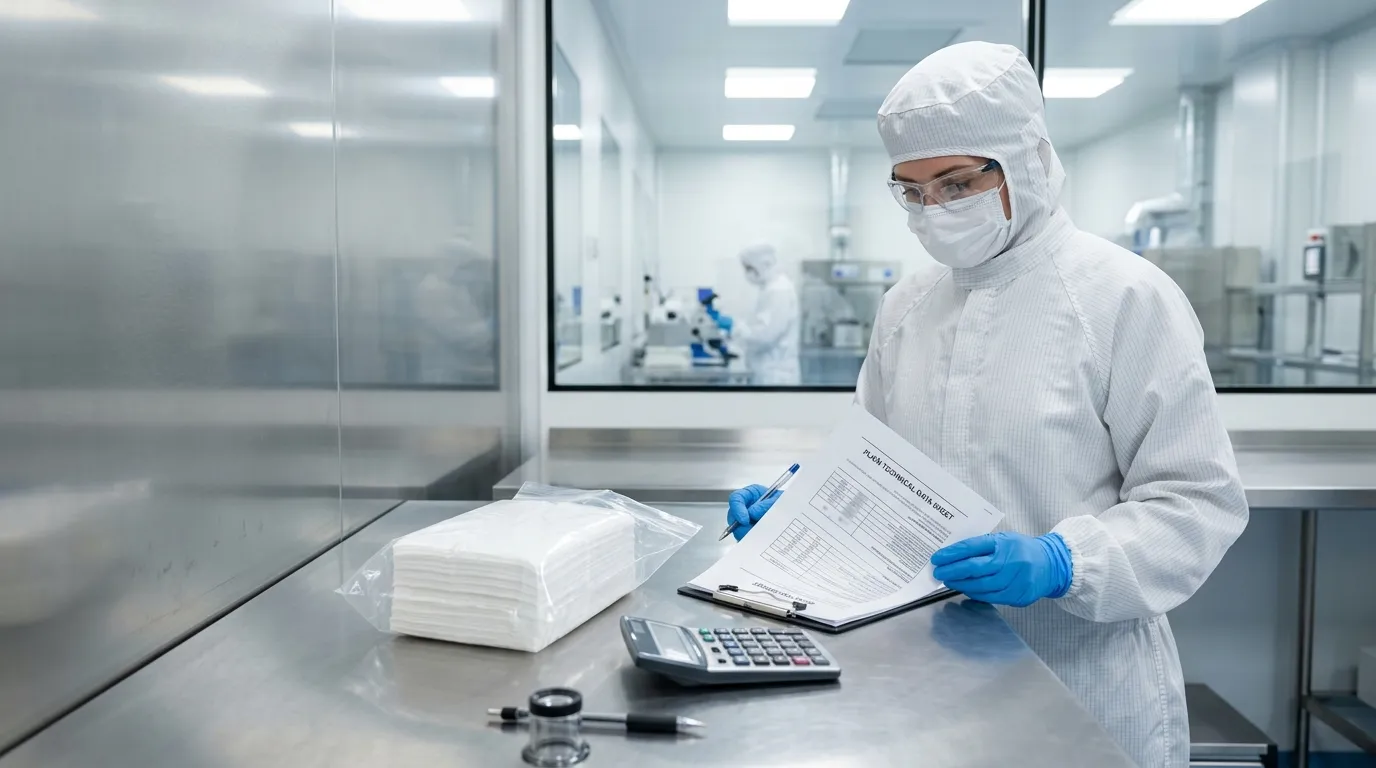
Normalize Pack and Case Configurations
Start by confirming the total number of wipes per case:
Total wipes per case = sheets per bag × bags per case
A case of a smaller or lighter wipe is not comparable to a case of a larger or heavier wipe even if the total wipe count is identical.
Calculate Cost per Wipe and Cost per Cleaning Task
Cost per wipe = case price ÷ total wipes per case
That figure is useful, but cost per cleaning task is more decision-relevant:
Cost per task = cost per wipe × wipes typically used per task
A 9 × 9-inch wipe and a 12 × 12-inch wipe may have different costs per wipe, but the larger wipe may require fewer wipes per task. In that case, the larger wipe can be the cheaper option per completed cleaning procedure.
Factor In MOQ, Lead Time, Freight, Storage, and Documentation Costs
A bulk purchase includes more than the unit price:
- MOQ influences cash flow and inventory.
- Lead time affects supply continuity.
- Freight and storage affect landed cost.
- Sample approval and incoming inspection require time.
When comparing two quotes, ask each supplier for the same fields: total wipes per case, MOQ, lead time, freight terms, packaging details, and available documentation. The supplier who provides complete, verifiable documentation is worth more than the supplier who provides only a low per-case price.
What Documentation Should a Bulk Polyester Wipe Supplier Provide?
A supplier's documentation is the most direct evidence that the product will meet your specification. Request these documents before placing a bulk order.
TDS vs. Batch Test Report vs. SDS
| Document | What It Contains | When to Request It |
|---|---|---|
| Technical Data Sheet (TDS) | Product-level specifications: material, construction, size, edge, cleanliness data, handling | During product evaluation |
| Batch Test Report / Certificate of Analysis | Lot-specific measured values: particle count, size, packaging, lot number | Before or at shipment; keep on file |
| Safety Data Sheet (SDS) | Hazard, handling, and safety information | For presaturated wipes or products with chemical components |
A TDS and a batch test report are not the same thing. A TDS describes a typical product; a batch test report verifies a specific manufacturing lot. If your process depends on lot-level consistency, request a batch test report for every shipment.
What to Request in an RFQ
A clean RFQ reduces ambiguity and improves comparability between suppliers. Include:
- Product composition and construction.
- Edge type, size, and basis weight/thickness if supplied.
- Sheets per bag and bags per case.
- Cleanliness data and the test method used.
- Sterility and ESD evidence, where applicable.
- Packaging description and shelf life.
- MOQ, lead time, and incoterms.
- Requested documents: TDS, batch test report, and SDS where relevant.
Sample Approval, Incoming Inspection, and Lot Traceability
Before committing to a bulk order, approve a sample that matches the exact specification. When the bulk shipment arrives:
- Verify the label and lot number match the approved specification.
- Confirm sheets per bag and bags per case match the order.
- Inspect packaging integrity.
- Keep the batch test report on file.
- Flag any deviation immediately.
For more details on specification and supplier evaluation, see our lint free cleanroom wipes supplier guidance.
Common Bulk-Buying Mistakes and Sourcing Risks
The following mistakes are common in bulk cleanroom wipe purchasing. Avoiding them protects both your contamination control and your budget.
Treating "Lint-Free" and "ISO Class" Claims as Certified Facts
| Common Claim | What to Ask Instead |
|---|---|
| "Lint-free" | What test method was used? What is the measured particle/fiber release? |
| "ISO Class 5 compatible" | What product-specific data supports this claim? |
| "Cleanroom packaged" | What packaging format is used? Double-bagged? Vacuum-sealed? |
Comparing Price per Case Instead of Normalized Cost per Wipe
Example:
| Offer | Case Price | Wipes per Bag | Bags per Case | Total Wipes | Cost per Wipe |
|---|---|---|---|---|---|
| Supplier A | $110 | 150 | 8 | 1,200 | $0.092 |
| Supplier B | $95 | 150 | 6 | 900 | $0.106 |
Supplier A has the higher case price but the lower cost per wipe. Without normalizing, the comparison is misleading.
Ignoring Packaging, Shelf Life, and Sterility Requirements
Damaged packaging can compromise a product before it reaches the cleanroom. Shelf-life limits matter most for sterile and presaturated products. Sterility claims need batch-level evidence. Confirm all three before payment.
Next Steps for Bulk Buyers
Use this checklist to make your next bulk polyester wipe purchase specification-driven:
- Define the application and required cleanliness level.
- Choose the construction: 100% polyester knit or polyester/cellulose nonwoven.
- Specify edge treatment, size, and pack configuration.
- Request TDS, batch test report, and SDS where relevant.
- Compare offers on cost per wipe and cost per cleaning task, not price per case.
- Approve a sample before the full order.
- Inspect the delivery against the approved specification.
For adjacent cleanroom contamination-control needs, explore bulk sticky mats for cleanroom to complete your entry-control program. If you are evaluating a manufacturing partner for custom cleanroom consumables, our oem support page explains our approach to sourcing and customization.
NEWS
GET SERVICE
With quality parts to meet every budget and friendly staff trained to make your visit informative and hassle free.