
Medical Device Sticky Rollers: Reliable Particle Removal In ESD-Sensitive Areas

Medical Device Sticky Rollers: Reliable Particle Removal In ESD-Sensitive Areas
Medical Device Sticky Rollers are used to remove loose particles. However, 2026 brings many changes. Medical device assembly lines will now define new expected standards. Static control regulations will now be stricter. Cleanliness audits will now be more stringent. And components will be getting smaller. A regular lint roller will no longer be good enough. We have advanced custom adhesive technology, which enabled us to design an advanced mechanism with the right materials. We are now fully equipped to meet the challenges of tomorrow. And of course, we won't promise more than we can deliver.
Why 2026 Changes the Medical Device Sticky Rollers Market
The medical devices themselves will have more flexible electronics, smaller sensors, and the FDA and IEC have made their cleanroom standards more stringent. There are three main design considerations:
•More static-sensitive subassemblies: Disposable smart sensors and wearable monitors can house circuits of low thresholds.
•Higher particle sensitivity: Cable and PCB housings have contained destructive microscopic residual fibers.
•Frequent cleaning cycles: Production lines run longer shifts. Rollers must perform consistently across hundreds of cleaning passes without degrading.
Conventional sticky rollers—often made from standard plastics with unknown static behavior—no longer meet internal quality rules. This is where Nabai's current design approach starts.
Material Choice: Polypropylene With Predictable Static Behavior
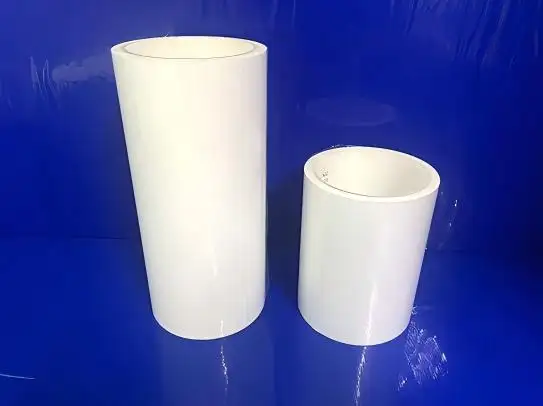
Nabai builds its Medical Device Sticky Rollers around a rigid polypropylene (PP) core. PP is widely used in cleanroom tools because it does not shed fibers and resists common cleaning solvents. But the key update for 2026 is the static-dissipative property built into the material.
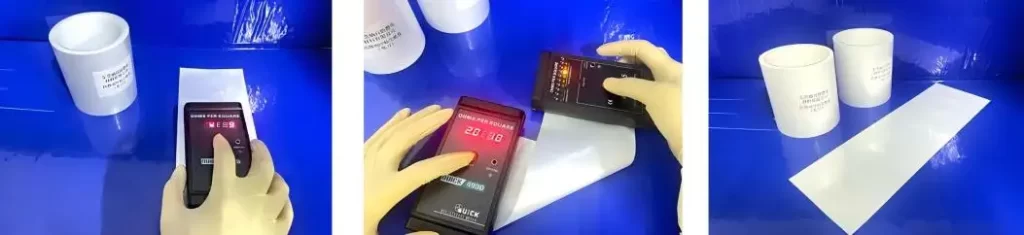
•Surface resistivity range: Nabai holds that resistivity lies between 10⁶ – 10¹⁰ Ω. This range satisfies the most widely accepted ESD Protected Area (EPA) criteria.
•No superficial coating: The persistent static-dissipative effect is due to the infusion of carbon and not due to a surface spray. This means the property does not wear off after repeated cleaning.
•Predictable grounding path: When used in a properly grounded EPA, the roller helps reduce electrostatic buildup without requiring special handling.
This material choice does not claim “zero static,” but it offers a measurable reduction in static-related particle attraction during routine cleaning.
Adhesive Layer: Balanced Between Capture And Release
The adhesive layer on a Medical Device Sticky Roller must do two things well: pick up dust and fibers, and release them cleanly when peeled. Nabai uses a carbon-loaded conductive adhesive that supports both functions.
•Adhesion strength options: Available from 200D to 1500D (g/25mm). Lower strengths suit smooth cleanroom surfaces; higher strengths handle light production debris.
•Surface resistivity: Conductive fillers run through the adhesive rather than being layered over the adhesive.
•Peel behavior: Layers cleanly disengage from the adhesive and the roller core without leaving a residue on the clean surface.
No adhesive removes 100% of particles in a single pass. However, Nabai's design yields the same results validating quality logs and internal audits.
Rolling Mechanics: Reduced Operator Effort and Variability
Inconsistent action of rollers results in missed and/or skipped cleanings. To solve this issue, Nabai's design implements controlled side ball bearing to aid in smoother, controlled, and consistent roller action.
•Pressure distribution: The bearing keeps the roller straight so the operator doesn't have to manage wobble.
•Ergonomic PP handle: made for the gloved hands of clean room personnel.
•Compatible widths: 6 inch and 10 inch refills fit current production line setups.
The aim is to reduce one variable, uneven rolling that results in stripes of untouched surface, and not to eliminate all variation on the part of the operator.
Standardization for the 2026 Buying Trends
In contrast to other years, buyers in 2026 will value standardization over customization. Nabai has two practical offerings:
•White (standard): Carbon-infused PP with visible ESD identification.
•Custom color: Only for facilities that color-code tools by cleanroom zone or shift.
To maintain a consistent performance for all batches, other control parameters cannot be altered:
•Thickness: 80µm
•Length: 20m (other lengths possible)
•Widths: 650mm to 2000mm in 100mm increments
•Core inner diameters: 38mm, 51mm, 76mm, 40mm
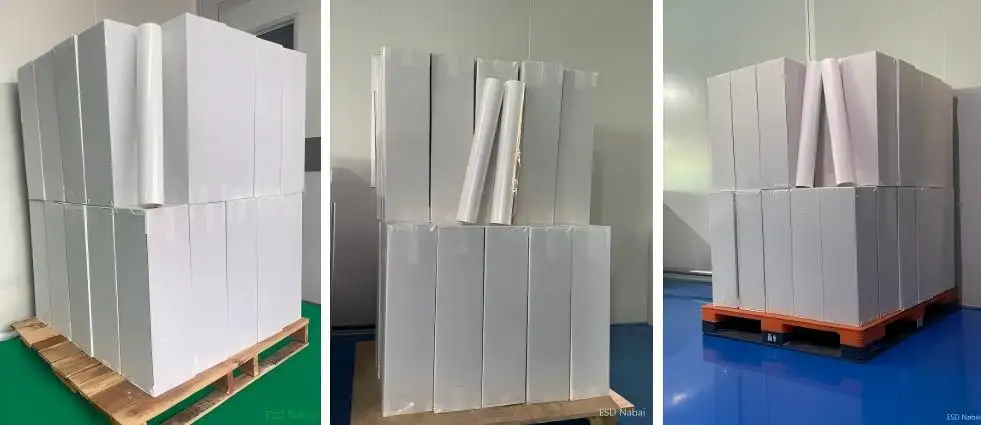
•Packing quantities: 4–9 rolls per carton depending on core size
Step-by-Step Use for Guaranteed Results
For reliable performance, all operators of any Medical Device Sticky Roller must follow a set procedure. Nabai's design facilitates this without the need for any extensive or specialized training.
•Roller surface must be inspected: The active layer should be uncovered and should be free of debris.
•Check EPA grounding: The roller must be used and only in a properly grounded ESD-protected area.
•Roll in one direction: Apply pressure. Do not roll back and forth, this action will redeposit the previously collected particles.
•Peel soiled layer: The used layer should be peeled to expose a new, unused adhesive layer.
•Repeat until surface is clean. This typically requires 2–5 passes for each area.
•Dispose responsibly: Used sheets go in ESD-safe trash bins.
•Replace refill: Install a new refill after all adhesive layers have been consumed.
When To Pair With A Silicone Sticky Roller
Nabai's Medical Device Sticky Roller can be used alone for routine dust removal. In some cases, facilities combine it with a silicone sticky roller.
•Use the PP roller first: Removes loose dry particles and fibers.
•Follow with silicone roller: Picks up residue or softer debris the adhesive layer does not capture.
This pairing is optional. Nabai does not claim its roller replaces all other methods, but the PP roller serves as a practical first layer of surface cleaning in static-controlled zones.
What Nabai's Design Does Not Claim
It helps to state limits clearly. Nabai's ESD-Safe PP Sticky Roller:
•Does not replace ionizers or full ESD flooring systems
•Does not remove chemically bonded residues
•There is no guarantee that electrostatic discharge will not occur in an ungrounded environment.
What it does offer is a measurable, repeatable cleaning tool designed for 2026 medical device assembly lines—where static matters, particles matter, and tool performance must be consistent shift after shift.
Final Takeaway For Buyers
When selecting Medical Device Sticky Rollers for 2026, look for three things: documented surface resistivity, clean adhesive peel behavior, and stable rolling mechanics. Nabai's ESD-Safe PP Sticky Roller meets these points through material choice and practical design—not through exaggerated claims. For manufacturers running EPA zones, PCB assembly, or cleanroom packaging lines, this roller provides one reliable step in a larger contamination control process.
FAQ
Q: Can Nabai's Medical Device Sticky Rollers be used in place of ionizers in an EPA?
A: No. The roller can reduce static charge build-up during cleaning, but cannot substitute other ESD gear such as ionizers or grounded workstations.
Q: How many cleaning passes are possible with one adhesive layer?
A: Usually one adhesive layer can handle 2-5 cleaning passes on a clean surface, and actual results will depend on the level of particle concentration. When the layer is no longer picking up debris evenly, it should be replaced.
Q: Are the rollers cleanroom-compatible and autoclavable?
A: To an extent the PP core and the adhesive are cleanroom-compatible (ISO Class 5 – 8) but are not autoclavable. For sterile applications, they can be used according to validated cleanroom protocols.
Q: What is the shelf life of an unused refill?
A: An unused refill has a shelf life of 12 months if stored the original package which is away from UV and solvent and stored in a room temperature area (15 – 30 °C).
Q: Can you manufacture custom widths or adhesive strengths for specific devices?
A: Yes, Nabai is able to offer custom widths from 650mm to 2000mm and standard adhesive strengths from 200D to 1500D. It is a minimum order quantity.
NEWS
GET SERVICE
With quality parts to meet every budget and friendly staff trained to make your visit informative and hassle free.