
The Science Behind A Non-Contaminating Roller For Electronics: 2026 ESD-Safe PE Technology

The Science Behind A Non-Contaminating Roller For Electronics: 2026 ESD-Safe PE Technology
Non-Contaminating Roller For Electronics is not a marketing claim—it is a performance specification built on material science, surface resistivity control, and contamination engineering. For quality and procurement managers sourcing consumables for semiconductor fabs, display module assembly, or PCB cleanrooms, selecting the wrong cleaning tool introduces defects rather than removing them. This guide explains how a properly designed Non-Contaminating Roller For Electronics works, why conventional sticky rollers fail in ESD-sensitive environments, and what specifications to look for when aligning with 2026 design and purchasing trends.
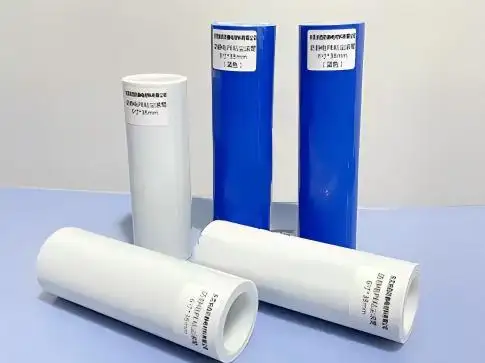
What Makes A Roller "Non-Contaminating"?
In precision electronics manufacturing, contamination includes particles, fibers, ionic residues, and electrostatic charge. A cleaning roller that removes dust but sheds lint, leaves adhesive transfer, or generates static charge is itself a contaminant. Three criteria need to be satisfied for a Non-contaminating Roller for Electronics:
•During the process, the adhesive layer on the roller or the peeler is designed to capture and retain the captured debris, preventing the debris from falling back on the surface.
•Microfiber shedding during the process must be avoided. Microfibers contaminate clean environments. Hence, shedding microfibers must be avoided while rolling.
•Static-dissipative: Surface resistivity between 10⁶ and 10¹⁰ Ω/sq will not result in uncontrolled discharge, and it will not create spark or latent ESD damage.
Nabai ESD-Safe PE Sticky Roller uses static-dissipative polyethylene (PE) as the main material and makes use of Carbon loaded conductive adhesive. The result is a tool that cleans without adding new contaminants.
Why Traditional Sticky Rollers Create Hidden Risks
Most standard sticky rollers use polypropylene (PP) or standard PE films with surface resistivity above 10¹² Ω/sq. These materials behave as insulators. When rolled across a charged surface, they accumulate static rather than dissipating it. The consequences are well documented in electronics manufacturing:
•Attraction effect: A charged roller passing over a cleaned surface pulls airborne particles back from up to 30 cm away.
•Latent ESD damage: Discharges as low as 30 volts can damage modern MOSFET gates; human sensitivity starts at 3,000 volts.
•Adhesive residue transfer: Low-quality adhesives leave hydrocarbon residues that interfere with wire bonding or coating adhesion.
In 2026 we expect an even latent defect occurring one million units would make a significant impact as node sizes get smaller and multi-layer assemblies become denser. Procurement teams are therefore shifting from lowest-riced consumables to total-cost-of-ownership models that account for yield impact.
Material Science: How Nabai Designs for Cleanrooms and EPAs
Nabai manufactures its ESD-Safe PE Sticky Roller for use in ESD-protected areas (EPAs), electronics assembly lines, and semiconductor back-end processes. The construction follows three engineering principles:
1. Static-Dissipative PE Roller Core
Surface resistivity is controlled between 10⁶ and 10⁹ Ω/sq. This range is high enough to prevent rapid discharge (which could damage sensitive devices) but low enough to bleed static safely to ground when the operator holds the properly grounded handle.
2. Carbon-Loaded Conductive Adhesive
The adhesive layer itself conducts. Unlike surface-treated films where only the top coating dissipates static, Nabai’s adhesive maintains consistent resistivity throughout its thickness and over repeated use. Adhesive strength ranges from 250g to 550g per 25mm, allowing selection for gentle cleaning (optical coatings) or more aggressive debris removal (solder paste residue).
3. Low-Lint PE Surface
Polyethylene generates less lint than alternatives made of non-woven materials. The roller’s smooth rolling action and ball bearing mechanism also reduce friction-generated particles.
Available technical specifications include:
•Thickness: 4 to 6 microns (4C–6C)
•Widths: 4, 6, 8, 10, 12 inches (custom available)
•Inner core diameters: 25.4mm, 38mm, 50.8mm, 76mm
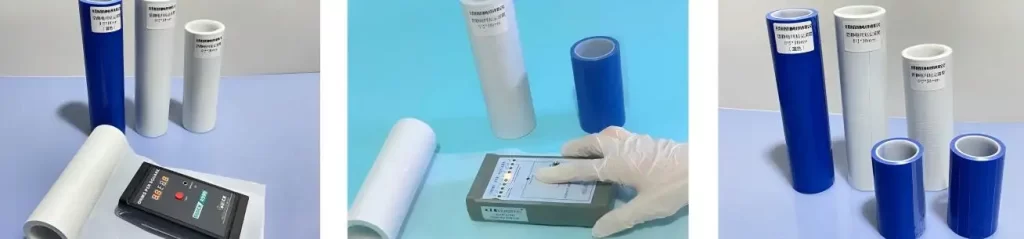
•Colors: Blue (standard ESD identification), White, Transparent, Grey
Application-Driven Design for 2026 Purchasing Trends
Buyers in 2026 are no longer asking "Is this ESD-safe?" but rather "How do you verify ongoing performance?" Nabai’s design responds with practical features:
•Ergonomic PE handle with smooth-rolling ball bearing: Reduces operator fatigue and ensures even pressure, which prevents uneven adhesive contact.
•Easy-to-replace refill cartridge: Minimizes downtime; the roller body stays in use while only the adhesive film is swapped.
•Color-coding options: White rollers for specific product lines, blue for general ESD areas, aiding visual compliance in a mixed environment.
For procurement, this means lower training costs, fewer errors from new users, and results are the same no matter the shift.
Correct Use of Non-Contaminating Rollers for Electronics
No matter how great a tool is, poor results follow improper use. Operators must adhere to the following rules when using Nabai’s ESD-Safe PE Sticky Rollers.
•Check the Earth: Before use, ensure the workstation’s EPA table’s wrist strap is properly grounded. The roller dissipates static by the operator standing in contact with Earth.
•Rollers must be kept clean: Inspect the exposed adhesive layer for contamination.
•Usage must be one directional: Apply pressure to the roller, and ensure stress is kept uniform. Rolling in any direction except one, may create dispersion of clean particles and may seal clean particles under the roller’s edge.
•Peel the contaminated layer: The used adhesive layer must be removed, and an ESD safe waste container must be used for disposal.
•Maintain Motion: To clean large areas, use parallel passes that overlap, rather than using strokes.
In the dry removal of particles, the roller stands alone. However, it may be used with a silicone sticky roller, one after the other, to clean based on the sequential steps.
Summary: Harmonizing 2026 Needs with Established Standards
The demand for higher density and greater defect tolerance in electronics manufacturing means that cleaning tools will need to be specified with the same rigor as process equipment. Nabai’s Non-Contaminating Roller For Electronics is a unique roller that incorporates static control, particle retention, and low linting. When assessing a supplier, be certain to ask for the supporting data on surface resistivity, adhesive transfer, and fiber release, and do not simply rely on marketing claims.
For more information on ESD control standards, see ANSI/ESD S20.20 and IEC 61340-5-1.For product specifications and custom sizing options, consult Nabai’s technical data sheets directly. Choosing the right roller today prevents the latent defects that would otherwise appear in final test tomorrow.
Frequently Asked Questions
Q: Can Non-Contaminating Rollers for Electronics be used on coated displays and optical lenses?
A: It is indeed possible. Opt for a less adhesive strength (250–350 g/25 mm) to minimize residue transfer. Nabai’s ESD-Safe PE Sticky Roller is designed for sensitive surfaces.
Q: How frequently should I swap the adhesive layer?
A: Swap the layer when the roller stops picking up particles uniformly or post a full cleaning pass over a contaminated section. Quick changeover is supported by Nabai’s refill cartridge system.
Q: Can I use the roller more than once once I’ve peeled off the top layer?
Q: Are the adhesive sheets for each roller separate or do they come layered?
A: Rollers consist of multiple layers of sticky sheets. After the first layer is peeled off, the Second layer is available. A layer must be fully utilized before a new one is added.
Q: Why is blue unlike any other color?
A: The blue rollers are made of Carbon PE which makes them partially dissipative. White or clear rollers could be used for production zone or product line color coding.
Q: Can I utilize this roller in an EPA with standard cleaning gloves?
A: Yes. However, check to ensure your gloves are also static-dissipative or conductive. The roller dissipates static through the operator and to ground; insulating gloves will block that path.
NEWS
GET SERVICE
With quality parts to meet every budget and friendly staff trained to make your visit informative and hassle free.