
How to Choose the Right PE Protection Film Thickness for Different Surfaces

How to Choose the Right PE Protection Film Thickness for Different Surfaces
Choosing PE Protection Film by thickness alone often leads to either over-specification or insufficient protection. A 20 μm film is not automatically the best choice for every industrial surface, just as a 3–5 μm film is not automatically too thin.
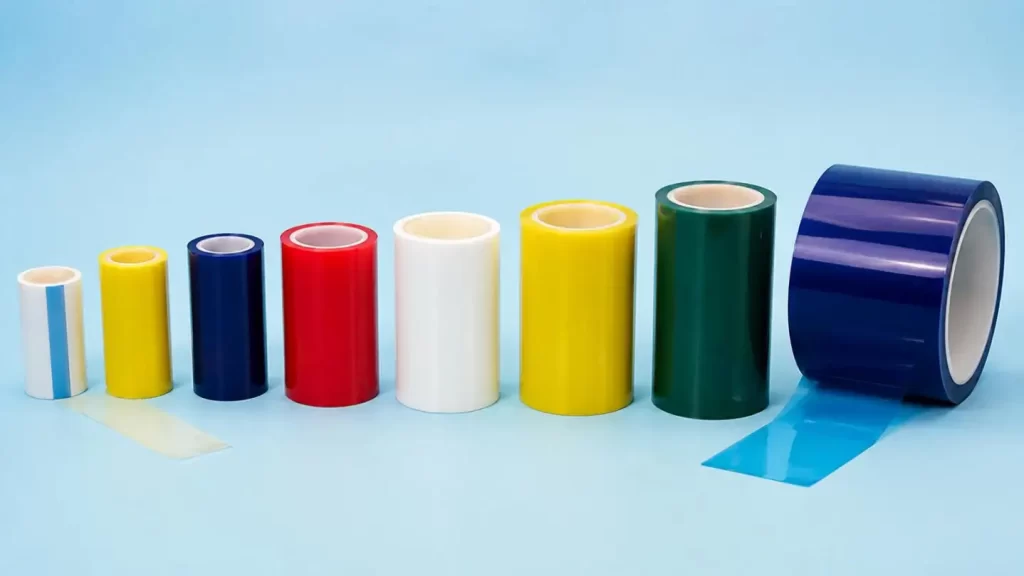
For surface protection, thickness must be considered together with surface finish, handling intensity, bending or forming, optical requirements, film tensile performance and ESD requirements.
At Nabai, our anti-static PE Protection Film is produced from ultra-clear LDPE in a 3–20 μm thickness range, giving buyers room to configure the film for applications ranging from optical components and displays to polished metal and painted panels.
PE Protection Film Thickness Selection by Application
The following thickness bands are practical engineering starting points, not universal industry standards. Final selection should be confirmed against the actual substrate and production process.
| PE Protection Film Thickness | Typical Protection Level | Suitable Application Examples | Main Selection Consideration |
| 3–5 μm | Very light | Optical components, display inspection, clean assembly | Maximum flexibility and minimum material |
| 6–8 μm | Light | Acrylic panels, display covers, polished plastic | Dust, fingerprints, light scratches |
| 9–12 μm | General purpose | Painted panels, electronic housings, polished metal | Handling and moderate surface contact |
| 13–15 μm | Medium-duty | Metal sheets, appliance panels, fabricated parts | Repeated handling and light processing |
| 16–20 μm | Higher mechanical protection | Industrial metal parts, stacking, transport, processing | Tear resistance and abrasion exposure |
These ranges should be treated as a starting point for sampling because LDPE formulation, tensile strength, elongation and contact mechanism can change performance even at the same nominal thickness.
3–5 μm: For Optical and Very Low-Contact Surfaces
The thinnest PE Protection Film configurations are most useful where the film is intended primarily to isolate the surface from:
•Airborne dust;
•Fingerprints;
•Light assembly contact;
•Minor cosmetic scratching.
Typical examples include optical components, transparent covers and display inspection surfaces.
The advantage of a 3–5 μm film is low stiffness. It conforms easily to smooth surfaces and introduces less material between the operator and the component.
However, this thickness range should not be selected for aggressive stacking, metal fabrication or contact with sharp edges.
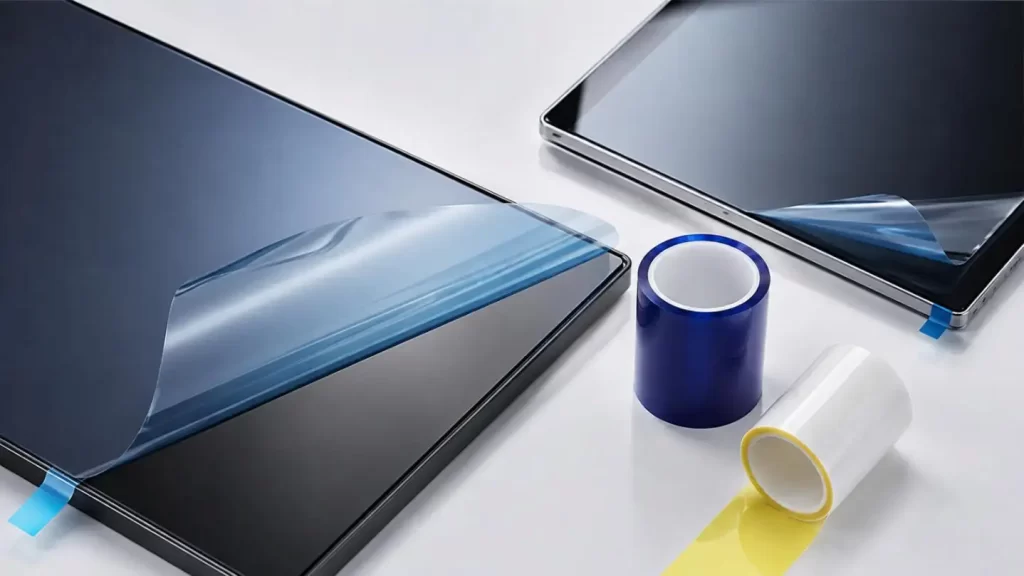
For optical applications, thickness must also be evaluated with transparency. Nabai's optical-grade PE film is specified at >92% light transmission and <2% haze, allowing protected surfaces to remain visible during inspection.
6–8 μm: For Acrylic, Display Covers and Light Handling
A 6–8 μm PE Protection Film provides a useful balance between conformability and physical coverage.
This range can be considered for:
•Acrylic sheets;
•Display covers;
•Polished plastics;
• Decorative surfaces;
•Components moving through light assembly.
Compared with 3–5 μm film, the additional material provides more resistance to incidental rubbing while retaining good flexibility.
For acrylic and display products, this range is particularly useful when the film must stay flat without making the protected component unnecessarily stiff.
Where ESD control is required, thickness should not be used as an indication of anti-static performance. Nabai's anti-static film is specified with surface resistivity of 10⁹–10¹¹ Ω/sq, which should be evaluated independently from micron thickness.
9–12 μm: A Practical General-Purpose Range
For many industrial applications, 9–12 μm PE Protection Film is a useful middle range.
Potential applications include:
•Painted equipment panels;
•Polished stainless-steel surfaces;
•Electronic housings;
•Appliance components;
•Plastic panels;
•Parts handled repeatedly during assembly.
At this thickness, buyers gain more material to absorb rubbing and handling contact without immediately moving to a heavy-duty film.
For example, a painted enclosure moved between assembly stations may require more than fingerprint protection but less protection than sheet metal entering a forming process. A 9–12 μm configuration can therefore be evaluated before moving to thicker film.
13–15 μm: For Repeated Handling and Light Fabrication
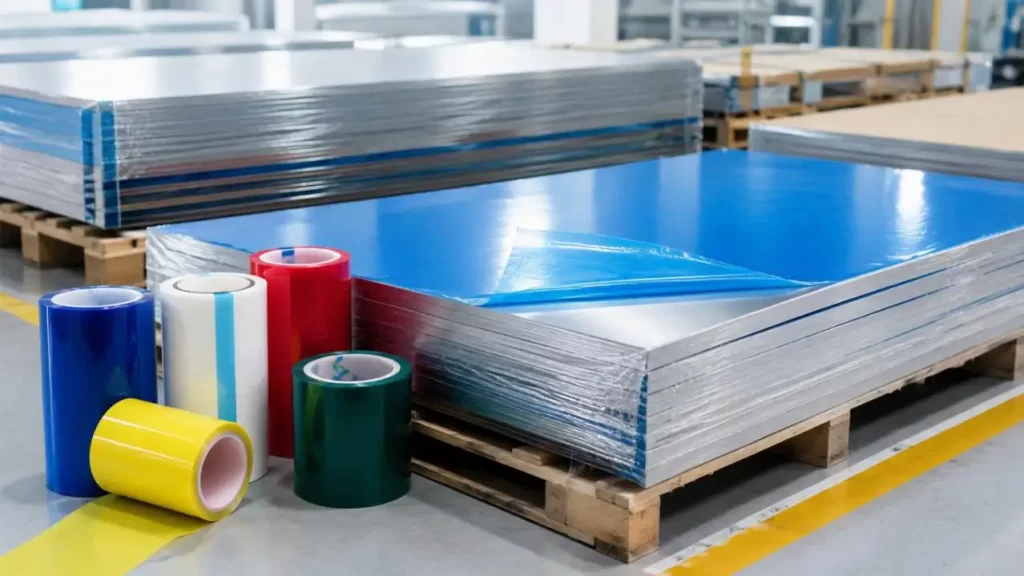
Once components are exposed to stacking, sliding contact, roller handling or light bending, thickness becomes more important.
A 13–15 μm PE Protection Film can be evaluated for:
•Stainless-steel sheets;
•Aluminum panels;
•Appliance surfaces;
•Fabricated metal components;
•Painted panels transported between production stages.
However, thickness alone does not determine whether the film will survive bending.
The mechanical relationship is:
Thickness + Tensile Strength + Elongation + Tear Resistance = Processing Durability
Nabai lists machine-direction tensile strength above 20 MPa for its PE anti-static protective film and also provides an industrial-grade option with enhanced tear resistance.
If the protected sheet will be bent or formed after lamination, sample testing should reproduce the actual bend radius and processing speed.
16–20 μm: For Higher Mechanical Exposure
The upper end of Nabai's 3–20 μm PE Protection Film range is more appropriate when the surface experiences greater physical contact.
Typical evaluation scenarios include:
•Industrial metal sheet handling;
•Repeated stacking and unstacking;
•Longer internal transportation;
•Higher abrasion risk;
•Processing where thinner film tears prematurely.
The additional thickness provides more material between the substrate and external contact.
But thicker is not automatically better.
On tight curves or flexible components, a 16–20 μm film may have greater bending stiffness than a thinner alternative. If stiffness exceeds the film's ability to follow the substrate geometry, wrinkling or edge lifting can become more likely.
Thickness Should Change With Surface Geometry
A flat metal sheet and a curved plastic cover may require different PE Protection Film even when both need similar scratch protection.
| Surface Condition | Thickness Direction | Why |
| Smooth optical surface | 3–8 μm | Prioritizes clarity and conformability |
| Flat acrylic panel | 6–10 μm | Balances handling and flexibility |
| Painted industrial panel | 9–15 μm | More protection against repeated handling |
| Flat polished metal | 10–15 μm | Better mechanical barrier |
| Metal under fabrication | 13–20 μm | Increased processing exposure |
| Tight curved component | Usually thinner/moderate | Reduces stiffness and edge lifting |
This is why a PE Protection Film specification should start with substrate geometry and process conditions, not with a fixed micron value.
Adhesion Method Matters as Much as Thickness
Nabai's anti-static PE Protection Film uses engineered electrostatic cling rather than a conventional adhesive coating. The film is designed to maintain surface contact while reducing the residue risk associated with traditional adhesive layers.
For static-cling film, buyers should evaluate:
•Surface smoothness;
•Curvature;
•Cleanliness;
•Film thickness;
•Application pressure;
•Required holding duration.
Dust or oil between the substrate and film can reduce contact regardless of thickness. Application should therefore begin on a clean surface, working from one edge and using hand pressure or a soft roller to remove trapped air. Nabai recommends this application method for its PE protective film.
Specify PE Protection Film by Process, Not Just Microns
A practical RFQ should define:
Surface material → Surface finish → Processing step → Scratch risk → Thickness → Tensile/elongation → ESD requirement → Optical requirement → Roll dimensions
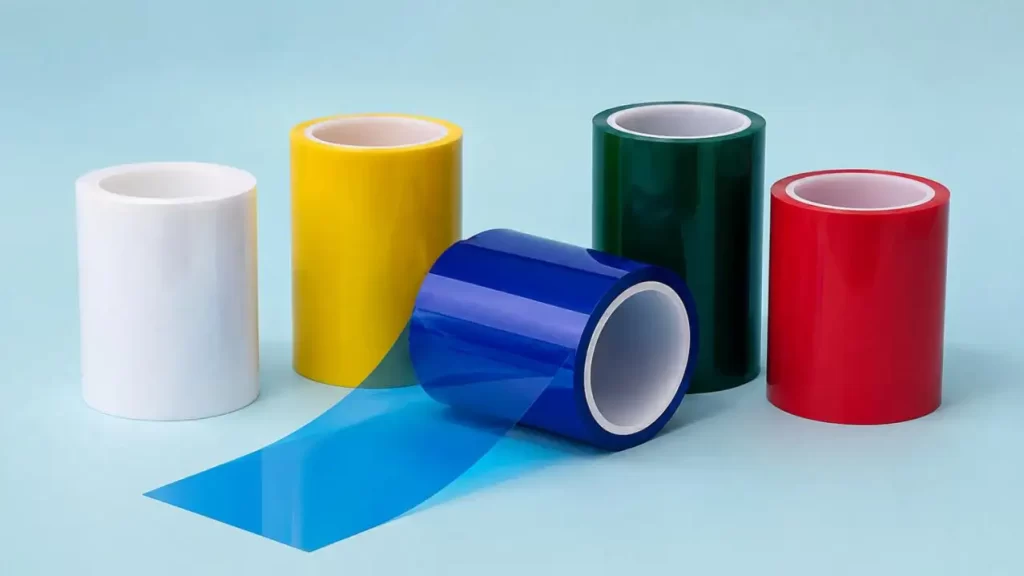
Nabai currently supports 3–20 μm PE Protection Film, 200–4000 m roll lengths, customized widths, pre-cut sheets, optical-grade and industrial-grade configurations, plus clear and colored film options.
For a new project, the most useful approach is to provide Nabai with the substrate, surface finish, processing method, expected handling level and ESD or optical requirement. From there, several thickness configurations can be sampled and compared before the final PE Protection Film specification is fixed for volume production.
FAQs
Q1. What thicknesses of PE Protection Film does Nabai offer?
Thicknesses of Nabai’s anti-static PE Protection Film range from 3 μm to 20 μm. Thicker films are better suited for surfaces which are rougher, require more mechanical protection, or have greater surface sensitivity and are subject to harsher handling conditions and processes.
Q2. What thickness of PE Protection Film is suitable for display screens?
In the case of display screens or other lightly handled optically smooth surfaces, one can consider the range of 3 to 8 μm. However, it would be more appropriate to evaluate other factors like transparency, haze, and ESD performance as well as surface cleanliness and not just thickness.
Q3. What thickness of PE Protection Film is appropriate for acrylic sheets?
For transparent plastic panels, or acrylic sheets, a PE Protection Film of 6 to 10 μm may be used, given the main concerns are fingerprints, light scratches, and dust. Thicker configurations can be considered if the panels are subject to higher mechanical stress and are handled multiple times.
Q4. What is the appropriate thickness of PE Protection Film for finished metal substrates?
For finished metal substrates like stainless steel, and aluminum, one can consider the range of 10 to 15 μm for typical handling situations and the 13 to 20 μm range if the metal substrates are subject to greater mechanical stress due to constructive activities like stacking, transporting, and fabricating.
Q5. Is greater thickness of PE Protection Film always better?
Not always. Thicker Films offer more protection, but many other factors like the film’s strength, elongation, and resistance to tears, and its surface strategy, as well as the method of application also affect the level of protection. Greater thickness can adversely affect the protection level in some cases by affecting the Film’s ability to conform to a curved surface.
NEWS
GET SERVICE
With quality parts to meet every budget and friendly staff trained to make your visit informative and hassle free.