
Protective Film for Stainless Steel Sheet: Brushed & Mirror

Protective Film for Stainless Steel Sheet: Brushed & Mirror
Protective film for stainless steel sheet is a temporary PE-based film coated with a pressure-sensitive adhesive. It is selected according to the sheet finish and the fabrication process, and brushed and mirror finishes create different adhesion and residue risks. Clean removal is not an absolute property of the film; it must be validated under the dwell time, exposure, and removal conditions of your specific process.
This guide focuses on the two finishes buyers most often ask about — brushed and mirror — and explains how to choose, test, and document a film before production approval. A broader overview of the category is available in the site's protective film solutions guide, and what is protective film explains the basics for first-time buyers.
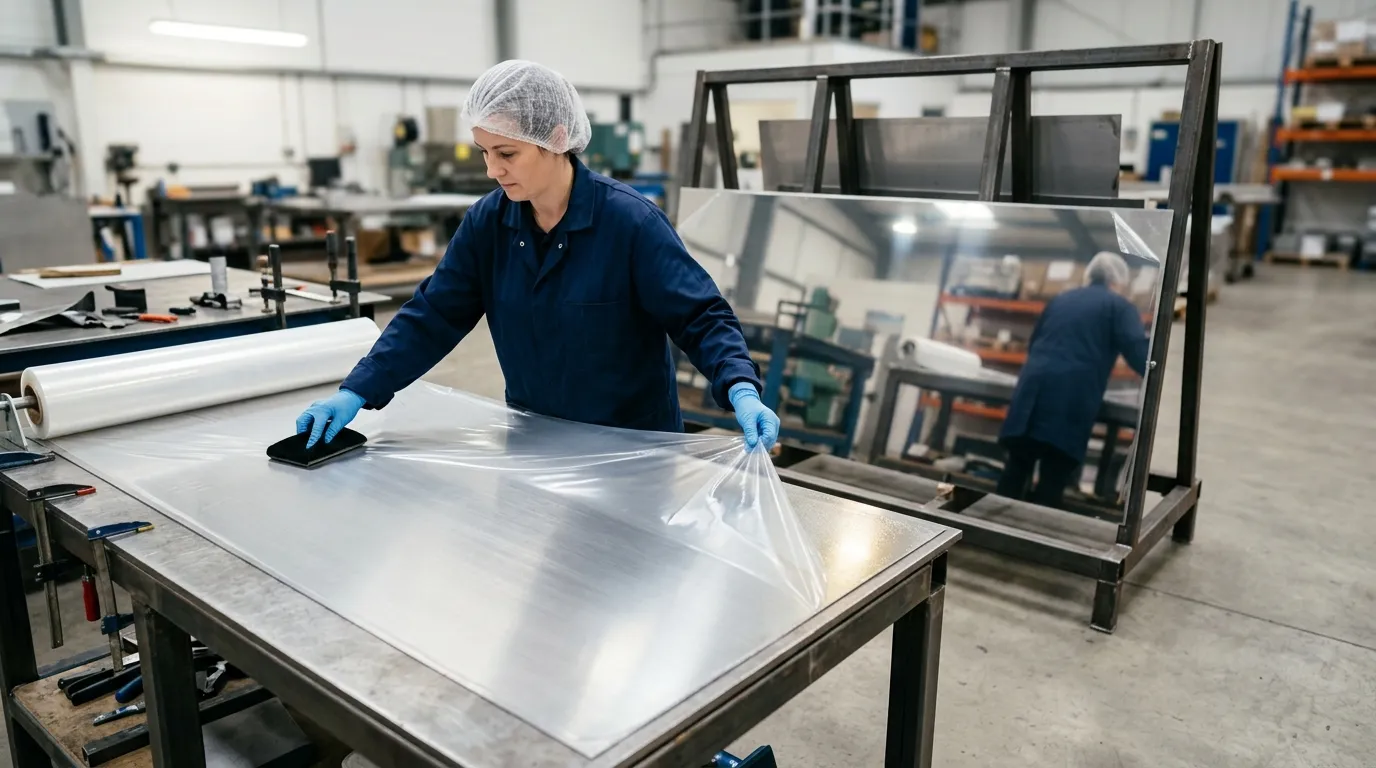
Why Brushed and Mirror Stainless Steel Need Different Protective Films
Brushed stainless steel has a directional grain and a visible surface texture. The film must conform to that texture and maintain contact across the peaks and valleys of the finish. If the adhesion is too low, the film can lift at the edges during shearing, bending, or handling.
Mirror stainless steel — polished or bright-annealed — is smooth, reflective, and visually sensitive. Ghosting, fingerprints, and adhesive residue are immediately visible, so the film must protect the surface without leaving anything behind at removal.
A film chosen for a brushed finish may be unnecessarily aggressive on a mirror finish, while a film chosen for a mirror finish may not hold well enough on a brushed surface. Finish is therefore the first selection criterion, ahead of thickness, colour, or width.
Brushed and Hairline Finishes: Contact, Conformity, and Edge-Hold
Brushed and hairline finishes are produced by abrasive or brush finishing, which leaves a fine directional texture. That texture reduces the real contact area between the adhesive and the metal, so the film needs sufficient wet-out to bond across the whole surface. In practice, this usually means a film with a slightly higher tack or a more conformable adhesive.
The main process risks are edge lift and tunneling. Edge lift typically appears during slitting, punching, or bending; tunneling appears when the film bridges surface features instead of following them. A film validated on the actual finish and process will generally perform more reliably than one chosen by a descriptive label such as "low tack" or "medium tack."
Mirror and Polished Finishes: Visual Sensitivity and Residue Risk
Mirror and polished finishes are the most visually demanding stainless surfaces. The same adhesive that performs well on a brushed finish can leave a visible ghost or a thin adhesive residue on a mirror finish.
Lower-adhesion films are often tried first on mirror surfaces, but they still have to survive the process. A film that lifts during forming is as much of a problem as one that leaves residue at removal. The right balance between holding force and clean removability can only be confirmed by testing the film on the exact finish.
How Stainless-Steel Protective Film Is Constructed: PE Film and Adhesive
Most stainless-steel protective films use a polyethylene (PE) backing coated with a pressure-sensitive adhesive (PSA). The PE backing provides mechanical protection against scratches, dirt, and light impact. The adhesive layer keeps the film in place during handling, fabrication, storage, and shipment.
The specification variables that matter most are:
- Film thickness, usually stated in micron or mil, which affects rigidity, conformability, and puncture resistance.
- Width and roll length, which must match the sheet width and the application method.
- Adhesive type, which affects tack, aging, and removal behaviour.
- Release liner, where used, which protects the adhesive before application.
Colour and printing are common options, often used to identify the film grade, the application side, or the date by which the film should be removed.
Nabai supplies adhesive coated PE protective film, and the product page lists the construction and options available for each grade.
Choosing Tack and Peel Adhesion Without Guessing
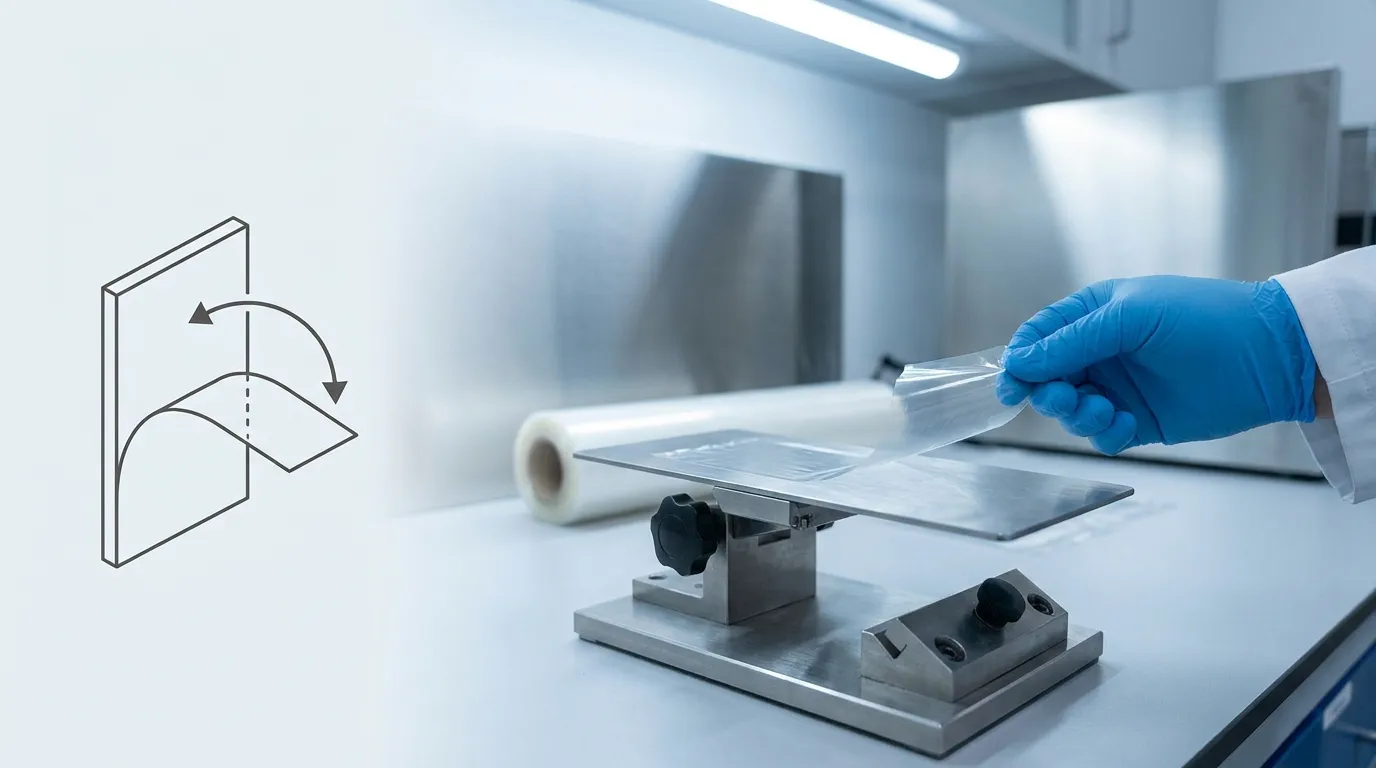
Tack is the initial grab — how quickly the film sticks to the sheet under light pressure. Peel adhesion is a measured force that describes how strongly the film is bonded under defined test conditions. The two are related, but they are not the same thing.
ASTM D3330, the standard test method for peel adhesion of pressure-sensitive tape, defines one common way to measure peel adhesion — including a 180-degree peel from a standard steel panel or another surface of interest (ASTM D3330). When a supplier provides a peel value, ask which test method and substrate were used, because values measured under different conditions are not directly comparable.
Some suppliers describe adhesion with a proprietary grade name or number, such as a 200D–1500D style scale, rather than a measured peel force. That grade is useful for comparing products within one supplier's range, but it is not a standard unit and should not be quoted as a peel-adhesion value.
A practical selection rule: choose the lowest adhesion that reliably survives your process and your required dwell time. Higher adhesion is not automatically better — it only makes removal harder and increases the risk of residue.
| Term | What it describes | Typical use |
|---|---|---|
| Tack | Initial stickiness under light pressure | Comparing how quickly a film grabs the sheet |
| Peel adhesion | Measured force required to peel the film under test conditions | Verifying bond strength with a named standard such as ASTM D3330 |
| Adhesive grade | Supplier-specific label or number | Comparing products within one supplier's range |
Why Adhesive Residue Appears — and How to Prevent It
Adhesive residue on stainless steel is usually the result of adhesive aging rather than a single "bad batch." The main contributors are:
- Dwell time — film left on the sheet longer than the adhesive was designed for.
- UV exposure — sunlight can degrade some adhesives and make removal more difficult.
- Temperature — high heat can soften the adhesive or change the bond.
- Finish mismatch — an adhesive selected for a smooth surface may bond too aggressively to a textured one.
The British Stainless Steel Association advises that avoiding residue depends on selecting the correct film and not leaving it on the surface for too long, and notes that some films have limited resistance to UV (BSSA article). Austral Wright Metals similarly warns that film left in place too long can become difficult to strip and may leave degraded adhesive residue that can retain atmospheric contaminants (advice note).
To prevent residue:
- Confirm that the film grade is designed for the finish and the process.
- Define the maximum dwell time before the film is applied.
- Control storage and exposure — keep sheet out of direct sunlight wherever possible.
- Test removal on a representative sample at the end of the planned dwell time.
- Record the removal conditions so the same process can be repeated on future batches.
Matching the Film to Fabrication, Storage, and Anti-Static Needs
The film must survive every step between application and removal.
- Bending and forming: the film must stretch or slide without cracking or delaminating.
- Shearing, punching, and drilling: the film must resist edge lift and tearing at the cut line.
- Laser cutting: not every film is suitable. Heat and fumes can damage the film or contaminate the cut edge, so a specific film-and-process trial is required.
- Storage and transport: the film is normally expected to protect the sheet for days or weeks, so the maximum dwell time and storage conditions should be defined at the outset.
Anti-static film is a separate question. A film described as anti-static has specific electrical properties that reduce static generation or buildup on the film surface. It is not automatically required for every stainless-steel sheet application. If static is a genuine problem in your process — for example, dust attraction or a discharge risk near sensitive electronics — ask the supplier for the film's surface resistance value and the test method used. Surface resistance is expressed in ohms, while surface resistivity is expressed in ohms per square; the two units are not interchangeable.
Nabai supplies PE anti-static protective film for applications where a static-control property is required. An anti-static film is one element of a static-control strategy; it does not replace grounding, ionisation, or a complete ESD programme where one is required.
Validate Before Production: Sample Testing and Incoming Inspection

A datasheet describes what the supplier intends the product to do. It does not prove how the film will behave on your finish, under your process, for your dwell time. That is why a sample trial is the essential step.
- Prepare representative samples of the exact stainless-steel finish — brushed and mirror, if both are used.
- Apply the film using the same method and pressure you will use in production.
- Run the samples through the real process: bending, punching, cutting, or storage.
- Remove the film at the planned end of the dwell time and inspect for residue, ghosting, edge lift, tunneling, and surface marking.
- Record the results and keep photographs or physical samples for comparison with the production rolls.
Incoming inspection closes the loop. When the production order arrives, check the delivered film against the approved sample and the supplier's documents before the rolls go to the line.
Documentation to Request: TDS, Test Report, and SDS
Three documents are often confused:
| Document | What it is | What it is not |
|---|---|---|
| TDS (Technical Data Sheet) | Declared product specifications: thickness, width, adhesive type, storage conditions, shelf life | A certificate of compliance for a specific batch |
| Batch test report | Measured values from the actual production lot supplied | A permanent product specification |
| SDS (Safety Data Sheet) | Safety and handling information for the material | A performance or residue guarantee |
Request all three from the supplier and confirm that the batch test report matches the TDS values for the properties that matter to your process.
Common Film Failures and How to Troubleshoot Them
| Failure | Likely cause | What to check |
|---|---|---|
| Edge lift | Adhesion too low for the surface or process | Confirm finish, application pressure, and adhesive grade; test a higher-adhesion grade |
| Tunneling (bubbles or channels) | Poor wet-out, trapped air, or a film too stiff for the contour | Check application pressure and film thickness; test a more conformable film |
| Tearing during removal | Film too thin for the removal method, or weakened by UV | Check film thickness and exposure; adjust removal angle and speed |
| Adhesive residue | Dwell time too long, UV or heat exposure, or adhesive too aggressive for the finish | Review dwell time and storage; test a lower-adhesion grade on the same finish |
Related Metal Substrate: Protective Film for Aluminum Profile
The same selection logic applies to other metals, although the details differ. Aluminum profiles have different surface finishes, bending behaviour, and corrosion considerations, so the film is chosen against a different set of requirements. See protective film for aluminum profile for the specific guidance.
Next Step: Confirm the Film With a Sample Trial
The decision path is straightforward: identify the finish, shortlist film grades that fit the process, request the documentation, test a sample on the exact surface, and inspect the removal result before approving a production order.
Nabai supplies adhesive coated PE protective film and can provide the product documentation for the grade you are evaluating. Request a sample cut for your finish and run it through your process — that is the only reliable way to confirm that the film holds through fabrication and removes cleanly at the end of the line.
NEWS
GET SERVICE
With quality parts to meet every budget and friendly staff trained to make your visit informative and hassle free.