
Aluminum Profile Protective Film: Extrusion & Storage

Aluminum Profile Protective Film: Extrusion & Storage
Protective film for aluminium profiles is a temporary polyethylene (PE) film applied to a finished profile surface to reduce scratches, dirt, and handling damage during extrusion-related handling, storage, and transport. The right film is not chosen by thickness alone: it must be matched to the profile finish, the adhesive tack, the expected dwell time, and the conditions the profile will face, including outdoor storage.
This guide covers the full selection and qualification process, from the extrusion line to final removal, and explains what to test before approving a film for production.
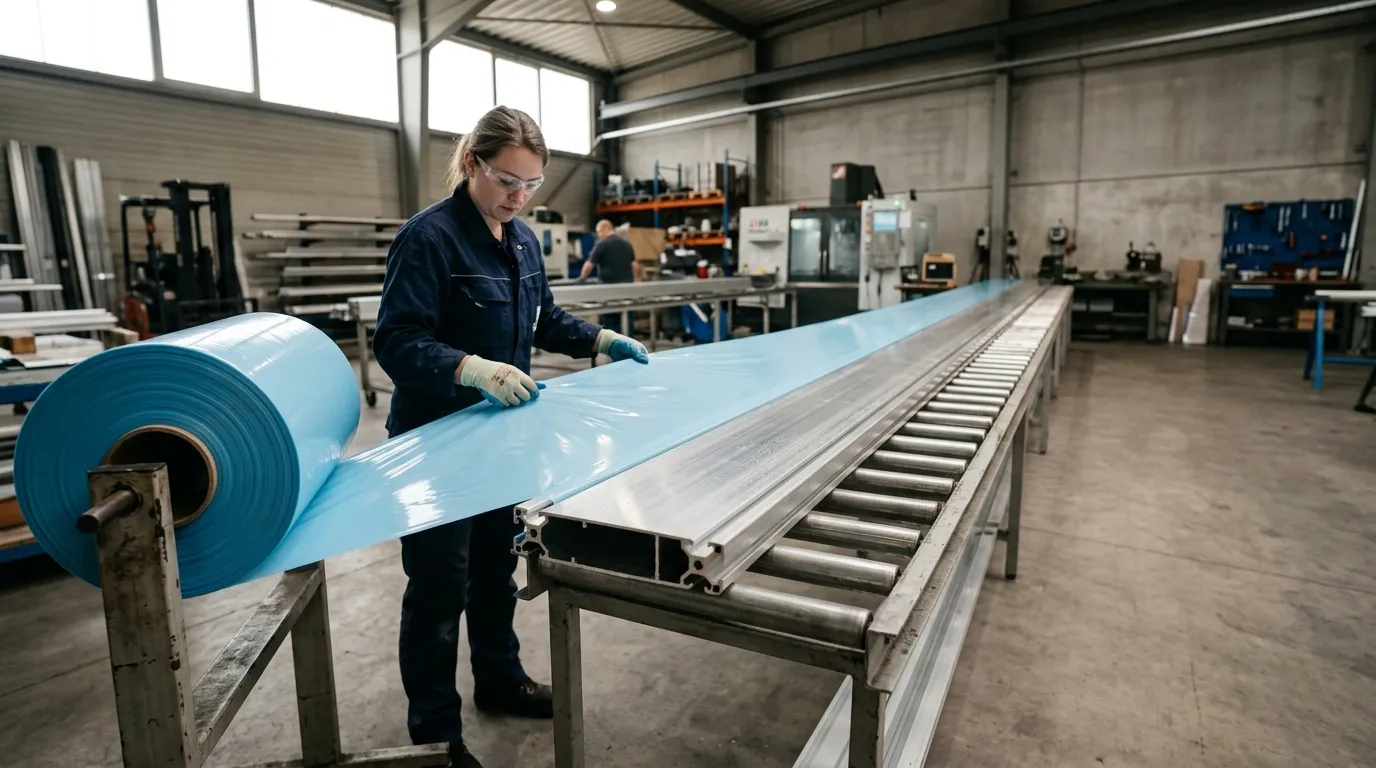
Why Aluminium Profiles Need Temporary Surface Protection
Extruded aluminium profiles leave the line with a clean, finished surface, but they rarely stay that way. Cutting, stacking, bundling, forklift movement, road transport, and site handling all create opportunities for scratches, abrasion, dust, and contact marking. A damaged profile may need rework, refinishing, or rejection.
Temporary protective film is used to keep the surface in sellable condition through the production and logistics cycle. Pregis, for example, describes temporary protective film for metals as protecting parts through fabrication, storage, assembly, and shipment.
A protective film is not a permanent coating. It is expected to stay in place through handling and transport, then come off cleanly without leaving adhesive residue or marking the surface.
What Protective Film for Aluminium Profiles Is Made Of
Most protective films for aluminium profiles are polyethylene films with either a separately applied adhesive layer or an integrated tack layer.
| Construction | How it works | Typical benefit | Typical limitation |
|---|---|---|---|
| Adhesive-coated PE film | A PE backing carries a separate adhesive layer | Wide choice of tack levels; can be tuned for different finishes and dwell conditions | Adhesive chemistry and coating consistency must be controlled |
| Co-extruded film | A tack layer is integrated into the film structure | Simple construction; no separate adhesive coat | Less flexibility for demanding profile geometries and long outdoor dwell |
Nabai supplies an adhesive coated pe protective film in this format, and its product page is a useful reference when comparing constructions.
Film thickness is not the same as adhesion. A thick film may resist abrasion better, but it will not stay on the profile if the tack is wrong for the surface. Thickness is usually expressed in micron or mil — keep the unit consistent, because a 50-micron film is not the same as a 50-mil film. Roll width and length matter too, especially when profiles are shaped, bundled, or run through automatic application equipment.
Choosing the Right Tack for Your Aluminium Finish
Tack describes how quickly and firmly the film bonds to the surface. It is the main selection variable for aluminium profiles.
| Tack level | When it is often used | Main risk |
|---|---|---|
| Low tack | Smooth anodised surfaces, short indoor handling, easy removal | Edge lifting on bends, rough surfaces, or longer dwell |
| Medium tack | General handling and transport | Needs testing for residue after extended dwell |
| High tack | Aggressive handling, bundling, and shipping | Higher removal force and residue risk, especially after heat or UV exposure |
There is no universal correct tack. The same tack level can behave differently on anodised, powder-coated, brushed, and bare aluminium depending on surface energy, texture, cleanliness, application temperature, and dwell time.
Ask the supplier for tack data measured with a recognised method such as ASTM D2979, which is used for pressure-sensitive adhesive tack. Do not compare suppliers on the words “low,” “medium,” or “high” unless they provide the test method and the unit behind the label.
Matching the Film to Anodized, Powder-Coated, Brushed and Bare Aluminium
The profile finish controls both adhesion and removal. A film that works on one finish may fail on another.
| Finish | What to check | Main risk |
|---|---|---|
| Anodised aluminium | Smooth, hard oxide surface; lower tack is often sufficient | Visible appearance marks or film edge lifting |
| Powder-coated aluminium | Cure quality and surface energy affect adhesion | Ghosting, residue, or surface marking if dwell is too long |
| Brushed aluminium | Directional texture can make adhesion uneven | Edge lifting along brushed lines or pattern boundaries |
| Bare or uncoated aluminium | Surface cleanliness and natural oxide layer | Adhesive compatibility and surface marking |
The same film should not be assumed to work across all finishes. Test it on the actual production finish, with the same cleaning state, application temperature, and expected dwell time.
From Extrusion Line to Job Site: Where the Film Must Hold
Protective film for aluminium profiles has to survive a defined sequence of handling steps. Work through each stage when specifying a film:
- Finish the profile surface first. If the profile will be anodised or powder-coated, apply the film after that finished surface is produced, not before.
- Apply the film before cutting or machining if tool-contact marks are a concern.
- Bundle and stack profiles immediately if possible, so the film prevents profile-to-profile abrasion.
- Load for transport with the film in place. The film must tolerate pressure, vibration, and temperature changes inside a truck or container.
- Keep the film on through site handling and installation only if the dwell time stays within the supplier’s stated window.
- Remove the film within that window, and inspect the surface before installation or final cleaning.
Plashield, for example, describes its profile protective film as protecting profiles from the extrusion and cutting workshop through loading and installation. That lifecycle expectation is exactly what a profile manufacturer should apply when choosing a film.
Outdoor Storage: What Changes When the Sun and Dwell Time Are Involved
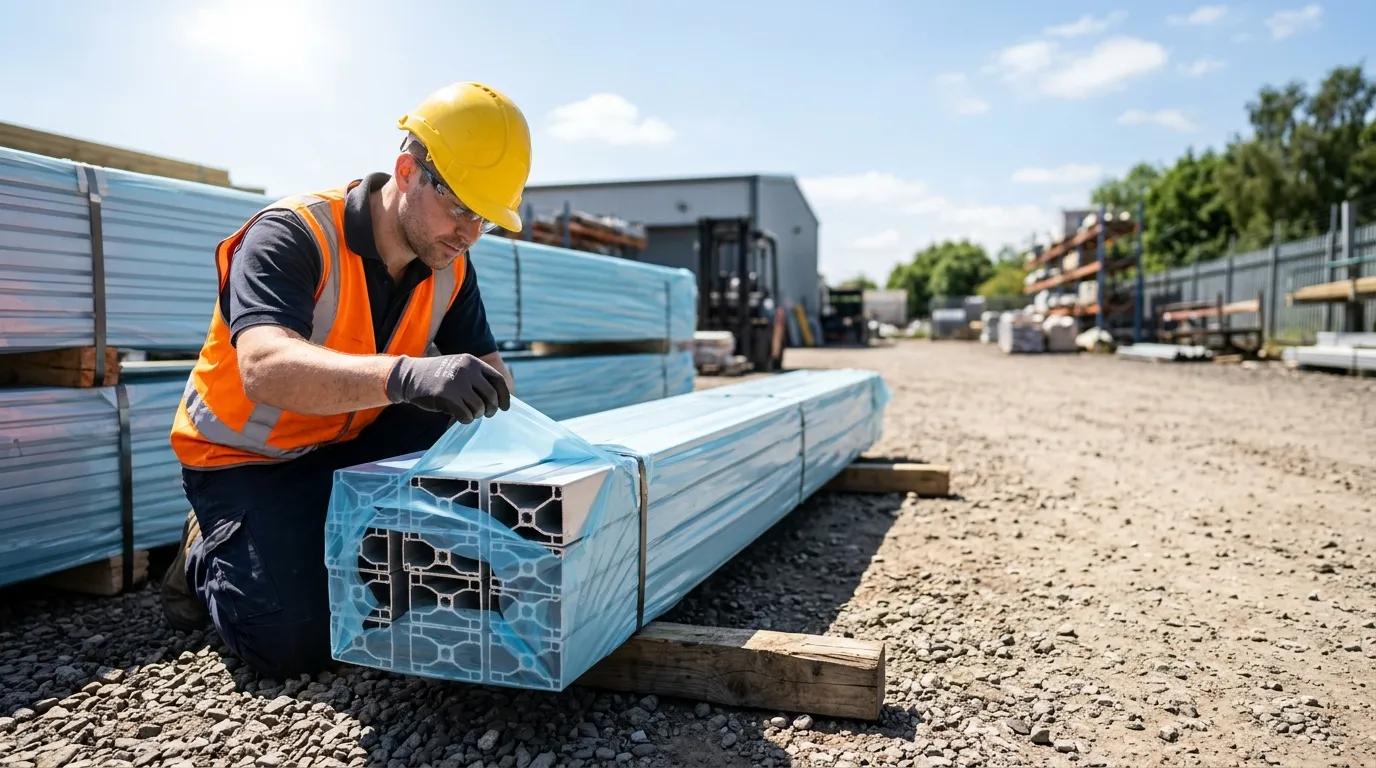
Outdoor storage makes film selection more demanding.
UV and heat accelerate adhesive aging. The film becomes harder to remove, and the risk of residue or adhesive transfer increases. Moisture at the edges can cause edge lifting and, over time, surface marking or discolouration.
A film chosen for a short indoor transit is not automatically suitable for outdoor storage. If profiles will be stored outside, ask the supplier for an explicit outdoor-dwell or UV statement. Do not infer it from a general indoor-handling recommendation.
Outdoor storage also requires a defined removal window. Confirm how long the film can remain on the profile in real weather conditions, and plan to inspect edges during storage so problems are caught before installation.
Edge Lifting, Residue and Delamination: How Film Fails and How to Prevent It
Most protective-film failures on aluminium profiles follow a predictable pattern.
| Failure mode | Likely cause | How to validate | Prevention |
|---|---|---|---|
| Edge lifting | Low tack for the profile geometry, dusty surface, or pressure during handling | Check edges after application and after each handling stage | Match tack to the finish and profile shape; apply to a clean, dry surface |
| Residue or adhesive transfer | Dwell too long, UV or heat aging, or tack too high for the finish | Remove a test piece at the planned dwell time and inspect with good lighting | Confirm the removal window and remove at the recommended angle and speed |
| Delamination | Cutting, bundling, or mechanical abuse separates the film layers or film from adhesive | Inspect cut edges and heavily handled areas | Choose a more durable construction for aggressive handling |
| Surface marking or ghosting | Adhesive or film chemistry incompatible with the finish | Perform a small-area dwell test on the actual finish | Qualify the film on the production finish before purchase |
Not every failure is a product defect. Application conditions, surface preparation, and dwell time are often the real cause.
How to Qualify a Film Sample Before You Buy
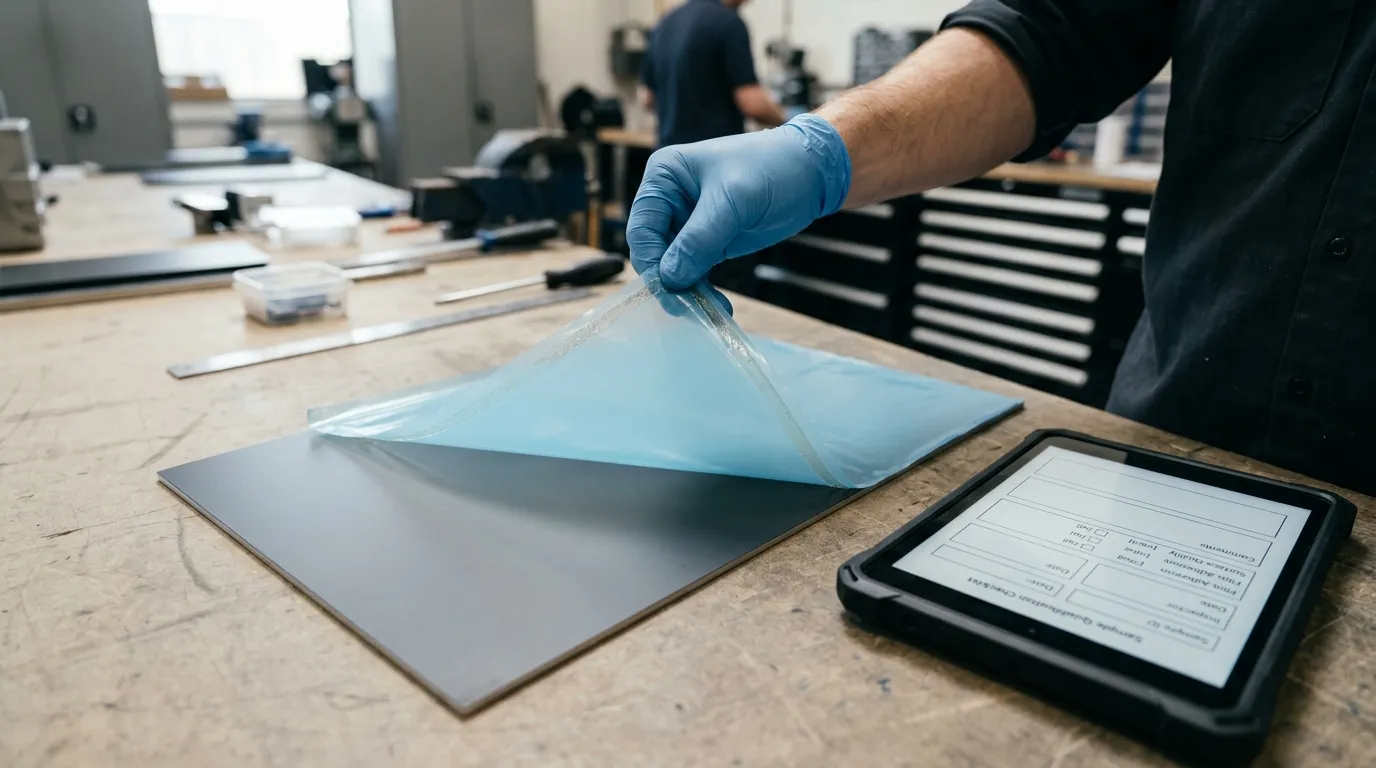
A supplier’s data sheet describes the intended product. A sample test tells you whether the film will work on your profile. Use this protocol before approving a film:
- Test on the actual production finish, cleaning state, application temperature, and expected dwell time.
- Define acceptance criteria before testing: no visible residue, no edge lift beyond an acceptable limit, and no surface marking.
- Apply the film under the same conditions used in production, and record the application date.
- Inspect the edges during the dwell period, especially if profiles are stored outdoors.
- Remove the film at the planned removal time, and record the removal angle, speed, and temperature.
- Inspect the full surface in good lighting, and take photos for the record.
- Ask the supplier for a TDS and, before delivery, a batch test report for the actual lot.
TDS vs Batch Test Report: What Each Document Tells You
A TDS and a batch test report answer different questions.
| Document | What it tells you | When you need it | What to check |
|---|---|---|---|
| TDS | The intended product specification: construction, thickness, width, adhesive type, storage conditions, and general handling limits | Before requesting samples or comparing products | That the product construction and dimensions match your process |
| Batch test report | Actual measured values for a specific manufactured lot, with test methods, lot identifier, and date | Before accepting delivery | That the delivered lot matches the agreed specification |
The TDS is the product’s design specification. The batch test report is evidence that the material you received meets that specification. A supplier that will not provide a batch test report leaves you no way to verify consistency between deliveries.
What to Ask a Protective Film Supplier
Use a focused checklist when comparing suppliers:
- Ask for product-specific specifications, not category-level values.
- Confirm the construction: adhesive-coated PE or co-extruded film.
- Confirm the backing, thickness range, and available roll widths.
- Ask for tack or peel data with the test method and width basis.
- If profiles will be stored outdoors, ask for an explicit UV or outdoor-dwell statement.
- Ask for a sample to test on your actual profile finish.
- Request a batch test report for the delivered lot.
- Ask about custom widths, converting, and printing only if your process requires them.
- Confirm MOQ, lead time, packaging, and shelf life in writing.
Special variants are worth asking about only when a requirement exists. For documented fire-performance requirements, Nabai lists a flame safe protective film in its protective-film range. If static-sensitive handling is part of your process, ask whether an anti-static film is needed; otherwise it adds no value to a standard profile-protection application.
Frequently Asked Questions
Is protective film applied before or after anodizing?
After. Protective film is meant to protect the finished profile surface. If film is applied before anodizing, it will interfere with the anodizing process and leave the finished surface unprotected when it matters most.
Can I use the same protective film on aluminium profiles, aluminium composite panels, and stainless steel?
No. Film selection depends on the substrate, surface finish, profile geometry, dwell time, and exposure conditions. A film that works on an anodised profile may behave differently on a powder-coated profile or a stainless steel sheet. If you also work with stainless steel, see our guidance on protective film for stainless steel sheet.
Does protective film prevent corrosion or oxidation during outdoor storage?
The primary job of protective film is mechanical protection: preventing scratches, abrasion, and surface contamination. A film that remains intact and well sealed at the edges can reduce exposure to moisture, but it is not a corrosion-prevention coating. If edge lifting occurs, moisture can become trapped between the film and the profile, so inspect stored profiles regularly and remove the film within the supplier’s stated dwell window.
The most reliable way to choose protective film for your aluminium profiles is to test it on your own finish, under your own handling and storage conditions, and demand the documents that prove what was delivered. That process takes time, but it prevents the most expensive mistake in profile protection: discovering after weeks of storage that the film will not come off cleanly.
NEWS
GET SERVICE
With quality parts to meet every budget and friendly staff trained to make your visit informative and hassle free.