Self Adhesive Paper: Acrylic Adhesive Technology Guide

Self Adhesive Paper: Acrylic Adhesive Technology Guide
Self Adhesive Paper is more than a sticky label. Adhesive performance is impacted by a myriad of factors such as the particle size of contaminants, contact pressure, environmental conditions, the nature of the substrate, the backing film and the chemistry of the adhesive.
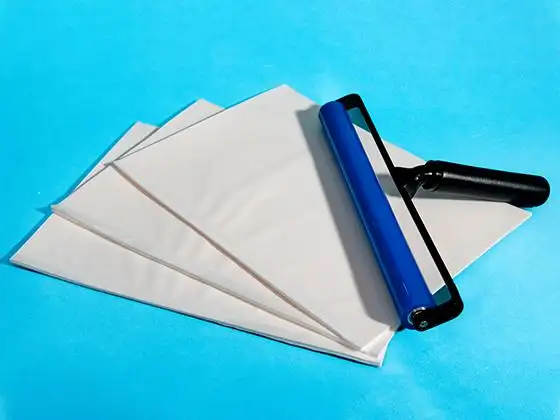
At Nabai, we design Self Adhesive Paper for applications where particles must be removed without introducing unnecessary lint, adhesive transfer, or secondary contamination. This is particularly important in cleanrooms, electronics assembly, printing lines, packaging areas, and laboratory workstations.
The key engineering question is therefore not "How sticky is the paper?" but:
Can the Self Adhesive Paper capture contamination effectively while maintaining controlled peel behavior and surface cleanliness?
Why Adhesive Balance Matters More Than Maximum Stickiness
A stronger adhesive does not automatically produce better cleaning.
For Self Adhesive Paper, the level of initial stickiness of the adhesive must allow it to capture dust and other fine particles. However, the adhesive must allow the paper to be removed from the surface without ripping or tearing.
The following terms will be assessed individually:
| Term | Definition | Effect on Self-Adhesive Paper |
| Initial Tack | Adhesion after light contact | Allows pickup of fine particles |
| Peel Adhesion | The force to remove the adhesive | Affects the force required to remove the paper and the surface it adheres to. |
| Shear Adhesion | Load if acting parallel to the adhesive surface | Stability of the adhesive |
| Cohesive Strength | the internal strength of the adhesive | Prevents the adhesive from splitting |
It is necessary to make this distinction since the above terms are often misunderstood and misused.
A product described only as "high viscosity" does not provide enough information for technical qualification.
How Pressure-Sensitive Acrylic Adhesive Works
Nabai Self Adhesive Paper uses a pressure-sensitive acrylic adhesive system.
Unlike heat-activated or chemically cured adhesives, a pressure-sensitive adhesive develops bonding through contact and light pressure. When the adhesive touches a surface, it must first flow into microscopic surface irregularities. This process is commonly referred to as wet-out.
Effective wet-out depends on:
• Adhesive softness and rheology;
• Surface energy of the substrate;
• Contact pressure;
• Surface roughness;
• Oil, moisture, or dust contamination;
• Contact time.
Once contact is made, Self Adhesive Paper depends on the proper balance between how well it sticks to itself (cohesion) and how well it sticks to the surface (adhesion).
Adhesion and Cohesion
Adhesion describes the interaction of an adhesive with a surface.
Cohesion describes the interaction of the adhesive with itself.
Generally, a strong balance of both is necessary for adequate performance of Self Adhesive Paper.
If adhesion becomes stronger than the internal cohesive strength of the adhesive, the risk of adhesive transfer increases. For this reason, industrial Self Adhesive Paper should not simply maximize tack. The formulation needs controlled tack together with adequate cohesive strength.
Acrylic PSA vs. Other Adhesive Systems
Pressure-sensitive adhesives can be based on several chemistries. For contamination-control applications, acrylic PSA is often selected because it provides a useful balance of environmental stability and controlled adhesion.
| Adhesive Strategy | Strength | Limitation |
| Acrylic PSA | Good aging, UV, and environmental stability | Must be matched to substrate |
| Rubber-Based PSA | Often provides high initial tack | Aging and temperature resistance can vary |
| High-Tack PSA | Strong particle pickup | Higher removal force and residue risk |
| Medium-Tack PSA | Better control on sensitive surfaces | May provide less aggressive pickup |
For Self Adhesive Paper, the better solution is not always the highest tack level.
The correct choice depends on three factors:
• What contamination must be removed;
• What surface will be contacted;
• How sensitive that surface is to adhesive force.
Why Surface Energy Changes Self Adhesive Paper Performance
One of the most overlooked factors is substrate surface energy.
Acrylic adhesive generally wets high-surface-energy materials such as glass and many metals more easily than low-surface-energy plastics such as PE and PP.
This means the same Self Adhesive Paper may show different contact behavior on:
• Stainless steel;
• Glass;
• PET film;
• PCB surfaces;
• Painted metal;
• PE;
• PP.
Oil, moisture, release agents, coatings, and surface roughness can further reduce real contact area.
For this reason, standard laboratory adhesion data should be treated as a reference, not as a substitute for actual application testing.
Practical Rule
Before bulk approval, test Self Adhesive Paper on the real production substrate rather than relying only on stainless-steel peel data.
Why the Backing Film Matters
The adhesive layer is only one part of the system.
For clean environments, the backing must also resist particle generation, tearing, moisture, and handling damage.
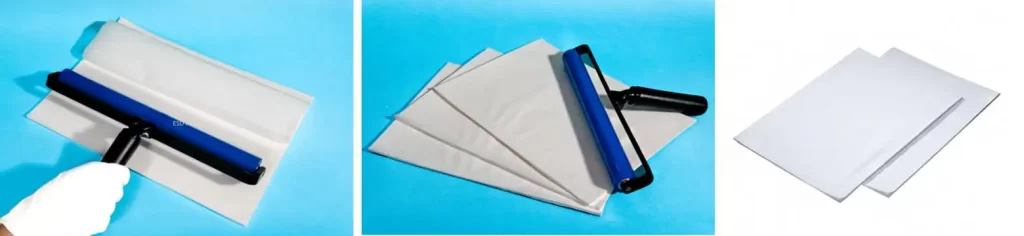
Nabai's PE Self-Adhesive Sticky Paper is designed with a low-particulate-shedding film and pressure-sensitive acrylic adhesive. The construction is intended to support repeated particle removal while limiting secondary contamination.
Nabai Specifications
| Item | Specification |
| Product Size | 240 × 330 mm |
| Layer Configuration | 1–50 layers |
| Adhesive Description | High viscosity pressure-sensitive adhesive |
| Published Thickness | 5C–10C |
| Color | White |
| Packing Option 1 | 50 layers/pc, 50 pcs/ctn |
| Packing Option 2 | 50 layers/pc, 30 pcs/ctn |
| Typical Applications | Cleanrooms, electronics, printing, packaging, laboratories |
The product is also designed with one-edge glue binding and cardboard support for easier handling.
Because backing stiffness can influence peel behavior, the backing and adhesive should always be evaluated as one functional system.
Controlling Residue During Use
Even a properly designed Self Adhesive Paper can perform poorly if application conditions are uncontrolled.
For better consistency, we recommend considering:
Contact Pressure
Use enough pressure to create full contact, but avoid unnecessary compression.
Contact Time
According to the manufacturer, increasing contact time may enhance wet-out of the adhesive and, consequently, the removal force.
Surface Contamination
When the surface is unknown or contains heavy oil or solvent films or chemical residues, it is advisable to test the self-adhesive paper.
Replacement of Active Layer
The active layer should be replaced when contamination reduces the available adhesive area.
Handling and Storage
The self-adhesive paper should be stored in dry and clean conditions.
How Self-Adhesive Paper Should Be Tested
During an on-site visit, or when the manufacturer does not have self-adhesive paper samples, the buyer should perform the following evaluations to validate the self-adhesive paper:
• Loop tack test to check initial tack;
• Peel adhesion test to check removal force;
• Shear test to check adhesive strength;
• Leave a self-adhesive paper sample in contact with the surface for a given time and check what kind of residue is left;
• Check how much contamination is left;
• Check the adhesive strength on actual surfaces of the product.
For cleanroom use, buyers should also evaluate whether the consumable itself introduces particles or chemical contamination. Adhesive strength alone is not enough.
A More Reliable Self Adhesive Paper Selection Process
A practical qualification sequence is:
Define the substrate → Identify contamination → Determine suitable tack → Evaluate peel force → Check adhesive transfer → Assess backing cleanliness → Test actual surfaces → Review test methods → Confirm batch consistency.
This approach helps buyers distinguish between a product that is simply "sticky" and a Self Adhesive Paper that is technically matched to the application.
At Nabai, our PE Self-Adhesive Sticky Paper is developed around this balance of adhesive performance, backing cleanliness, multilayer usability, and industrial handling. For projects involving cleanrooms, electronics, printing, packaging, or laboratory contamination control, buyers can review our current specifications and discuss substrate, layer count, packaging, and application requirements before sample evaluation or bulk purchasing.
FAQs
Q1. What adhesive does Nabai Self Adhesive Paper use?
Nabai Self Adhesive Paper uses a pressure-sensitive acrylic adhesive designed to develop adhesion through light contact pressure without heat or curing.
Q2. What is the standard size of Nabai Self Adhesive Paper?
The standard size is 240 × 330 mm, making it suitable for manual particle-removal applications in controlled production areas.
Q3. How many layers are available in Nabai Self Adhesive Paper?
Nabai offers configurations from 1 to 50 layers. A multilayer structure allows users to remove a contaminated layer and expose a fresh adhesive surface.
Q4. Where can Nabai Self Adhesive Paper be used?
Typical applications include cleanrooms, electronics assembly, printing presses, packaging lines, laboratories, and other areas where surface particles must be controlled.
Q5. Can Nabai Self Adhesive Paper remove fine dust and fibers?Yes. Its pressure-sensitive adhesive surface is designed to pick up dust, fibers, hair, and other loose particles through direct contact.
NEWS
GET SERVICE
With quality parts to meet every budget and friendly staff trained to make your visit informative and hassle free.