
How Silicone Sticky Mat Removes Dust and Particles From Shoes and Wheels

How Silicone Sticky Mat Removes Dust and Particles From Shoes and Wheels
A Silicone Sticky Mat is used at cleanroom transition points to reduce particles carried by footwear, trolley wheels, carts, and other floor-contact surfaces. Its effectiveness depends on more than surface tack. Particle transfer is influenced by adhesion, real contact area, contact pressure, mat length, wheel rotation, contamination loading, and cleaning condition.
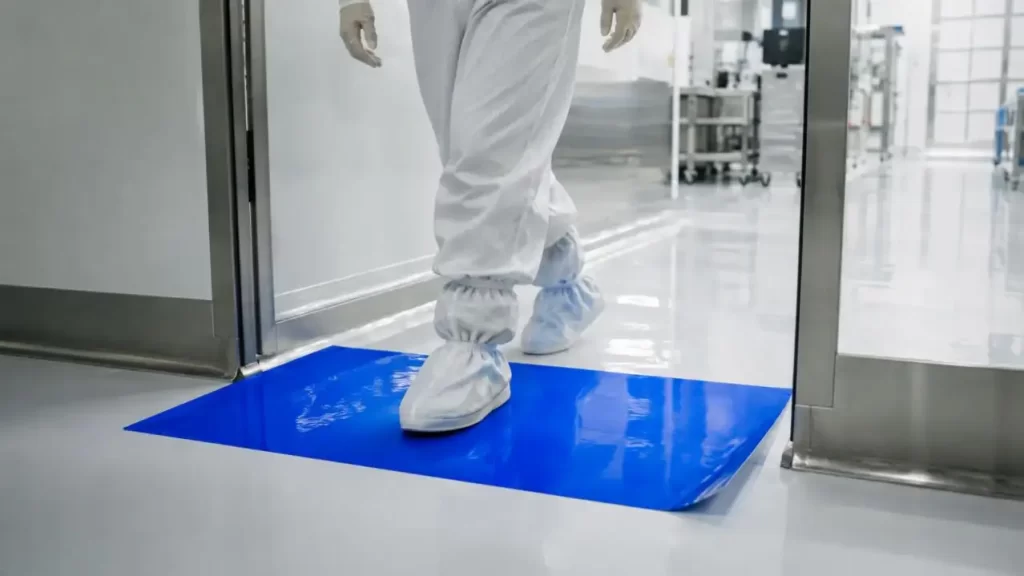
At Nabai, we design reusable Silicone Sticky Mat solutions for semiconductor, electronics, precision manufacturing, and controlled production areas where repeated particle capture and lower disposable-mat consumption are important.
Why Shoes and Wheels Continue to Carry Particles Into Clean Areas
Footwear and wheels are difficult contamination sources because particles are not distributed evenly across their surfaces.
Industrial shoe soles often contain deep tread grooves where dust, fibers, and process debris remain trapped. Cart wheels create a different problem: as the wheel rotates, new sections of the circumference repeatedly contact the floor.
The contamination pathway is typically:
Uncontrolled Floor → Shoe Sole / Wheel → Cleanroom Entrance → Cleaner Production Area
A Silicone Sticky Mat interrupts this pathway by providing a higher-adhesion contact surface before personnel or equipment enter the controlled zone.
| Traffic Type | Contact Mechanism | Main Selection Factor |
| Personnel | Step, compression, lift | Tack, mat length, sole coverage |
| Trolleys | Continuous wheel rotation | Rotation distance, thickness, stability |
| Heavy carts | High localized pressure | Structural support, backing, durability |
| Mixed traffic | Repeated steps + rolling | Balanced tack and mechanical strength |
How a Silicone Sticky Mat Transfers Particles From Shoes and Wheels
Particle removal is essentially an adhesive transfer process.
When a contaminated shoe or wheel contacts the tacky silicone surface, three conditions determine whether the particle transfers to the mat:
Surface Adhesion
Nabai's Silicone Sticky Mat uses a permanently tacky silicone contact surface. When adhesion between the mat and a loose particle becomes greater than the particle's attachment to the shoe or wheel, the particle remains on the mat as the contact surface lifts away.
However, high tack alone does not guarantee better cleaning.
Effective Contact Area
The apparent contact area and the real contact area are different.
A flat sole may touch most of the mat surface, while a deep-tread safety shoe may contact only raised sections. Wheel contact also changes according to:
•Wheel diameter
•Wheel width
•Rubber or PU hardness
•Tread design
•Cart load
•Mat surface hardness
A properly selected Silicone Sticky Mat therefore needs sufficient conformability to create contact without becoming excessively soft under wheel loading.
Repeated Contact
Particle pickup improves when more sections of the shoe sole or wheel circumference contact the mat.
This makes mat length a functional parameter rather than only a dimensional parameter.
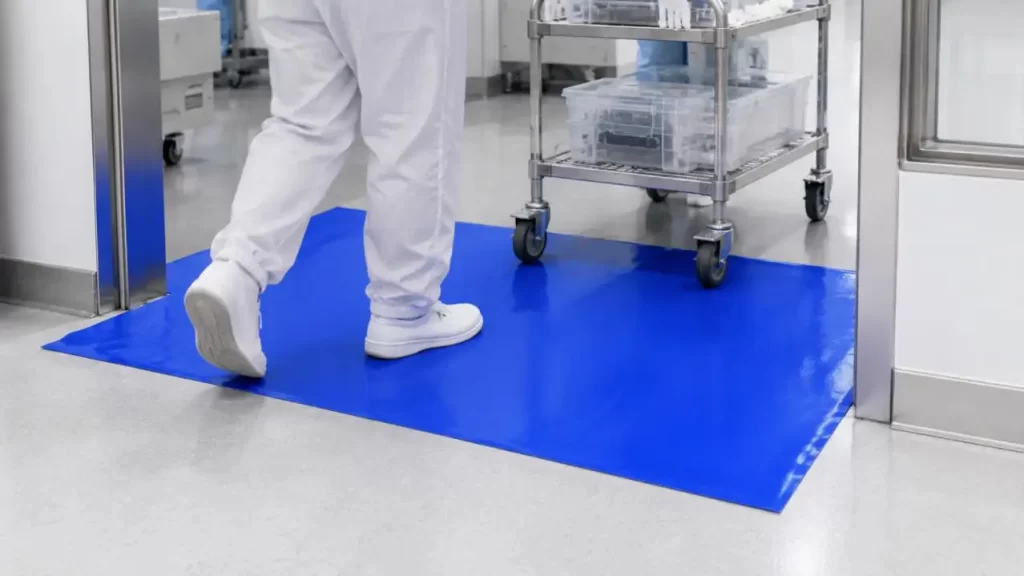
For personnel, additional mat length allows more complete steps. For carts, greater travel distance allows more wheel rotation and exposes a larger circumference to the adhesive surface.
Why Maximum Tack Is Not Always the Correct Choice
One common specification mistake is selecting the highest available tack without considering traffic conditions.
Excessive tack may cause:
•Noticeable shoe-pull during walking
•Displacement of lightweight shoe covers
•Increased trolley rolling resistance
•Higher force requirements for loaded carts
•Uncomfortable traffic flow through busy entrances
Nabai therefore considers tack together with traffic type, contamination level, contact area, and mat size rather than treating viscosity as an isolated specification.
For applicable Nabai sticky-mat configurations, supplied viscosity specifications can range from approximately 250 g to 550 g, depending on the selected construction.
Silicone Sticky Mat vs. Peel-Off Sticky Mat
Both systems remove particles through adhesive contact, but their maintenance models are different.
| Technical Factor | Silicone Sticky Mat | Peel-Off Sticky Mat |
| Active surface | Reusable tacky surface | Disposable adhesive film |
| Contamination removal | Washing | Peel off top layer |
| Maintenance frequency | Based on surface loading | Based on layer contamination |
| Waste generation | Lower consumable waste | Repeated film disposal |
| High-traffic operation | Requires planned cleaning | Quick surface renewal |
| Cost evaluation | Initial cost + cleaning + service life | Mat consumption + replacement frequency |
A reusable Silicone Sticky Mat is useful where facilities can establish regular cleaning procedures and want to reduce frequent disposable layer replacement. Peel-off mats may be more practical where immediate surface renewal is operationally important.
The better solution depends on traffic volume, contamination loading, maintenance labor, cleaning facilities, and required uptime.
Matching Silicone Sticky Mat Size to Personnel and Wheel Traffic
Nabai offers several entrance-oriented dimensions that can be selected according to traffic path and available floor area:
| Nominal Size | Metric Size | Typical Selection Consideration |
| 18 × 24 in | 450 × 600 mm | Compact personnel transition point |
| 18 × 36 in | 450 × 900 mm | Extended foot-contact area |
| 18 × 45 in | 450 × 1143 mm | Longer personnel or light trolley path |
| 24 × 36 in | 600 × 900 mm | Wider entrance coverage |
| 26 × 45 in | 650 × 1143 mm | Wider mixed-traffic entrance |
For wheels, a useful engineering check is whether the available mat length allows sufficient wheel rotation.
A 150 mm diameter wheel has a circumference of approximately 471 mm. A very short contact zone may therefore expose only part of the wheel circumference, while a longer Silicone Sticky Mat provides additional rotation and particle-transfer opportunities.
Structural Design Matters Under Cart Traffic
Wheel applications impose concentrated mechanical loads that personnel-only entrances may not experience.
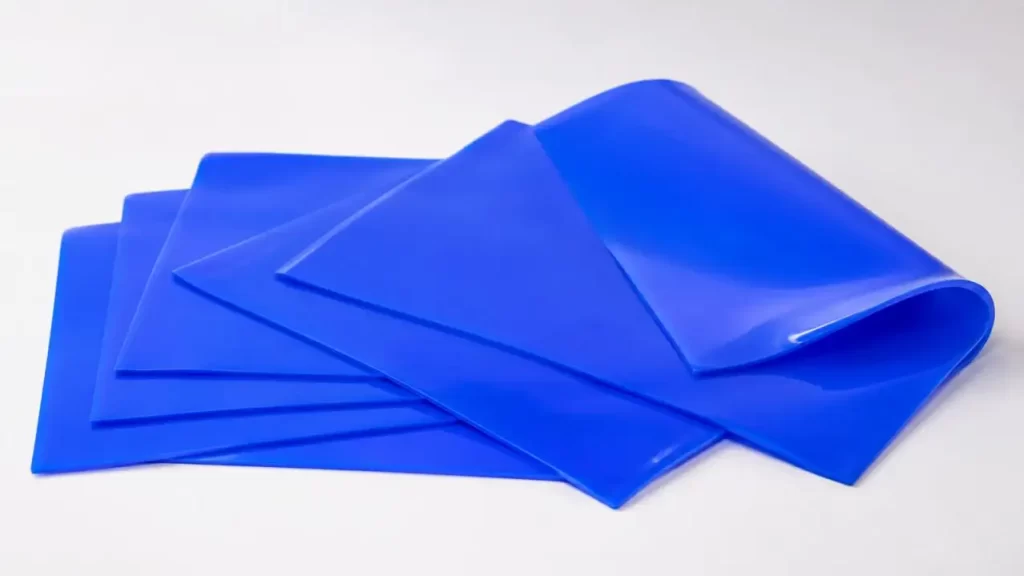
Nabai builds the Silicone Sticky Mat with the following options:
•Reusable silicone contact surface: Enables repeated use for dust pickup and wash cycle.
•Reinforced composite construction: Dimensional stability is improved through the placement of fiberglass.
•Anti-slip backing: Provides stability for repeated traffic.
•Optional aluminum frame: Enhanced stability along the edges for fixed installations.
•Multiple colors: Color options of blue and gray and transparent color as well as custom colors can provide some options for facility zoning.
Thickness, backing strength, and surface hardness should be considered together for high frequency trolley traffic.
Cleaning Controls Long-Term Particle Pickup
As particles build up, they occupy available tacky surface and limit the space for contact of new particles. A dirty Silicone Sticky Mat will thus exhibit a different behavior to a clean one even if the silicone has not degraded.
The suggested maintenance is:
- Clean the mat according to the facility cleaning procedure.
- Wash the surface with water and a mild detergent compatible with the mat.
- Remove tough contaminations with the approved cleaning method.
- Rinse to remove all residues that may block the tacky surface.
- Air-dry or wipe with a clean, lint-free cloth.
- Install the mat only when it is completely dry.
- Check if the mat has lost tack, surface damage, edge condition and check if the Mat has been stable in use.
Oil, grease, and chemical residues should receive special attention because their behavior differs from dry particulate contamination.
Validate Cleanroom and ESD Requirements Separately
A Silicone Sticky Mat should not be selected from generic claims alone.
ISO 14644 cleanroom classifications define airborne particle cleanliness; they do not specify one universal sticky-mat tack value. Likewise, silicone construction does not automatically mean that a mat meets an ESD requirement.
For semiconductor and electronics projects, buyers should confirm applicable data such as:
•Tack or adhesion test method
•Mat thickness and tolerance
•Surface hardness
•Chemical compatibility
•Anti-slip performance
•Surface resistance where ESD control is required
•Particle pickup test conditions
•Cleaning-cycle durability
Nabai can support Silicone Sticky Mat selection based on entrance dimensions, personnel or trolley traffic, required tack, color, backing structure, and maintenance conditions. For projects replacing disposable sticky mats or designing a new contamination-control entrance, sharing the actual traffic path and operating environment helps us recommend a more appropriate configuration rather than relying on a single generic specification.
FAQs
Q1. How does the Silicon Sticky Mat remove particles from shoe soles?
The Silicon Sticky Mat is designed with a silicone surface that is always sticky to remove adhesion. When the mat captures particles with more adhesion than the particles have on the shoe sole, the particles adhere to the mat.
Q2. Can the Nabai Silicone Sticky Mat be used for the wheels of carts and trolleys?
Yes. The Nabai Silicone Sticky Mat can be used at entrances designed for personnel, trolleys, and combinations of both. For wheel applications, the length of the mat, the wheel diameter, the load, the strength and thickness of the mat, as well as the adhesion on the contact surface of the mat, must be considered.
Q3. What sizes are available for the Nabai Silicone Sticky Mat?
Some of the most common sizes of Nabai are 450 x 600 mm, 450 x 900 mm, 450 x 1143 mm, 600 x 900 mm, and 650 x 1143 mm. Custom sizes can be used for special entrances.
Q4. Does a higher tack level necessarily provide better particle removal?
Not at all. Excessive tack creates an increased shoe pull resistance and a rolling resistance of carts. For Nabai Silicone Sticky Mat, it is best to match the tack level of the contaminants and the type of footwear and wheel traffic, the contact area, and the operating requirements of the Mat.
Q5. Are Nabai Silicone Sticky Mats washable and reusable?
Yes. The silicone adhesive surface of the Mat is designed for cleaning and reuse. Regular cleaning of the Mat reduces the dependency on disposable mats.
NEWS
GET SERVICE
With quality parts to meet every budget and friendly staff trained to make your visit informative and hassle free.