
Adhesion and Material Factors in Sticky Floor Mat Cleanroom Performance

Adhesion and Material Factors in Sticky Floor Mat Cleanroom Performance
Cleanroom entrances are important transfer points for dust, fibers, skin flakes, and loose debris carried by footwear and trolley wheels. A properly specified Sticky Floor Mat Cleanroom solution helps capture these contaminants before traffic enters a cleaner production zone.
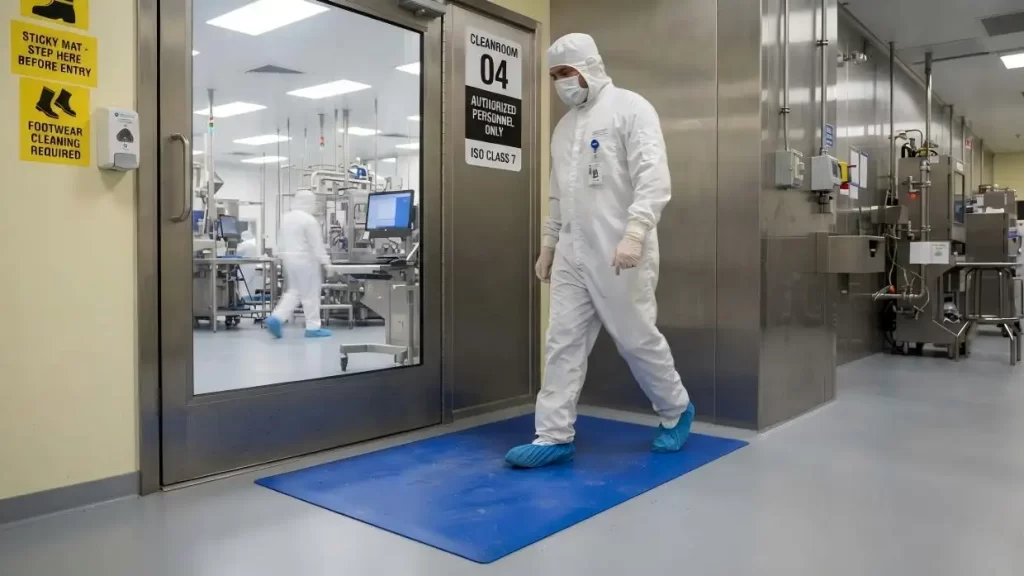
At Nabai, we manufacture peel-off sticky mats by coordinating adhesive performance, polyethylene film quality, layer construction, and floor stability. The objective is not simply to create the strongest possible adhesive surface. Reliable performance depends on repeatable particle pickup, clean layer removal, low residue, and practical integration into a wider contamination-control program.
Why Cleanroom Entryway Control Matters
ISO 14644-1 classifies cleanrooms according to airborne particle concentration rather than the presence of any individual contamination-control product. In sterile pharmaceutical manufacturing, EU GMP Annex 1 also requires a facility-wide Contamination Control Strategy covering particles, microorganisms, personnel, equipment, premises, and procedures.
Therefore, a Sticky Floor Mat Cleanroom product should support—not replace—controls such as:
•Personnel gowning and footwear procedures
•Routine floor cleaning and disinfection
•HEPA filtration and airflow management
•Environmental monitoring
•Material-transfer and zoning procedures
When correctly positioned, the mat provides a renewable floor-level capture surface for footwear and equipment wheels.
Adhesion Force: Stronger Is Not Always Better
Adhesion force affects whether particles are lifted from passing surfaces and retained by the mat. However, excessive tack may pull at shoe covers, increase trolley resistance, make sheets difficult to peel, or transfer adhesive residue.
When establishing a reliable design for Sticky Floor Mat Cleanrooms, Nabai studies four performance factors.
Initial Tack
The surface should bond to and hold dust particles under normal foot or wheel traffic.
Particle Retention
Particles should not be released from the adhesive by continued traffic.
Coating Uniformity
The adhesive should exhibit the same performance throughout the surface area and from one production batch to another.
Controlled Layer Removal
A loaded sheet should peel away evenly without tearing, delaminating, or exposing irregular adhesive areas.
The term adhesion viscosity should be avoided because viscosity describes the flow behavior of a liquid. Finished sticky-mat performance is more accurately described using tack, peel adhesion, or adhesive strength.
ASTM D3330 provides methods for measuring the peel adhesion of pressure-sensitive tapes under defined conditions. When stating methods for testing adhesive values, one must specify the peel angle, the test width, the substrate, dwell time, and the test speed.
How Material Selection Influences Performance
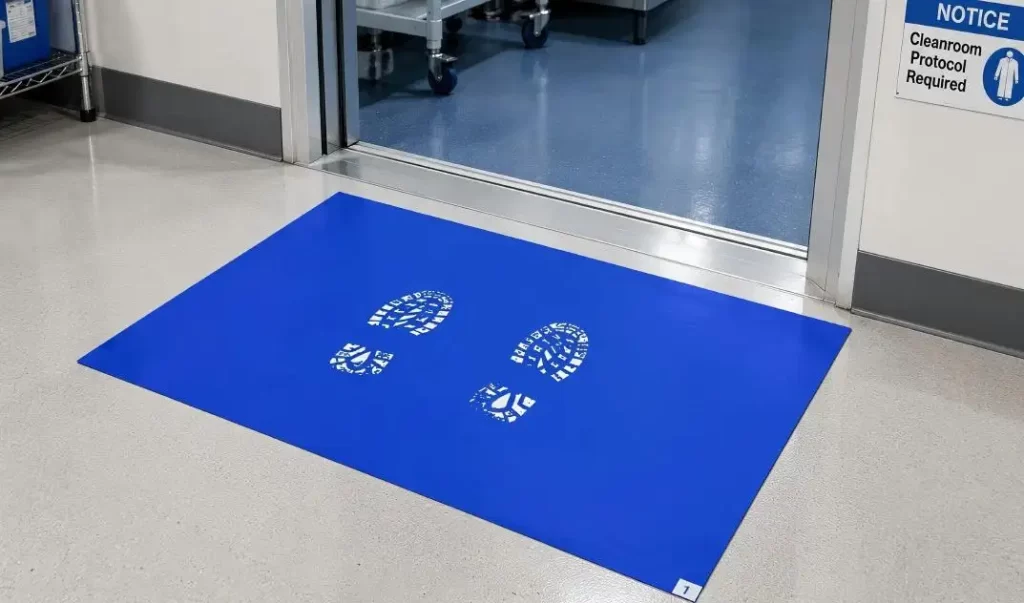
PE and LDPE films are widely used in peel-off mats because they provide a smooth, flexible, and relatively low-linting carrier when properly manufactured.
| Component | Main Function | Manufacturing Control |
| PE peel-off film | Provides the particle-capture surface | Film thickness, cleanliness, flexibility, and surface uniformity |
| Acrylic pressure-sensitive adhesive | Lifts and retains loose debris | Coating weight, tack consistency, and residue control |
| Numbered corner tabs | Identify the active layer | Clear printing and easy sheet access |
| Bottom adhesive or HDPE backing | Holds the mat securely | Floor compatibility, flatness, and edge stability |
| Antibacterial treatment | Helps limit bacterial growth on the treated surface | Validated testing and documented results |
Material quality also affects whether a Sticky Floor Mat Cleanroom product remains flat, peels cleanly, and withstands repeated foot and trolley traffic.
Antibacterial Performance Requires Validation
An antibacterial additive may be incorporated into the film or surface treatment to help limit bacterial buildup on the mat. However, this feature should not be described as sterilization or complete microbial control.
ISO 22196 specifies a method for evaluating antibacterial activity on antibacterial-treated plastics and other non-porous surfaces. Claims involving organisms such as Staphylococcus aureus or Escherichia coli should only be published when supported by relevant test reports.
Antibacterial treatment remains a supplementary surface-hygiene feature. It does not replace validated cleaning, disinfection, or microbiological monitoring.
Typical Nabai Sticky Floor Mat Cleanroom Specifications
| Parameter | Typical Nabai Option |
| Film material | Polyethylene peel-off film |
| Adhesive | Pressure-sensitive acrylic adhesive |
| Adhesion range | 250–550 g, subject to agreed test conditions |
| Nominal film thickness | Approximately 30–60 μm, confirmed by order specification |
| Layer configurations | 30 or 60 peel-off layers |
| Standard sizes | 18 × 24, 18 × 36, 18 × 45, 24 × 36, and 26 × 45 inches |
| Colors | Blue, white, transparent, or gray |
| Backing | Full-surface floor adhesive or non-slip HDPE backing |
| Customization | Size, color, tack level, printing, layers, and packaging |
These dimensions, adhesion values, colors, and packaging configurations are based on Nabai's published peel-off sticky mat specifications.
Because a value stated only in grams is not a complete adhesion specification, buyers should confirm the measurement conditions before comparing products from different suppliers.
Installation and Layer-Replacement Guidelines
Even a well-designed Sticky Floor Mat Cleanroom product can underperform when installed incorrectly.
•Clean and dry the floor before installation.
•Position the mat where every shoe or wheel must cross it.
•Allow enough mat length for multiple footsteps or full wheel rotation.
•Press the backing flat and remove air pockets.
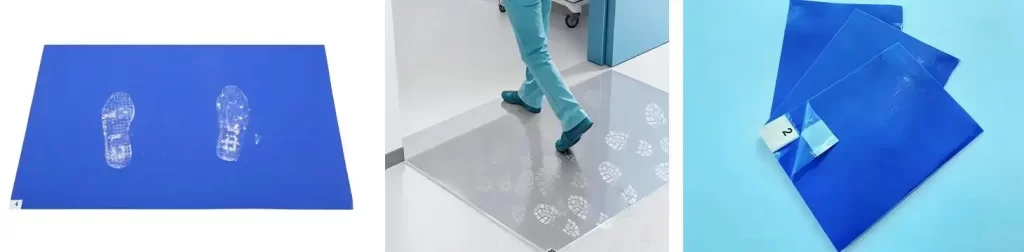
•Peel away the protective top sheet before use.
•Replace the exposed layer when visibly loaded or according to the site procedure.
•Peel sheets slowly to reduce unnecessary disturbance.
•Replace the complete mat if the backing shifts or the edges begin to lift.
Selecting the Right Configuration with Nabai
Traffic volume, trolley weight, floor finish, required tack, cleaning chemicals, layer count, and replacement frequency should be reviewed together.
At Nabai, we use these project conditions to recommend a Sticky Floor Mat Cleanroom configuration that balances:
•Effective particle capture
•Comfortable footwear and trolley movement
•Low adhesive-transfer risk
•Clean and controlled peeling
•Stable floor attachment
•Practical replacement intervals
A sticky mat is a supplementary entrance-control product rather than a substitute for cleanroom qualification or validated sanitation procedures. When adhesion force and material selection are correctly matched, it becomes a simple and repeatable component of a stronger contamination-control system.
FAQ
Q1. How Many Layers Does Nabai Offer?
Typical configurations are 30-layer and 60-layer mats.
Q2. Where Is the Mat Typically Installed?
The mat is generally installed at the entrances and exits of controlled environments, at gowning and airlock transfer areas.
Q3. When Should You Change the Top Layer?
You should change the top layer once dust is visible or the adhesive loses its tack.
Q4. Does Higher Adhesion Result in Better Performance?
Higher adhesion does not necessarily mean better performance. A mat may have adhesion that is too high which could make the mat uncomfortable to walk on and may leave residue.
Q5. What is the Commonly Used Material?
The most common material is a film of PE or LDPE due to its flexibility, smoothness, and low linting.
NEWS
GET SERVICE
With quality parts to meet every budget and friendly staff trained to make your visit informative and hassle free.