Sticky Floor Mat for Clean Room: Understanding 3C–6C PE Film Thickness

Sticky Floor Mat for Clean Room: Understanding 3C–6C PE Film Thickness
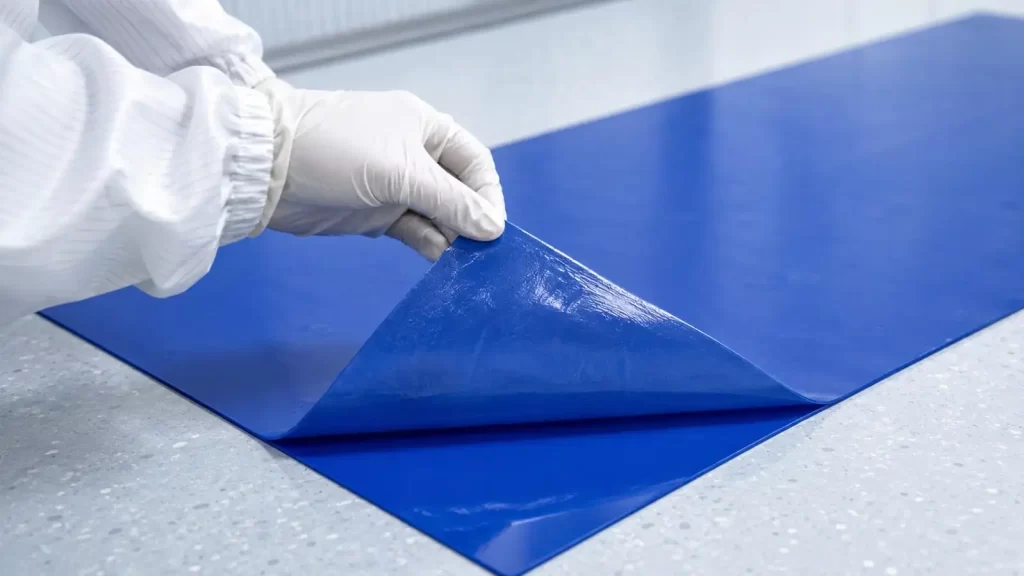
A Sticky Floor Mat for Clean Room is not simply a sheet of adhesive film placed at an entrance. In daily cleanroom operation, it must tolerate repeated foot traffic, trolley wheels, directional loads, layer peeling, and continuous particle pickup without creating unnecessary handling problems.

For this reason, PE film thickness deserves more attention than it usually receives.
At Nabai, our antibacterial Sticky Floor Mat for Clean Room is based on low-linting polyethylene film and is available in a 3C–6C thickness range. However, thickness should never be selected alone. It must be evaluated together with adhesive level, number of layers, traffic conditions, mat dimensions, and replacement procedures.
Why PE Film Thickness Matters Under Real Cleanroom Traffic
The PE film serves as the bonding layer in each adhesive element. During use, the film is subject to compression, stretching and other forms of deformation.
The film thickness impacts several characteristics of the PE layer:
•Stability: The ability of the layer to withstand stretching.
•Handling: How easily contaminated layers can be separated.
•Conformability: How well the layer follows surface irregularities.
•Edgebehavior: How the layer behaves in the presence of deformation, e.g. the behavior of an edge of the mat which is frequently loaded by a wheel.
The profile of a stack of several layers of the mat.
The film thickness alone does not affect the ability of the mat to capture foreign particles. In fact, a mat with a thicker film may not remove foreign particles better. Particle removal is dependent on the adhesive used, the contact area and the load on the mat, among other factors. The mat should also be designed to remove particles by periodically replacing the portions of the mat that come in contact with the contaminants.
What Does 3C–6C Mean for Sticky Mat Selection?
Nabai lists 3C–6C as the available thickness range for this PE sticky mat. The public specification does not define a direct C-to-micrometer conversion or dimensional tolerance, so these values should be treated as product thickness grades unless a detailed technical datasheet provides additional dimensional information.
From an engineering perspective, the useful question is not simply:
"Should I buy 3C or 6C?"
It is:
"What mechanical load will the film experience, and what construction gives sufficient stability without unnecessary material?"
| Selection Factor | Lighter PE Construction | Heavier PE Construction |
| Flexibility | Generally higher | Generally lower |
| Material usage | Lower | Higher |
| Repeated wheel loading | Requires careful evaluation | May provide greater mechanical margin |
| Total multilayer profile | Lower | Higher |
| Peeling behavior | Must be verified | Must be verified |
The correct grade therefore depends on the application rather than on a simple "thicker is better" rule.
Foot Traffic and Cart Traffic Should Not Use the Same Logic
A Sticky Floor Mat for Clean Room installed outside a gowning room experiences a different load from one positioned along a material-transfer route.
Personnel Traffic
Shoes and cleanroom footwear create relatively broad, intermittent contact. Important factors include:
•Sufficient adhesive contact with the sole;
•Comfortable shoe release;
•Adequate walking length across the mat;
•Easy removal of contaminated layers.
Trolley and Cart Traffic
Wheels create narrower and more concentrated loading. Repeated rolling can also place more stress on mat edges.
For wheel traffic, users should pay greater attention to:
•Film stability;
•Backing stability;
•Mat width;
•Wheel-path coverage;
•Edge lifting;
•Frequency of layer replacement.
This is why PE thickness should be specified according to traffic mechanics, not only cleanroom classification.
Thickness Must Be Matched with Adhesive Strength
At Nabai, the antibacterial Sticky Floor Mat for Clean Room is listed with a 250g–550g viscosity range and uses a pressure-sensitive antibacterial acrylic adhesive. The adhesive is described as silicone-free and non-transferring.
Film thickness and adhesive performance solve different problems:
• PE thickness → mechanical behavior
•Adhesive level → surface pickup and release behavior
More adhesion is not always better. The adhesion must permit the pickup of a useful quantity of particles without unacceptable footwear drag or objectionable residue.
When comparing procurement specifications, potential buyers should ask the supplier how they determine their range of 250g to 550g. Test methods, the size of the samples used, the environment in which the test is performed, and the procedure used to determine the test results vary from company to company.
30 or 60 Layers? Consider Contamination Load, Not Just Quantity
Nabai provides both 30-layer and 60-layer configurations.
The product is packed as:
•30 layers/piece, 10 pieces/box
•60 layers/piece, 5 pieces/box
A 60-layer Sticky Floor Mat for Clean Room provides more renewable adhesive surfaces, but this does not mean its effective service life is automatically twice that of a 30-layer version.
Actual consumption depends on:
Traffic volume × Contamination load × Replacement threshold
A high-traffic material entrance may consume exposed layers much faster than a lightly used personnel entrance.
Mat Size Is Part of the Contamination-Control Design
Nabai offers several standard sizes:
| Size in Inches | Metric Size |
| 18 × 24 in | 450 × 600 mm |
| 18 × 36 in | 450 × 900 mm |
| 18 × 45 in | 450 × 1143 mm |
| 24 × 36 in | 600 × 900 mm |
| 26 × 45 in | 650 × 1143 mm |
Available colors include blue, white, transparent, and gray. The construction also uses a non-slip HDPE or plastic backing to help stabilize the mat during use.
Width and length should be selected to increase actual shoe or wheel contact. A technically correct adhesive and film thickness cannot compensate for a mat that is too narrow for the traffic path.
Installation and Layer Management Determine Real Performance
Even a properly specified Sticky Floor Mat for Clean Room can perform poorly when installed on an unsuitable floor.
Nabai recommends installing the mat on a clean, dry, and level surface, removing the bottom protective film, fixing the mat firmly in position, and then peeling away the top protective liner.
During operation, the SOP should define when a layer is removed. Useful triggers include:
•Obvious particle loading;
•Reduced tack;
•Damaged or stretched film;
•Excessive wheel-path contamination;
•Lifted or unstable edges.
Waiting until the surface is completely covered with visible dirt can reduce effective contact before the layer is changed.
ISO 14644 Does Not Specify a 3C–6C Sticky Mat
ISO 14644-5:2025 requires an Operations Control Programme covering areas such as personnel, material movement, cleaning, maintenance, and monitoring. It does not prescribe a particular PE-film thickness or individual sticky-mat specification.
That means the Sticky Floor Mat should be part of a total contamination control system.
When technically purchasing, please confirm:
•PE thickness and tolerance,
•Amount of adhesive and testing method,
•30/60 layer construction,
•Size and/or dimensions,
•Design of the backing,
•Test for antibacterial activity,
•TDS or other supporting documents.
The Sticky Floor Mat produced by Nabai is made of PE with a thickness of 3C-6C (250g-550g), 30/60 layers, and contains antibacterial acrylic adhesive. Non-slip backing is also incorporated. The mat is designed for use in the pharmaceutical industry, as well as the food and cosmetics industries.
Rather than selecting a mat by thickness alone, buyers can use these parameters to build a specification around their actual traffic and contamination-control conditions. For a specific project, Nabai can be contacted through the product page to discuss the appropriate Sticky Floor Mat for Clean Room configuration and supporting product information.
FAQs
Q1. What thickness options does Nabai offer for a Sticky Floor Mat for Clean Room?
Nabai offers PE film thickness options from 3C to 6C. The suitable thickness should be selected according to traffic type, mechanical loading, layer handling, and the cleanroom application rather than simply choosing the thickest option.
Q2. What adhesive strength is available for Nabai Sticky Floor Mat for Clean Room products?
Nabai offers a 250g–550g viscosity/tack range for its antibacterial sticky mats. Buyers who need precise technical comparisons should also confirm the relevant test method and measurement conditions.
Q3. Does Nabai offer both 30-layer and 60-layer sticky mats?
Yes. Nabai offers 30-layer and 60-layer configurations. The 30-layer version is packed at 10 pieces per box, while the 60-layer version is packed at 5 pieces per box.
Q4. What sizes are available for Nabai Sticky Floor Mat for Clean Room products?
Standard sizes include 18 × 24 in, 18 × 36 in, 18 × 45 in, 24 × 36 in, and 26 × 45 in, covering different personnel entrances and material-transfer paths.
Q5. What material is used in Nabai cleanroom sticky mats?
Nabai uses low-linting PE film combined with a pressure-sensitive acrylic adhesive. The construction is designed for controlled environments where particle transfer from footwear and wheels needs to be reduced.
NEWS
GET SERVICE
With quality parts to meet every budget and friendly staff trained to make your visit informative and hassle free.