
Sticky Mat for Electronics Manufacturing | Control Solutions

Sticky Mat for Electronics Manufacturing | Control Solutions
Sticky Mat for Electronics Manufacturing: Defense Against Dust and ESD Risks
In the sticky mat for electronics manufacturing, accuracy is all. A dust particle, which is a microscopic particle, can affect the functioning of the circuit, destroy the fragile parts, or deteriorate the quality of the product. Regardless of whether you produce semiconductors, printed circuit boards, microchips, or electronic assemblies, you need to keep the environment clean.
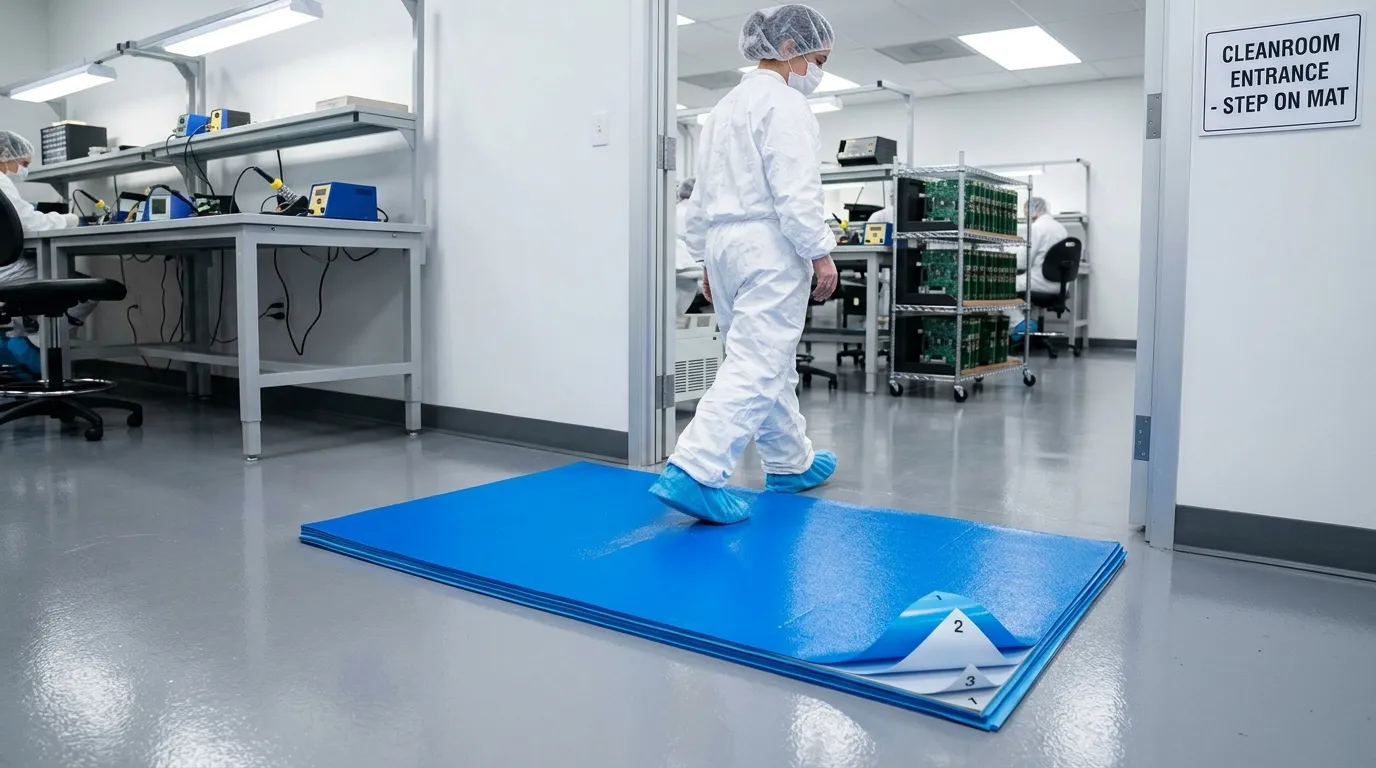
- This is where a sticky mat in electronics manufacturing is a necessary component of contamination control. These sticky mats are laid at the doorways, workstations, and workplaces to collect dirt, dust, fibers, and other impurities before they can get to the actual manufacturing zones.
- As electronics facilities continue to move to more demanding and cleanliness-restricting requirements, the necessity to invest in the proper contamination control products has no longer been an option. It is a necessity in the protection of products, quality assurance, and efficiency in operations.
Importance of Contamination Control in Electronics Manufacturing
Electronic components are becoming smaller, more complex, and delicate. Even the particles that are not visible to the naked eye can become a significant issue in the production.
The most prevalent risks of contamination are:
• Fibers from clothing
• Dirt on equipment wheels.
• Airborne debris
• Static-attracted contaminants
• Packaging residue
In the absence of appropriate contamination control, manufacturers can have:
• Reduced product reliability
• Increased defect rates
• Higher production costs
• Recalls and rework of products.
• Lower customer satisfaction
The sticky mat employed in the production of electronics is of high quality and therefore helps in eradicating these risks before the contaminants get to the sensitive areas of production. The working of Sticky Mats.
Principle of the Sticky Mat
When the personnel or equipment cross the mat:
1. The dust and dirt are picked up by the sticky surface.
2. The contaminants are left on the mat.
3. Washed shoes and wheels enter restricted areas.
4. Migration of particles is reduced.
Thousands of particles can be stored on an electronic plant premium peel-off sticky mat, and then it must be changed.
Characteristics of a High-performance Electronics Manufacturing Sticky Mat
Not all sticky mats offer the same level of protection. The higher models offer better performance in the challenging electronics environment.
Key features include:
Multi-Layer Construction
A sticky mat with several layers has several adhesive sheets with numbers that can be removed separately.
Benefits include:
• Longer service life
• Easier maintenance
• Consistent contamination control
• Reduced replacement frequency
High-Tack Adhesive Technology
A high tack adhesive mat is useful in trapping:
• Fine dust
• Fibers
• Hair
• Dirt particles
• Packaging debris
The glue is strong enough to contain the contaminants but not damaging to the wheels of footwear and equipment.
ESD Protection
An electronics manufacturing ESD sticky mat helps in reducing the risk of electrostatic discharge in the static-sensitive places where the electronic parts are vulnerable to damage. The mats often are a part of bigger ESD protection systems that include flooring, grounding, footwear, and workstation controls.
Durable Surface Design
An industrial sticky floor mat is made to withstand:
• Heavy foot traffic
• Equipment movement
• Cart wheels
• Continuous manufacturing operations
Electronics Production Plant Uses
Sticky mats are employed in different stages of production.
- Electronics Assembly Areas
An electronic assembly sticky mat is used to ensure that contamination does not get into assembly stations that deal with sensitive parts.
- PCB Manufacturing Facilities
A PCB assembly sticky mat minimizes the movement of particles that can disrupt the process of soldering, inspection, and testing.
- Semiconductor Production
A semiconductor manufacturing sticky mat upholds high standards of cleanliness demanded in the process of wafer fabrication and chip manufacturing.
Why Cleanroom Environments Need Sticky Mats
Numerous electronics plants have cleanrooms to ensure high levels of contamination. A cleanroom that is essential in controlling access of particles into controlled areas is an electronics manufacturing sticky mat.
The most common mats installed are:
• Outside cleanroom entrances
• Inside gowning rooms
• Between production zones
• Close to equipment access points.
A good cleanroom entrance sticky mat serves as a shield against contamination prior to its propagation across the facility.
Sponsorship of ISO Cleanroom Standards
Clean rooms that are operated using the ISO classifications have several contamination controls. A professional cleanroom contamination control mat helps in:
• Reduced particle counts
• Improved cleanliness performance
• Better environmental consistency
• Compliance support
Sticky mats are not a panacea for compliance, but they play an important role in a holistic contamination management program.
Benefits of Sticky Mats in Electronics
The advantages are far more than cleaner floors.
Improved Product Quality
Less contamination results in fewer defects and better product consistency.
Lower Manufacturing Costs
Fewer defects mean:
• Less rework
• Reduced waste
• Lower scrap rates
• Higher production efficiency
Better Equipment Performance
Healthier environments help in protecting:
• Inspection systems
• Automated assembly equipment
• Testing machinery
• Production tools
Enhanced Customer Satisfaction
The quality of the product will be increased, leading to more reliability and confidence in the customer.
Choosing the Most Suitable Sticky Mat in Electronics Manufacturing
The solution that is to be taken depends on the operational needs. Take into account the following factors:
- Adhesive Strength
Select a dust-trapping sticky mat that has enough tackiness to trap contaminants without leaving behind a residue.
- Layer Count
A peel-away sticky mat with more than one sticky layer will be easier to maintain and have a longer service life.
- ESD Requirements
Electronics assembly lines in facilities dealing with sensitive electronics need to choose an ESD-safe sticky mat.
Where to Place Sticky Mats?
Best location maximizes performance. Recommended locations include:
• Cleanroom entrances
• Gowning areas
• Assembly zones
• Inspection stations
• Packaging departments
• Material transfer points
• Equipment entry locations
A strategically positioned floor mat in an electronics assembly area creates a number of checkpoints in the facility in terms of contamination control.
Conclusion
In the sticky mat for electronics manufacturing, quality starts way before the components are assembled on the assembly line. Each particle that is eliminated at the entrance is a risk that is eliminated to your products, equipment, and reputation. A sticky mat used in electronics manufacturing is selected appropriately to enable cleaner production, better ESD protection, and better production consistency.
To reduce contamination, safeguard sensitive electronics, and enhance manufacturing standards, investing in innovative contamination control solutions at NABAI ESD is a wise step towards long-term operational excellence.
NEWS
GET SERVICE
With quality parts to meet every budget and friendly staff trained to make your visit informative and hassle free.