
How Does a Sticky Mat for Cleanroom Entrance Actually Work?

How Does a Sticky Mat for Cleanroom Entrance Actually Work?
Footwear and trolley wheels can carry dust, fibers, hair, and other loose particles across controlled-area boundaries. A Sticky Mat for Cleanroom Entrance provides point-of-entry particle control by transferring this debris from the contacting surface to a pressure-sensitive adhesive layer.
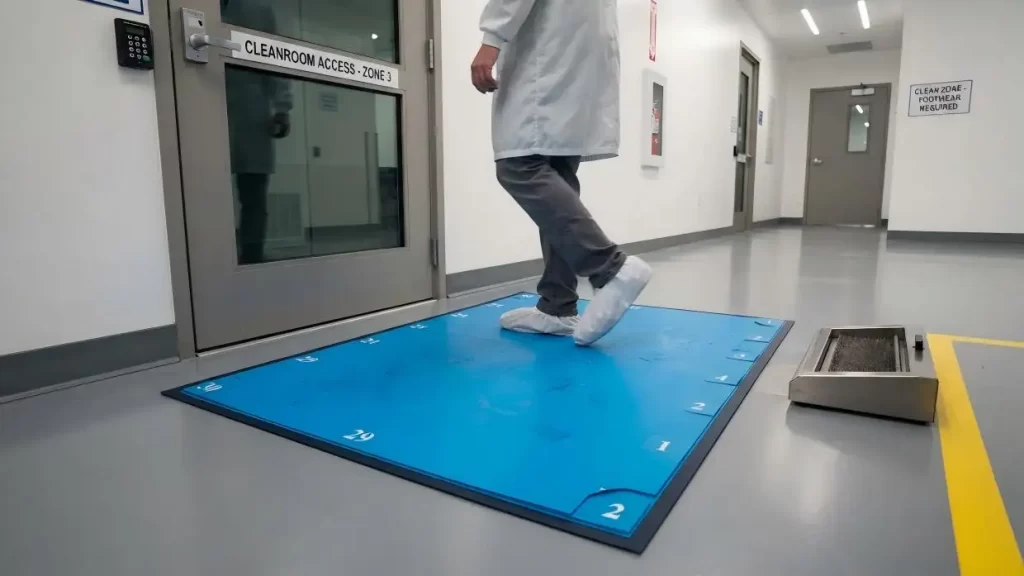
At Nabai, we design peel-off mats as one component of a broader contamination-control program. ISO 14644-1 classifies cleanrooms according to airborne particle concentration; it does not certify an individual entrance mat. In sterile pharmaceutical production, the facility's Contamination Control Strategy should coordinate premises, procedures, personnel practices, cleaning, monitoring, and technical controls. Therefore, a mat supports—but does not replace—these systems.
How a Sticky Mat for Cleanroom Entrance Captures Particles
A Sticky Mat for Cleanroom Entrance works through three connected actions:
•Contact: A shoe sole or trolley wheel presses against the adhesive-coated PE surface.
•Transfer: Loose particles detach from the contacting surface and adhere to the mat.
•Retention: Debris builds up on the exposed sheet until it is removed.
Performance is impacted by contact with the surface. Length of the mat, method of installation, direction of traffic, the load on the surface, the type of shoes, the type of wheels, and the strength of the adhesive all influence the degree of particle pickup.
A correctly selected Sticky Mat for Cleanroom Entrance should encourage several natural steps or adequate wheel contact rather than allowing personnel and equipment to bypass the active surface.
Peel-off models contain multiple adhesive sheets. When the exposed layer becomes visibly loaded or no longer provides consistent tack, operators remove it to reveal a clean layer underneath. Used sheets should be peeled slowly and folded inward to minimize disturbance of collected debris.
How Nabai's Four-Corner Structure Works
Conventional peel-off mats normally expose one complete sheet at a time. Nabai's four-corner Sticky Mat for Cleanroom Entrance divides the working surface into four triangular sections that meet at the center.
This design provides multiple functional benefits:
•Targeted use: depending on the direction of the flow, one of the corners can be left exposed.
•Selective removal: sections with a high weight can be removed in advance of sections with a low weight.
•Flexible rotation: Operators can progress clockwise or counterclockwise.
•Reduced avoidable waste: Layer replacement can follow actual contamination distribution.
•Simplified maintenance: Teams can inspect and manage individual working sections.
The four-corner design does not eliminate inspection or full-mat replacement. Instead, it helps maintenance teams match peeling frequency more closely to uneven loading at entrances, gowning transitions, and material-transfer points.
Material and Construction
The reliability of a Sticky Mat for Cleanroom Entrance depends on the coordinated performance of its film, adhesive, segmentation, and floor-contact construction.
| Component | Primary Function | Selection Consideration |
| PE Film | Supports each removable layer | Needs to withstand tearing and have controlled peeling |
| Acrylic Pressure-Sensitive Adhesive | Captures dry, loose particles | Needs to have consistent tack and low transfer risk |
| Four-Corner Segmentation | Allows for selective activation | Requires precision cutting and alignment of sections |
| Floor-Contact Backing | Prevents the mat from curling | Needs to work with clean, dry floors |
| Protective Liners | Prevents damage to surfaces prior to installation | Requires simple removal and no damage to surface |
Nabai's products come in sizes of 18 × 24 inches to 26 × 45 inches in 30 or 60 layered configurations and blue, white, transparent, or gray colors.
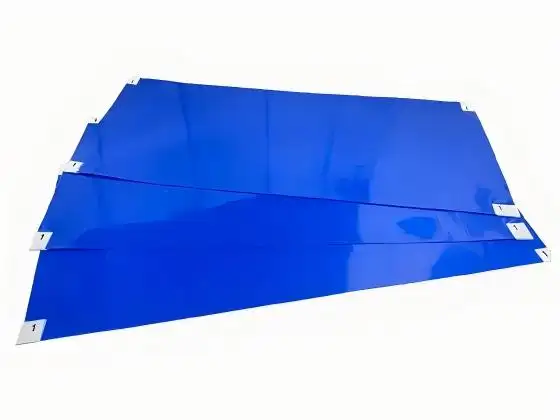
The 250-550 g value listed should be considered a nominal adhesion or tack value and not a viscosity value unless a viscosity value is given and a viscosity measurement method is specified. Potential buyers should also ask for the following:
•Test method and test direction
•Dwell time and peeling rate
•Film thickness in micrometers
•Adhesive transfer acceptance criteria
•Storage conditions and shelf life
The original "3C-6C" thickness description should be converted to micrometers in the final technical data sheet to avoid confusion.
Recommended Installation and Use
Nabai recommends these suggestions for the installation of Sticky Mats for Cleanroom Entrances:
1.Preparation of the flooring: Eliminate all loose debris, moisture, dust, oils and residues.
2.Mat alignment: Place the mats with the longer side in the direction of the dominant flow of the foot traffic.
3.Backing secure: Flatten the mat after removing the bottom liner.
4.One section exposed: Peel the protective liner in the corner of the mat to be sectioned.
5.Traffic contact: Foot and/or wheeled contact is made to the section of the mat which is active.
6.Sections should be replaced either when the section becomes contaminated, or when the mat loses its stickiness.
7.Used layers should be peeled and removed carefully by being folded in on themselves.
8.Record all inspections and replacements and properly document the disposal of used layers in accordance with local standard operating procedures.
A Sticky Mat for Cleanroom Entrance should not be installed on wet, uneven, dusty, or damaged flooring. It must also remain clear of emergency routes and should not create a trip or trolley-transfer hazard.
Role Within a Cleanroom Program
A Sticky Mat for Cleanroom Entrance may support particulate control in:
•Semiconductor fabrication and packaging
•Electronics and precision assembly
•Medical-device manufacturing
•Pharmaceutical gowning transitions
•Biotechnology laboratories
•Controlled material-transfer areas
However, ISO classification applies to airborne particle concentration—not to the mat itself. Suitability for an ISO Class 5, 6, 7, or 8 facility should be determined through site risk assessment, traffic analysis, cleaning procedures, and operating controls.
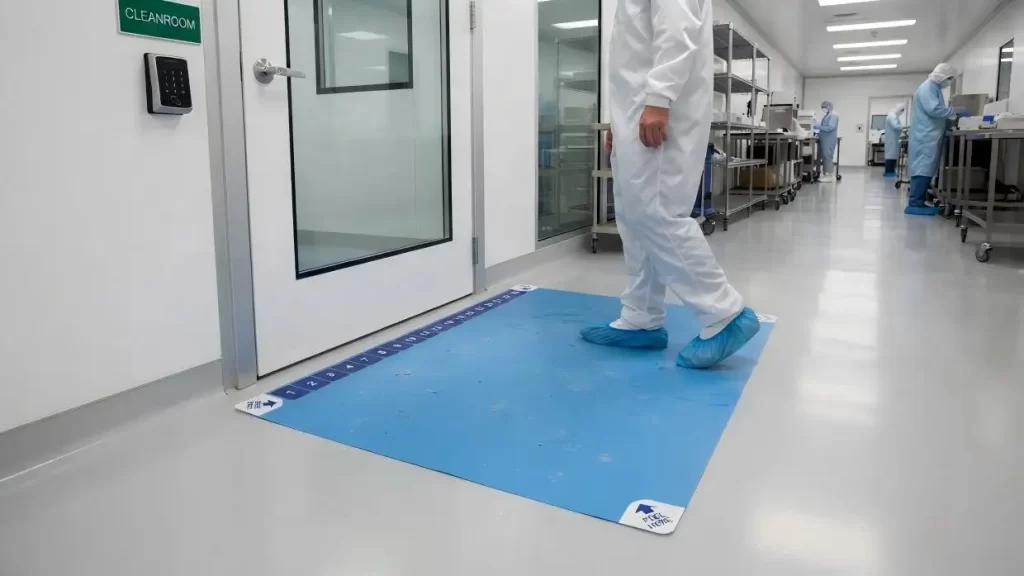
For sterile manufacturing, the Sticky Mat for Cleanroom Entrance should be evaluated within the facility-wide Contamination Control Strategy rather than treated as a stand-alone compliance measure. EU GMP Annex 1 specifically emphasizes coordinated controls for particles, microorganisms, personnel, materials, premises, and procedures.
Selection Checklist
Before ordering, confirm:
•Doorway width and traffic direction
•Required walking or wheel-contact length
•Personnel and trolley volume
•Layer count and replacement frequency
•Adhesion test method and acceptance range
•Film thickness stated in μm
•Floor compatibility and residue requirements
•Packaging, labeling, color, and waste procedures
A Practical Entrance-Control Component
A Sticky Mat for Cleanroom Entrance works through controlled physical contact: loose particles transfer from footwear and wheels to a renewable adhesive surface.
Nabai's four-corner structure adds segmented activation and selective peeling, helping facilities respond to uneven traffic patterns without prematurely replacing cleaner sections. Its effectiveness still depends on correct placement, routine inspection, careful layer removal, and integration with gowning, cleaning, airflow, monitoring, and site-specific contamination-control procedures.
FAQ
Q1. What are the available layers by Nabai?
Nabai has standard offerings of 30 or 60 peelable layers, and custom options are available.
Q2. When should the top layer be replaced?
The top layer should be replaced when it becomes soiled or loses its stickiness.
Q3. Can the use of a sticky mat classify the cleanroom into an ISO class?
No. The classification of cleanrooms into ISO classes depends on the concentration of airborne particles and is not related in any way to the use of an entrance mat.
Q4. Where should the mat be placed?
The mat should be placed on a level, clean and dry surface at the entrance of the controlled area.
Q5. Can trolley wheels roll over the mat?
Yes. A Sticky Mat for Cleanroom Entrance is designed to remove particles from footwear and trolley wheels.
NEWS
GET SERVICE
With quality parts to meet every budget and friendly staff trained to make your visit informative and hassle free.