
what is esd protection

what is esd protection
Electrostatic Discharge (ESD) is one of the most common yet often overlooked threats to electronic devices and components. Electronic assemblies, circuit boards and microchips can be so sensitive that a minor static shock that would not harm a person can render the device permanently unusable. With continued trend towards size reduction and increased complexity of modern electronic devices, ESD protection is now a must-have criterion in manufacture, test, storage and transport, and repair facilities.
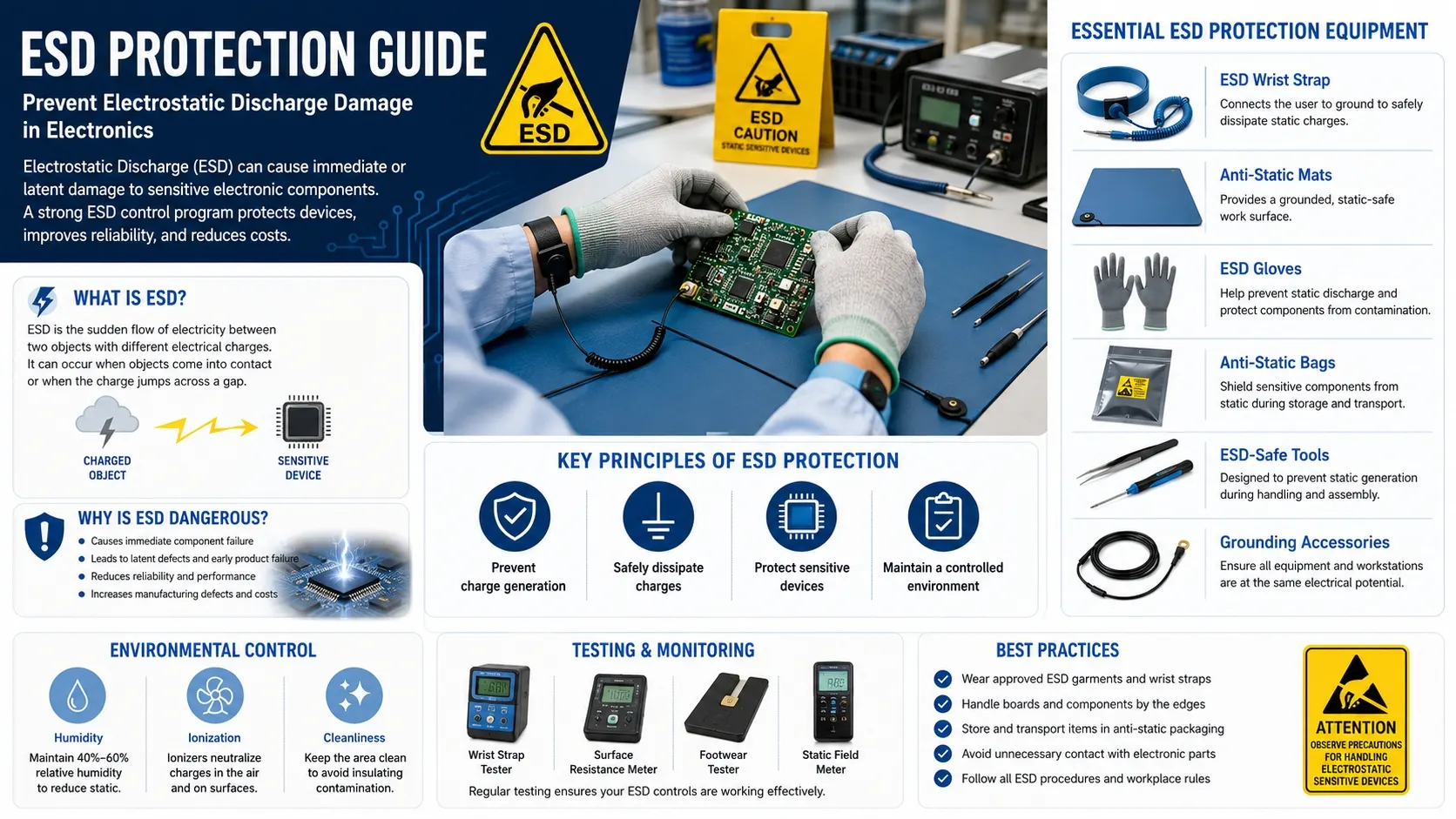
This guide introduces the concept of ESD and why it can be hazardous to electronic equipment and provides the most effective ways to arrest damage caused from electrostatic effects.
What Is Electrostatic Discharge (ESD)?
Electrostatic Discharge is the release of electrical energy from one object to another in a short, sharp burst, due to differing electrical charges. When charged objects come into contact or move close enough together for electrons to jump, this is the discharge that happens. ESD could produce only a small spark, or it could be a high-voltage discharge that could harm electronic components.
An example of this is the small shock that may be experienced if a person walks on a carpet that causes their body to charge up and then touches a conducting surface. This powerful impact could have little effect on human beings but could cause damage to sensitive electronic circuits.
Why Is ESD Dangerous?
A lot of electronic components are so designed that they can only work with very low voltage. These components can only withstand a tiny electric spark, and when that happens they can have a variety of effects:
- Immediate component failure
- Reduced product lifespan
- Intermittent performance issues
- Data corruption
- System instability
- Increased manufacturing defects
In industry, failures due to ESD can lead to costly repairs, warranties and lost production times. Some damage may not manifest or be apparent that could lead to products failing after leaving the laboratory.
Common Causes of ESD
Static electricity is created by rubbing together any two materials. Common sources include:
- Walking on carpets
- Sliding across plastic chairs
- Handling packaging materials
- Moving electronic components
- Friction between clothing fabrics
- Dry environmental conditions
The ESD effect occurs when a charged object touches a conductive surface or electronic equipment, and allows the charge to move into a path to balance its distribution.
Key Principles of ESD Protection
A single product or procedure can never provide ESD protection. It instead demands an in-depth approach to the equipment, workplace design, equipment training and appropriate handling procedures.
The main objectives of the ESD control are:
- Prevent static charge generation.
- Safely dissipate accumulated charges.
- Protect sensitive devices from electrostatic exposure.
- Maintain a controlled work environment.
Organizations that implement these principles significantly reduce the risk of component damage and production losses.
Essential ESD Protection Equipment
ESD Wrist Straps
ESD wrist strap is one of the most popular anti-static products. They ground the user to the earth, protecting static charges from reaching sensitive electronics. Wrist straps properly worn will keep the Operator at the same electrical potential level as the workstation.
Anti-Static Mats
ESD-safe workbench mats & floor mats provide controlled surfaces which minimize accumulation of static. These mats are usually grounded and offer a designated electronics handling area that is safe for ESD.
ESD Gloves and Finger Cots
Anti-static gloves not only protect components from static, but also eliminate the risk of static and keep components from becoming contaminated by fingerprint or skin oil on the hands. However, the finger cots are commonly used for precision handling.
Grounding Cables and Clamps
Grounding accessories provide connections between equipment, workstations and safely connect to ground. Grounding systems help to avoid sudden discharge event occurrences by bringing down the electrical potential.
Anti-Static Bags
Anti-static packaging should always be used for sensitive electronic components, which include storage and transport. These bags act as a means to reduce static charges, as well as offer extra protection from ambient electrostatic events.
ESD-Safe Tools
Professional electronics technicians use these and many other tools that are ESD-safe. The products come with materials that either conduct electricity or dissipate it to prevent the build-up of static during use.
Creating an ESD-Safe Workstation
An effective ESD-protected workstation typically includes:
- Grounded work surface
- Anti-static mat
- Wrist strap connection point
- Common grounding system
- ESD-safe seating
- Static-dissipative flooring
- Proper humidity control
To prevent unwanted discharge events, all conductive components should be kept at the same electrical potential.
Various electronics manufacturers set up anti-static special areas on their premises called ESD Protected Areas (EPAs), in which all anti-static procedures are adhered to at all times.
The Role of Environmental Control
Static generation can be greatly affected by the environment.
Humidity Management
Humid environments are not conducive to a build-up of static. Some built hygrometers can automatically adjust the relative humidity within the range of 40 % to 60 % which is ideal for minimizing electrostatic charge.
Air Ionization
Ionizers can neutralize static charges by scattering positive and negative ions into the air, helping to minimize static build-up in regions where grounding is not enough. These types of systems come into use particularly with insulated materials that are not directly grounded.
Cleanroom Considerations
The use of anti-static garments, ESD control floor mats and even ionization systems in the cleanroom are common for protecting extremely sensitive semiconductor devices.
ESD Testing and Monitoring
Regular testing is essential for maintaining an effective ESD control program.
Common testing equipment includes:
- Surface resistance meters
- Wrist strap testers
- Footwear testers
- Ground continuity monitors
- Static field meters
Continuous monitoring systems can tell when grounding connections are working during production. These tools can detect issues before they cause expensive equipment damage.
Employee Training and Best Practices
The most sophisticated ESD equipment will not adequately protect against damage if employees do not perform handling procedures correctly.
Recommended practices include:
- Wearing approved ESD garments
- Using grounded wrist straps
- Handling circuit boards by their edges
- Avoiding unnecessary contact with electronic components
- Storing products in anti-static packaging
- Following established ESD protocols
Dedicated user accessible ESD protection is always desired for connectors, external interfaces and built-in protection may be inadequate in some applications.
Conclusion
One of the most common reasons for electronic component failure throughout all manufacturing, assembly, test and repair operations is due to electrostatic discharge. There are ways to prevent expensive damage: a complete ESD control program that includes grounding systems, employee training, environmental controls and anti-static equipment can significantly reduce the damage risk.
From large full-fledged electronics manufacturing plants to small repair shops, investing in the right ESD protection system can help ensure product reliability, workplace safety, and valuable electronics protection. The sophistication of electronic devices is constantly increasing, and, consequently, effective ESD control cannot be ignored and is an integral component of today's electronic business.
NEWS
GET SERVICE
With quality parts to meet every budget and friendly staff trained to make your visit informative and hassle free.