
Why Use Sticky Mats in Cleanrooms | Contamination Control Guide

Why Use Sticky Mats in Cleanrooms | Contamination Control Guide
What is the Use of Sticky Mats in Cleanrooms?
The cleanroom has entry sticky mats that are used to prevent the entry of dust into clean areas. These mats are placed at the entry points where risk of contamination is most likely to occur.
• Reason sticky mats are used in cleanrooms.
• Cleanroom contamination control mats.
• Dust control sticky mat system purpose
• Cleanroom hygiene adhesive mat position.
• Cleanroom entry sticky mat.
Why Sticky Mats Should Be Used in Cleanrooms to Control Contamination?
It is important to know why sticky mats are used in cleanrooms and any controlled facility. Cleanrooms are based on the strict control of dust. Even small particles may spoil products or experiments.
- A cleanroom sticky mat functionality is straightforward yet mighty. It cleanses dust off shoes, carts, and wheels before entry. This reduces contamination of sources.
- Sticky mats in cleanroom setups are not there to be cute. It is a part of hygiene control in the laboratory, factories, and sterile zones.
Sticky Mats are Used in Contamination Control
The particle removal entrance mat system is used with adhesive layers to trap dust. Every step eliminates particles from shoes and wheels. Nabai sticky mats can improve this process with the help of the advanced material design.
Working Principle
- Fine dust is immediately deposited on the adhesive surface.
- The multi-layer system can be easily peeled off.
- Each layer has a reset contamination control.
- Access areas are cleaner and safer.
This produces a powerful, clean entry dust-trapping mat system.
Nabai Sticky Mats Technical Structure
Nabai mats are designed to be utilized in a clean environment with high hygienic standards.
Material & Construction Details
- Base Film: Antimicrobial agent polyethylene, low-linting.
- Adhesive Layer: Anti-bacterial acrylic pressure adhesive.
- Support: Non-slip HDPE sheet to keep it stable.
- Technology: In-built antibacterial agent to offer continuous protection.
This helps the ISO standards of the cleanroom flooring protection system.
Cleanroom Safety and Antibacterial Protection
The anti-bacterial sticky mat of Nabai is an additional protective measure. It minimizes the growth of microbes and captures dust.
Key Hygiene Features
• Antibacterial surface support reduces the bacteria build-up.
• Collection of dust and dirt from shoes and carts.
• Sensitive work areas that are cleaner.
It is perfect for the use of cleanroom contamination barrier systems.
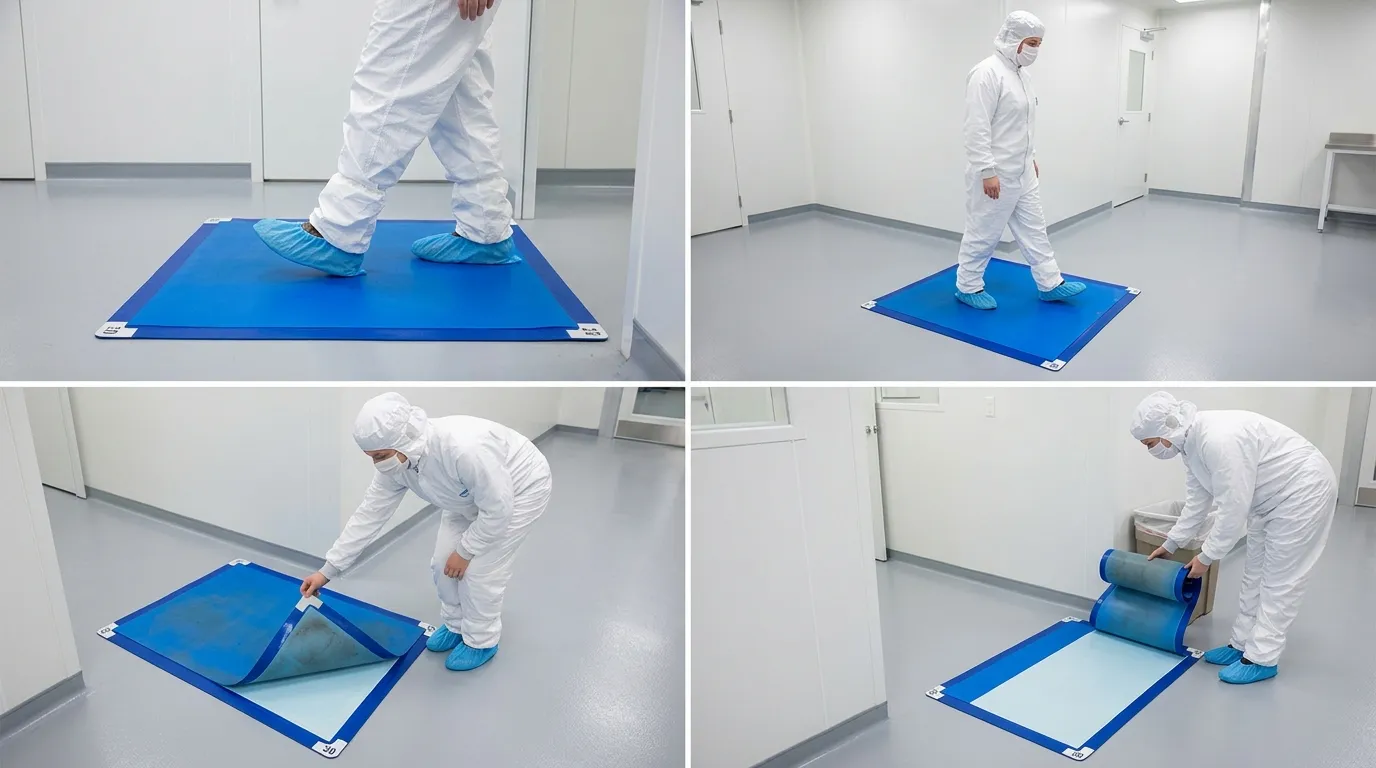
The Importance of Sticky Mats in Cleanrooms
The significance of sticky mats in cleanrooms is associated with the control of contamination. The cleanrooms are to be dust-free, fiber-free, and particle-free. Even the small traffic can cause unwanted contamination inside. Sticky mats are laid at the points of entry, and this problem is prevented before it becomes rampant.
Shoes and carts with no sticky mats easily transport dust. This poses a risk to vulnerable work areas like laboratories, pharmaceutical facilities, and electronic factories. One step on the mat eliminates the loose particles and assists in keeping the space clean.
Main Reasons for Use
• Eliminates the entry of particles at cleanroom doors and entry points.
• Minimizes contamination at the source, and then it spreads within.
• Preferring a controlled environment entry mat system to increase hygiene control.
• Enhances the stability of cleanroom hygiene in everyday activities.
• Helps uphold cleanroom gowning area mats criteria in critical areas.
The ISO cleanroom regulations are also supported by sticky mats since the dust is contained at the first point of contact. This makes them an easy but important tool in contamination control systems used in modern industries.
Function and Performance Under Real Conditions
A dust control sticky mat system is a system that works continuously. Traffic and contamination load are factors of performance.
Performance Benefits
- Sticky mats are still effective in removing particles.
- Cleanliness of the cleanroom entrances is improved.
- The adhesive mat dust trapping mechanism is an instant mechanism.
- There is no change in surface particle capture performance.
- Reduction of entry in dust loads is kept in check.
These functions are used to promote cleanroom safety at any point in time.
Sticky Mats in Industry
In numerous high-precision industries, sticky mats are employed.
Key Industry Uses
- Use of semiconductor cleanroom sticky mats.
- Cleanroom contamination control systems in the pharmaceutical industry.
- Electronics production cleanroom hygiene mats.
- Entry floor mats in sterile zones in hospitals.
- Cleanroom flooring solutions in laboratories.
All industries must have controlled environment hygienic standards.
Benefits of Sticky Mats in Cleanroom Hygiene
An entry control system is essential to a cleanroom contamination prevention system. Dust is prevented by sticky mats.
Hygiene Improvements
- The process of removing particles of footwear is realized.
- Contamination on the surface is minimized at entry points.
- The functionality of the multi-layer sticky mat peel system ensures fresh surfaces.
- Cleanroom hygiene improvement tools are maintained in operation on a daily basis.
This renders mats as an important component of contamination control.
Cleanroom Standards and Compliance with ISO
Clean rooms are founded on strict ISO guidelines. Sticky mats are used to ensure compliance.
ISO Related Functions
- Cleanrooms that are ISO compliant have compliance systems that facilitate entry control.
- Particle trap adhesive mats enhance the level of cleanliness.
- The cleanliness in the controlled areas is fixed.
- Audits are supported by dust control floor mat technology.
This guarantees the significance of adequate cleanroom entry sticky mats.
Advantages of Nabai Sticky Mats in Controlled Environments
Nabai mats are created to be used in clean places and to perform.
Key Benefits
• Good particle trapping efficiency.
• Anti-bacterial hygienic surface.
• Good heavy traffic adhesion.
• Dirty residue material to be removed.
• Long-lasting multi-layer structure
These properties contribute to entry protection strategies in cleanrooms in industries.
Use in Sensitive Industries
Nabai mats are commonly used in high-hygiene industries.
Where They Are Used
• GMP cleanrooms
• Pharmaceutical labs
• Biotechnology facilities
• Food packaging areas
• Semiconductor production units
Such settings demand rigid, cleanroom footwear cleaning mats.
Conclusion:
Understanding the reason behind using sticky mats in cleanrooms will assist in safeguarding all processes within the cleanrooms. Entry control is relied upon in cleanrooms. Dust is not spread because of sticky mats.
Nabai antibacterial sticky mats offer excellent protection, unlimited adhesion, and hygiene assistance. They improve security in labs, pharmaceutical production plants, and semiconductor manufacturing plants.
NEWS
GET SERVICE
With quality parts to meet every budget and friendly staff trained to make your visit informative and hassle free.