
Why Use Sticky Rollers in Electronics Manufacturing | Guide

Why Use Sticky Rollers in Electronics Manufacturing | Guide
Use of Sticky Rollers in Electronics Manufacturing
During the manufacturing process, electronics demand very clean surfaces. Even a small dust particle may lead to the defect or total breakdown of the product. This is why nowadays sticky rollers are widespread in the electronics production lines.
- Sticky rollers are employed to help in maintaining contamination of electronic surfaces under control through removing dust, lint, and micro particles in work areas. They facilitate consistent production with the cleaning of sensitive parts before assembly and testing.
- In electronics factories, cleanliness is not an option. It has a direct impact on the quality and performance of products. Sticky rollers enhance the ability of dust particles to be removed by trapping fine debris that cannot be removed by normal cloths or air cleaning.
- They are usually used in PCB assembly, semiconductor handling, and cleanrooms. They help to reduce risks related to static and contamination in the production process.
- Sticky rollers are also useful in enhancing workflow by ensuring that cleaning is quick and uniform. They enable better stability of output and reduce the chances of defects in the end products.
Use Sticky Rollers in Electronics Manufacturing to Clean Results
Why use sticky rollers in electronics manufacturing? Sticky rollers are used to remove dust from delicate surfaces. They back up contamination-free production in regulated areas. Even micro dust is a threat in electronics plants. It may destroy circuits when assembling or testing. Sticky rollers can be used in:
- Cleaning of surfaces with electronics.
- Removal of dust in PCB production.
- Control of the cleanliness of production lines.
- Use of precision surface cleaning tools.
They promote the cleaning efficiency of adhesive rollers in workstations.
Sticky Rollers are Important in Electronics Assembly
Electronic assembly lines are very sensitive to cleanliness. This is where sticky rollers are needed. Sticky rollers are used to keep:
- Lint-free surface maintenance
- Particle adhesion control
- Particle control of cleanroom air.
- Process of micro dust elimination.
They minimize surface particulate removal problems at work. They also help with the ISO cleanroom compliance criteria in factories.
Industry Applications of Sticky Rollers
The sticky rollers in the electronics industry are utilized in numerous processes. They wash the surfaces before sensitive operations.
- Printed circuit board (PCB) assembly.
- Semiconductor wafer handling
- Electronic component mounting
- Surface mount technology (SMT) lines.
- Inspection of quality during pre-assembly.
The processes require a high particle retention efficiency. Sticky rollers minimize the risk of contamination in every step.
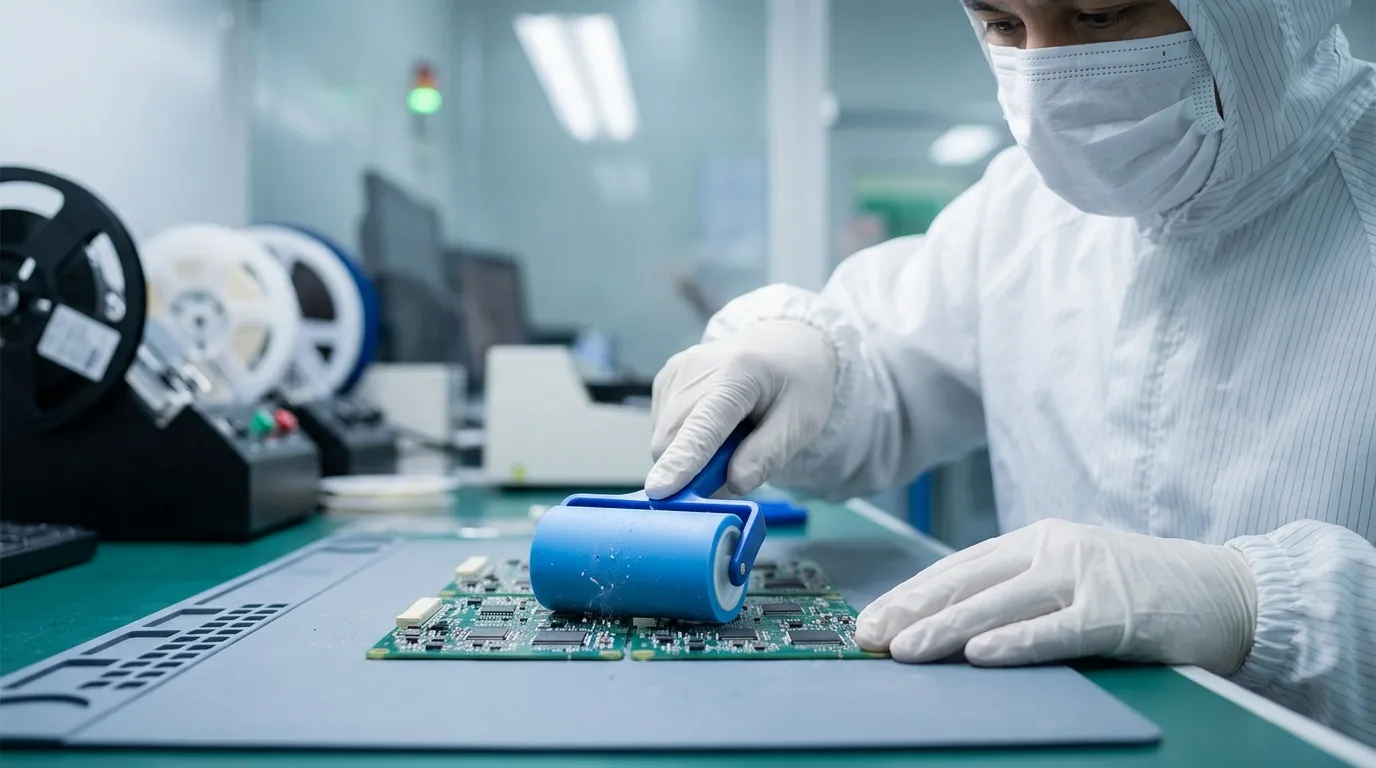
Benefits of Sticky Rollers in PCB Manufacturing
The manufacture of PCBs is very delicate. Short circuits or defects can be caused by dust. Sticky rollers are used to enhance:
- Improvement of defects in assembly.
- High-precision manufacturing workflow
- Stability of clean electronics production.
They help in the control of PCB assembly contamination at each stage.
Technical Impact
- Improves yield rate
- Reduces rework cost
- Limit the diffusion of micro particles.
- Ensures consistent production.
They are important anti-static contamination control devices in PCB lines.
Use of Sticky Rollers in Semiconductor Manufacturing
Semiconductor work involves very clean environments. Even microscopic dust affects the quality of the wafer. Sticky rollers help maintain:
- Semiconductor fabrication cleanliness
- Cleaning protocols of a controlled environment.
- Surface particulate removal systems.
- When handling, they protect delicate wafers.
They minimize the risks of electrostatic discharge (ESD) protection indirectly. This enhances the end chip reliability and performance.
Protection of Electronic Components by Sticky Rollers
Electronic components are dust and static-sensitive. Sticky rollers minimize contamination in handling. They help with:
- Component sensitivity protection
- Microelectronics manufacturing hygiene
- Dust control on the production line.
- They capture particles prior to reaching components.
This minimizes the destruction of dust in electronics manufacturing.
Technical Knowledge: The Secret of Sticky Rollers
Pressure-sensitive adhesive layers are used to create sticky rollers. These layers entrap particles by bonding to the surface. Key Technical Points are:
- Micro particles are contained in the adhesive coating.
- The capture rate is enhanced by the electrostatic attraction.
- Fine dust is trapped by surface tension.
- A low level of lint content removes further contamination.
- This helps in the effective adhesive roller.
- It also enhances the control of particle adhesion in clean areas.
Electronics Sticky Roller Standard PP
The Nabai standard PP sticky roller eases clean handling processes. It is to be employed in electronics and precision applications.
Product Features
- Low-lint PP surface
- Reduces the amount of fiber released during cleaning.
- Reliable dust pickup
- Collects small dust and particles.
- Smooth rolling operation
- Demonstrates steady movement on flat surfaces.
This design enhances clean surface preparation in electronics.
Material & Construction
- Base Material: polypropylene (PP) high-purity film.
- Adhesive Layer: Pressure-sensitive acrylic film.
- Core Material: 3-inch cardboard core.
These materials are applied to hold stable dust removal rollers, which will be applied in the electronics industry.
When Sticky Rollers Enhance the Quality of Production
Sticky rollers are used to enhance various factory results.
- Key Improvements
- Lower defect rates
- Better surface cleanliness
- Higher production yield
- Stable inspection results
They facilitate automated cleaning processes of production lines. They also minimize the loss of efficiency in operations in factories.
Role in Clean Electronics Environment
Strict control systems are required in clean environments.
- This structure is supported by sticky rollers.
- They help maintain:
- Cleaning procedures in a controlled environment.
- Anti-static pollution control equipment.
- Micro dust elimination process
They are a component of complete contamination control tool systems.
Conclusion:
Why use sticky rollers in electronics manufacturing? Sticky rollers are not the only cleaning tools. They protect the quality of all electronic processes. They minimize dust, enhance safety, and promote accurate work. The reason why sticky rollers are used in the manufacture of electronics in modern factories is evident.
They safeguard yield, minimize defects, and enhance clean control. Install Nabai ESD solutions in your cleaning system. Choose powerful tools that can facilitate accuracy, safety, and sustainability in the production of electronics.
NEWS
GET SERVICE
With quality parts to meet every budget and friendly staff trained to make your visit informative and hassle free.