
Cleanroom Pressure Cascade and Airflow: Why Entry Control Fails Without It

Cleanroom Pressure Cascade and Airflow: Why Entry Control Fails Without It
A cleanroom pressure cascade is a planned sequence of differential pressures between adjacent rooms that makes air move from cleaner areas to less clean areas. When the cascade is missing, unstable, or unverified, entry-control equipment such as air showers and sticky mats cannot prevent contaminated air from moving the wrong way. Airflow direction, not equipment alone, determines whether a cleanroom entrance actually protects the room.
This article explains how pressure cascade and airflow design work, why they are the foundation of cleanroom entry control, and how to verify that a facility's pressure relationships are performing as intended — whether you are designing a new cleanroom, troubleshooting an existing one, or evaluating supplier proposals.
What Is a Cleanroom Pressure Cascade?
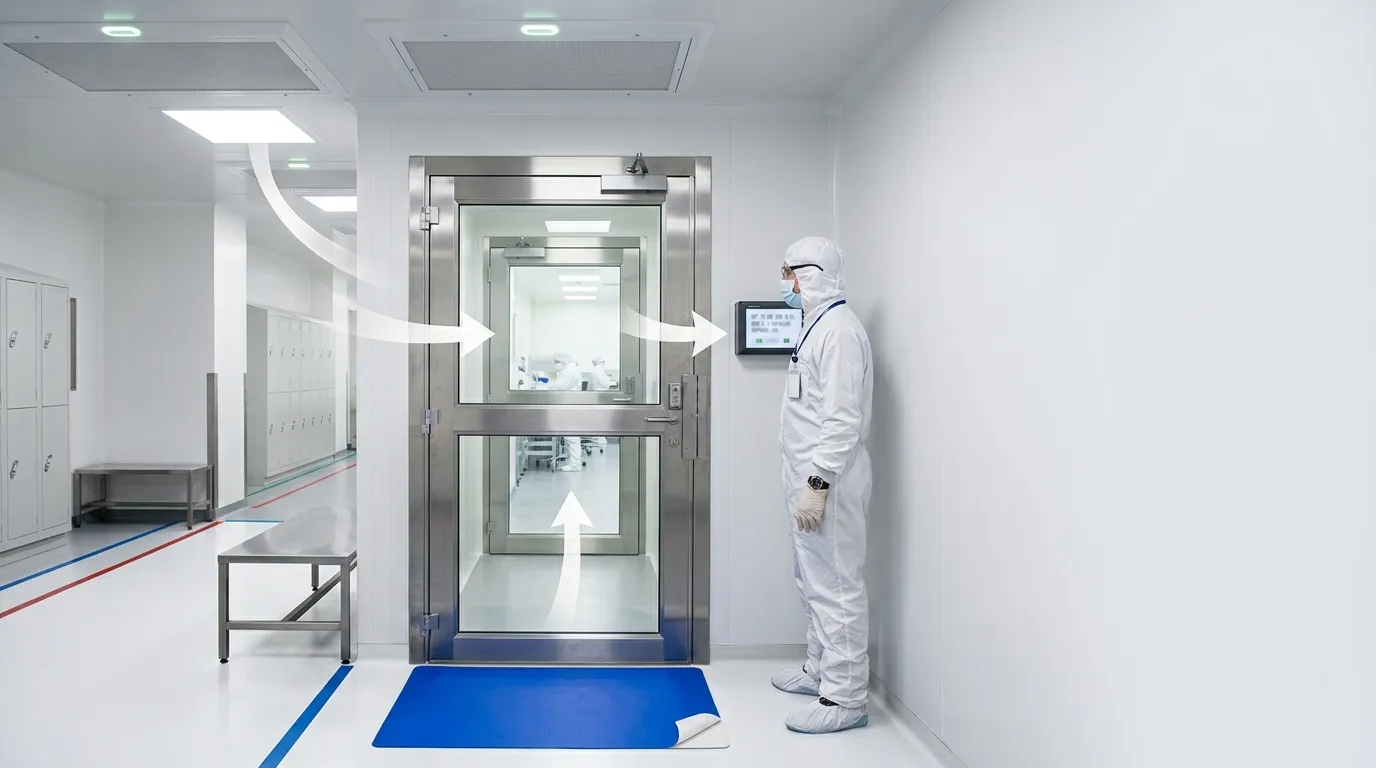
A pressure cascade is an ordered set of pressure differences between rooms or zones. Each room is held at a slightly different pressure relative to its neighbors, and air moves from higher-pressure areas to lower-pressure areas. That pressure arrangement is what sets the direction of airflow between rooms.
In a typical positive-pressure cascade, the cleanest room has the highest pressure. Air flows outward through less clean areas, preventing airborne particles and microbes from being drawn into the protected zone. In a negative-pressure cascade, the controlled room has the lowest pressure, so air flows into it — the strategy used when the room itself contains a hazard that must not escape.
The cascade is not the same as HEPA filtration or air-change rate. Filtration removes particles from the supplied air; air changes determine how quickly the room volume is replaced. Neither establishes the pressure relationship between rooms. ISO 14644-4, the international standard for cleanroom design, construction, and start-up, addresses the integration of these systems at the design stage.
How Airflow Design and Pressure Zones Work Together
The HVAC system creates the cascade by balancing supply air against return and exhaust air. When a room receives more air than it exhausts, its pressure rises. When it exhausts more than it receives, its pressure falls. The difference between supply and exhaust for each room is what establishes the differential pressure relative to adjacent spaces.
The building envelope matters as much as the HVAC system. Gaps around doors, poorly sealed walls, cable penetrations, and unsealed utility pass-throughs allow air to bypass the intended path. An HVAC system cannot hold a stable cascade in a leaky enclosure. Airflow design must therefore treat the room envelope as part of the pressure system.
Supply and return grille placement also influences performance. A room can be at the correct pressure yet still have stagnant zones, or air that crosses the product in an unintended path. How to remove dust particles from air explains the role of filtration and air movement in particle control, but for pressure control the critical factor is the balance of supply, return, and exhaust — not simply the presence of filters.
HEPA and ULPA filters condition the air supplied to the cleanroom, but they do not pressurize it. Filter selection and pressure cascade design are decided together because the air-handling system must deliver the required cleanliness and the required pressure profile at the same time, but they are distinct functions. For a detailed comparison of the two filter grades, see the hepa vs ulpa filter difference explained in our separate guide.
Positive-Pressure Protection vs Negative-Pressure Containment
The correct cascade direction depends on what the cleanroom exists to protect.
| Configuration | Pressure Relative to Adjacent Areas | Airflow Direction | Typical Applications |
|---|---|---|---|
| Positive-pressure cascade | Cleanroom pressure higher than surroundings | Air flows out of the cleanroom | Semiconductor fabrication, electronics assembly, sterile pharmaceutical filling, medical device manufacturing |
| Negative-pressure containment | Controlled room pressure lower than surroundings | Air flows into the controlled room | Handling hazardous materials, potent compounds, infectious agents, or dust-generating processes |
| Mixed-zone facility | Different rooms designed for their own protection or containment needs | Direction varies by zone | Facilities requiring both product protection and operator or environment protection |
Positive pressure protects the product or process from external contamination. Negative pressure protects operators and the surrounding environment from contamination generated inside the room. Some facilities need both. A pharmaceutical suite, for example, may hold an aseptic filling room positive relative to the corridor while a dispensing room handling potent ingredients is held negative. WHO guidance on HVAC systems for pharmaceutical facilities explains how pressure differentials and airflow direction work together with airlocks to protect classified areas.
There is no universal pressure value that fits every cleanroom. The required differential depends on the application, the room classification, the governing standard or user requirement specification, and the physical layout of the facility.
Airlock and Door Design: Making the Cascade Survive Entry
The pressure cascade must survive the moment a person or material enters the cleanroom. That is the purpose of airlocks and door controls.
Personnel airlocks (PALs) and material airlocks (MALs) serve different functions. A PAL stages the movement of people through gowning and entry. A MAL stages the transfer of materials so external packaging can be removed before the item enters the cleanroom. Both depend on the same pressure logic.
Three airlock configurations are common:
- Cascade airlock: air flows from the cleanroom through the airlock toward the less clean corridor.
- Bubble airlock: air flows out of the airlock to both adjacent areas.
- Sink airlock: air flows into the airlock from both adjacent areas.
Cascade airlocks are used when the priority is cleanroom protection. Bubble airlocks suit facilities where both adjacent zones must be protected from each other. Sink airlocks are used for containment, when the airlock itself must capture contamination. The IEST Recommended Practice for cleanroom design treats these airlock types as a core design consideration, and the NIH technical bulletin on airlock pressurization provides a practical explanation of the same distinction.
Door interlocks prevent two interlocked doors from opening at the same time, so the airlock is not bypassed. They do not, however, eliminate the pressure transient that occurs when a single door opens. Every door opening momentarily connects two pressure zones, and the direction and duration of the air exchange depend on the pressure difference, the door size, and the conditions in both rooms. The system must recover quickly after the door closes — and the facility team must know what "quickly" means for their specific design.
Why Entry Control Fails Without a Pressure Cascade
Entry-control equipment and procedures act on people and materials. They do not act on room pressure. An air shower can remove particles from a gown. A sticky mat can remove particles from shoe soles. Neither can reverse the movement of air that is already flowing the wrong way. When the pressure cascade is unstable or reversed, contaminated air enters the cleanroom around the very equipment installed to stop it.
Entry control is a system: pressure cascade, airflow direction, airlocks, door interlocks, surface-cleaning equipment, and procedures. Each layer has a specific function, and when the pressure cascade fails, the remaining layers cannot compensate.
What an Air Shower Can and Cannot Do
An air shower uses high-velocity jets of filtered air to dislodge particles from clothing and exposed surfaces before personnel enter the cleanroom. When correctly installed and maintained, it is a useful final step in the personnel-entry sequence.
An air shower cannot establish or maintain room pressure. It does not create a pressure differential between the cleanroom and the corridor, and it does not prevent air from entering the cleanroom when the room is at lower pressure than its surroundings. An air shower installed in a room with a failed cascade becomes part of the contamination path rather than a barrier. When selecting this equipment, working with an air shower manufacturer for cleanroom entrance who understands the pressure cascade is essential — but the equipment itself will never replace the room's pressure relationship.
What a Sticky Mat Can and Cannot Do
A sticky mat removes particles from footwear and wheeled equipment by contact with an adhesive surface. When the mat is correctly placed, sized, and replaced on schedule, it reduces the amount of contamination carried into the cleanroom on the soles of shoes.
A sticky mat does not control airborne contamination. It has no effect on airflow direction, and it cannot compensate for a room held at the wrong pressure. Nabai's sticky mat for air shower room is an example of a surface-contamination-control product designed for exactly this placement — one layer of a larger system, not a substitute for the pressure cascade.
Common Pressure Cascade Failures and How to Troubleshoot Them
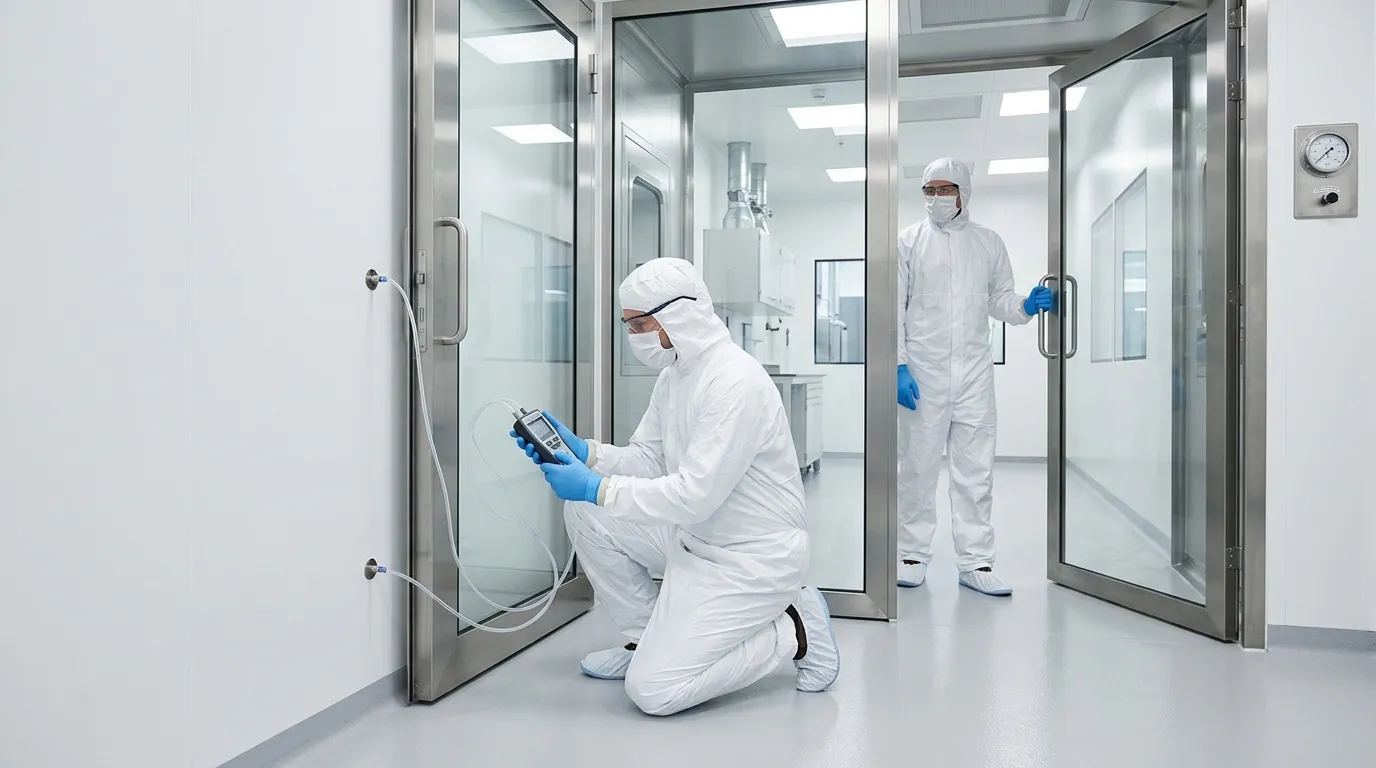
When entry control appears to fail despite air showers, sticky mats, and gowning procedures, the cause is often a pressure-cascade problem.
| Symptom | Likely Cause | What to Check |
|---|---|---|
| No measurable pressure difference between rooms | Supply/return balance not established or dampers out of adjustment | Compare supply and exhaust volumes for each room; review the balancing report |
| Pressure reverses when a door opens | Interlock not functioning or differential pressure too low | Verify interlock logic; confirm doors close fully; review the design differential |
| Alarm sounds during normal entry | Alarm setpoint too close to normal operating range, or sensor in a turbulent location | Review setpoints against measured baseline; check sensor placement |
| Slow pressure recovery after door closure | Excessive leakage, undersized supply, or unbalanced returns | Perform a door-closure test; inspect seals and penetrations; check HVAC response |
| Contamination excursion despite full entry procedure | Cascade direction reversed or airflow recirculating into the cleanroom | Measure every room pair; run a smoke study |
| Stagnant area in one part of the room | Poor return-air placement or obstructed airflow path | Review airflow-visualization results; adjust grilles or deflectors |
The pattern matters: a problem that appears only during entry points to interlock and door-seal issues; a continuous loss of pressure points to balance or envelope leakage.
Testing, Monitoring, and Qualification: Proving the Cascade Works
A pressure cascade that is designed but never verified is an assumption, not a control. Testing and monitoring turn the design into demonstrable performance.
Three values should not be confused:
- Design setpoint: the pressure difference the facility was designed to maintain.
- Operating range: the acceptable band around the setpoint under normal conditions.
- Alarm limit: the value at which the system alerts operators that the cascade is compromised.
FDA guidance on sterile drug process inspections lists airflow-pattern studies, HEPA filter integrity testing, air-velocity measurement, non-viable particle testing, and pressure-differential verification as evidence used to confirm that a cleanroom consistently provides its intended level of protection. The same categories apply to less critical facilities, though the rigor of the program should match the application.
A practical verification sequence:
- Confirm the pressure-zone layout is documented and matches the design intent.
- Measure differential pressure across every adjacent room pair, including airlocks.
- Perform an airflow-pattern smoke study to confirm air moves in the intended direction.
- Verify that door interlocks operate in the correct sequence.
- Test pressure recovery after door openings and record the recovery time.
- Check the alarm and monitoring system by testing at the alarm limit, not just at the setpoint.
- Record all results in a commissioning or qualification report.
Documentation matters as much as the measurement. A TDS describes what a product is expected to do under normal conditions. A batch test report records what a specific batch actually measured. Neither substitutes for room-level commissioning data, and neither should be presented as if it did.
What to Specify and What Evidence to Request from a Cleanroom Supplier
The best time to prevent a cascade failure is before the system is built — or before an entrance-control product is purchased. Start with a written user requirement specification that states what must be achieved, not just which components must be supplied.
A practical request list for any cleanroom or entrance-control supplier:
- A design narrative explaining the pressure zones and intended airflow direction for every room pair.
- A balancing report showing measured supply, return, and exhaust volumes.
- A commissioning report documenting pressure differentials, airflow visualization, and recovery tests.
- A description of the alarm and monitoring system, including setpoints and alarm limits.
- For surface-control products, the relevant product TDS and, where applicable, batch test reports.
Keep the evidence types separate. Product documentation verifies product performance, not room performance. A sticky mat TDS will describe its construction, dimensions, and handling requirements; it will not describe the airlock pressure relationship.
Select the Cascade Before the Equipment
Entry control fails when it is treated as a collection of products rather than the result of pressure and airflow design. The cascade comes first. When the pressure zones, airflow direction, airlocks, and monitoring are proven, then an air shower, a sticky mat, and a documented entry procedure add real protection. Reverse the order, and equipment delivers only the appearance of control.
For facilities evaluating the surface-contamination layer of their entry sequence, Nabai's sticky mat for air shower room is one example of a product designed for cleanroom entrance support — useful when the pressure cascade is correct, and never a replacement for it.
NEWS
GET SERVICE
With quality parts to meet every budget and friendly staff trained to make your visit informative and hassle free.