
Surface Resistance vs Resistivity: ESD Spec Sheet Guide

Surface Resistance vs Resistivity: ESD Spec Sheet Guide
Surface resistance is the measured resistance between two electrodes placed on the surface of a material, reported in ohms. Surface resistivity is a geometry-normalized version of that surface measurement, reported in ohms per square. The two values are not interchangeable: you can only compare datasheets when the test method, electrode arrangement, and measurement conditions are also the same.
When you open an ESD specification sheet, you will often see one value in ohms and another in ohms per square. That difference is not a typo. It tells you how the measurement was taken and what the number actually describes. This guide explains the distinction, why it matters, and what to check before you trust or compare a quoted value.
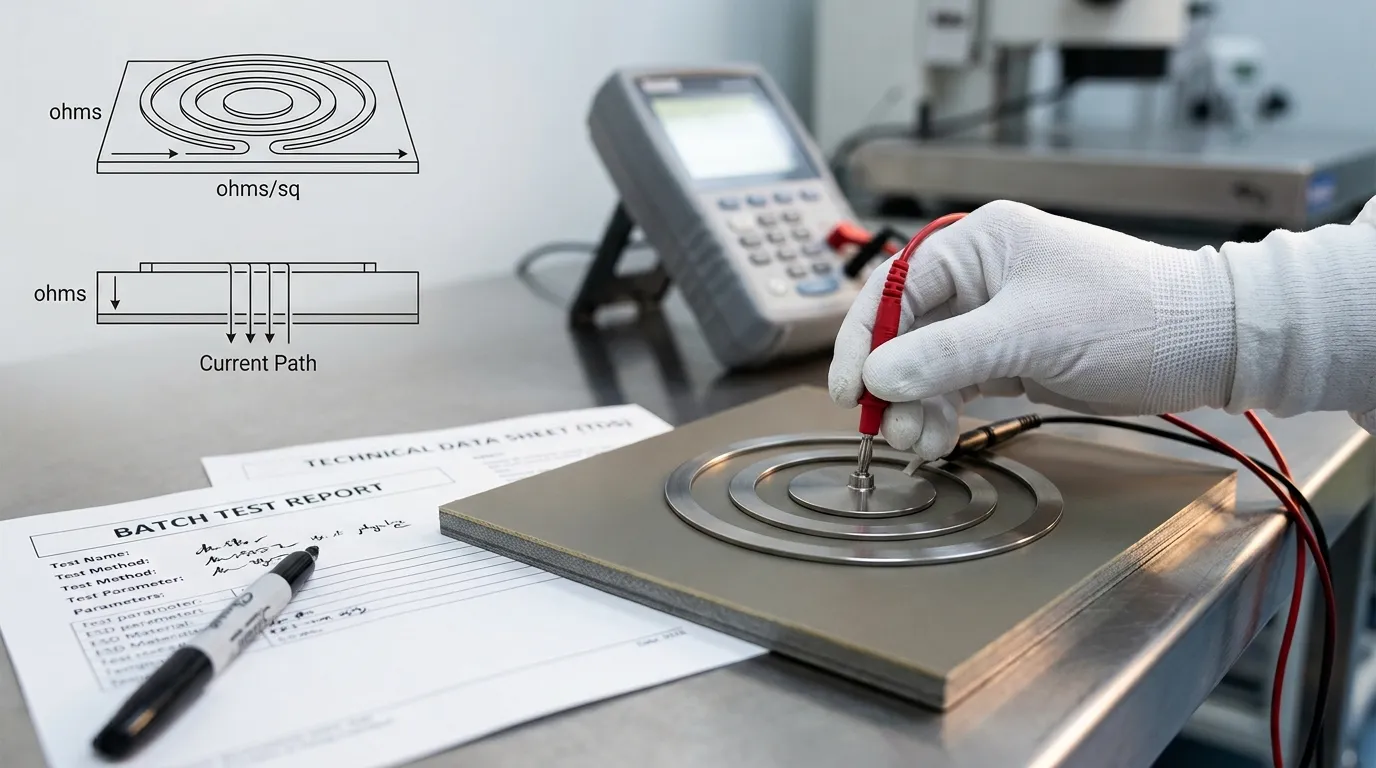
What Is Surface Resistance?
Surface resistance is the ratio of a DC voltage to the current flowing between two electrodes placed on the same surface of a material. The measurement is expressed in ohms (Ω). It describes how easily charge moves along the surface from one electrode to the other.
The value depends on more than the material itself. Electrode spacing, electrode shape, applied voltage, contact pressure, surface contamination, and the surrounding temperature and humidity can all change the result. For that reason, a surface resistance value is only meaningful when the test conditions and electrode arrangement are reported alongside it.
The ESD Association's test method for this measurement, ANSI/ESD STM11.11, is titled Surface Resistance Measurement of Static Dissipative Planar Materials. It is the standard most often used for ESD mats, films, and other flat materials.
What Is Surface Resistivity?
Surface resistivity is the same type of surface conduction, but normalized to a square geometry. It is expressed in ohms per square (Ω/sq). The "square" is dimensionless: a large square of the same material gives the same resistivity value as a small square, as long as the material is uniform.
The practical effect is that surface resistivity describes an inherent property of the material surface, while surface resistance describes a specific measurement setup. A single surface resistance reading can change if you change the electrode distance. Surface resistivity is meant to remove that geometry dependence and give you a value that is comparable across different test setups — provided the same test method is used.
Standards such as ANSI/ESD STM11.11 and IEC 61340-2-3 include procedures for deriving resistivity values from surface measurements with defined electrode configurations.
Surface Resistance vs Surface Resistivity: How They Differ
The fastest way to see the difference is to put the four common terms side by side.
| Term | Unit | What it measures | Typical context |
|---|---|---|---|
| Surface resistance | ohms (Ω) | Resistance between two electrodes on the same surface | ESD mats, work surfaces, films |
| Surface resistivity | ohms per square (Ω/sq) | Surface resistance normalized to a square area | Material datasheets, plastics, films |
| Volume resistance | ohms (Ω) | Resistance between two opposite faces of a material | Through-thickness measurements |
| Volume resistivity | ohm-centimeters (Ω·cm) | Bulk resistance normalized to a cube | Insulating materials, packaging |
The most common confusion is between the first two rows. A value reported in ohms tells you about a specific measurement with a specific electrode arrangement. A value reported in ohms per square tells you about the material's surface property after normalization.
Do not compare a surface resistance value in ohms with a surface resistivity value in ohms per square as if they were the same number. Even when the numeric values look similar, they represent different measurement conditions. The only safe way to compare two datasheets is to confirm that both use the same unit, the same standard, the same electrode geometry, and the same test conditions.
Surface vs Volume: Why the Current Path Matters
Surface measurements describe charge moving along the top surface. Volume measurements describe charge moving through the thickness of the material. Both are relevant to ESD materials, but they answer different questions.
A material can have a low surface resistance because of a conductive coating while its bulk remains insulative. Conversely, a material can be filled with a conductive additive throughout its volume but have a high-resistance surface layer. If a specification sheet lists only one value, you cannot infer the other.
Laboratory testing guidance, such as ASTM D257's description of surface and volume resistivity, makes this distinction explicit. In practice, you need to know which current path is important for your application. For a work surface, the surface path is usually the critical one. For a static-shielding bag, both surface and volume behavior can play a role, along with shielding performance, which is a separate property.
Which Test Method Was Used? Standards and Measurement Conditions
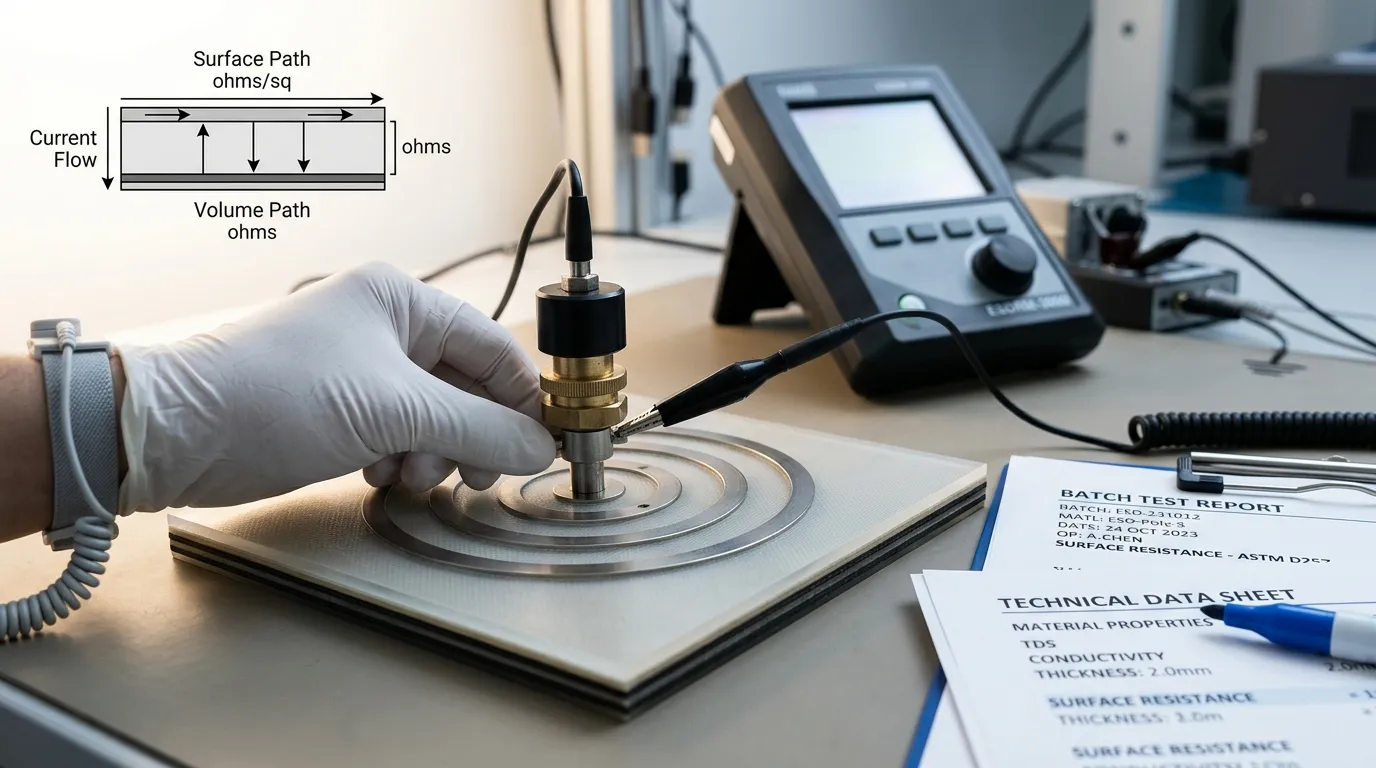
The same material can produce different resistance values depending on the test method. This is why a specification sheet should always identify the standard used.
| Standard | Scope | Why it matters |
|---|---|---|
| ANSI/ESD STM11.11 | Surface resistance measurement of static-dissipative planar materials | The most common method for ESD mats and flat films |
| IEC 61340-2-3 | Test methods for resistance and resistivity of solid materials | International method for solid materials used in static control |
| ASTM D257 | DC resistance or conductance of insulating materials | Often cited for surface and volume resistivity of plastics |
Even when the standard is the same, the measurement conditions must be reported. Look for these details on any ESD specification sheet:
- Electrode geometry — parallel bars, concentric rings, or point-to-point probes give different results.
- Test voltage — conductive materials are typically measured at lower voltages; dissipative materials often need higher voltages.
- Electrification time — how long the voltage is applied before the reading is taken.
- Temperature and relative humidity — surface resistance of many ESD materials changes with humidity.
- Conditioning — whether the sample was stored or preconditioned before testing.
If any of these are missing, ask the supplier. A value without its test conditions is not enough to compare products.
For the complete field procedure for ESD mat resistance, see our guide: how to test esd mat resistance.
Conductive, Static-Dissipative, or Insulative: What the Number Means
Once you have a valid surface resistance or surface resistivity value, the next question is usually whether the material is conductive, static-dissipative, or insulative.
These are classification bands, but their boundaries depend on the standard, the test method, and the application. There is no single universal threshold that applies to every ESD material. The same material might be called static-dissipative by one manufacturer's test method and conductive by another.
Some industry documents, such as Texas Instruments' application note SZZA027, describe conductive and static-dissipative materials in terms of surface or volume resistivity ranges for electronics contexts. These are useful reference points, but they should not be treated as a universal legal boundary. Always confirm the classification with the standard that governs your product type.
A resistance value alone also does not prove that a material is safe for an ESD-protected area. Charge decay, triboelectric behavior, grounding, and the complete ESD control program all matter. Standards such as ANSI/ESD S20.20 and IEC 61340-5-1 define program-level requirements that go far beyond a single material measurement.
For a broader look at ESD material categories, see our esd materials page.
How to Read an ESD Spec Sheet or TDS
A technical data sheet (TDS) should make the measurement clear. If it does not, treat the specification with caution. Use this checklist before you compare any ESD value:
- Identify the exact term. Is it surface resistance, surface resistivity, volume resistance, or volume resistivity?
- Check the unit. Ohms, ohms per square, and ohm-centimeters are not interchangeable.
- Find the test method. Which standard was used: ANSI/ESD STM11.11, IEC 61340-2-3, ASTM D257, or another method?
- Look for the electrode geometry. The reported value depends on the electrodes.
- Confirm the test voltage and electrification time.
- Confirm the temperature and relative humidity.
- Check whether the value is a nominal number or a range. Some sheets list a typical value; others give a tolerance band.
- Look for a batch or lot number and a test date. A published number on a TDS is not the same as the measured result for a specific batch.
TDS vs Batch Test Report: What Each Document Does
A TDS describes the product's nominal or typical specification. It is a general product-level document. A batch test report records the measured values for a specific lot of material, including the test date, method, and conditions.
If the application is sensitive, request both. The TDS tells you what the product is designed to do. The batch test report tells you what a particular lot actually measured.
How These Values Apply to ESD Mats, Floors, Films, and Packaging
Different product types use different measurements. The table below shows which value is relevant for each category and why.
| Product type | Measurement that matters | Typical unit | Notes |
|---|---|---|---|
| ESD mat / workbench surface | Point-to-point resistance and resistance-to-ground | ohms | Evaluates how the installed mat performs in a grounded ESD workstation |
| ESD flooring | Resistance-to-ground and point-to-point | ohms | Typically tested after installation, with methods such as IEC 61340-4-1 |
| Protective film | Surface resistivity, sometimes volume resistivity | ohms per square or ohm-centimeters | Depends on whether the coating controls the surface or the additive controls the bulk |
| Shielding bag | Surface resistance, plus separate shielding attenuation | ohms | Resistance alone does not indicate shielding effectiveness |
For ESD mats, the installation and grounding method affects the final in-situ measurement. A material that measures well as a loose sample can perform differently once installed. Flooring is especially dependent on the installation, which is why installed-floor testing is covered by its own standard, IEC 61340-4-1.
For packaging materials, ANSI/ESD S541 explains that ESD packaging evaluation involves more than surface resistivity. Shielding performance, charge generation, and other properties are evaluated separately.
If you are selecting floor mats, see our anti static mats floor guide. If you are evaluating shielding bags, the same spec-reading framework applies when you review a bag datasheet from an esd shielding bag manufacturer.
Common Mistakes to Avoid When Comparing ESD Values
- Mistake: Treating ohms and ohms per square as the same unit.
Correction: Convert nothing until you confirm the test method and geometry behind each value.
- Mistake: Comparing two products tested with different standards.
Correction: Compare only values that use the same standard and similar electrode arrangement.
- Mistake: Ignoring relative humidity.
Correction: Check the conditioning and test humidity for both values.
- Mistake: Focusing on the nominal number while ignoring the tolerance.
Correction: Ask for the acceptable range, not just the typical value.
- Mistake: Treating a TDS as a guarantee for a specific batch.
Correction: Request the batch test report for the lot you are actually using.
- Mistake: Assuming that a lower surface resistance always means better ESD protection.
Correction: The right range depends on the application, the standard, and the grounding scheme.
- Mistake: Confusing surface resistance with shielding effectiveness.
Correction: A shielding bag must be evaluated for shielding attenuation separately from its surface resistance.
The Bottom Line: What to Check Before You Compare
The difference between surface resistance and surface resistivity comes down to units and geometry. Surface resistance is reported in ohms and is specific to a measurement setup. Surface resistivity is reported in ohms per square and is normalized to a square geometry. Another way to phrase it: a resistance value tells you about a particular test; a resistivity value describes the material's surface property under a defined method.
Do not compare two ESD specifications until you have confirmed the unit, the test method, the electrode geometry, the test voltage, the conditioning conditions, and whether the value came from a general TDS or a batch-specific test report. Once those are aligned, the numbers become meaningful and the comparison becomes reliable.
If you are evaluating an ESD material and need to verify its electrical specification, ask the supplier for the TDS and the batch test report for the specific lot you plan to use. At Nabai, we can provide product documentation and help you identify the specification that matters for your cleanroom application.
NEWS
GET SERVICE
With quality parts to meet every budget and friendly staff trained to make your visit informative and hassle free.