
PE Protective Film Manufacturer for Export

PE Protective Film Manufacturer for Export
PE protective film is a temporary polyethylene surface-protection film used during fabrication, handling, and transport to prevent scratches, contamination, and surface damage on metal, glass, and electronic components. Selecting the right film depends on the substrate, adhesive tack, clarity requirements, static-control needs, and the documentation a manufacturer can provide.
Nabai supplies PE protective film products for industrial surface protection, including an anti-static PE film for static-sensitive environments. This page explains how PE protective film works, how to choose between standard and anti-static options, what specifications to request, and how to qualify a manufacturer for export supply. For a broader view of the product family, see our protective film solutions.
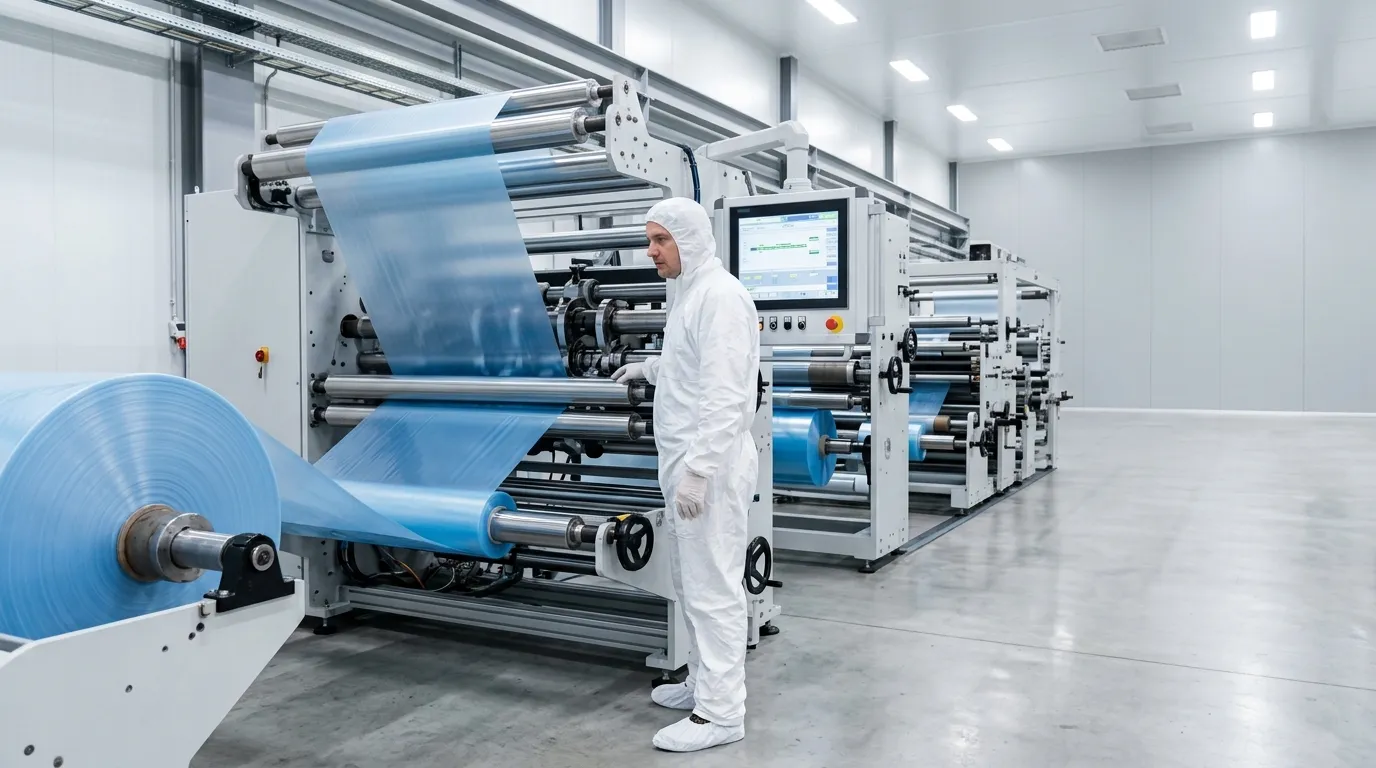
PE Protective Film and How Does It Work?
PE protective film is a thin polyethylene film coated on one side with a pressure-sensitive adhesive. It is applied to a clean surface and removed after the protected stage of production, handling, or transport is complete. The film acts as a sacrificial layer that absorbs abrasion, prevents contamination, and preserves the surface finish of the part underneath.
Two components determine film performance:
- Base film: polyethylene provides flexibility, conformability, and protection against scratching and abrasion.
- Adhesive layer: must hold the film in place through handling and fabrication, then release cleanly when removed.
Adhesive systems and tack levels vary by application. A film that performs well on smooth stainless steel may adhere too aggressively to glass or leave residue on a coated aluminum profile. Protective film selection should therefore start with the substrate and process conditions, not with the film alone.
PE Protective Film for Metal, Glass and Electronics
One film does not fit every surface. The table below summarizes the primary selection driver for each application group.
| Application | Primary Selection Driver | Common Risk to Manage |
|---|---|---|
| Stainless steel and metal sheets | Adhesion matched to surface finish | Edge lifting, adhesive residue |
| Aluminum profiles | Tack level for bare, anodized, or painted surfaces | Residue on coated surfaces |
| Glass and transparent panels | Clarity, haze, clean removal | Residue after extended dwell time |
| Electronics and displays | Static control, contamination, optical clarity | Electrostatic discharge, particle attraction |
PE Protective Film for Metal Surfaces: Stainless Steel and Aluminum Profiles
Metal sheets, coils, and profiles are typically protected during stamping, bending, handling, and transport. Stainless steel and aluminum both benefit from a film that withstands moderate abrasion and stays in place through fabrication steps.
The correct tack level depends on the surface finish. Bare metal surfaces generally tolerate a higher-tack film; anodized, painted, or powder-coated aluminum requires a lower-tack adhesive to avoid residue or coating damage. Edge lifting usually points to an adhesive that is too light for the forming process, or a dusty or oily surface at application. For substrate-specific guidance, see our pages on protective film for stainless steel sheet and protective film for aluminum profile.
PE Protective Film for Glass and Transparent Surfaces
Glass panels, mirrors, and transparent acrylic surfaces require a film that does not interfere with visual inspection. Light transmission and haze become critical when the protected surface is inspected through the film.
Residue risk is the main concern for glass applications. As dwell time increases — especially under heat or sunlight — some adhesives become more difficult to remove. Testing the film on the actual glass surface under realistic dwell conditions is the only reliable way to confirm clean removal.
PE Protective Film for Electronics and Displays
Electronic components and display panels are static-sensitive. Peeling a protective film can generate triboelectric charge — static electricity that attracts particles or, in severe cases, damages sensitive circuitry.
For this reason, electronics manufacturers often select an anti-static PE protective film rather than a standard PE film. Nabai offers a PE anti-static protective film for this requirement. Anti-static performance should be verified through a documented surface-resistance measurement, not assumed from the product name alone.
Standard PE vs Anti-Static PE Protective Film: Which Do You Need?

| Factor | Standard PE Film | Anti-Static PE Film |
|---|---|---|
| Primary purpose | Scratch and contamination protection | Protection for static-sensitive surfaces |
| Static behavior | May generate or hold charge during peeling | Designed to reduce electrostatic charge build-up |
| Typical use | Metal, glass, general handling and transport | Electronics, displays, ESD-sensitive assembly areas |
| Verification | Visual and physical inspection | Surface resistance value with stated unit and test method |
| Replaces a full ESD program? | No | No — one control measure, not a complete ESD program |
The key distinction is that "anti-static" describes a measurable electrical property, not a blanket safety guarantee. Surface resistance is reported in ohms or ohms per square, and the value determines whether a material behaves as insulative, static-dissipative, or conductive. If a supplier claims anti-static performance, ask for the reported value, the unit, and the test method. International standards such as IEC 61340-5-1 define general requirements for protecting electronic devices from electrostatic phenomena.
PE Protective Film Specifications: What to Verify Before You Order
Compile the technical fields that matter for your application before requesting a quotation. The table below lists the specifications a PE protective film manufacturer should be able to confirm.
| Specification | Unit to Request | Why It Matters |
|---|---|---|
| Film thickness | Micron or mil | Affects protection level, conformability, and handling |
| Roll width | mm or inches | Must match material width and converting process |
| Roll length | m or ft | Determines coverage and replacement frequency |
| Adhesive type | Acrylic, rubber, or other | Affects adhesion, residue behavior, and aging |
| Tack or peel adhesion | Force per stated width | Confirms the film will hold without damaging the surface |
| Transparency | % light transmission | Important when inspection occurs through the film |
| Haze | % | Important for optical or display applications |
| Surface resistance | ohms or ohms/square | Required for anti-static claims |
| Shelf life | Months | Affects inventory planning |
| Storage conditions | Temperature, humidity | Protects adhesive performance |
Tack and peel adhesion are frequently confused. Tack describes the initial grab of the adhesive; peel adhesion measures the force required to remove the film under defined conditions. Both should be stated with their unit and test method. A proprietary adhesive-grade number — for example, a supplier's own 200D–1500D scale — is not a substitute for a measured force value.
Documentation to Request: TDS, Batch Test Reports and Certificates
A product page is a starting point, not proof of performance. For export purchasing, request the following documents:
| Document | What It Provides | When to Request |
|---|---|---|
| Technical Data Sheet (TDS) | Product-level specifications: construction, dimensions, handling | Before evaluation |
| Batch test report | Measured values for one specific production batch | Before approving production |
| SDS/MSDS | Safety, handling, and transport information | Before shipping |
| Certificates | Compliance statements for a named product or batch | Before order confirmation |
A TDS documents what the product is designed to be. A batch test report verifies what a specific batch measured — resistance, tack, thickness, or other properties under a stated test method. The two serve different purposes and should not be treated as interchangeable.
Nabai maintains a certificates page where product-level and company-level documentation can be reviewed. When requesting a certificate, confirm that it names the exact product or batch you are purchasing. A certificate that applies to one product line does not automatically cover every film a manufacturer produces.
How to Qualify a PE Protective Film Supplier for Export
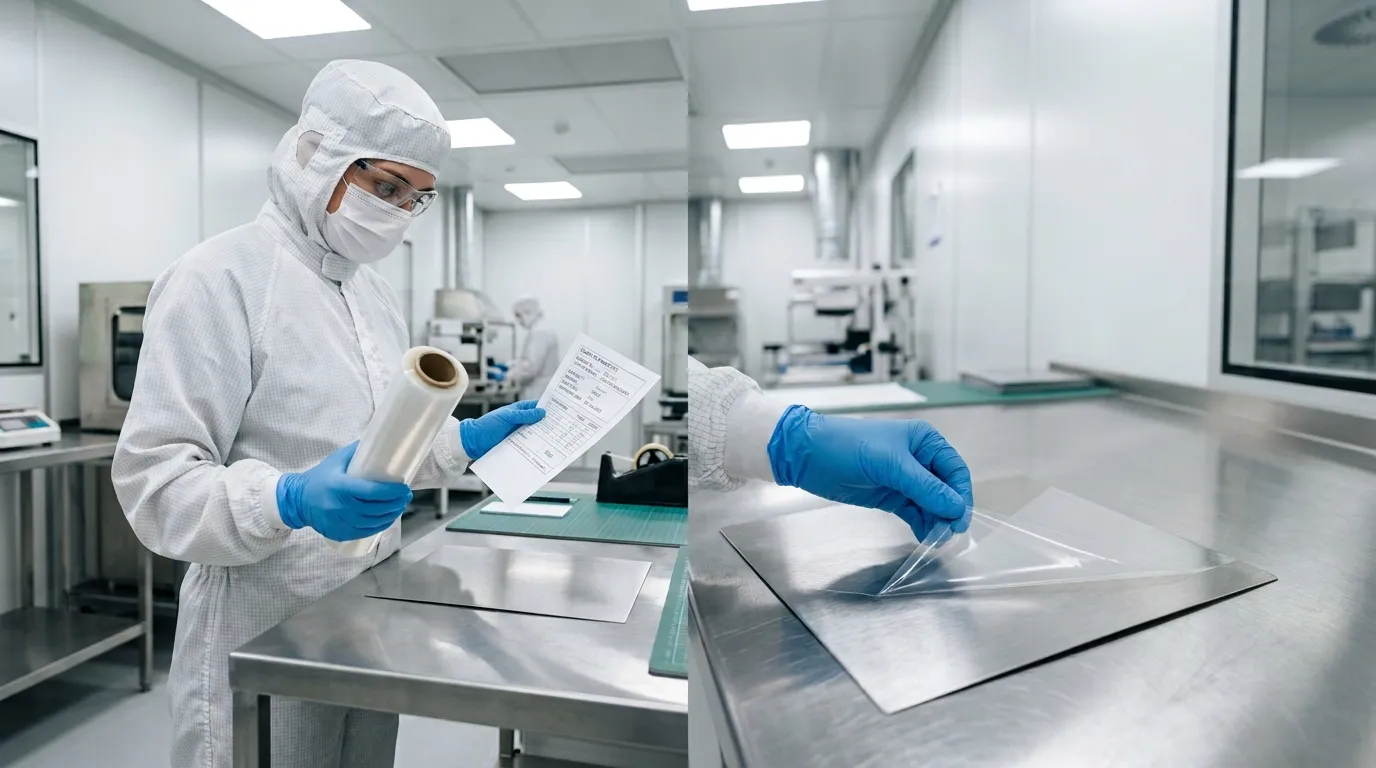
Qualifying a supplier is a structured process, not a brochure review. The following steps work for most export buyers:
- Define the application in writing. Send the substrate type, surface finish, fabrication process, dwell time, clarity requirements, and static-control needs. The more context the supplier receives, the more relevant the recommendation.
- Request samples and test them on the actual surface. Apply the film under production-like conditions. Test removal after the expected dwell time, including temperature and humidity variations.
- Review the TDS and batch test report. Confirm that the reported values match the product specification and that units and test methods are clearly stated.
- Check customization capability. If you need custom width, printing, or adhesive selection, confirm the manufacturer supports it through its oem support process.
- Clarify commercial terms. Confirm MOQ, lead time, packaging, labeling, and export documentation before placing an order.
- Plan incoming inspection. Verify the delivered batch against the approved sample and the batch test report before committing to production use.
Common PE Protective Film Selection Mistakes
Buyers frequently make the following errors:
- Using one tack level for every surface. A film that protects bare steel may damage an anodized aluminum profile.
- Ignoring dwell time. Residue and removal difficulty generally increase the longer the film remains applied.
- Testing only on a clean sample panel. Real production surfaces may have oil, dust, or surface-energy variations that affect adhesion.
- Assuming "anti-static" means full ESD protection. Anti-static film is one element of an ESD control strategy, not a complete solution.
- Choosing film by thickness alone. Thickness affects protection, but adhesion and release behavior determine whether the film performs without damaging the product.
- Skipping batch-level documentation. A product-page specification does not guarantee that every production batch matches it.
PE Protective Film Sourcing Checklist
Use this checklist to confirm every requirement before placing an order:
- Substrate and surface finish identified
- Tack level and film thickness selected
- Transparency and haze confirmed where optical inspection is needed
- Anti-static requirement determined and resistance value verified
- Sample tested on the actual surface under realistic dwell conditions
- TDS, batch test report, and SDS/MSDS reviewed
- MOQ, lead time, packaging, and export terms confirmed
- Custom size, printing, or adhesive requirements discussed with the manufacturer
- Incoming inspection plan agreed
Request a Sample or Quotation for PE Protective Film
Nabai supplies PE protective film products for industrial surface protection, including anti-static PE film for electronics applications. To discuss your requirements, include the following information in your inquiry:
- Substrate type and surface finish
- Sheet or profile dimensions
- Application and fabrication process
- Expected dwell time before removal
- Static-control or optical requirements
- Target documentation (TDS, batch test report, SDS/MSDS)
For custom sizes, printing, or specification requirements, contact Nabai through its oem support channel. Nabai also supplies a wider range of cleanroom and ESD consumables, making it a practical single source for buyers consolidating supplier lists — explore its offer as a cleanroom consumables manufacturer china.
NEWS
GET SERVICE
With quality parts to meet every budget and friendly staff trained to make your visit informative and hassle free.