
Cleanroom Consumables Manufacturer in China

Cleanroom Consumables Manufacturer in China
A cleanroom consumables manufacturer in China should be evaluated by verified product-family coverage, specification fit, documentation, samples, and supply consistency — not by catalogue breadth alone. This guide covers the four product families that buyers most often consolidate from one supplier: cleanroom sticky mats, sticky rollers, self-adhesive sticky paper, and protective films.
Before comparing prices or MOQs, you need to know which products the supplier actually controls, which specifications and documents you should request for each family, and how to qualify the supplier without confusing a wide catalogue with real manufacturing depth.
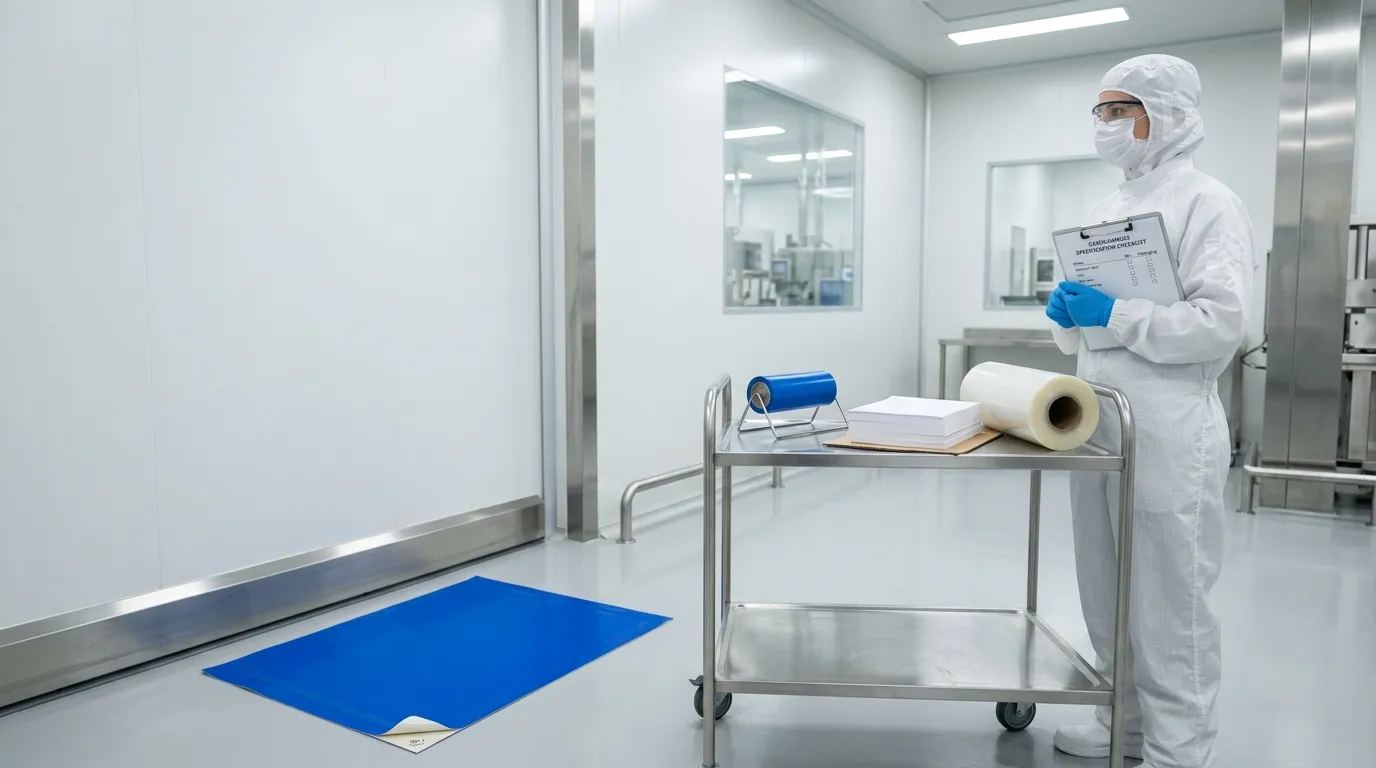
What Counts as a Cleanroom Consumables Manufacturer in China?
Cleanroom consumables are replaceable contamination-control products used inside or at the edge of controlled environments. In this guide, we focus on four product families that are usually purchased together:
| Product family | Typical function | What to check before ordering |
|---|---|---|
| Cleanroom sticky mats (also called tacky mats or adhesive mats) | Capture particles from shoes and wheeled traffic at entrances, air showers, gowning areas, and cleanroom edges | Disposable peel-off versus washable silicone construction; mat size; sheet count and layer construction; adhesive tack; ESD value if claimed |
| Sticky rollers | Remove particles from garments, equipment, and work surfaces | Roller barrel material (PP or PE), roller width, core size and handle compatibility, film type, tack, ESD value if claimed |
| Self-adhesive sticky paper | Provide disposable clean sheets for workstations, floors, and inspection areas | Sheet size, backing type, perforation, printability, packaging, sheet count per pack |
| Protective films | Shield sensitive surfaces from dust, scratches, and static during handling, storage, and transport | Film base (PE or PET), adhesive type, film thickness, light transmission if relevant, residue behaviour, ESD value if claimed |
These families are functionally related, but they are not interchangeable. Each one needs its own specification review. A supplier that lists all four families may still not produce all of them in-house — a catalogue proves range, not manufacturing depth.
Adjacent categories such as wipes, gloves, and garments are outside the scope of this guide. If you also need cleanroom wipes, the lint free cleanroom wipes supplier page is a better starting point.
How to Tell a Manufacturer From a Trading Company
A manufacturer controls part or all of the production process. A trading company or distributor resells products made by other factories. Both models can deliver usable products, but they require different qualification methods.
Ask the supplier directly:
- Which of the four product families do you manufacture in-house?
- Which items are purchased from other factories and resold?
- Can you provide factory photos, videos, or a live audit?
- Can you supply a product-specific TDS and batch test report for each family?
- What is the registered company name, and does it match the factory address?
A vague answer, or a catalogue that lists dozens of unrelated products, is a sign to dig deeper before committing.
Materials and Construction: PE, PP, PET and Silicone
The base material determines how the product behaves during use, cleaning, and disposal.
| Material | Typical use in cleanroom consumables | Advantages | Limitations |
|---|---|---|---|
| PE | Mat backing, roller barrels, protective film, sticky paper | Flexible, economical, common in film and mat construction | Tears more easily than PET; softer surface may limit reuse |
| PP | Roller barrels, paper and mat components | More rigid, good surface durability, common in roller and sheet formats | Less flexible; less suitable for conformable film applications |
| PET | Protective film base | Dimensional stability, transparency, resistance to tearing | Less flexible than PE; may require a release liner or coating system |
| Silicone | Washable or reusable mats and rollers | Reusable, heat resistant, consistent release after cleaning | May transfer silicone to sensitive surfaces; usually needs a documented cleaning procedure |
These are general material tendencies, not certified product claims. The supplier's TDS should state the exact material construction and properties for each finished product.
Adhesive, Tack and Particle Pickup
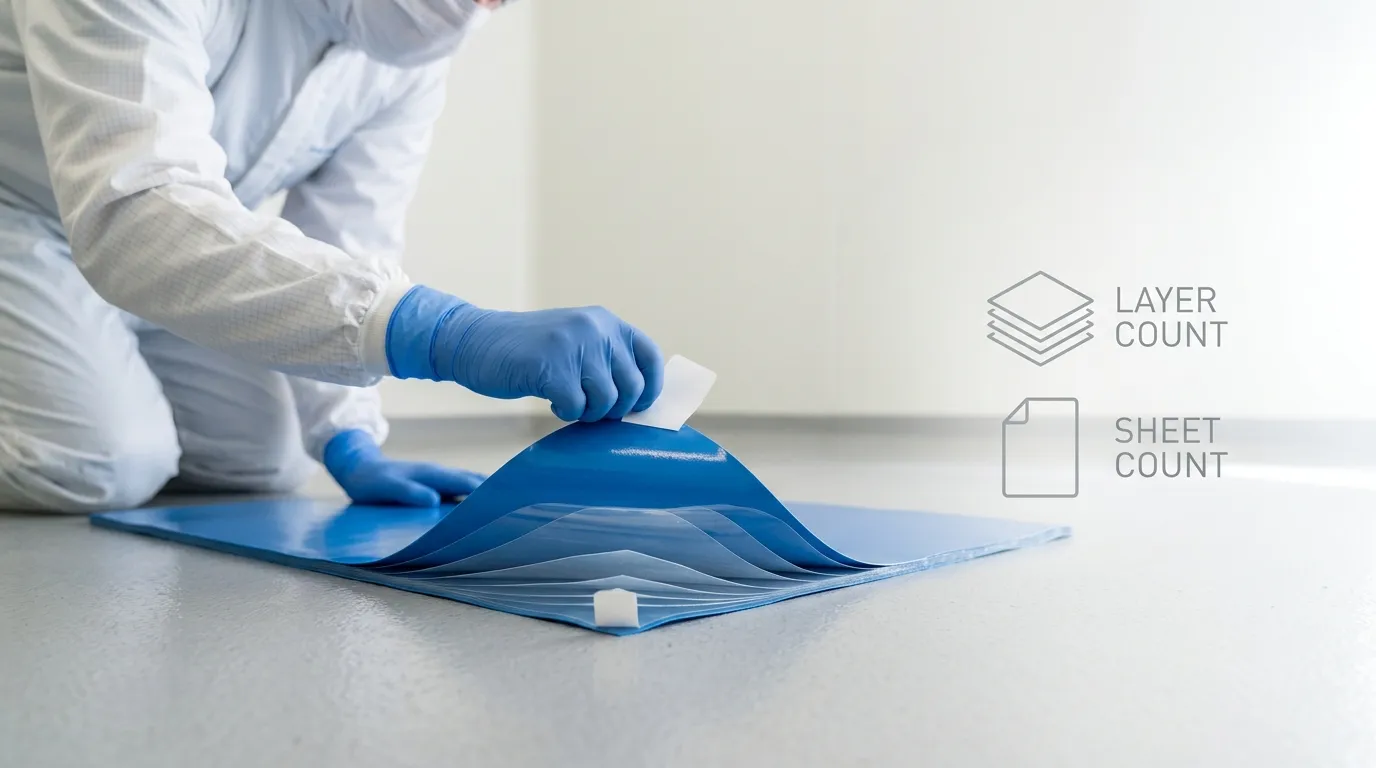
Adhesive tack is the immediate grip of the adhesive coating — how quickly it grabs particles on contact. Peel adhesion is a measured value: the force needed to remove an adhesive layer from a surface, reported with a stated width and test method.
Higher tack can improve particle pickup, but it also increases the risk of adhesive residue on the surface you are trying to protect. This trade-off matters most in optical, display, and precision-manufacturing applications where even a faint residue can cause rejects.
Pay attention to two similar-sounding terms:
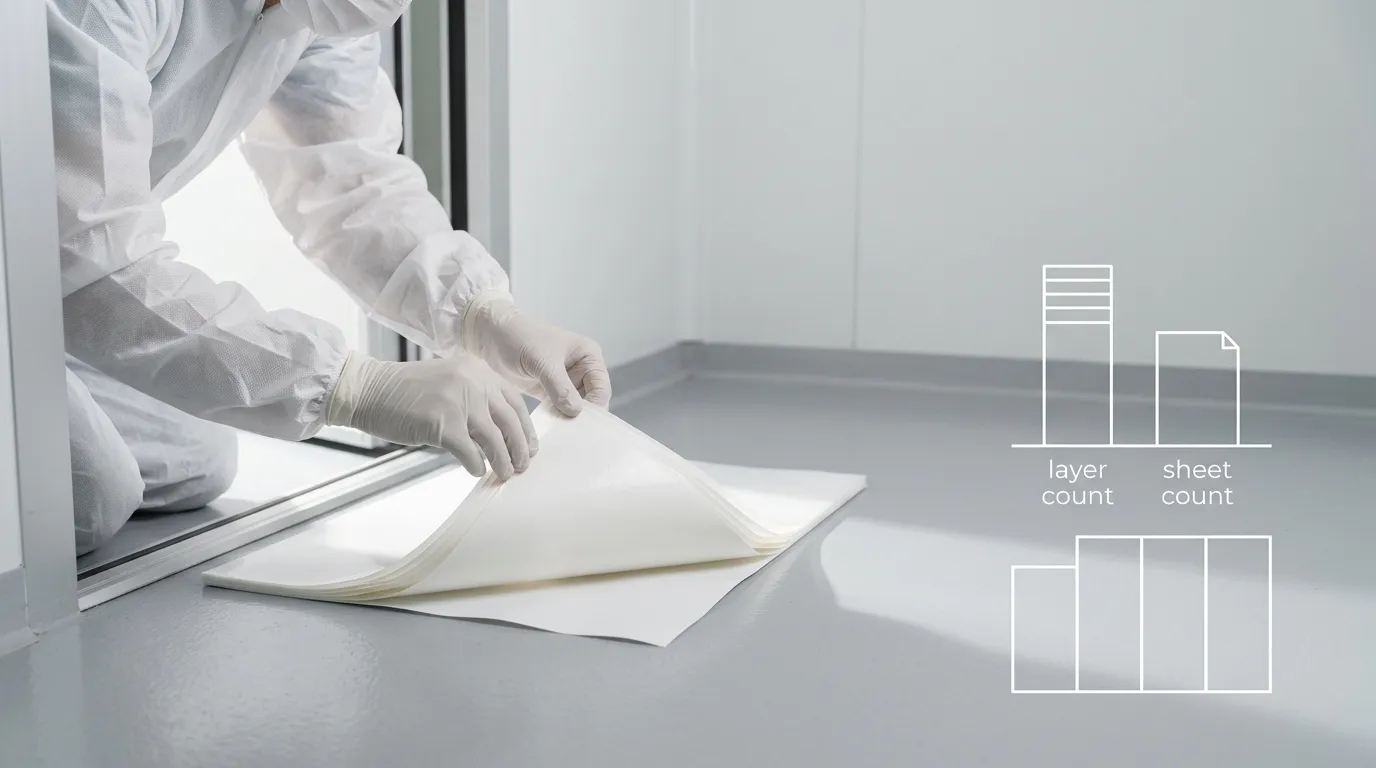
- Layer count describes the number of adhesive-coated layers within a product.
- Sheet count describes the total number of peelable sheets supplied.
Ask for both. Two mats with the same sheet count can have different layer constructions, which changes how often the mat must be replaced and what it costs per entry.
ESD Behavior: Resistance, Resistivity and "ESD-Safe" Claims
Static control is a measurement issue, not a label. Two units are commonly confused:
- Surface resistance is measured in ohms.
- Surface resistivity is measured in ohms/square.
They are not interchangeable. When a supplier gives you a value, require the exact unit and the test method used.
The terms conductive, dissipative, and insulative describe different ranges of static-control behaviour:
- Conductive materials allow charge to move across them easily.
- Dissipative materials allow charge to flow more slowly and are common in ESD-safe products.
- Insulative materials resist the movement of charge and can generate or hold static.
"ESD-safe" alone is not a sufficient answer. Ask for the measured value, the test method, and whether the measurement covers the full product construction or only a surface treatment. A product with an ESD-safe top layer can still generate static if the underlying structure is insulative.
Also keep product-level ESD data in context: one product cannot make a facility ESD-compliant. Facility-level programs such as ANSI/ESD S20.20 define the overall grounding, flooring, personnel, and equipment requirements. A consumable contributes to that program, but its individual specification must be verified for the exact product.
Specifications to Request for Each Product Family
Use this table as the starting point for an RFQ. Ask for every value with its unit and test method.
| Product family | Key specifications to request |
|---|---|
| Sticky mats | Width, length, total sheet count, layer construction, disposable or washable, tack or peel-adhesion value with method, residue behaviour, surface resistance if ESD is claimed, packaging per carton |
| Sticky rollers | Roller width and total film length, core size or handle compatibility, barrel material (PP or PE), film material, tack or peel-adhesion value, surface resistance if ESD-safe is claimed, no-knife or tear-perforation options |
| Self-adhesive sticky paper | Sheet size, backing type, perforation, printability, sheet count per pack, packaging and storage conditions |
| Protective film | Roll width and length, film base (PE or PET), film thickness in micron or mil, adhesive type, release liner, light transmission if transparency matters, residue or outgassing notes, shelf life |
Do not accept values without units. A "high tack" description tells you nothing you can compare; a peel-adhesion value with a stated width and test method tells you whether the product fits your process.
Choosing Cleanroom Consumables by Application
| Environment | Main concern | Product-family priority | What to verify in documentation |
|---|---|---|---|
| Semiconductor / wafer handling | Particles and static | ESD-safe mats, rollers, protective film | Resistance or resistivity values, test method, low-residue adhesive claims |
| Electronics / PCB / SMT | Static and particles | Sticky rollers, mats, film | ESD classification, tack values, residue behaviour |
| Display / panel manufacturing | Particles and residue | Protective film, sticky rollers, mats | Low-residue adhesive, light transmission if film covers panels, tack values |
| Pharmaceutical / GMP | Particles and biocontamination risk | Mats, sticky paper | Batch test reports, documented cleaning procedure, handling and storage conditions |
| Food processing | Hygiene and safety | Mats, sticky paper | Material suitability for the intended contact level, packaging integrity |
| Optical / precision manufacturing | Fine particles and residue | Protective film, sticky rollers | Silicone-transfer risk, tack values, film thickness, residue behaviour |
Do not assign a product to an ISO cleanliness class unless the supplier provides test evidence for that exact product. ISO 14644-1:2015 classifies air cleanliness by particle concentration; it does not certify consumables. The IEST's description of ISO 14644-1 explains the particle-size ranges and the measurement approach. Similarly, WHO GMP guidance for sterile pharmaceutical products distinguishes cleanroom classification from operational environmental monitoring — a distinction that applies to the products and materials you bring into those rooms.
For a deeper look at mat selection in these environments, see Nabai's sticky mat selection guide.
Documentation: TDS, Test Reports, SDS and Certificates
| Document | What it states | What it verifies | When to request |
|---|---|---|---|
| TDS | Physical and electrical specifications, handling, storage | The supplier's stated product specification; typical values, not batch proof | At initial evaluation, for every product family |
| Batch test report | Measured values for one production batch | That the specific batch met the stated values | Before shipment or with delivery, for critical applications |
| SDS/MSDS | Safety and handling information | Hazard communication for safe handling | With first order or when handling requirements change |
| Certificate | Scope, issuing body, product or batch coverage | Compliance for the exact scope named on the certificate | When a certification claim is part of your selection |
| RoHS / REACH declaration | Restricted-substance status for the stated product | Restricted-substance compliance for the stated scope | When required by your market or customer |
Two warnings matter here.
First, a company certificate is not automatically a product certificate. Check whether the certificate names the specific product, batch, or site you are buying from.
Second, the phrase "look for ISO, GMP, UL, or RoHS" is common buyer advice. It is not proof that a supplier holds those credentials. Ask for the actual document, then check the issuing body, scope, number, validity, and the covered product or batch.
Nabai publishes its certificates and documentation on a dedicated page; use it as a practical example of what to request from any supplier: certificates.
How to Qualify a Cleanroom Consumables Supplier in China: 6 Steps
- Define your four product-family needs and application requirements. Write down the environment, the contamination risk, and the static risk before you contact suppliers.
- Request the current TDS and product specification for each family. Compare dimensions, thickness, tack, ESD values, layer or sheet count, packaging, and shelf life.
- Request samples from every relevant product family, not just one item. A strong mat sample does not prove the quality of a roller or a film.
- Ask for batch test reports and verify the values against the TDS. Confirm the units and the test method for every measured figure.
- Confirm packaging, shelf life, MOQ, lead time, and private-label capability in writing. Verbal commitments disappear after the order is placed.
- Run a trial order and incoming inspection before scaling up. Inspect count, packaging, labels, and visual quality on arrival.
A practical RFQ checklist should include:
- Product family, size, material, and thickness
- Tack or peel-adhesion value with test method
- Surface resistance or surface resistivity with test method
- Sheet count and layer count
- Packaging, shelf life, and storage conditions
- Documentation: TDS, batch test report, SDS, certificates
- MOQ, lead time, incoterms, and private-label options
One Factory vs One Supplier: What "From One Factory" Really Means
A single supplier can consolidate purchasing even when it does not manufacture every product in its catalogue. "One supplier" means one company handles your order, documentation, and commercial communication. "One factory" means the same production site physically manufactures the products.
The distinction matters because a wide catalogue by itself proves neither. A supplier can list mats, rollers, films, and paper while producing only one of those families in-house and reselling the rest.
Consolidation has clear advantages: fewer suppliers to qualify, one set of documentation, simpler sampling, and a stronger commercial relationship. It also has risks: single-source dependency, variable quality across categories, and resold items that arrive with inconsistent specifications.
Ask directly: "Which of these four product families do you manufacture in-house, and which do you source from others?" A confident, documented answer is a good sign. A vague answer means the supplier should be qualified more carefully.
Private Label and Customisation for Cleanroom Consumables
If you plan to sell these products under your own brand, finish the supplier qualification first. Private label, custom size, custom printing, and custom packaging require an approved sample and an updated product specification for every family.
Nabai's private label cleanroom products manufacturer page explains the next steps in that process. Use it to evaluate whether the supplier's customization process matches your packaging, labelling, and order-volume needs.
Next Steps: Compare Products and Confirm Current Documentation
Before requesting a quotation, compare current product specifications and review the supplier's documentation.
- Browse the products archive to compare product-family listings and current specifications.
- Review the certificates page to confirm which certificates, standards, and test documentation apply.
- If you intend to sell under your own brand, move to the private label cleanroom products manufacturer page to plan the customization stage.
The supplier that wins your order is the one that can prove its product-family coverage, document its specifications, and support you through sampling and trial orders — not the one with the longest list of product names.
NEWS
GET SERVICE
With quality parts to meet every budget and friendly staff trained to make your visit informative and hassle free.